

AAPOD2 Image Archives
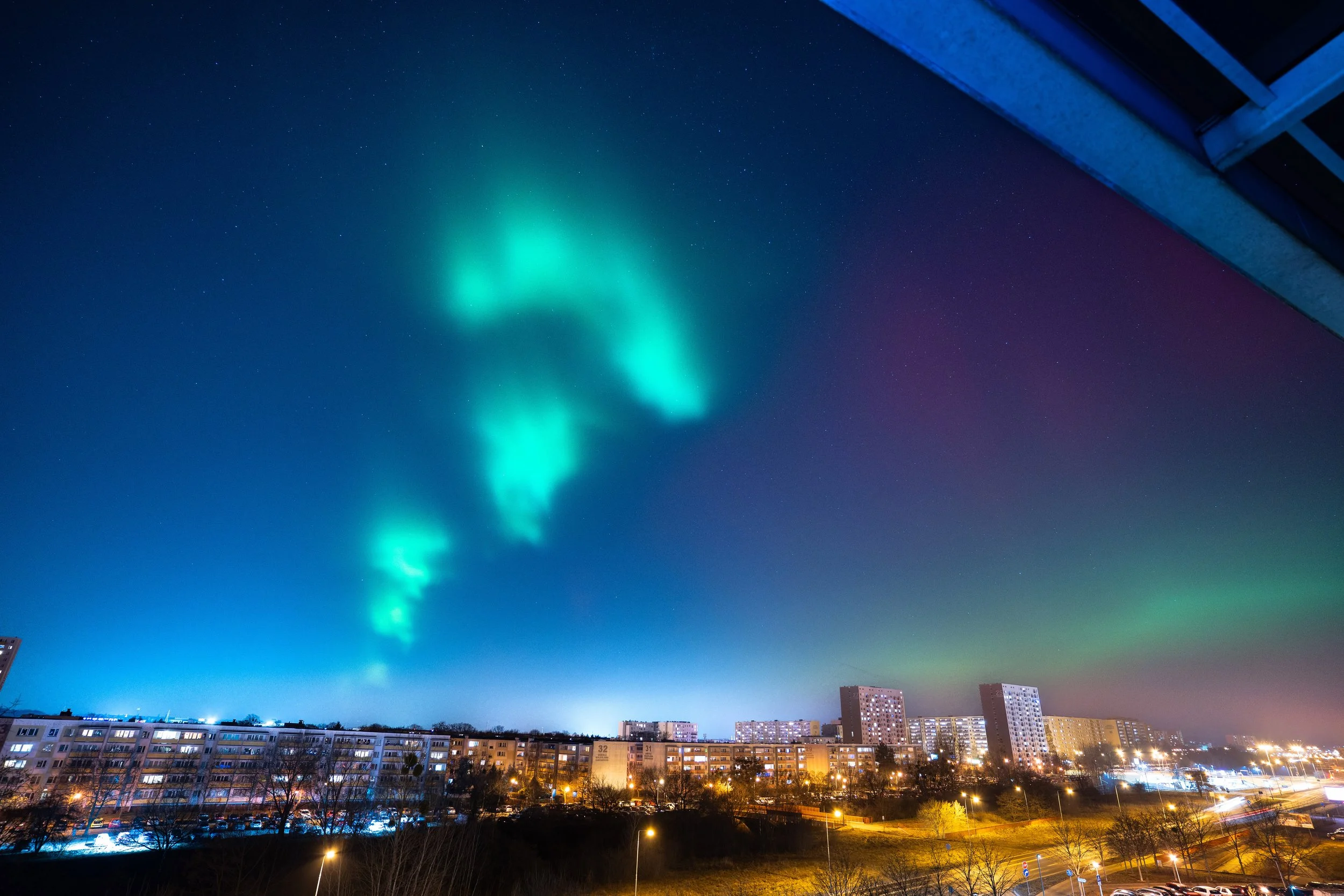
Green Auroral Arc Over Poznań
This image captures a vivid green auroral arc stretching high above the city of Poznań in west central Poland. The glow is produced when energetic particles from the solar wind are guided by Earth’s magnetic field into the upper atmosphere, where they collide with oxygen atoms roughly 100 to 200 kilometers above the ground. These interactions excite the oxygen, which then emits its characteristic green light as it returns to a lower energy state.
Seen from an urban setting, the aurora highlights the scale and reach of geomagnetic activity during periods of enhanced solar activity. City lights illuminate the landscape below, providing a stark contrast to the delicate, flowing structure of the auroral arc overhead. The scene emphasizes how space weather driven by the Sun can briefly transform familiar city skies into displays typically associated with much higher latitudes.
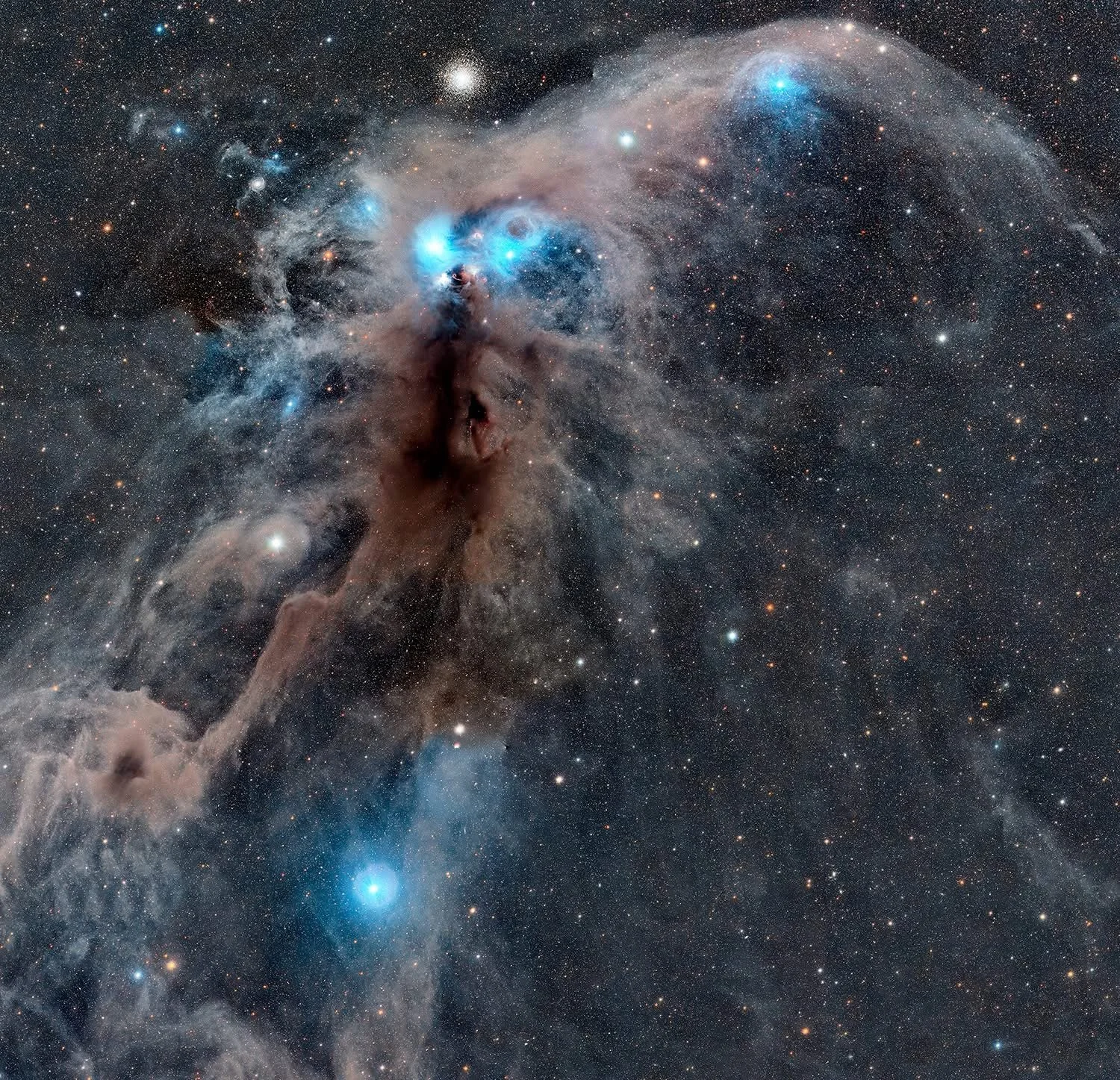
CORONA AUSTRALIS
This mosaic reveals the Corona Australis molecular cloud complex, a nearby star-forming region roughly 400 light-years away on the edge of the Milky Way. Dark lanes of cold interstellar dust weave through softly glowing reflection nebulae, where blue starlight from young suns is scattered by microscopic grains. Embedded within the dust are sites of ongoing stellar birth, including dense cores that will collapse into new stars over the coming millions of years.
As a composite assembled over four years, the image emphasizes both depth and delicacy. Subtle gradients in color trace variations in dust density and composition, while the wide field highlights how star formation is shaped by turbulence and gravity on large scales. The result is a quiet, immersive portrait of one of the sky’s most textured regions, where darkness and light coexist in the early chapters of stellar evolution.
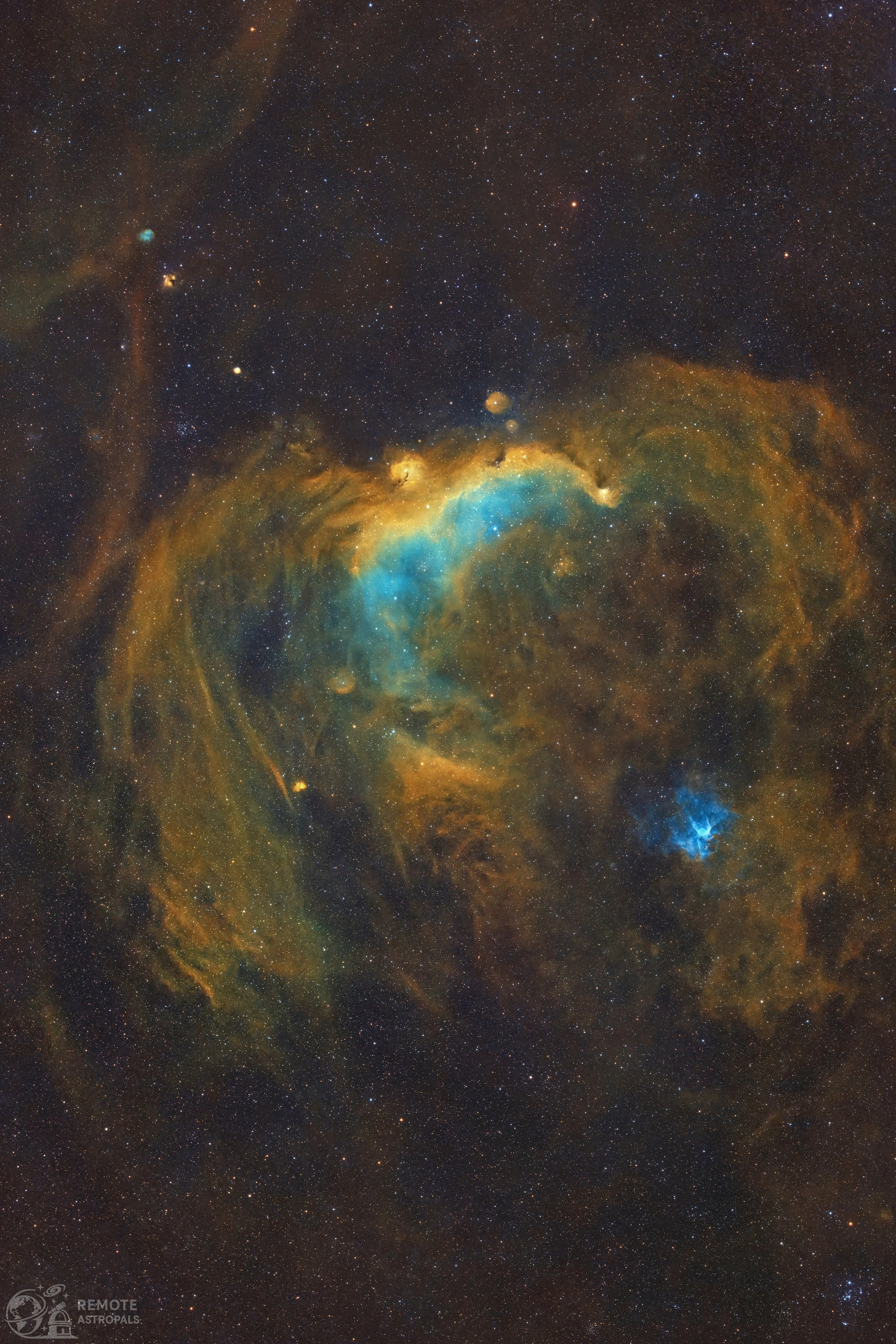
The Phoenix rising from its ashes (IC 2177 – The Seagull Nebula)
IC 2177, commonly known as the Seagull Nebula, is a vast complex of ionized hydrogen, dust, and young stars located along the border of the constellations Monoceros and Canis Major, roughly 3,800 light-years from Earth. The dominant emission arises from hydrogen gas energized by ultraviolet radiation from massive, recently formed stars embedded within the nebula. These stars sculpt the surrounding material into sweeping arcs and filaments, giving rise to the nebula’s wing-like appearance.
In this view, the glowing hydrogen clouds are interwoven with dark dust lanes that trace the colder, denser regions of the interstellar medium. Bright knots and compact blue regions mark active star-forming zones, while the broader, faint structures reveal how stellar winds and radiation gradually reshape the nebula over millions of years. The interplay of destruction and creation within IC 2177 makes it a striking example of how star birth emerges from the remnants of earlier generations.
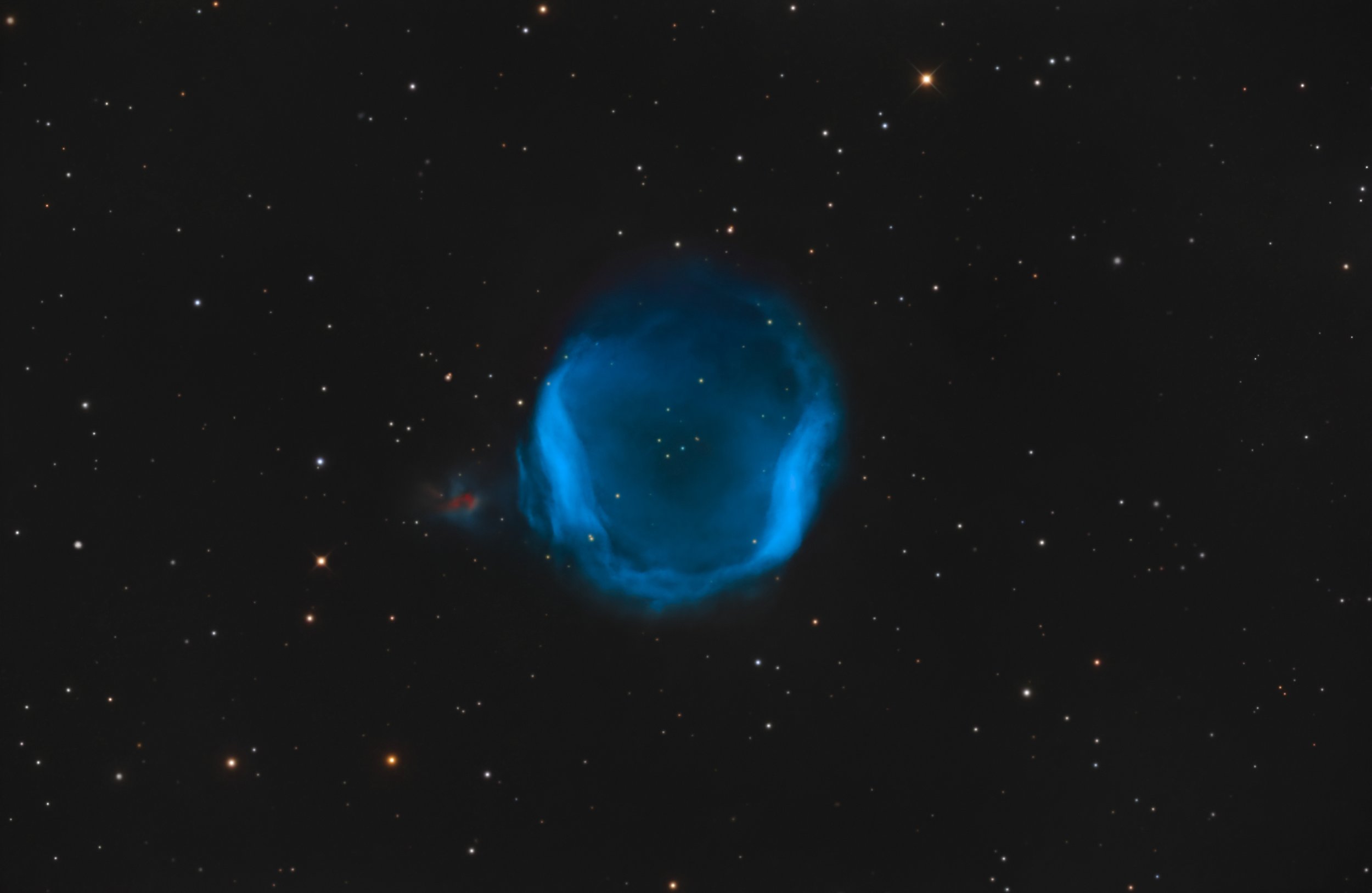
Jones 1 / PK 104-29.1 HOO
Jones 1, also cataloged as PK 104-29.1, is a large and extremely faint planetary nebula located in the constellation Pegasus. This delicate structure is the expanding shell of ionized gas expelled by a Sun-like star near the end of its life. The nebula’s soft blue glow is dominated by doubly ionized oxygen, while subtle hydrogen emission outlines its irregular, filamentary rim, revealing interactions between the outflowing material and the surrounding interstellar medium.
Because of its low surface brightness and wide angular size, Jones 1 is a challenging target for both visual observers and astrophotographers. Long integrations and narrowband imaging are required to separate the nebula from the dense background star field. This image, captured from Huércal de Almería in Almería, Spain, highlights the ghostly, bubble-like form of the nebula and preserves faint internal structure that traces the final evolutionary stages of the central white dwarf remnant.
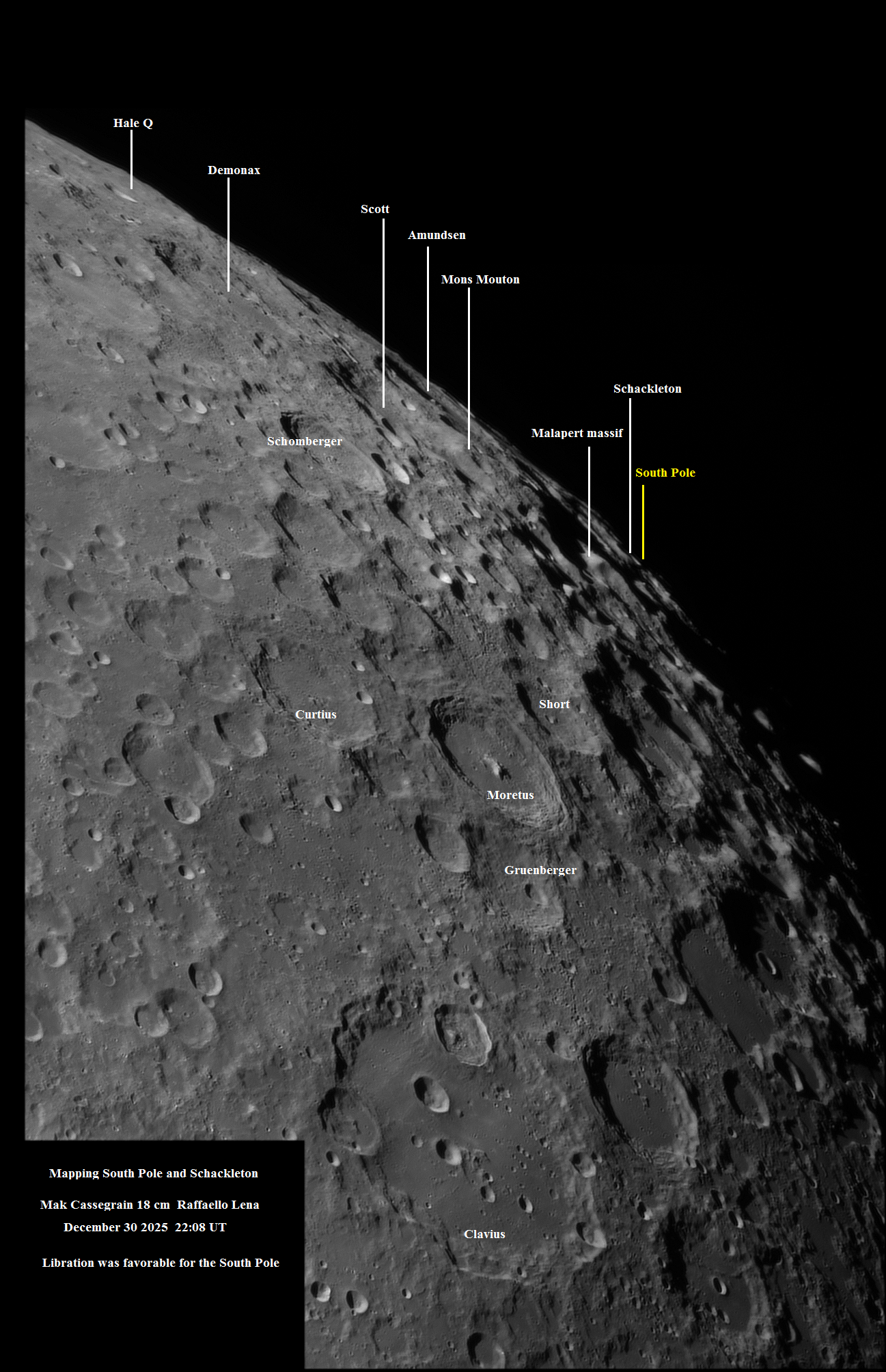
Mapping the Lunar South Pole and Shackleton Crater
This detailed view of the Moon’s southern polar region reveals a rugged landscape shaped by billions of years of impacts and extreme illumination conditions. Prominent features along the limb include the massive craters Clavius, Moretus, and Short, with smaller formations such as Curtius and Gruenberger scattered across the heavily cratered highlands. The oblique perspective emphasizes relief, with long shadows accentuating crater rims, terraces, and ejecta patterns near the terminator.
Near the lunar limb, the South Pole itself lies close to Shackleton crater, a feature of particular scientific interest due to its permanently shadowed interior. These regions receive little to no direct sunlight, allowing volatile compounds like water ice to remain stable over geological timescales. Favorable libration makes it possible to observe this normally hidden terrain from Earth, offering insight into surface morphology, lighting geometry, and why the lunar south pole is a key target for future robotic and human exploration.
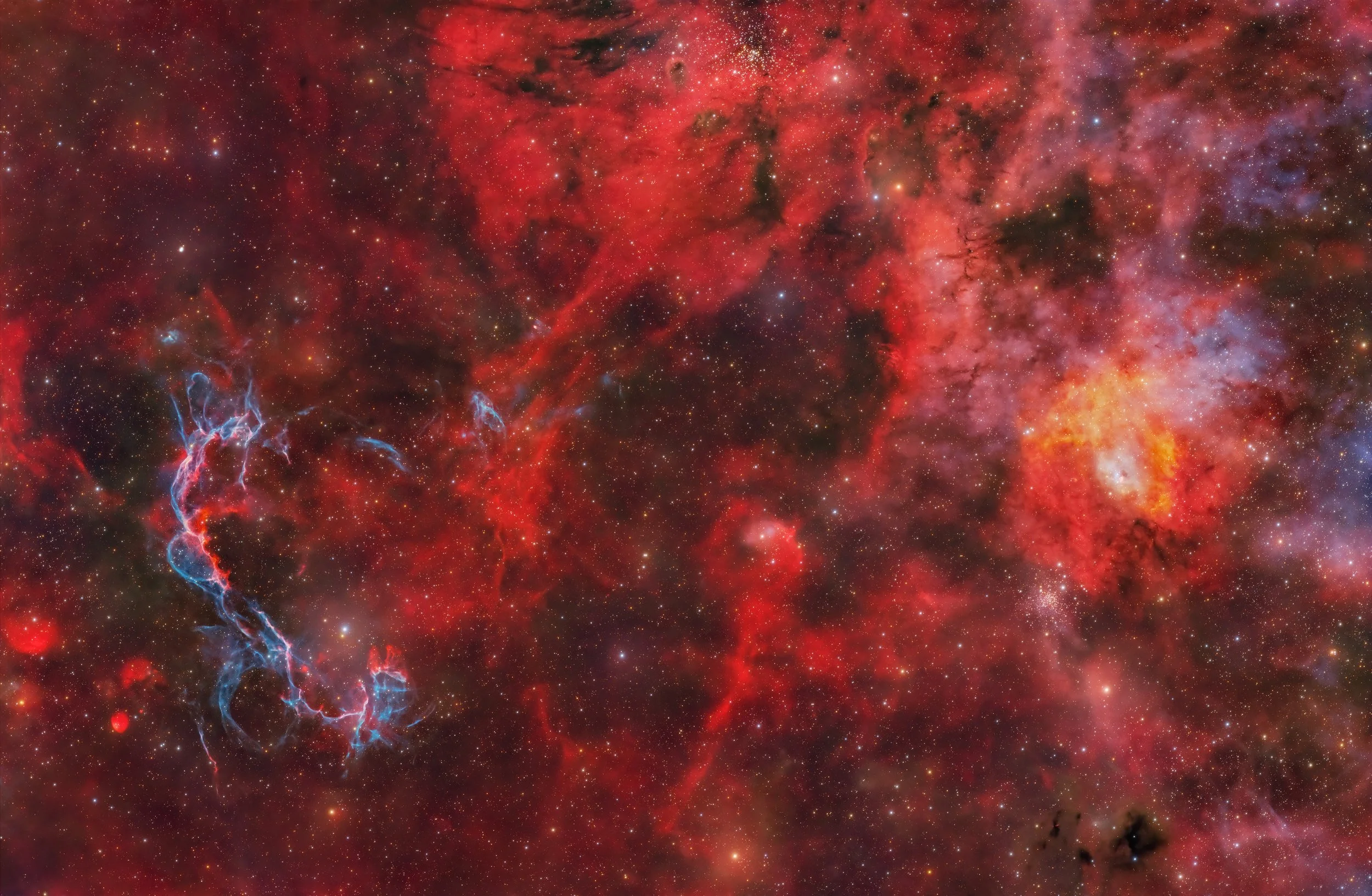
The Sapphire Diadem of Cassiopeia (SNR G126.2+01.6) and a new discovery
The Sapphire Diadem of Cassiopeia centers on the faint but intricate supernova remnant SNR G126.2+01.6, a vast shell of energized gas created when a massive star ended its life in a titanic explosion tens of thousands of years ago. The electric blue filaments trace oxygen-rich shock fronts racing through interstellar space, while the surrounding crimson glow marks hydrogen excited by the remnant’s expanding wave of energy. Together they reveal how stellar death reshapes its galactic environment, compressing, heating, and sculpting the raw material between the stars.
To the right of the frame lies a newly identified emission complex, a luminous pocket of ionized gas and dust likely tied to ongoing star formation within the same spiral arm of the Milky Way. Its warm golden core contrasts with the cooler blue shock arcs of the supernova remnant, illustrating two very different phases of the stellar life cycle captured in a single field. The pairing of violent stellar remains and emerging stellar nurseries turns this region of Cassiopeia into a striking visual and physical narrative of cosmic renewal.
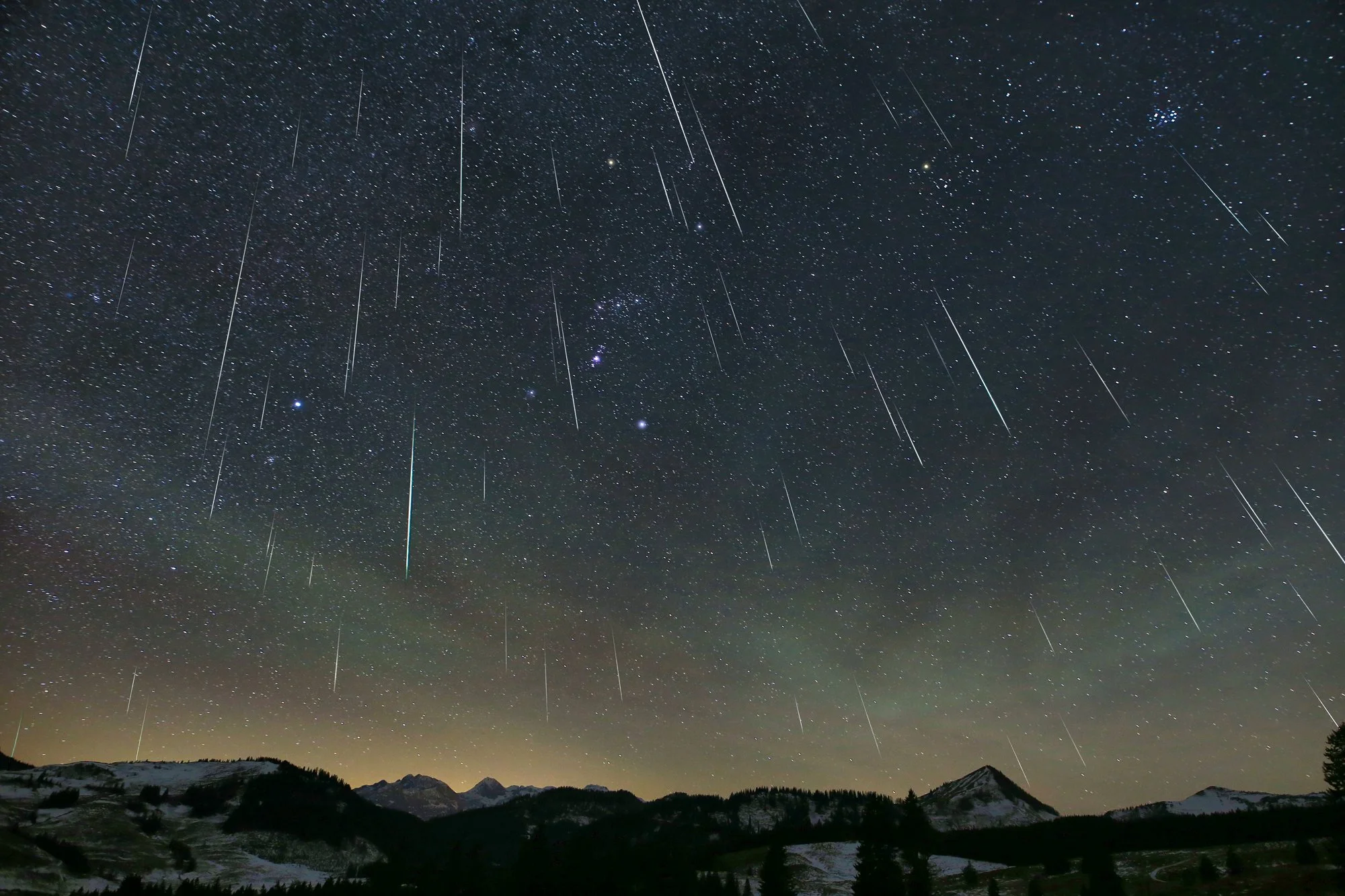
Geminid composite over Austria.
From the dark alpine skies of Postalm in Austria, this composite captures dozens of Geminid meteors streaking through the winter Milky Way as Earth crossed the densest filaments of the stream. Radiating from Gemini near Orion, the meteors appear as fine, parallel lines because they are fragments of the asteroid 3200 Phaethon entering the atmosphere at about 35 kilometers per second. Unlike many showers produced by icy comets, the Geminids originate from a rocky parent body, which explains their dense, bright particles and their reputation for slow, luminous trails that often leave persistent ionized wakes.
The wide field reveals Orion, Taurus, and the Pleiades set against a star rich sky, giving geometric context to the shower’s radiant while the snow capped ridges anchor the scene on Earth. A composite like this merges many short exposures taken over the peak hours of activity, preserving the true sky background while accumulating the fleeting paths of individual meteors. The result is both scientifically informative and visually striking, showing how a narrow debris stream intersects our planet to paint brief, precise strokes across the celestial sphere.
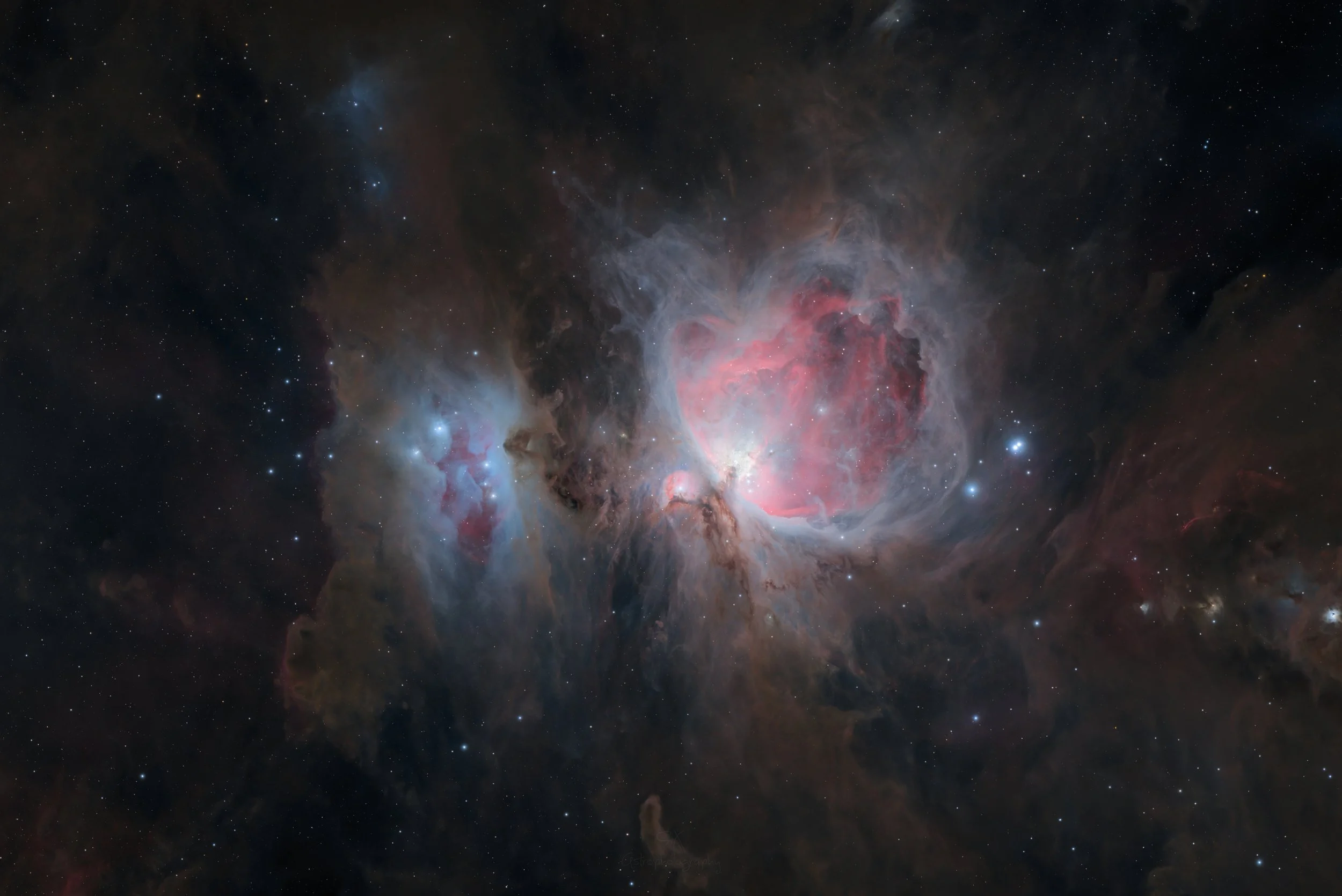
M42 - The Great Nebula in Orion
M42, the Great Nebula in Orion, is the nearest massive star-forming region to Earth at about 1,350 light-years away. This immense cloud of hydrogen, oxygen, and dust is energized by the Trapezium Cluster at its core, where several extremely young and hot stars flood the surrounding gas with ultraviolet radiation. That radiation causes the nebula’s hydrogen to glow red while oxygen and scattered starlight create blue and cyan tones, revealing a layered structure of ionized gas, reflective dust, and darker molecular clouds.
What makes M42 so scientifically important is that it offers a front-row view of how stars are born. Within these luminous curtains are hundreds of protostars and protoplanetary disks, some already sculpted by stellar winds and radiation from their massive neighbors. The sweeping arcs, glowing cavities, and dark filaments seen here trace shock fronts, evaporation flows, and gravity-driven collapse, capturing a moment in the ongoing transformation of cold interstellar matter into a new generation of stars and planetary systems.
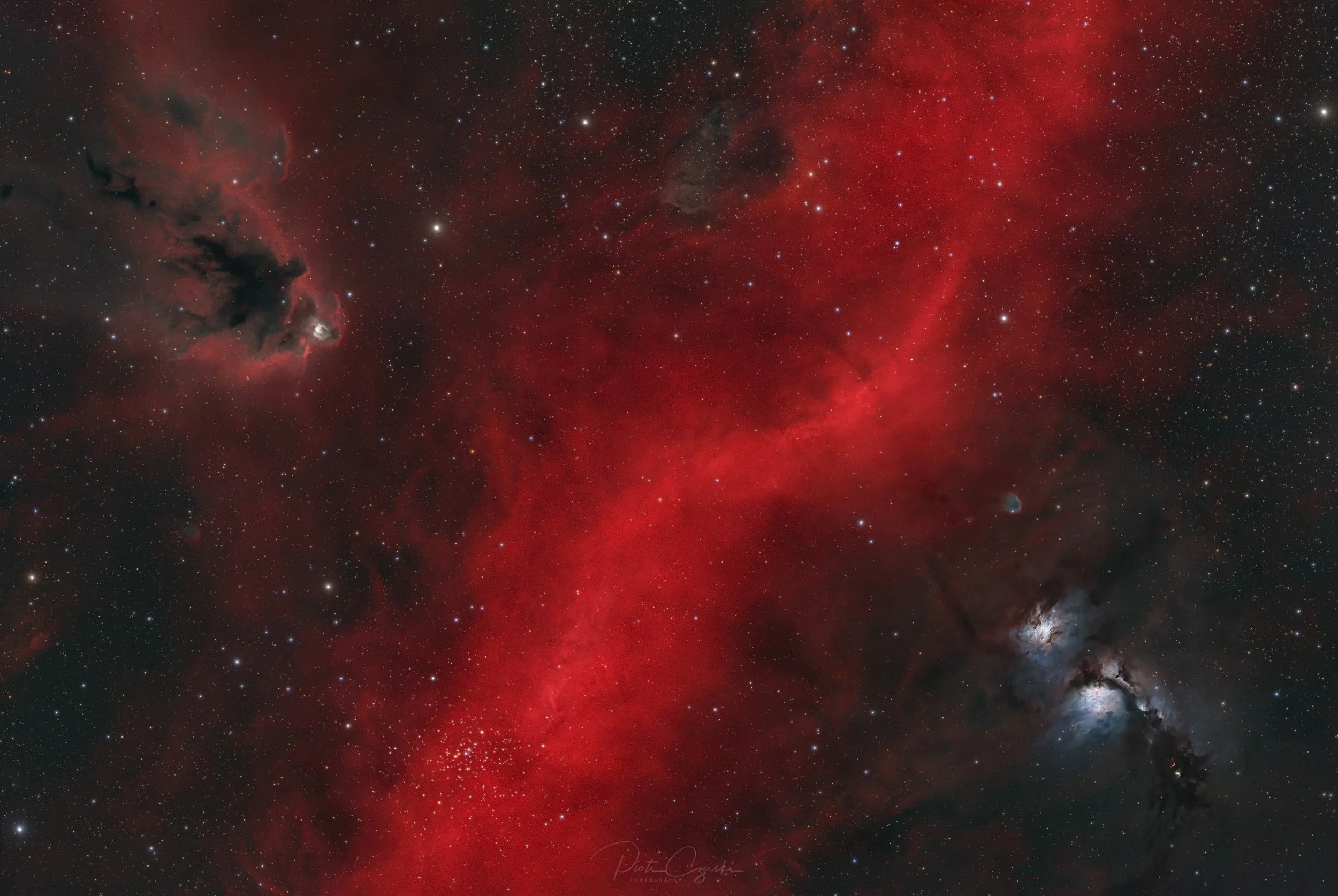
Dust and Glow Along Barnard’s Loop | HaRGB
Barnard’s Loop is a vast arc of glowing hydrogen that curves through the Orion Molecular Cloud Complex, stretching for hundreds of light-years across one of the most active star forming regions in the nearby Milky Way. In this HaRGB rendering, the loop’s ionized hydrogen stands out in deep crimson, revealing the shock fronts and ultraviolet illumination produced by massive young stars in Orion’s OB associations. The bright emission traces where stellar radiation and winds energize the surrounding interstellar medium, carving out cavities and sweeping gas into long, filamentary shells.
Embedded within this glowing backdrop are pockets of dense dust and molecular gas, including the dark nebula LDN 1622 and the reflection nebula M78, which shines blue as starlight scatters off fine dust grains. These contrasting structures show different phases of the same stellar nursery, from cold, star forming clouds to regions already cleared and ionized by newborn suns. Together, they illustrate how gravity, radiation, and turbulence shape the Orion region into a dynamic landscape of both obscuring dust and radiant gas.
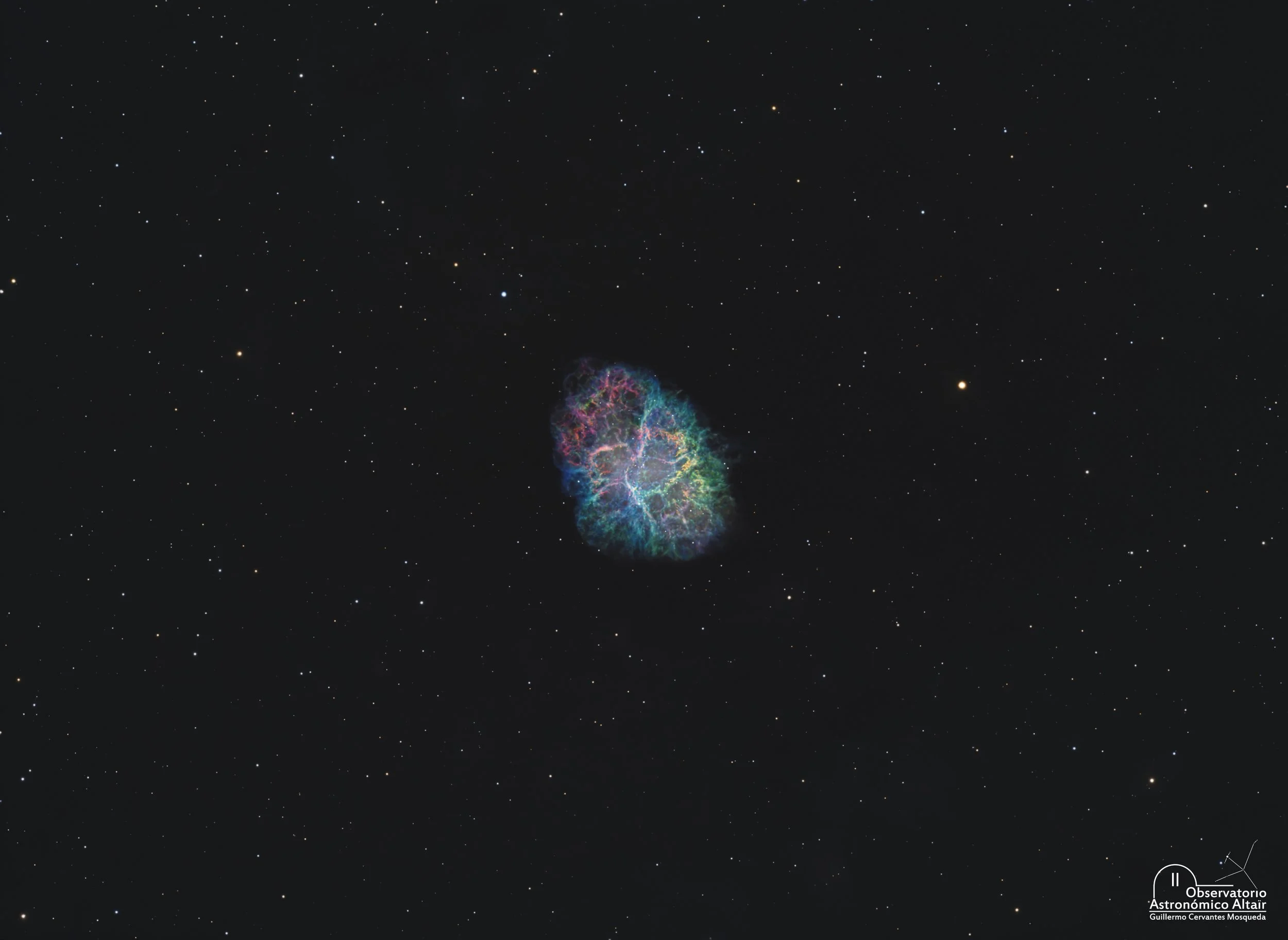
M1: The Crab Nebula in Hubble Palette
M1, the Crab Nebula, is the expanding debris field of a supernova explosion recorded by Earth based astronomers in 1054 CE. Located about 6,500 light years away in the constellation Taurus, this remnant is powered by a rapidly spinning neutron star at its core that floods the surrounding gas with intense radiation and high energy particles, causing the filaments of ejected material to glow across the electromagnetic spectrum. In this Hubble Palette rendering, ionized oxygen, hydrogen, and sulfur are mapped to blue, green, and red, revealing a complex web of shock heated filaments and turbulent knots tracing where the blast wave continues to plow into interstellar space.
Captured from the Observatorio Astronómico Altair in Spain, the Crab appears suspended against a rich stellar background, its chaotic structure standing in sharp contrast to the calm, evenly spaced field stars behind it. What looks like a colorful cosmic cloud is in fact a still ongoing stellar catastrophe, a bubble of debris racing outward at over 1,500 kilometers per second, steadily reshaping its local environment more than a millennium after the original star met its explosive end.
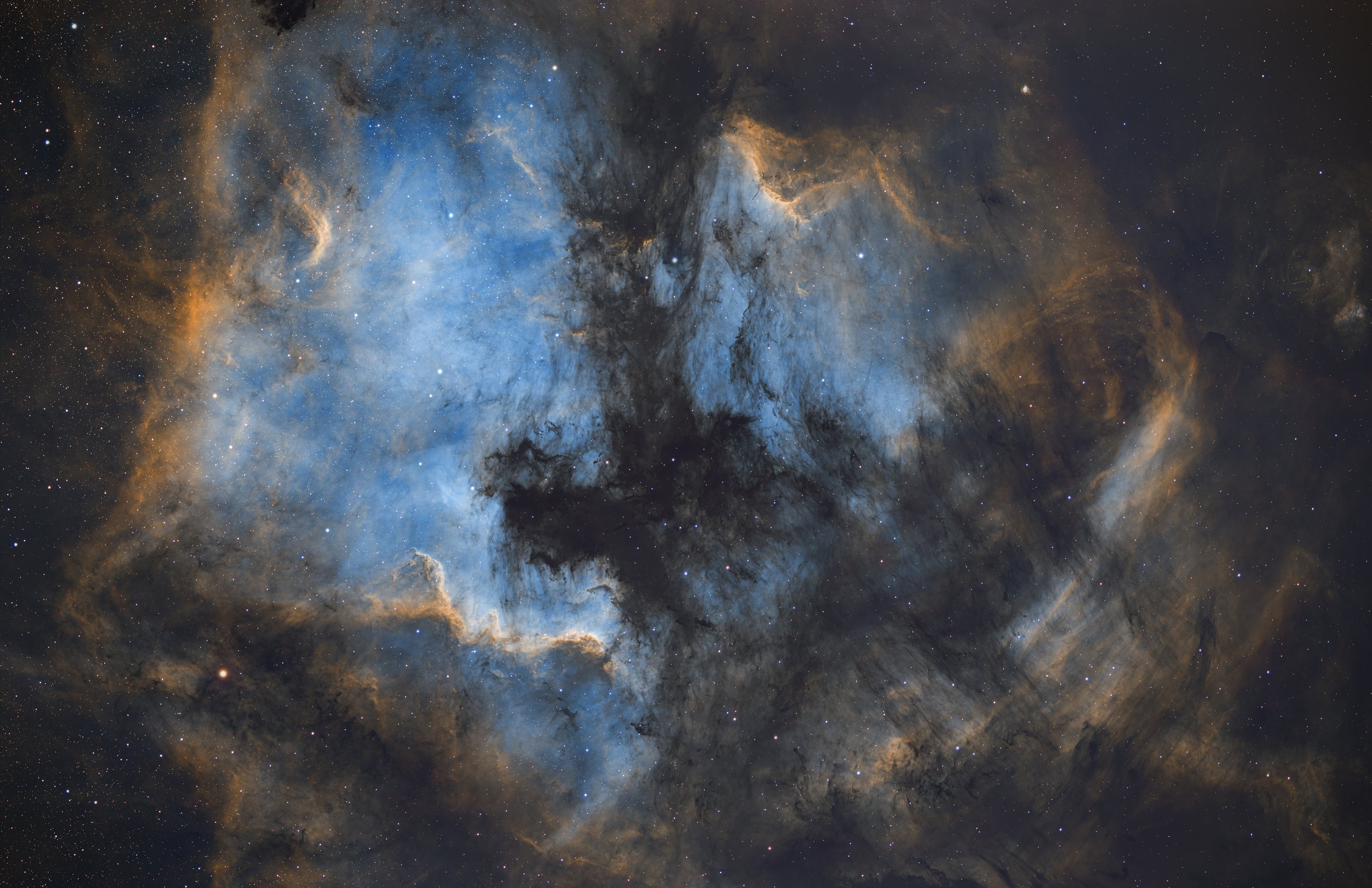
NGC 7000, The North America Nebula
NGC 7000, commonly known as the North America Nebula, is a vast emission nebula located roughly 2,600 light-years away in the constellation Cygnus. Its familiar continental outline is shaped by dense clouds of interstellar dust that obscure the glowing hydrogen gas behind them, carving out prominent features such as the Gulf of Mexico and the eastern coastline. The blue regions trace scattered starlight and oxygen emission, while warmer gold tones highlight ionized hydrogen energized by nearby massive stars, revealing the complex interplay between radiation and cold molecular material.
This image was captured from East Texas under Bortle 3 skies, allowing faint dust structures and subtle color gradients to emerge with exceptional clarity. The composition emphasizes the contrast between luminous gas and opaque dust, giving the nebula a sculpted, almost terrestrial appearance. Scenes like this showcase an active star forming environment, where radiation from young stars reshapes the surrounding clouds and prepares the raw material from which future generations of stars will eventually form.
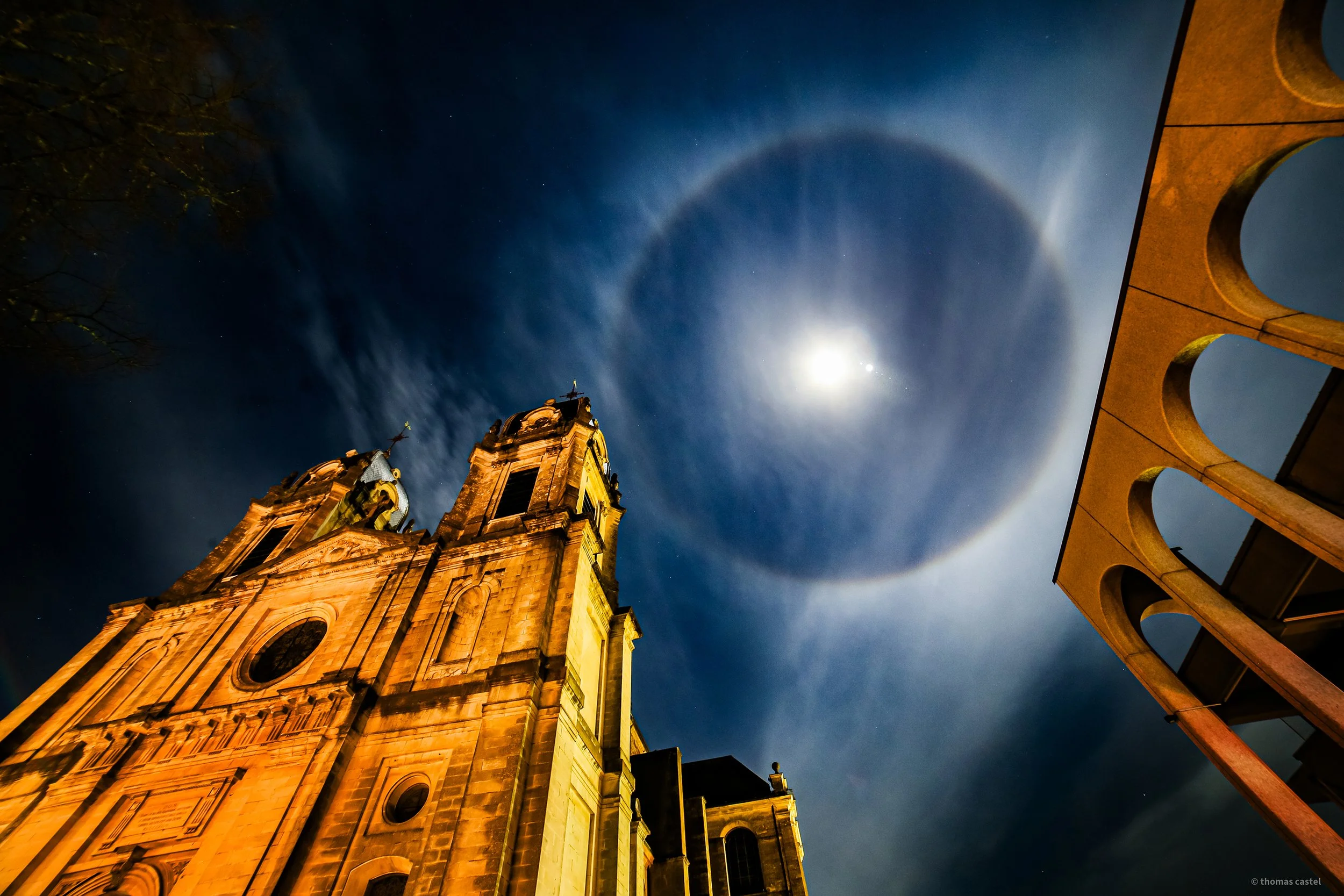
Wolf Moon, Jupiter, and a Complete Lunar Halo over Dax
A rare atmospheric and celestial alignment is captured here as the Wolf Moon appears in conjunction with Jupiter, both encircled by a fully closed lunar halo. The halo forms when moonlight is refracted by countless hexagonal ice crystals suspended in thin, high altitude cirrostratus clouds, producing a precise 22 degree ring around the Moon. Complete halos are uncommon, as cloud uniformity must persist across the entire sky, making this moment both fleeting and scientifically notable. Jupiter, visible just off the lunar glare, adds a planetary anchor to the scene and highlights the scale of the night sky.
The foreground features the cathedral of Dax in southwestern France, its warm illumination contrasting with the cool, ethereal glow of the haloed Moon above. This juxtaposition of ancient architecture and transient atmospheric optics lends the image a symbolic resonance, blending human history with celestial mechanics. The closed halo overhead evokes themes of unity and completeness, reinforcing the sense of awe that arises when rare natural phenomena align above familiar landmarks.
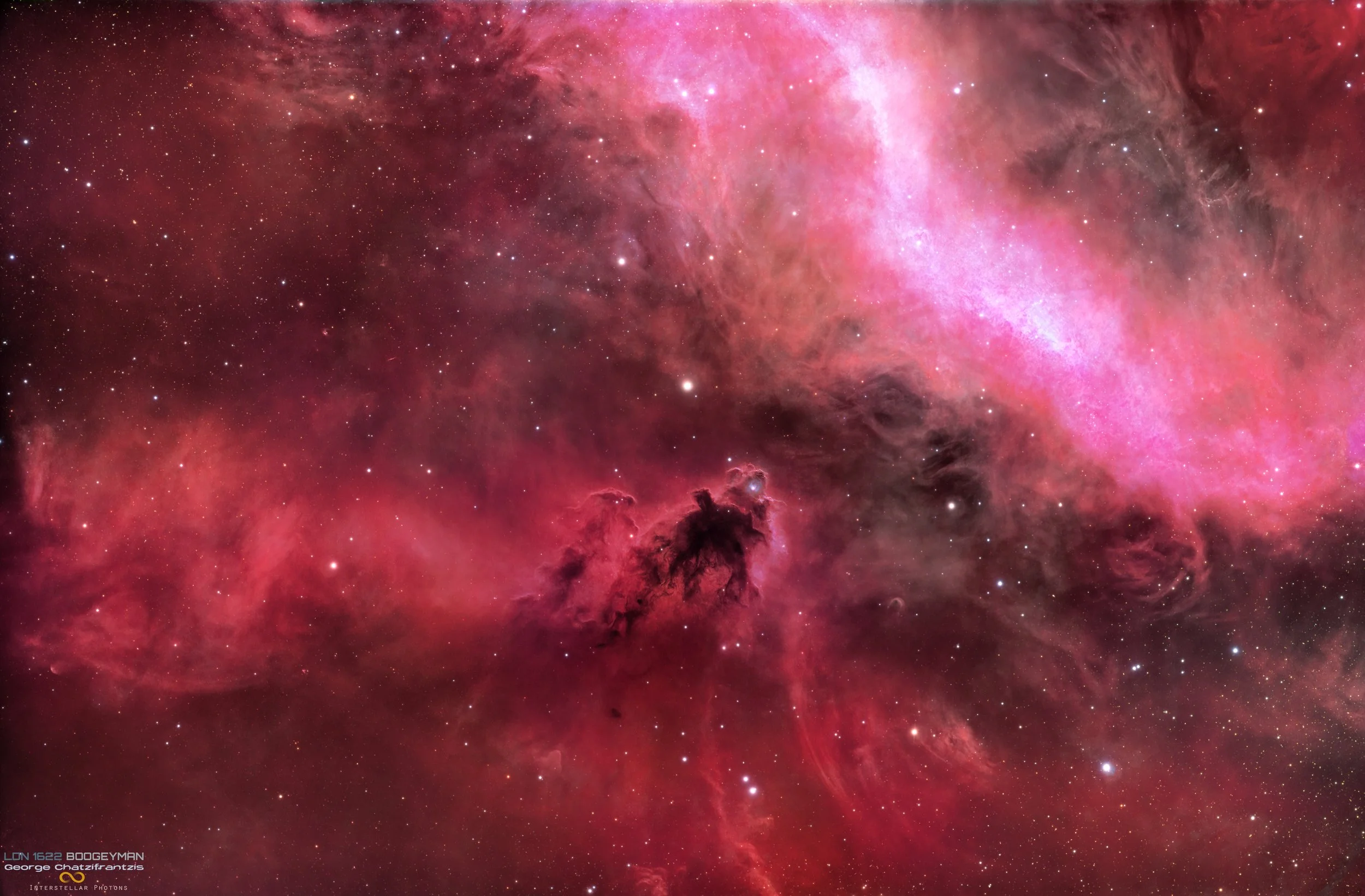
LDN 1622, the Boogeyman Nebula
LDN 1622, popularly known as the Boogeyman Nebula, is a dark molecular cloud embedded along the edge of the Orion–Eridanus region, set against a rich backdrop of hydrogen emission. The nebula itself is not emitting light but is instead visible in silhouette, its dense dust obscuring the bright H-alpha glow of ionized hydrogen behind it. Subtle internal structures and curling tendrils reveal turbulence within the cloud, where gravity and external radiation fields shape the dust into sharp, organic forms. The surrounding red emission traces vast ionized regions energized by nearby hot, young stars, highlighting the contrast between star forming light and starless darkness.
This image combines 15 hours of H-alpha with 3 hours of RGB data, captured from the Interstellar Observatory in Greece, allowing both the faint dust absorption and the surrounding emission to be rendered with depth and texture. The wide field emphasizes how small and isolated LDN 1622 is compared to the immense glowing clouds around it, reinforcing its eerie, claw like appearance. Scenes like this offer a glimpse into the earliest stages of star formation, where cold, opaque clouds quietly gather mass long before new stars ignite within them.
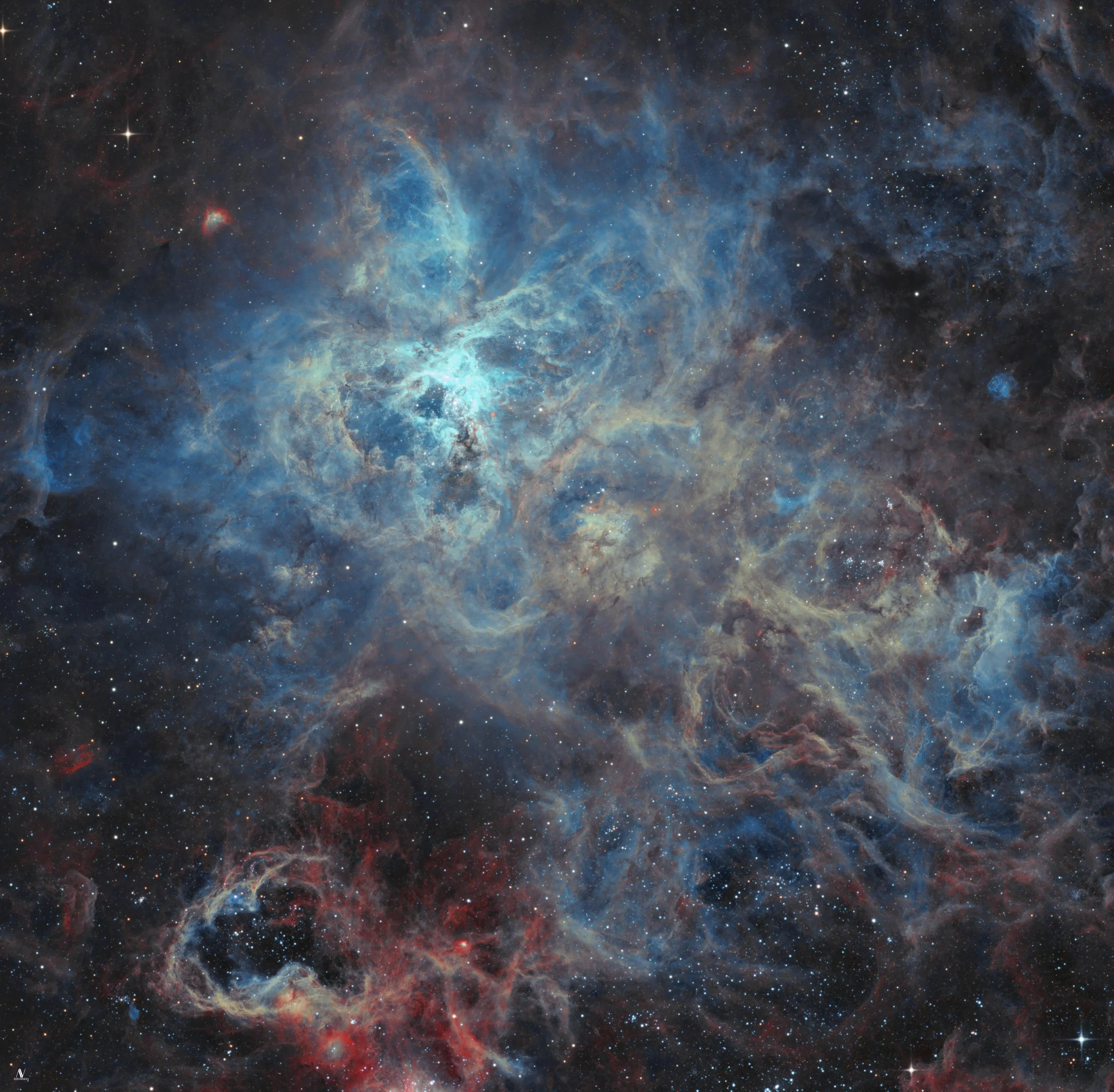
NGC 2070 – The Heart of the Tarantula Nebula
NGC 2070 is the dense, energetic core of the Tarantula Nebula, the most active star-forming region in the Local Group of galaxies. Located within the Large Magellanic Cloud roughly 160,000 light-years away, this region is dominated by the massive young star cluster R136, whose intense ultraviolet radiation ionizes the surrounding hydrogen and oxygen gas. The result is a complex network of glowing filaments, cavities, and shock fronts sculpted by stellar winds and radiation pressure from some of the most massive stars known.
Rendered here in an HOO-based palette with additional RGB contribution, ionized hydrogen traces vast turbulent clouds while doubly ionized oxygen highlights the hottest and most energetic structures near the cluster core. Dark dust lanes weave through the luminous gas, marking regions where future stars may still be forming. Captured from Obstech in Chile, this image reveals NGC 2070 not as a single object, but as a dynamic ecosystem where stellar birth, feedback, and destruction unfold on truly galactic scales.
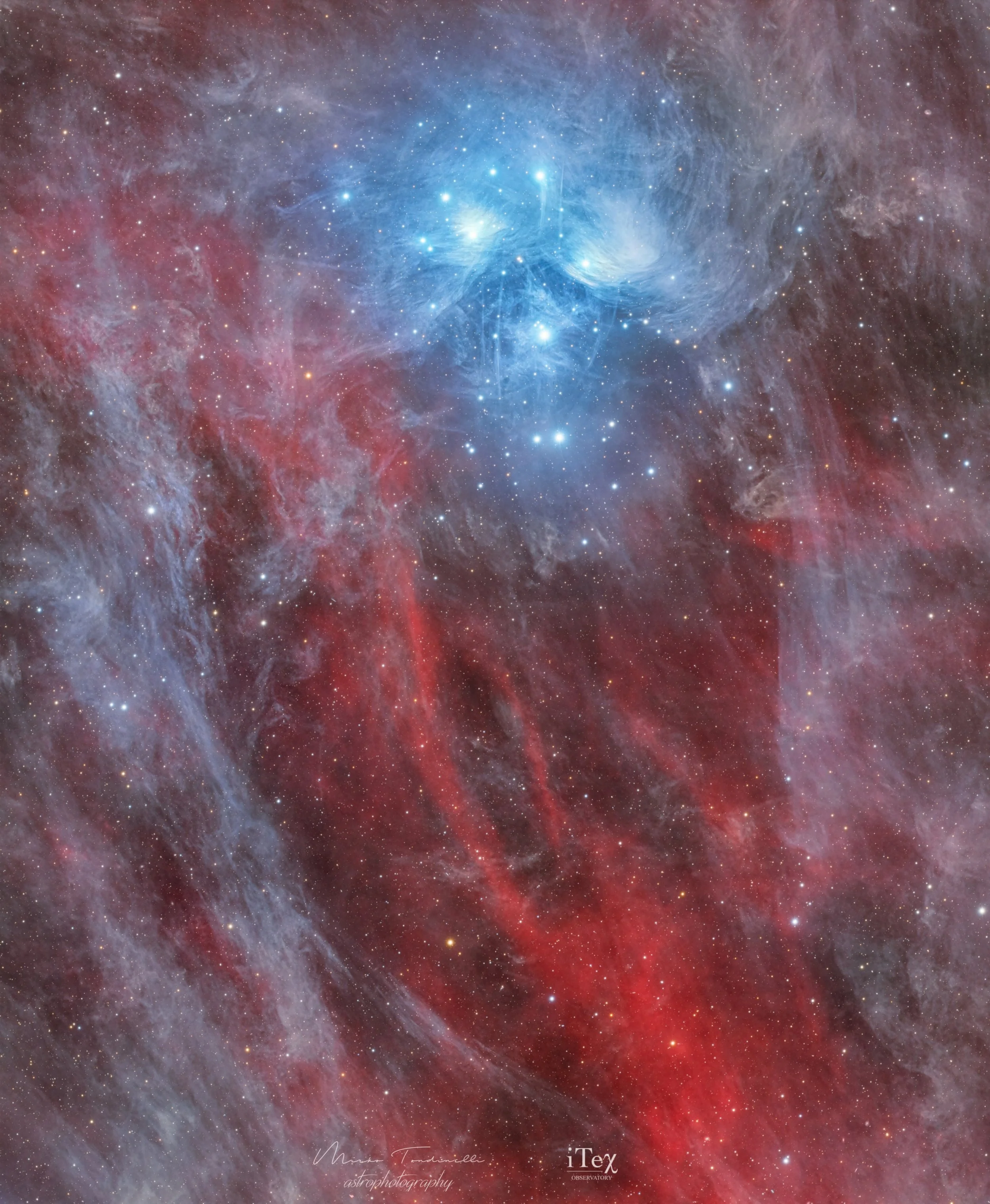
The Pleiades and Surrounding Interstellar Dust
The Pleiades, also known as Messier 45, is a nearby open star cluster dominated by hot, young blue stars whose intense radiation illuminates the surrounding interstellar dust. The bright blue nebulosity seen here is not leftover material from the cluster’s formation, but a chance encounter as the stars pass through a complex region of dusty interstellar space. Fine filamentary structures trace the interaction between starlight and dust grains, revealing the delicate texture of the local interstellar medium.
Beyond the familiar blue reflection nebulae, faint reddish emissions thread through the field, marking distant clouds of hydrogen excited by other energetic sources along the same line of sight. This combination of reflection and emission structures highlights the layered nature of our galaxy, where nearby stellar groups and far more distant nebulae overlap visually. Together, they create a rich portrait of stellar light sculpting and revealing the cosmic dust between the stars.
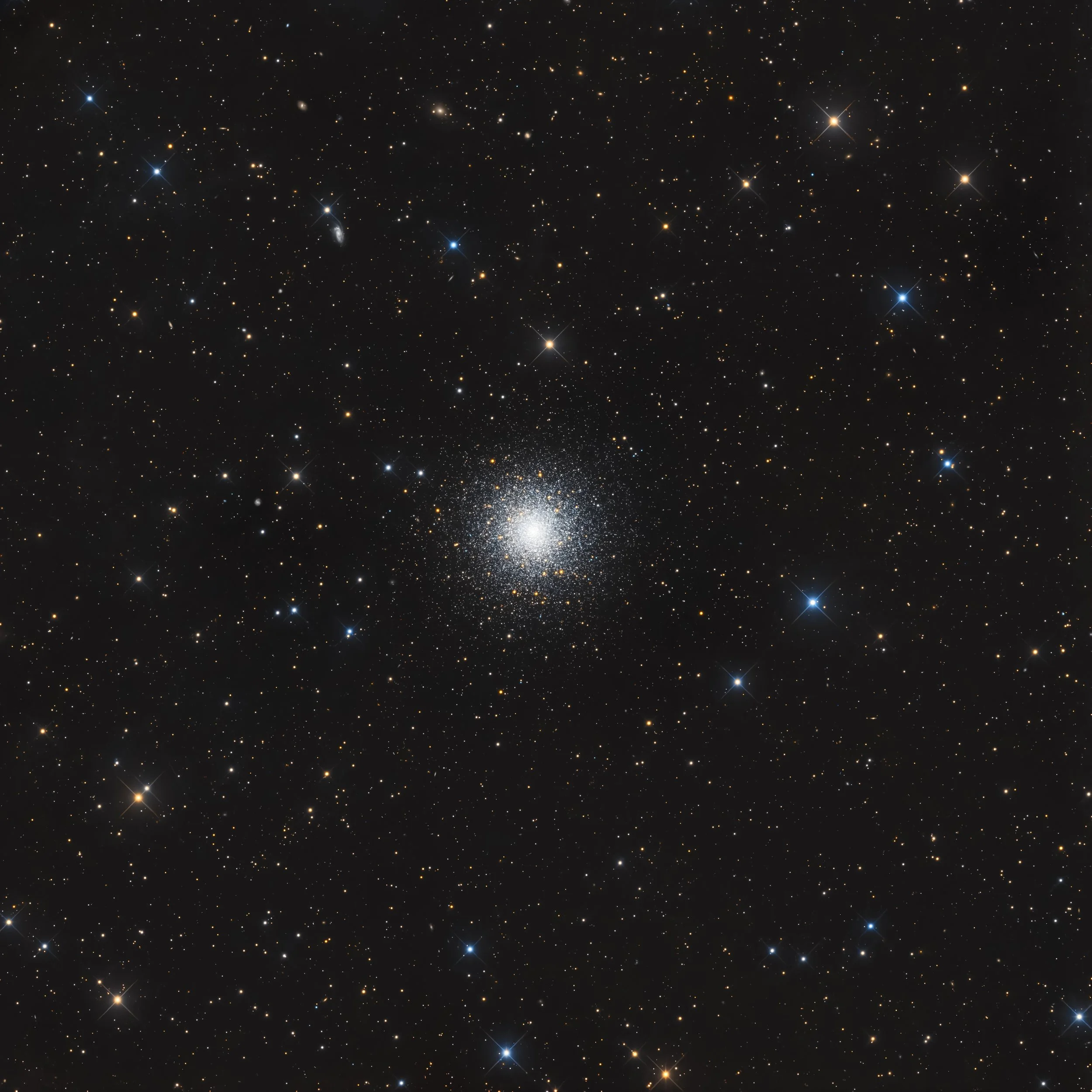
NGC 1851, Caldwell 73
NGC 1851, also cataloged as Caldwell 73, is a massive globular cluster located in the southern constellation Columba. Situated about 39,500 light-years from the Sun and roughly 54,100 light-years from the Galactic Center, it is one of the more compact and concentrated globular clusters in the Milky Way. Its dense core contains hundreds of thousands of ancient stars, many of them more than 10 billion years old, offering a direct glimpse into the early history of our galaxy.
Captured from Rio Hurtado in Chile, this image resolves the cluster’s tightly bound core while revealing a halo of individual stars extending outward into space. The strong central concentration reflects the cluster’s advanced dynamical evolution, where gravitational interactions have driven stars inward over cosmic time. Set against a background of distant field stars and faint galaxies, NGC 1851 stands out as a luminous fossil of the Milky Way’s formative years, preserving clues about stellar evolution and galactic assembly.
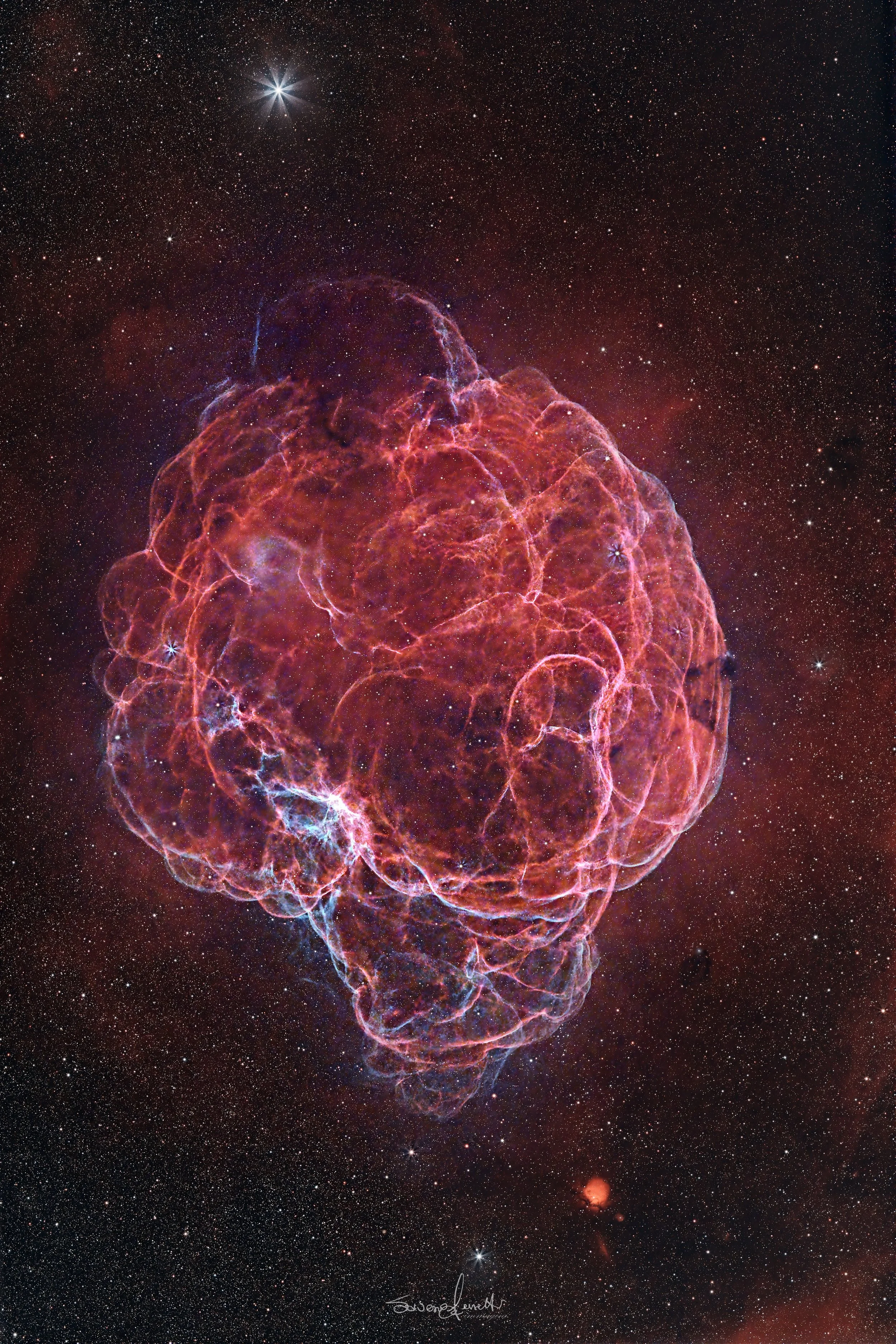
Simeis 147, The Spaghetti Nebula
Simeis 147, commonly known as the Spaghetti Nebula, is an enormous and extremely faint supernova remnant located in the constellation Taurus. Spanning nearly three degrees on the sky, it is the expanding debris field from a stellar explosion that occurred roughly 40,000 years ago at a distance of about 3,000 light-years. The nebula’s characteristic appearance comes from long, tangled filaments of ionized hydrogen and oxygen, shaped by shock waves propagating through the surrounding interstellar medium as the remnant continues to expand and dissipate.
This narrowband view was captured from Forca Canapine in the Parco Nazionale dei Monti Sibillini in the Marche region of Italy, a high-altitude site well suited for deep-sky imaging. Using an Optolong L-Ultimate filter, the image isolates hydrogen and oxygen emission, allowing the delicate filamentary network to emerge despite the nebula’s extremely low surface brightness. The result highlights both the chaotic structure left behind by the supernova and the slow return of enriched material to the galaxy, where it will eventually contribute to future generations of stars.
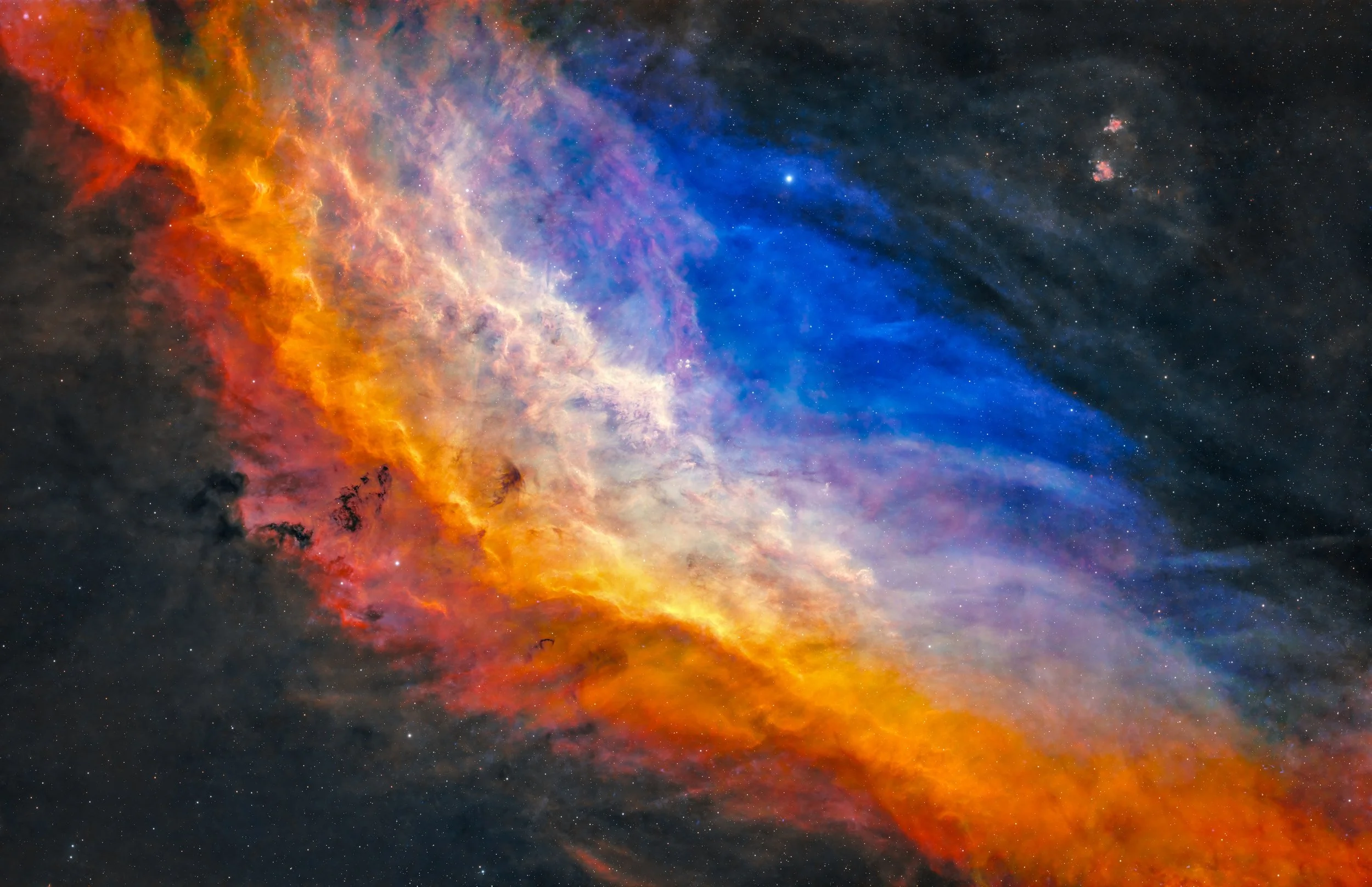
The California Nebula in SHO
The California Nebula, cataloged as NGC 1499, is a vast emission nebula in the constellation Perseus, stretching nearly 100 light-years across. In this SHO narrowband presentation, ionized hydrogen dominates the structure, while sulfur and oxygen reveal layered filaments, knots, and subtle shock fronts within the glowing gas. The nebula’s elongated shape and complex internal texture are sculpted by energetic radiation from the hot star Xi Persei, which excites and ionizes the surrounding interstellar medium.
Captured from a Bortle 7 sky, this image demonstrates the power of narrowband imaging in overcoming light pollution. By isolating specific emission lines, faint structures and contrast within the nebula emerge despite challenging urban conditions. The result highlights both the large-scale flow of ionized gas and the finer details embedded within it, offering a scientifically rich and visually striking view of one of the sky’s most recognizable emission nebulae.
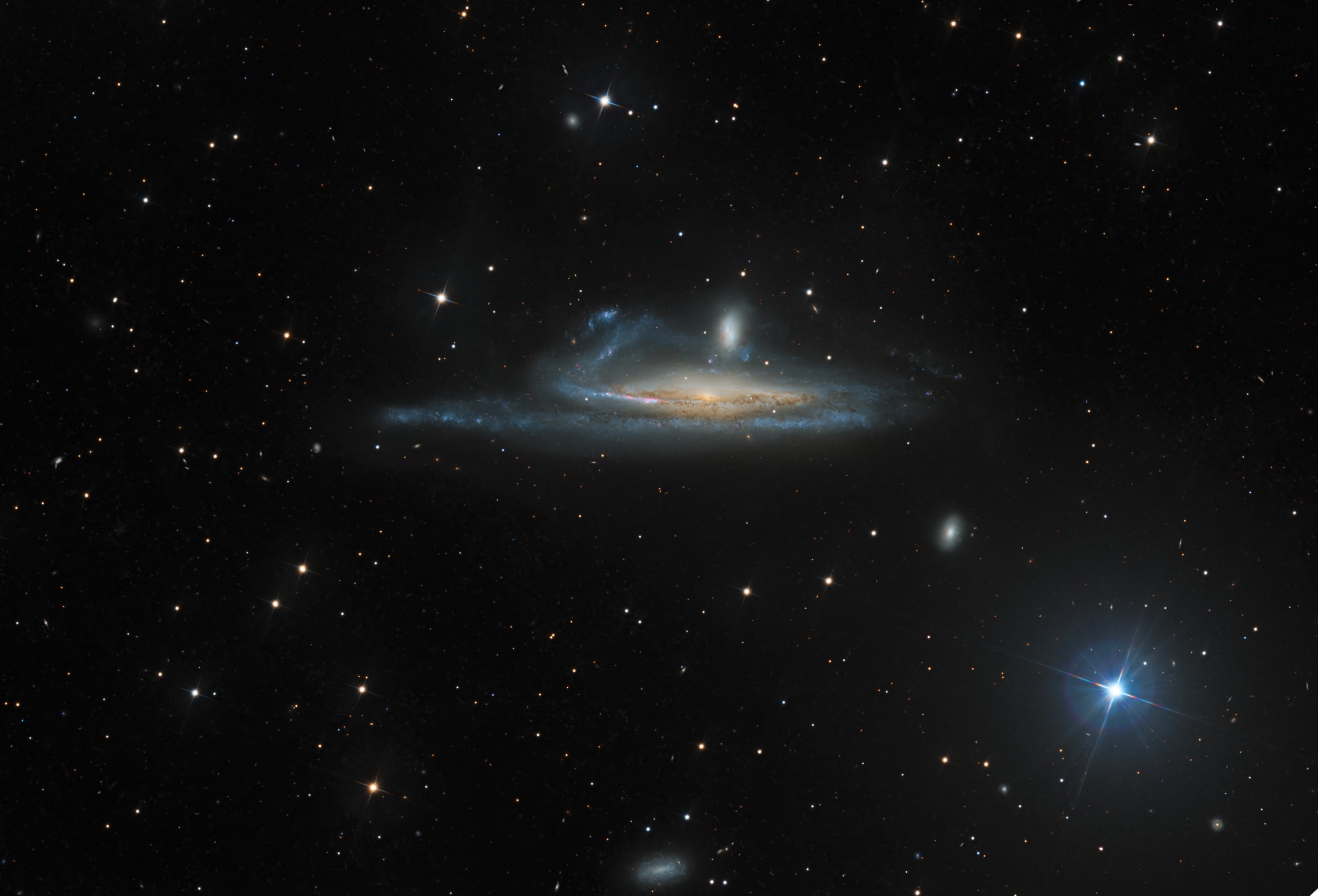
NGC 1532 and Companion Galaxy NGC 1531
NGC 1532 is a massive barred spiral galaxy located in the constellation Eridanus, seen here nearly edge-on. Its flattened disk stretches across the frame, marked by a bright central bulge, dark dust lanes, and faint bluish regions tracing spiral arms rich in young stars. The edge-on perspective emphasizes the galaxy’s impressive size, spanning well over 100,000 light-years, and reveals subtle vertical structure within the disk shaped by gravity and rotation.
Just above the main disk lies NGC 1531, a smaller companion galaxy whose distorted shape betrays a strong gravitational interaction. Tidal forces between the two systems are triggering star formation and warping NGC 1532’s spiral structure, effects that will continue to evolve over hundreds of millions of years. Scattered throughout the background are countless distant galaxies, adding depth and context to this dynamic scene within the Eridanus galaxy group.
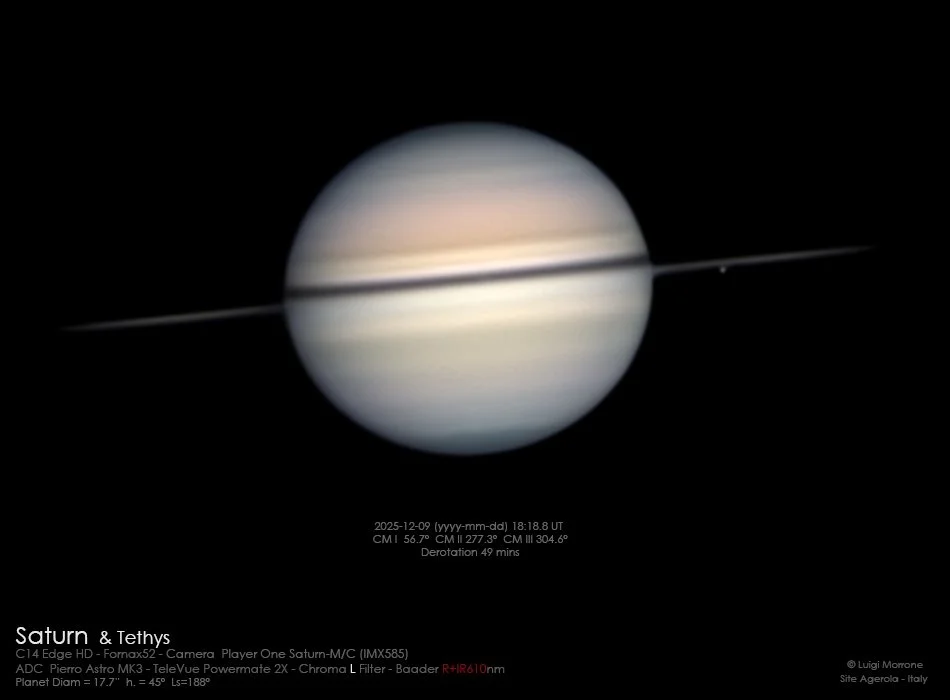
Saturn and Tethys Near Ring Plane
Saturn is captured here under very good seeing conditions, revealing subtle atmospheric banding across the planet’s pale golden disk. At the time of observation, Saturn’s ring system was approaching a ring-plane crossing, causing the normally broad rings to appear exceptionally thin. This geometry emphasizes the dark ring shadow cast across the planet’s equatorial regions, a striking visual marker of the Sun’s low angle relative to the ring plane.
To the right of the planet, the icy moon Tethys appears closely aligned with the narrow rings, creating a compelling sense of depth and scale. With a diameter of about 1,060 kilometers, Tethys orbits Saturn every 1.9 days and is composed largely of water ice. Its proximity to the rings in this view is a line-of-sight effect, but it highlights the intricate and dynamic architecture of the Saturnian system, where moons, rings, and shadows interact in constantly changing configurations.