

AAPOD2 Image Archives
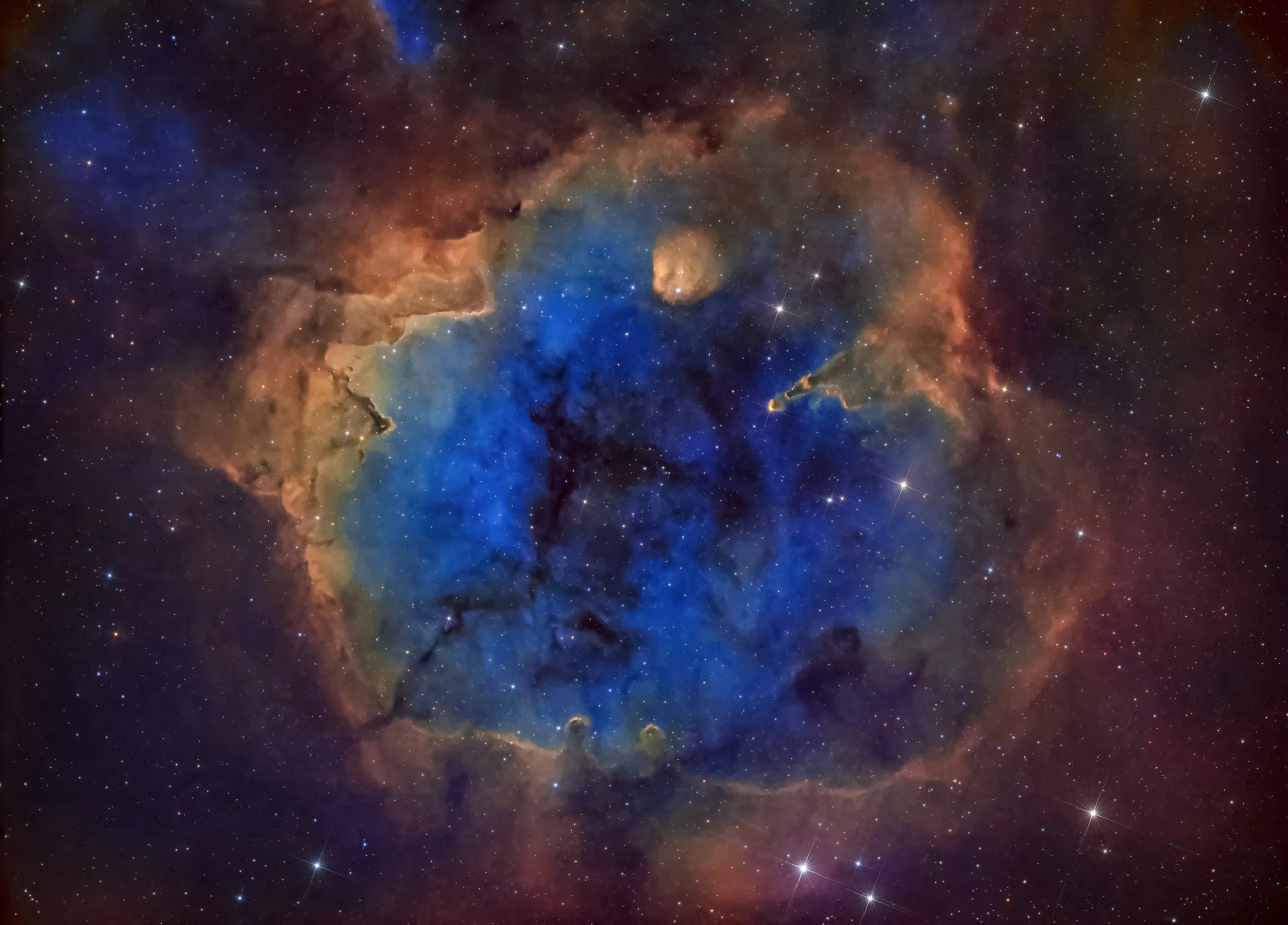
SH2-284 in SHO with RGB stars
Captured in a mesmerizing SHO palette with vibrant RGB stars, SH2-284 stands as a testament to the dynamic interplay of cosmic forces within our galaxy. This emission nebula, also known as the Wolf-Rayet nebula, showcases intense regions of ionized hydrogen, sulfur, and oxygen, painted against the backdrop of a rich stellar tapestry.
Enveloped in the intricate tendrils of ionized gas, SH2-284 harbors regions of stellar birth and death, offering astronomers a window into the tumultuous processes shaping the cosmos. The juxtaposition of the nebula's luminous hues with the brilliance of surrounding stars provides a captivating visual narrative of the cosmic drama unfolding in the depths of space, inviting contemplation of the universe's awe-inspiring complexity.
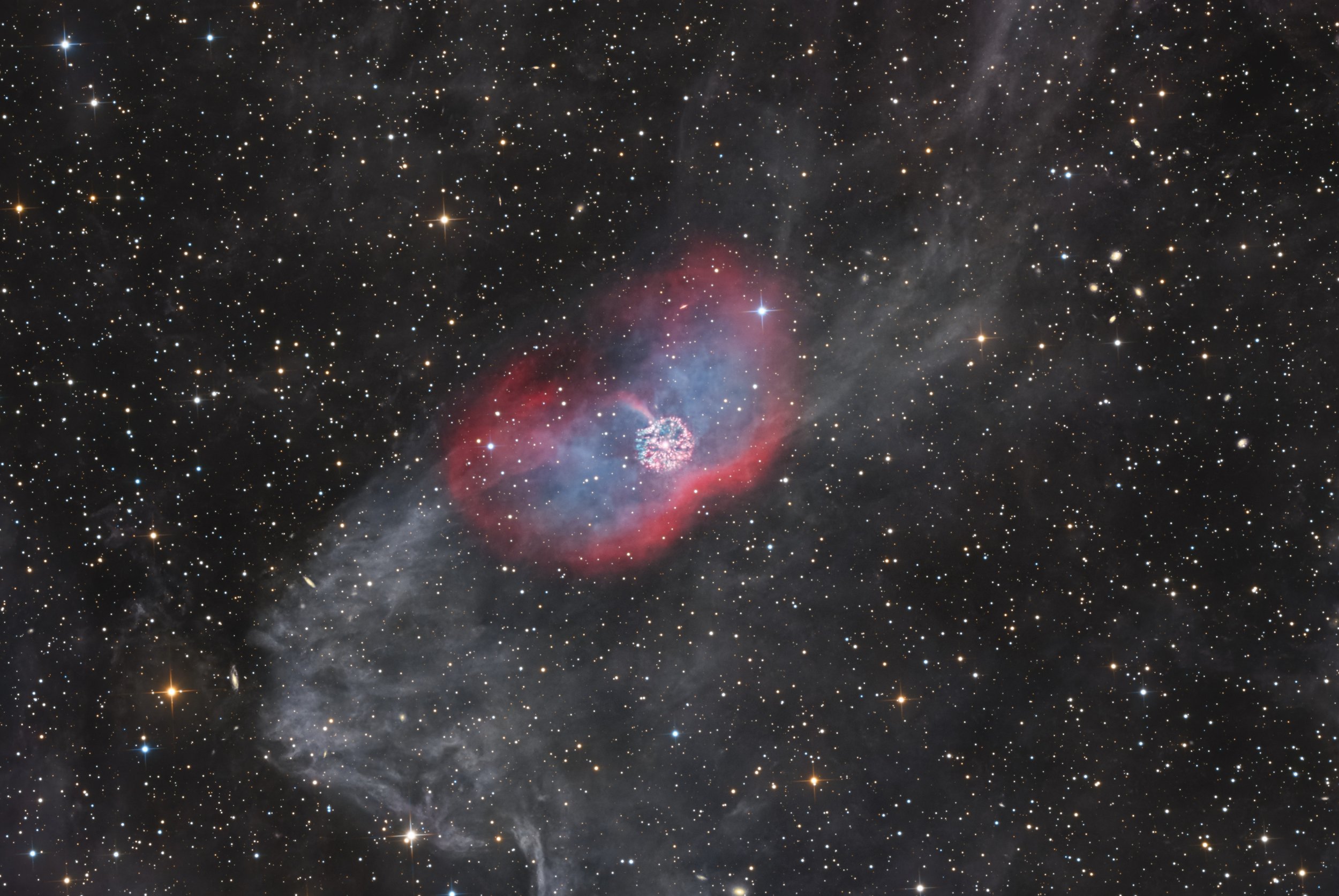
A deep dive into GK Persei's hidden planetary nebulae
GK Persei, also known as Nova Persei 1901, is a cataclysmic variable star system located in the constellation Perseus. This celestial object is famous for its historical outburst in 1901 when it briefly became one of the brightest stars in the sky. The remnants of this event include a fascinating planetary nebula, shrouded in the surrounding interstellar material.
This remarkable image of GK Persei's hidden planetary nebula showcases the intricate details of its structure, achieved through an unprecedented integration time of 265 hours. This extensive observation period, the longest ever conducted on GK Persei, has unveiled the subtle nuances of the nebula's morphology, highlighting intricate filaments and regions of ionized gas.
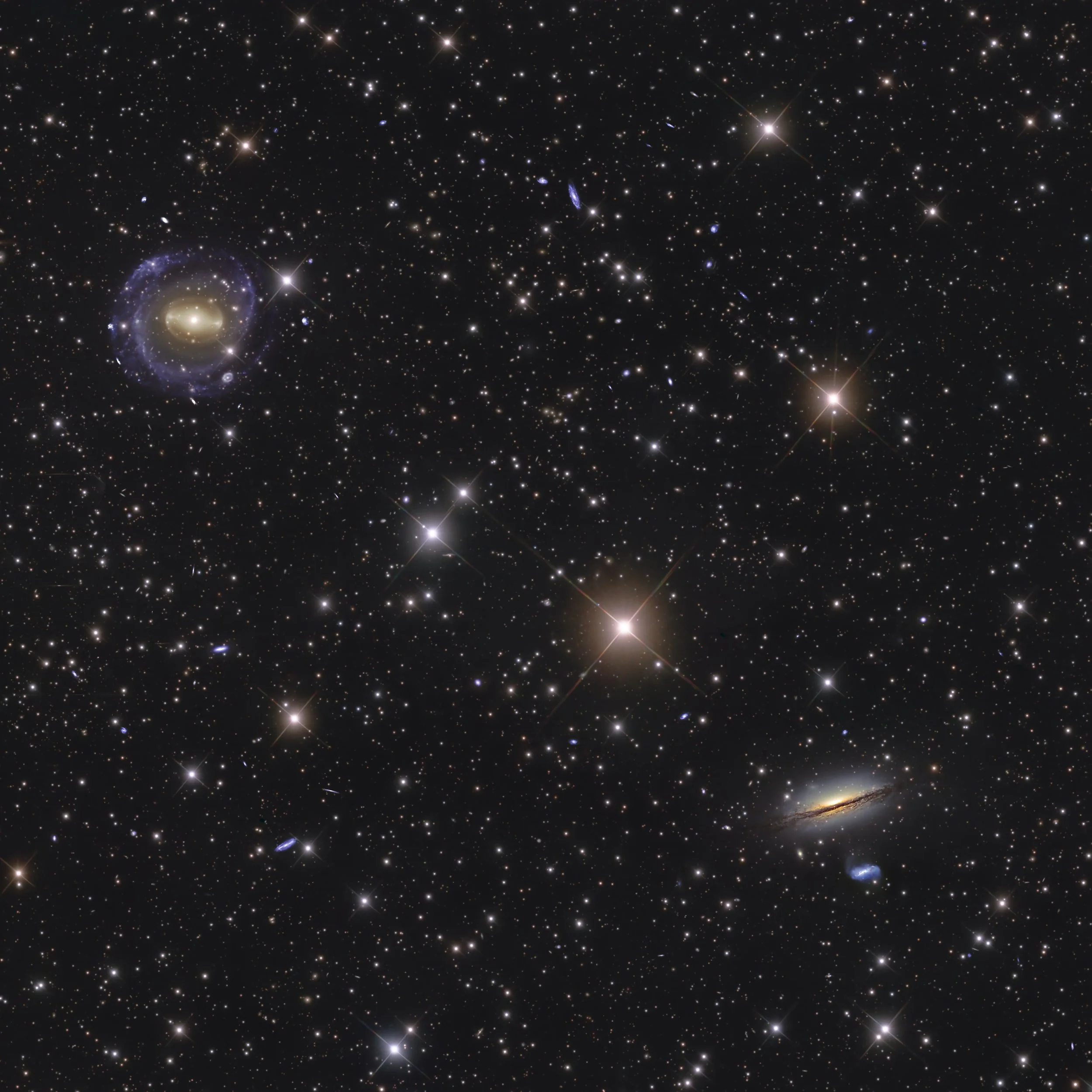
NGC 5078 & NGC 5101
NGC 5078 and NGC 5101 are two captivating galaxies located in the constellation Hydra. NGC 5078 is an edge-on spiral galaxy, characterized by its flattened disk structure and prominent dust lanes that obscure part of its starlight. It exhibits a bright central bulge surrounded by a diffuse stellar halo, making it an intriguing object for astrophotography and scientific study. NGC 5101, on the other hand, is a barred spiral galaxy with a distinctive central bar structure that extends through its disk. It showcases intricate spiral arms adorned with regions of star formation, adding to its visual allure and scientific significance.
Both galaxies offer astronomers valuable insights into the processes of galaxy formation and evolution. Studying their morphology, stellar populations, and dynamics can provide clues about the underlying mechanisms driving the formation of stars and the assembly of galaxies over cosmic time. Additionally, the proximity of these galaxies allows for detailed observations and analyses, contributing to our broader understanding of the universe's vast tapestry of celestial objects.
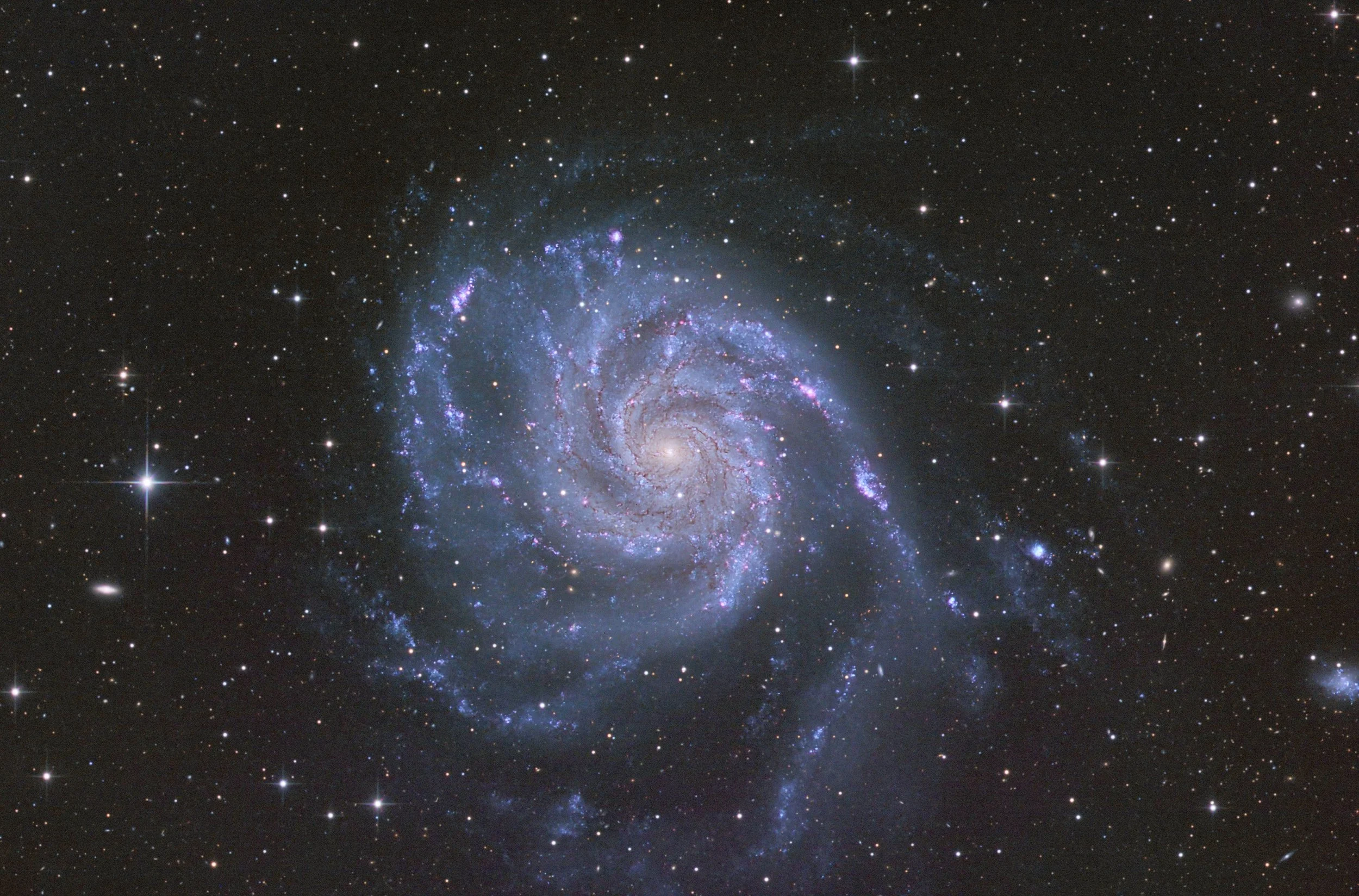
M101
M101, also known as the Pinwheel Galaxy, is a majestic spiral galaxy located in the constellation Ursa Major. Situated about 21 million light-years away from Earth, M101 is one of the largest and brightest spiral galaxies in the sky, spanning approximately 170,000 light-years in diameter. Its spiral arms are adorned with clusters of young, hot stars, bright nebulae, and dark lanes of interstellar dust, creating a captivating tapestry of celestial beauty.
This stunning galaxy has been the subject of numerous astronomical studies due to its proximity and striking appearance. It hosts a high rate of supernova activity, making it an excellent laboratory for studying stellar evolution and galaxy dynamics. M101 offers astronomers valuable insights into the formation and evolution of spiral galaxies, enriching our understanding of the cosmos.
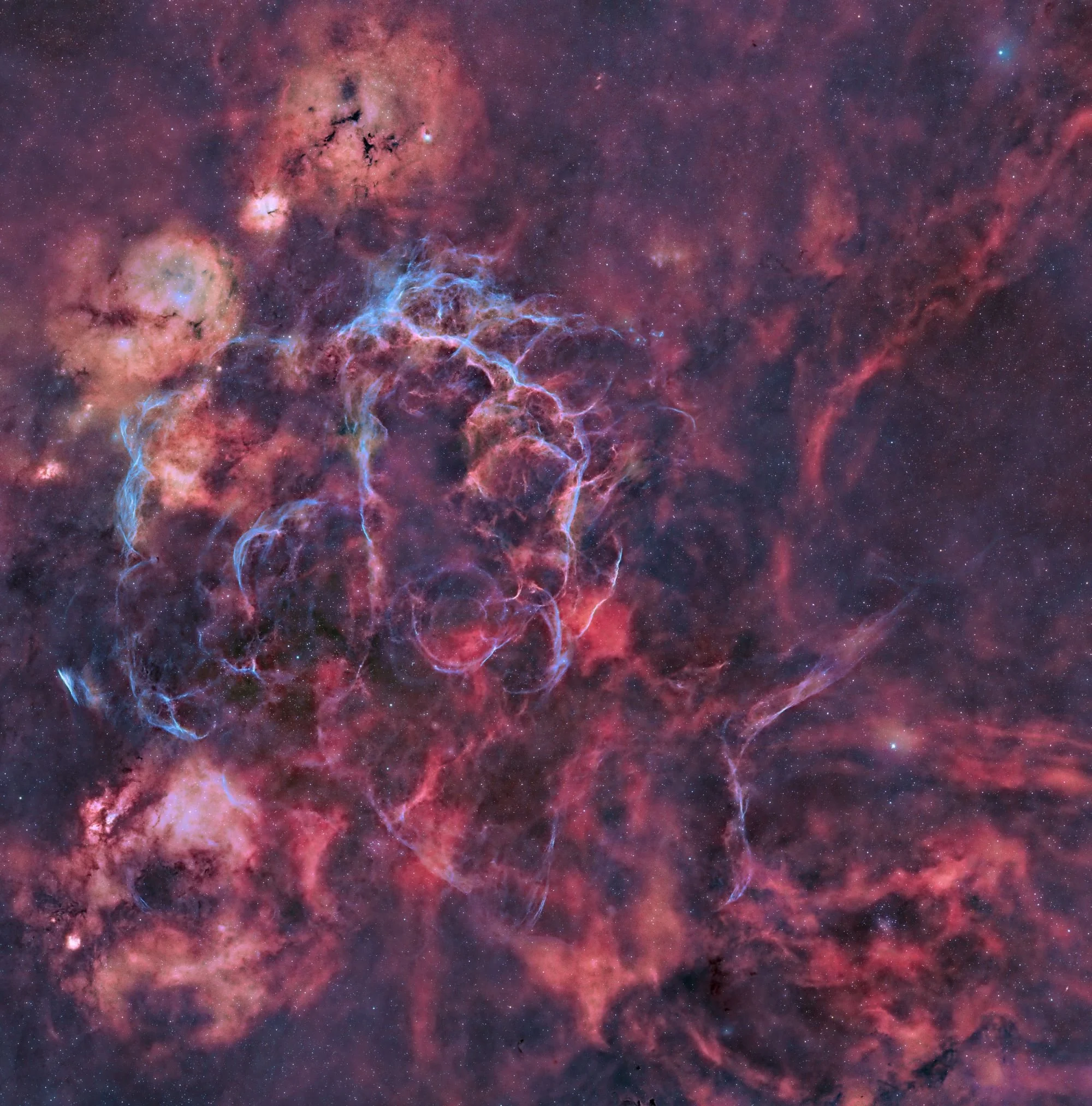
Vela (XYZ) 12 tiles
Embark on a scientific exploration of Vela, a sprawling constellation in the southern sky, with this impressive 12-tile mosaic capturing its celestial wonders. Vela, Latin for "the sails," is rich in astronomical treasures, including stellar nurseries, supernova remnants, and intricate star clusters.
This mosaic offers a panoramic view of Vela's diverse cosmic landscape, showcasing its vibrant tapestry of gas clouds, young stars, and remnants of stellar explosions. Each tile in the mosaic reveals a unique aspect of Vela's celestial splendor, providing astronomers with valuable insights into the processes shaping the evolution of stars and galaxies.
From the delicate filaments of the Vela Supernova Remnant to the glittering jewels of star clusters nestled within its embrace, this mosaic offers a window into the rich tapestry of cosmic phenomena that populate the constellation of Vela. Through meticulous observation and data processing, astronomers unravel the mysteries of Vela, shedding light on the intricate interplay of forces that govern the universe.
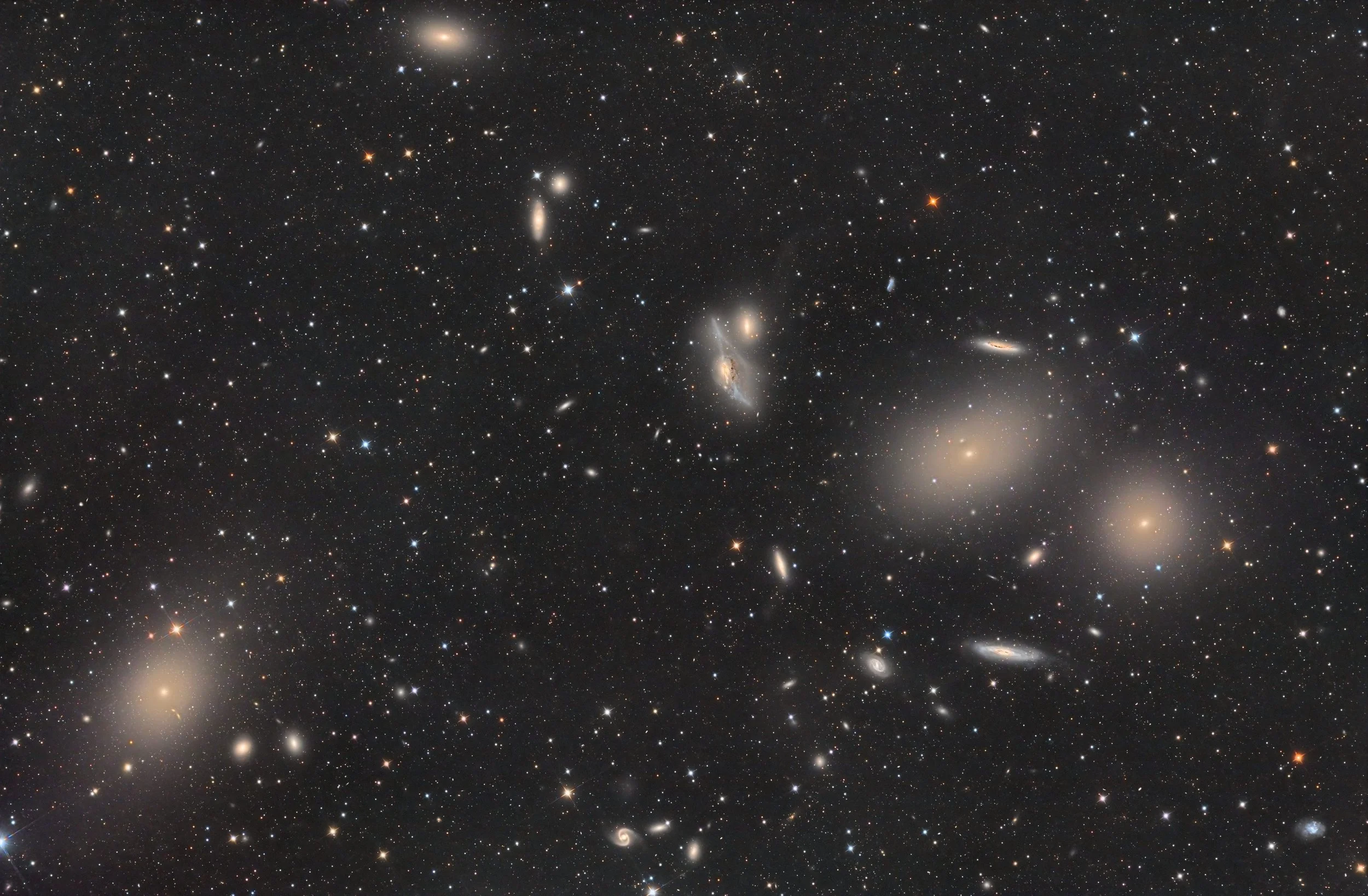
The Markarian Chain
The Markarian Chain, a striking arrangement of galaxies, stretches across the Virgo constellation, forming a captivating celestial chain. This cosmic spectacle is a visual treat for astronomers and stargazers alike, showcasing a diverse collection of galaxies bound together by gravity.
At the heart of the Markarian Chain lies the Virgo Cluster, one of the richest galaxy clusters in the nearby universe. This cluster hosts hundreds of galaxies, ranging from massive ellipticals to intricate spirals and irregulars. The Markarian Chain itself is composed of numerous interacting and merging galaxies, their gravitational dance shaping the evolution of the cosmic landscape.

The Angel in sky
The Angelfish Nebula Complex, also known as the Angelfish Nebula, is a fascinating region of space situated in the constellation Ara. This intricate celestial tapestry encompasses a variety of nebulae, including emission, reflection, and dark nebulae, each contributing to the complex's captivating appearance.
At the heart of the Angelfish Nebula Complex lies the prominent emission nebula designated as IC 4678, which glows with the light of newly formed stars embedded within its nebulous clouds. Surrounding IC 4678 are intricate tendrils of dust and gas, sculpted by the intense radiation and stellar winds emanating from nearby massive stars.
The Angelfish Nebula Complex offers astronomers a glimpse into the ongoing processes of star formation and interstellar dynamics. Its diverse array of nebulae presents a rich tapestry of cosmic phenomena, inviting exploration and further study into the mysteries of our universe.
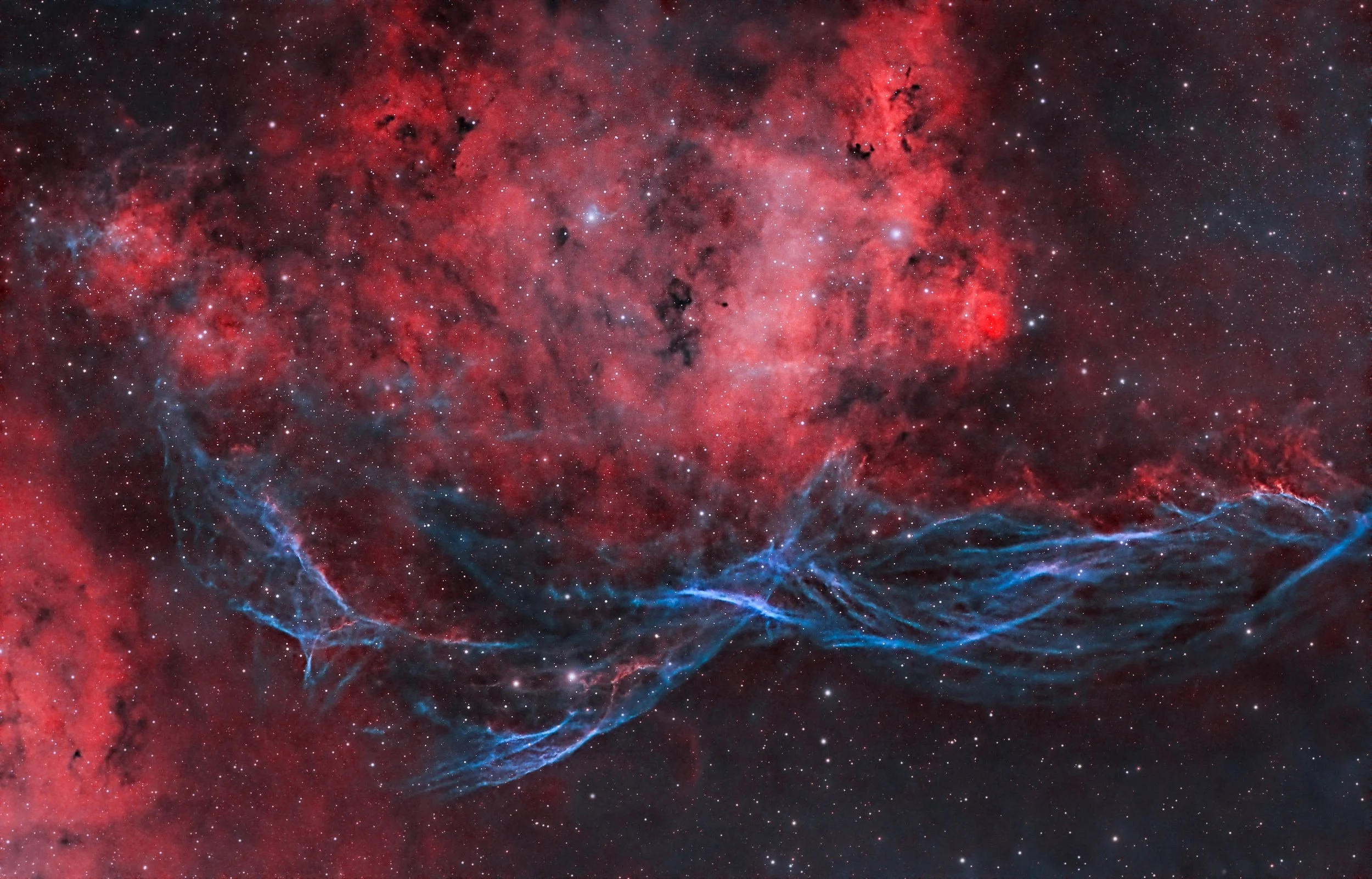
Gum 18/ Rcw 35
Gum 18, also known as RCW 35, is a stunning emission nebula located in the southern constellation of Vela. This cosmic cloud of gas and dust is illuminated by the intense radiation of hot, young stars nestled within its midst.
Stretching across the sky, Gum 18/Rcw 35 presents a captivating display of vivid colors, with its glowing hydrogen gas emitting a striking red hue against the backdrop of the surrounding interstellar medium.
As astronomers peer deeper into the heart of Gum 18/Rcw 35, they uncover the intricate processes of star formation occurring within its dense molecular clouds, offering insights into the birth and evolution of massive stars. This celestial gem serves as a testament to the dynamic forces shaping our galaxy and the awe-inspiring beauty of the cosmos.
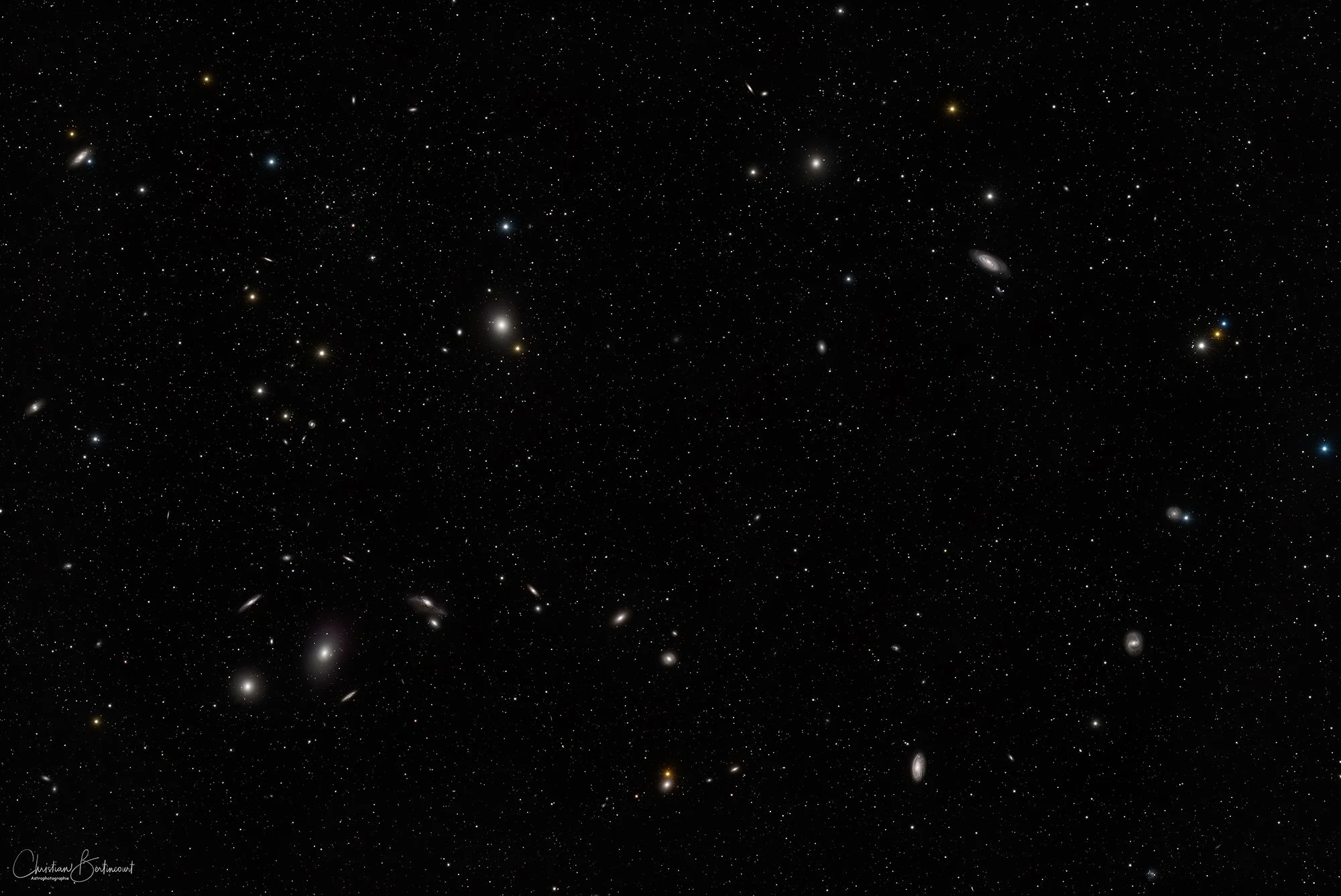
THE MARKARIAN CHAIN and its neighbors
The Markarian Chain, a striking alignment of galaxies, stretches across the cosmos like a celestial necklace adorning the night sky. Situated within the Virgo Cluster, this remarkable assembly of galaxies features prominent members such as M84, M86, and the giant elliptical galaxy M87.
Spanning over 3 degrees of space, the Markarian Chain is a testament to the gravitational dance of galaxies, with each member influenced by the gravitational pull of its neighbors. This intricate cosmic ballet offers astronomers a unique opportunity to study galaxy interactions, mergers, and the evolution of cosmic structures over billions of years.
The Markarian Chain and its neighboring galaxies stand as a captivating reminder of the vastness and complexity of the universe, inviting us to explore the mysteries of deep space and unravel the secrets of galactic evolution.
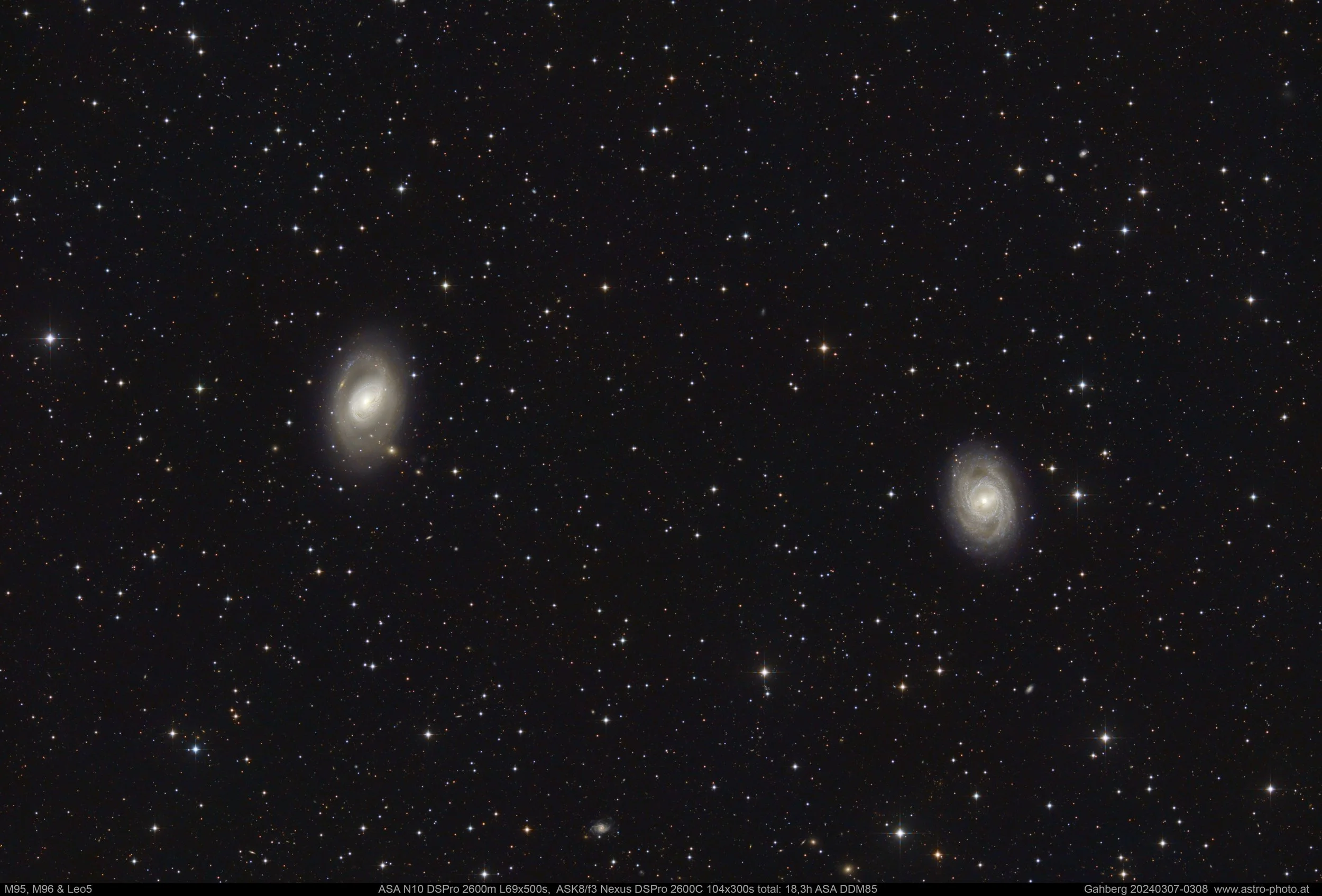
M95 & M96
In the constellation Leo, two majestic galaxies, M95 and M96, stand as celestial marvels awaiting discovery. M95, also known as NGC 3351, boasts a striking spiral structure adorned with regions of vibrant star formation. Meanwhile, M96, or NGC 3368, exhibits a similar spiral form, with spiral arms stretching gracefully from its bright core.
These galaxies reside approximately 38 and 31 million light-years away, respectively, and both belong to the Leo I galaxy group. Their intricate shapes and rich stellar populations provide astronomers with valuable insights into the dynamics of galactic evolution. Observing them in the night sky, one cannot help but marvel at the sheer scale and beauty of the cosmos.
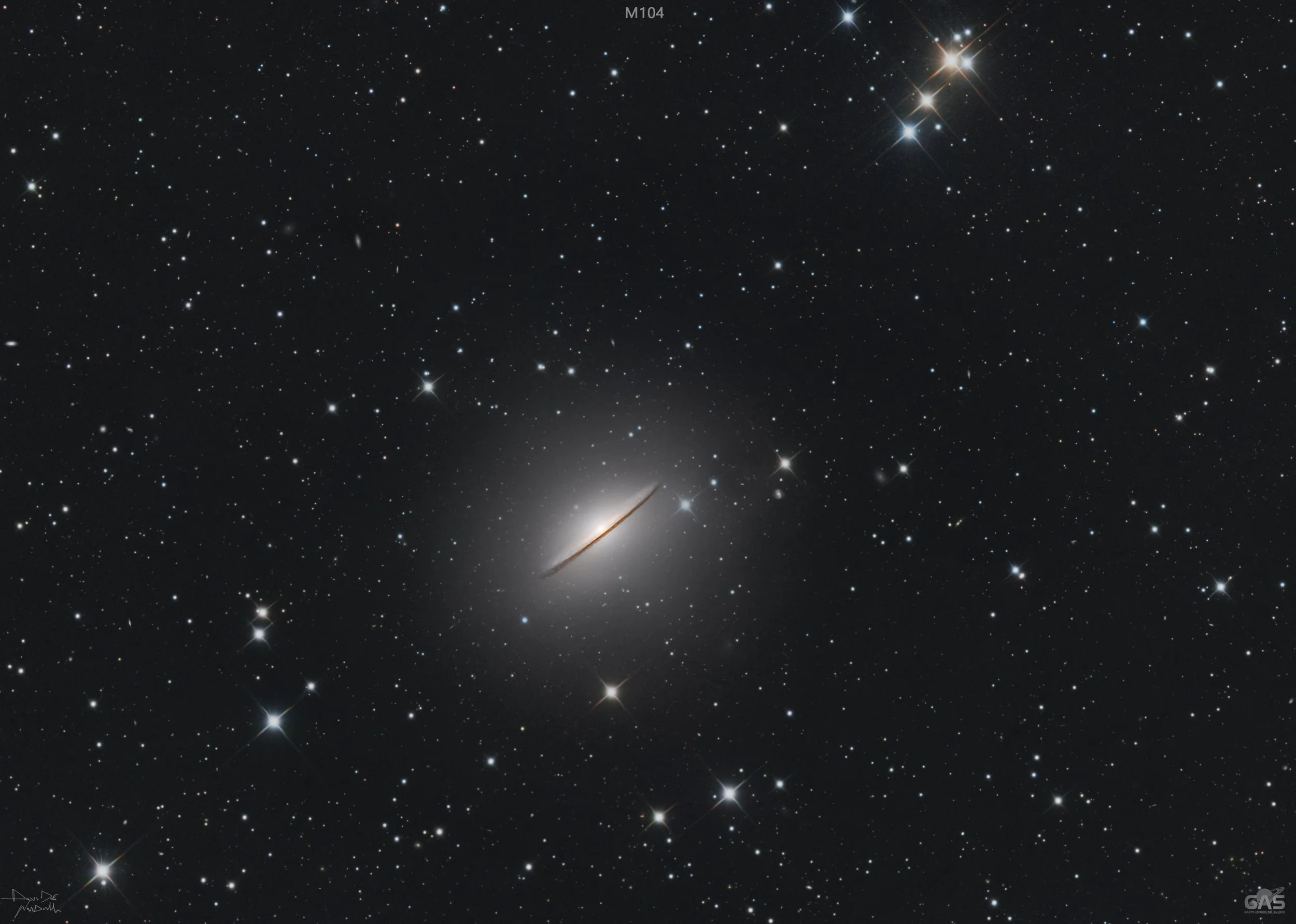
M104 Sombrero Galaxy widefield
In this wide-field image, the somber beauty of the Sombrero Galaxy, also known as Messier 104 (M104), graces the night sky. Situated in the constellation Virgo, this stunning spiral galaxy captivates with its prominent dust lane that wraps around its bulging core, resembling the brim of a wide-brimmed hat.
M104 lies approximately 28 million light-years away from Earth and harbors a supermassive black hole at its center. Its distinctive appearance and unique structure make it a fascinating subject for astronomers and astrophotographers alike. This image offers a glimpse into the vastness of our universe and serves as a testament to the intricate beauty found in the cosmos.

Badwater Salt Flats Milkyway Pano
The Badwater Salt Flats, located in Death Valley National Park, California, provide a stunning backdrop for capturing the Milky Way galaxy in all its splendor. In this panoramic image, the Milky Way stretches across the night sky, its billions of stars casting a soft glow over the surreal landscape of the salt flats. The still waters of the lake create a perfect mirror, reflecting the celestial spectacle above.
As one of the lowest points in North America, the Badwater Salt Flats offer unparalleled views of the night sky, free from light pollution and atmospheric disturbances. The Milky Way's intricate structure is on full display, with dark lanes of dust contrasting against the bright star clusters and nebulae. This image serves as a reminder of the beauty and majesty of the universe, captured in a single breathtaking panorama.

Messier 81 - Bode's galaxie in Ursa Major
M81, also known as Bode's Galaxy, is a striking spiral galaxy located in the constellation Ursa Major, approximately 11.8 million light-years away from Earth. It is one of the brightest galaxies visible in the night sky and is a prominent member of the M81 Group, a small galaxy group that includes several other galaxies.
What sets M81 apart is its remarkable appearance and structure. It features grand spiral arms filled with young, hot stars, interspersed with dark dust lanes and glowing regions of star formation. At its center lies a supermassive black hole with a mass equivalent to approximately 70 million times that of the Sun. M81 is also notable for its interaction with its smaller neighbor, M82, which has led to the distortion of M81's outer spiral arms.
Studying M81 provides astronomers with valuable insights into the processes of galaxy formation and evolution. Its proximity to Earth and its clear, detailed structure make it an ideal target for observational studies aimed at understanding the dynamics of spiral galaxies and the role of interactions and mergers in shaping their properties.
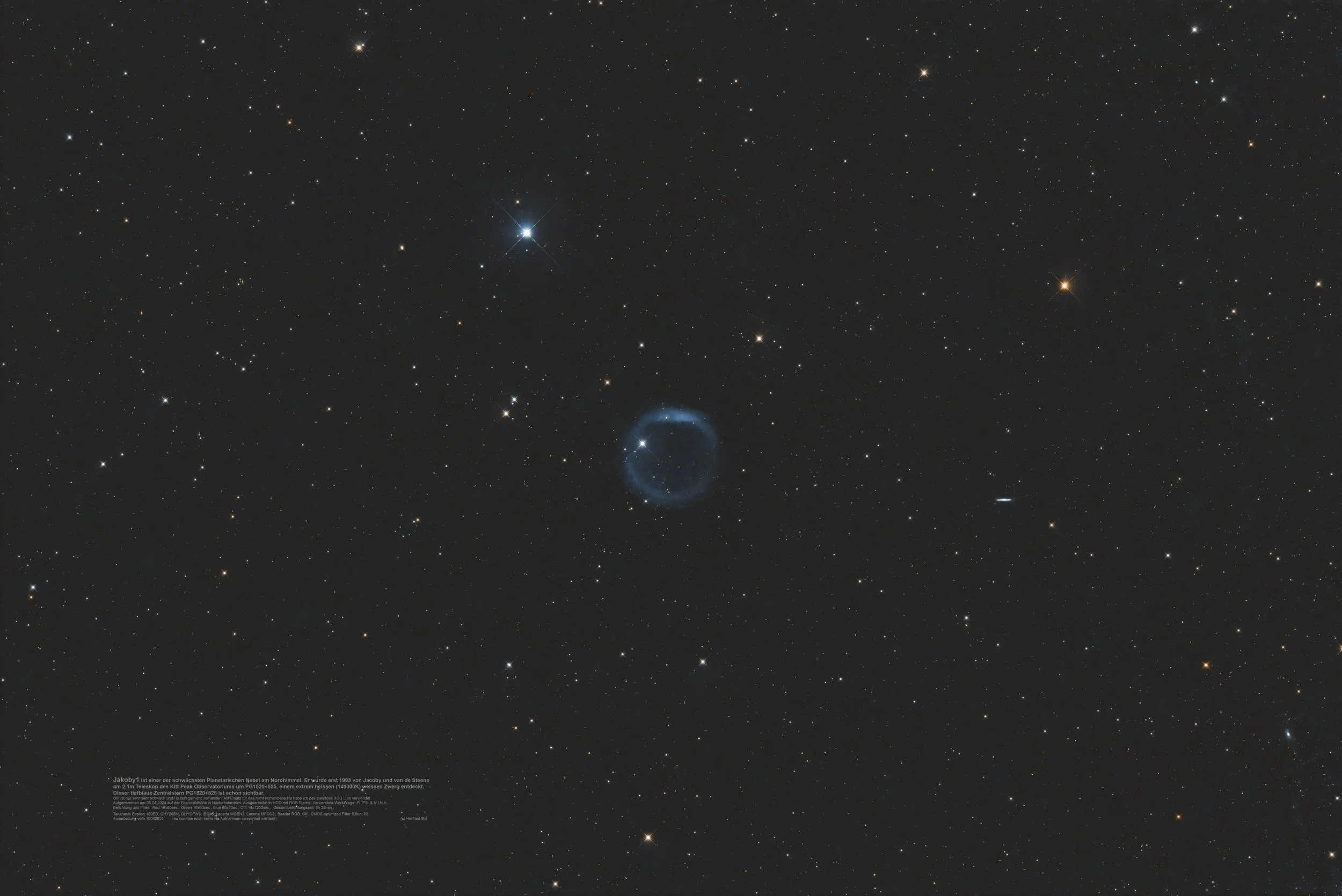
Jakoby1
Jakoby 1, also known as JaFu 1, is a young and enigmatic planetary nebula located in the constellation Pegasus. Discovered by amateur astronomer Rainer Sparenberg and named after his son, Jakob, it represents a fascinating and relatively rare class of celestial objects. Planetary nebulae are formed during the late stages of a star's life when it sheds its outer layers, creating a glowing shell of ionized gas surrounding a hot central star.
What makes Jakoby 1 particularly intriguing is its complex and asymmetric structure, which sets it apart from more symmetrically shaped planetary nebulae. This asymmetry hints at dynamic processes occurring within the nebula, such as interactions with the surrounding interstellar medium or the presence of binary companions shaping its morphology. Studying Jakoby 1 provides astronomers with valuable insights into the late evolutionary stages of low- to intermediate-mass stars and the mechanisms responsible for shaping the diverse array of planetary nebulae observed throughout the cosmos.
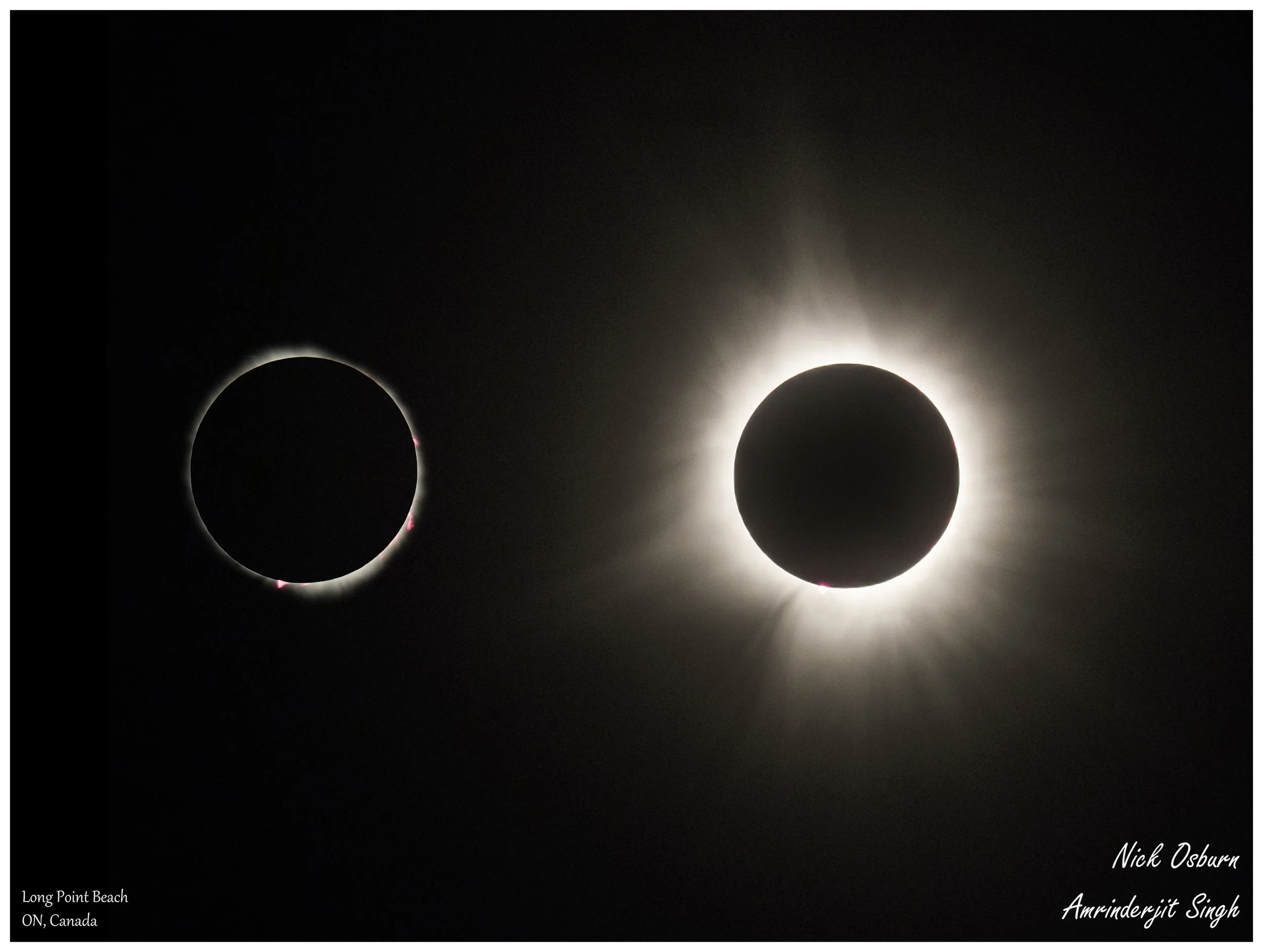
Moment of Totality - 8/April/2024
If the Moon were in a perfectly circular orbit and in the same orbital plane as Earth, there would be total solar eclipses once a month, at every new moon. Instead, because the Moon's orbit is tilted at about 5 degrees to Earth's orbit, its shadow usually misses Earth. Solar (and lunar) eclipses therefore happen only during eclipse seasons, resulting in at least two, and up to five, solar eclipses each year, no more than two of which can be total.
Total eclipses are rarer because they require a more precise alignment between the centers of the Sun and Moon, and because the Moon's apparent size in the sky is sometimes too small to fully cover the Sun.
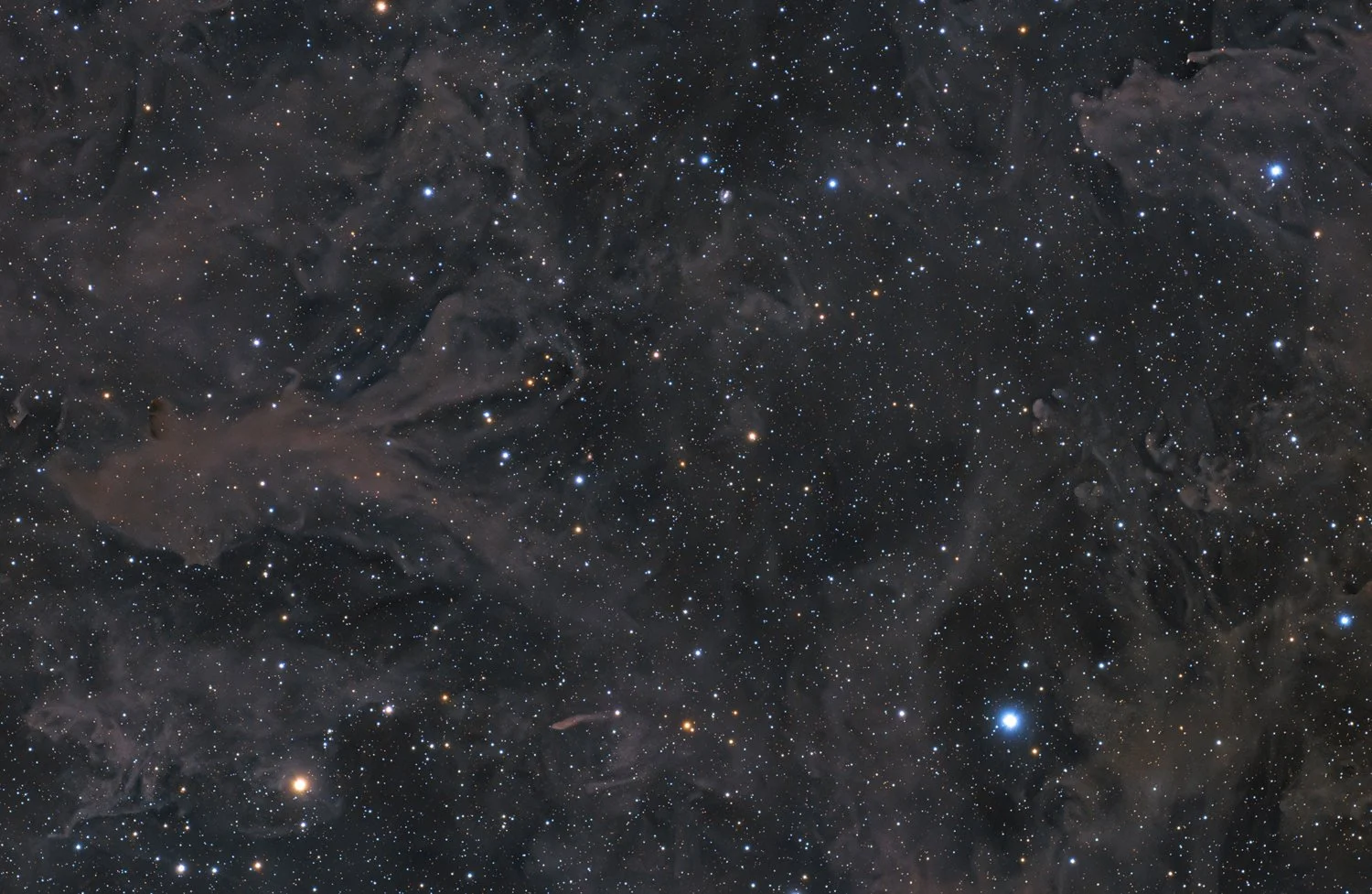
Integrated Flux Nebula
The Integrated Flux Nebula (IFN) is a subtle yet captivating phenomenon that stretches across the night sky, revealing itself as a faint glow in deep-sky astrophotography. Unlike traditional emission or reflection nebulae, the IFN does not emit its own light nor reflect light from nearby stars. Instead, it consists of dust particles scattering and reflecting the light of distant stars, giving rise to a diffuse luminosity that pervades large regions of space.
Named for its integrated flux of scattered starlight, the IFN is often found in regions with relatively low levels of interstellar dust, allowing the faint glow to become visible against the backdrop of the Milky Way. Its presence highlights the vast expanses of dust and gas that permeate our galaxy, serving as a testament to the intricate interplay between stars, dust, and the cosmic environment. Despite its elusive nature, the IFN offers astronomers valuable insights into the distribution of interstellar material and the dynamics of starlight scattering throughout the Milky Way.
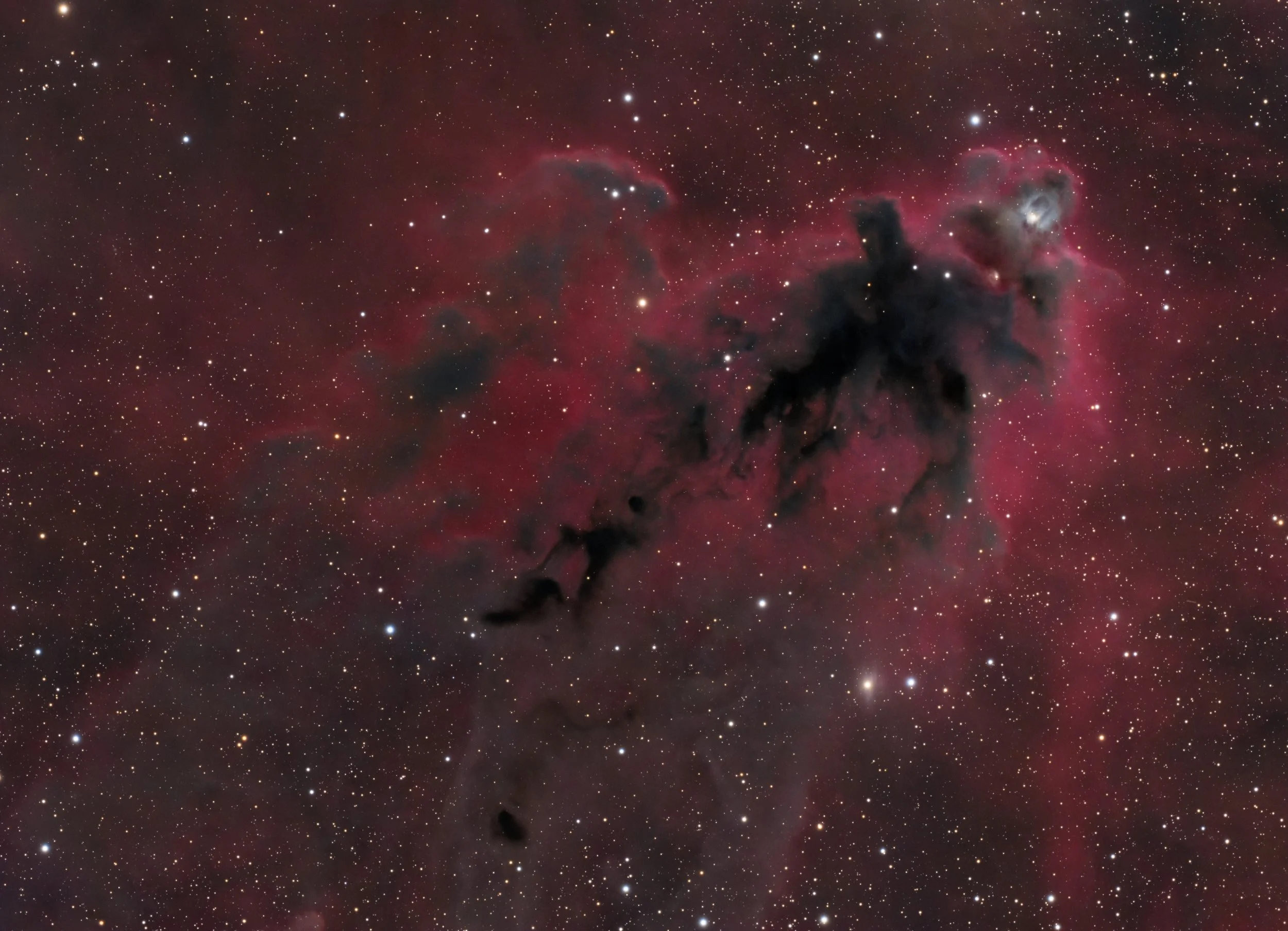
LDN 1622 (Bogeyman Nebula) HaLRGB
LDN 1622, famously dubbed the Bogeyman Nebula, presents a captivating celestial spectacle nestled within the constellation Orion. This dark nebula, shrouded in cosmic dust and gas, creates a mysterious and eerie silhouette against the backdrop of the Milky Way. Resembling the mythical figure of the Bogeyman, it evokes a sense of intrigue and wonder among stargazers and astronomers.
Photographed in a combination of hydrogen-alpha (Ha) and RGB filters, this image reveals the intricate details of LDN 1622's structure and surroundings. The HaLRGB composition captures the interplay between light and shadow, showcasing the subtle glow of ionized hydrogen gas amidst the dark tendrils of dust. Such intricate features offer valuable insights into the processes of star formation and interstellar matter within this enigmatic region of space.
Studying LDN 1622 provides astronomers with a window into the complex dynamics of molecular clouds and the birth of new stars. By unraveling the mysteries of this cosmic bogeyman, scientists deepen their understanding of the fundamental processes shaping the evolution of galaxies and the universe at large.

The Southern Pinwheel Galaxy (M83)
The Southern Pinwheel Galaxy, also known as Messier 83 or M83, is a striking barred spiral galaxy located in the constellation Hydra. Situated approximately 15 million light-years away from Earth, M83 is one of the closest and brightest spiral galaxies visible from the Southern Hemisphere. Its distinctive spiral arms, adorned with bright clusters of young stars and nebulae, make it a captivating subject for astronomers and astrophotographers alike.
M83 is a hotbed of stellar activity, with ongoing star formation occurring within its spiral arms. It is home to numerous star clusters, nebulae, and regions of intense starbirth, indicating a vigorous cycle of stellar birth and death. Studying M83 provides astronomers with valuable insights into the processes driving galaxy evolution and the formation of stars. Additionally, M83 has been the site of several supernova explosions, further adding to its allure for astronomers seeking to understand the life cycles of stars and galaxies.
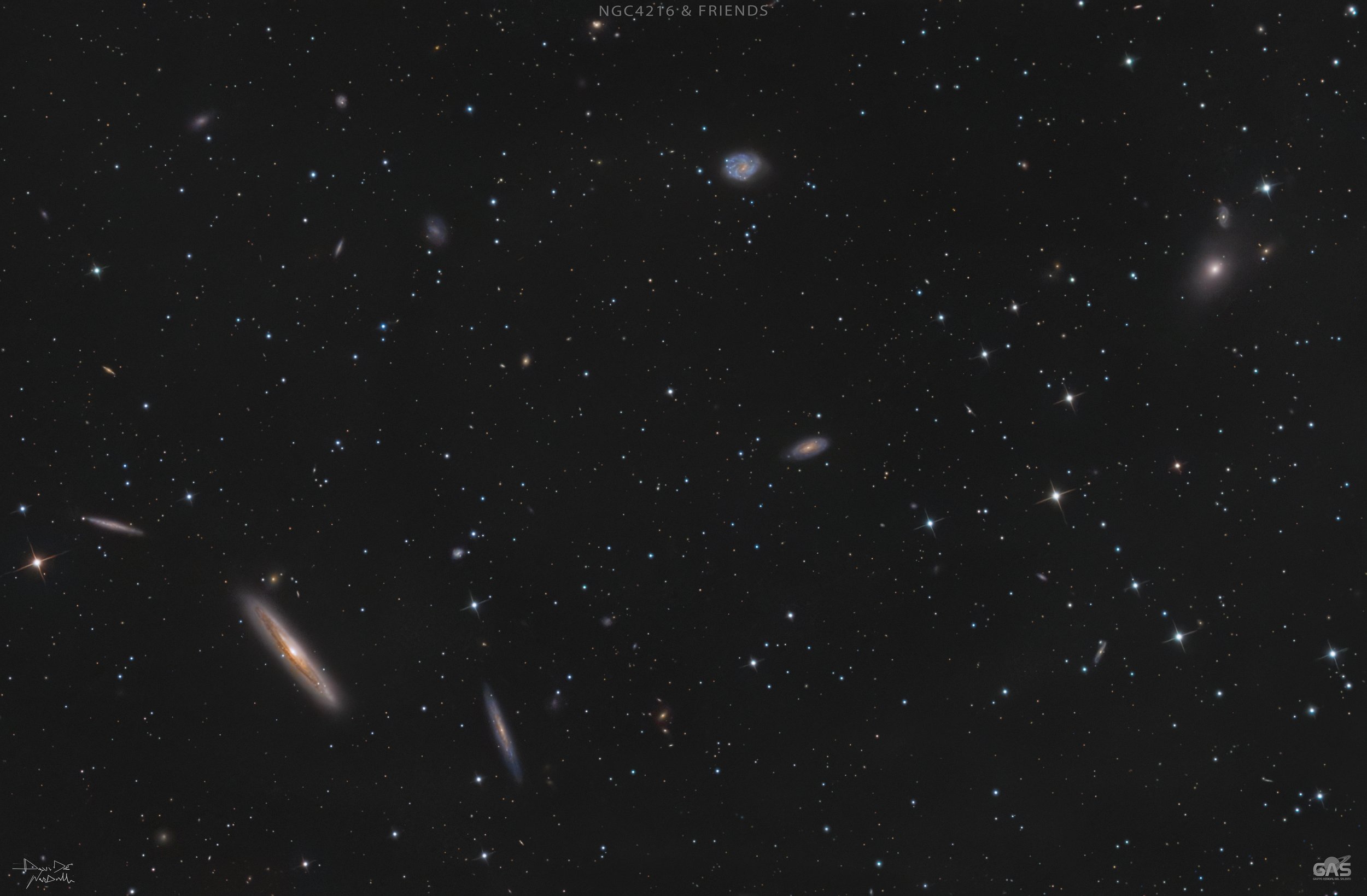
NGC 4216 and Friends
NGC 4216, nestled within the constellation of Virgo, is a beautiful barred spiral galaxy situated about 40 million light-years away from Earth. It is part of the vast Virgo Cluster, a rich gathering of galaxies bound together by gravity. In this cosmic neighborhood, NGC 4216 is not alone; it shares its celestial surroundings with a host of neighboring galaxies, forming a captivating ensemble of cosmic companions.
Among its companions are several other galaxies, each with its own unique features and characteristics. These celestial neighbors contribute to the rich tapestry of the Virgo Cluster, offering astronomers valuable opportunities to study the dynamics and interactions within this galactic community. By observing NGC 4216 and its companions, scientists can unravel the complex processes shaping the evolution of galaxies and gain deeper insights into the vast cosmic web of which we are a part.
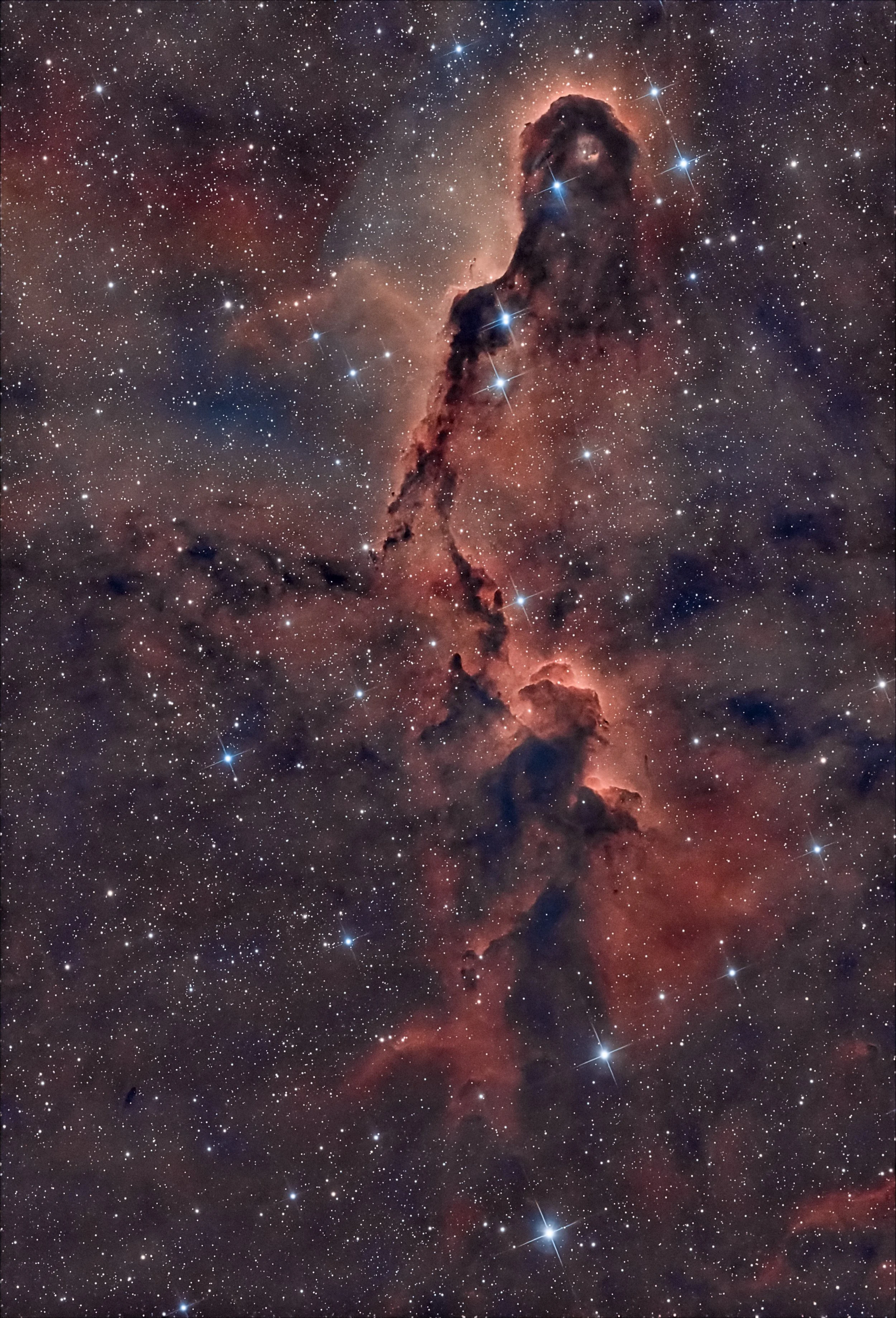
Trunk Nebula
The Trunk Nebula, formally known as IC 1396A, is a striking emission nebula located within the larger star-forming region IC 1396 in the constellation of Cepheus. Aptly named for its resemblance to an elephant's trunk, this nebula exhibits a distinctive elongated shape with a dark, winding lane of dust and gas. At its tip lies a cluster of young, massive stars that illuminate the surrounding nebular material, causing it to glow with vivid colors.
IC 1396A offers astronomers a fascinating glimpse into the processes of star birth and evolution. Within its dense clouds of gas and dust, new stars are forming, surrounded by glowing regions of ionized hydrogen. These stellar nurseries provide valuable insights into the mechanisms driving star formation and the dynamics of interstellar matter. Additionally, the Trunk Nebula serves as a captivating example of the intricate structures found throughout the cosmos, inspiring wonder and curiosity about the mysteries of the universe.