

AAPOD2 Image Archives
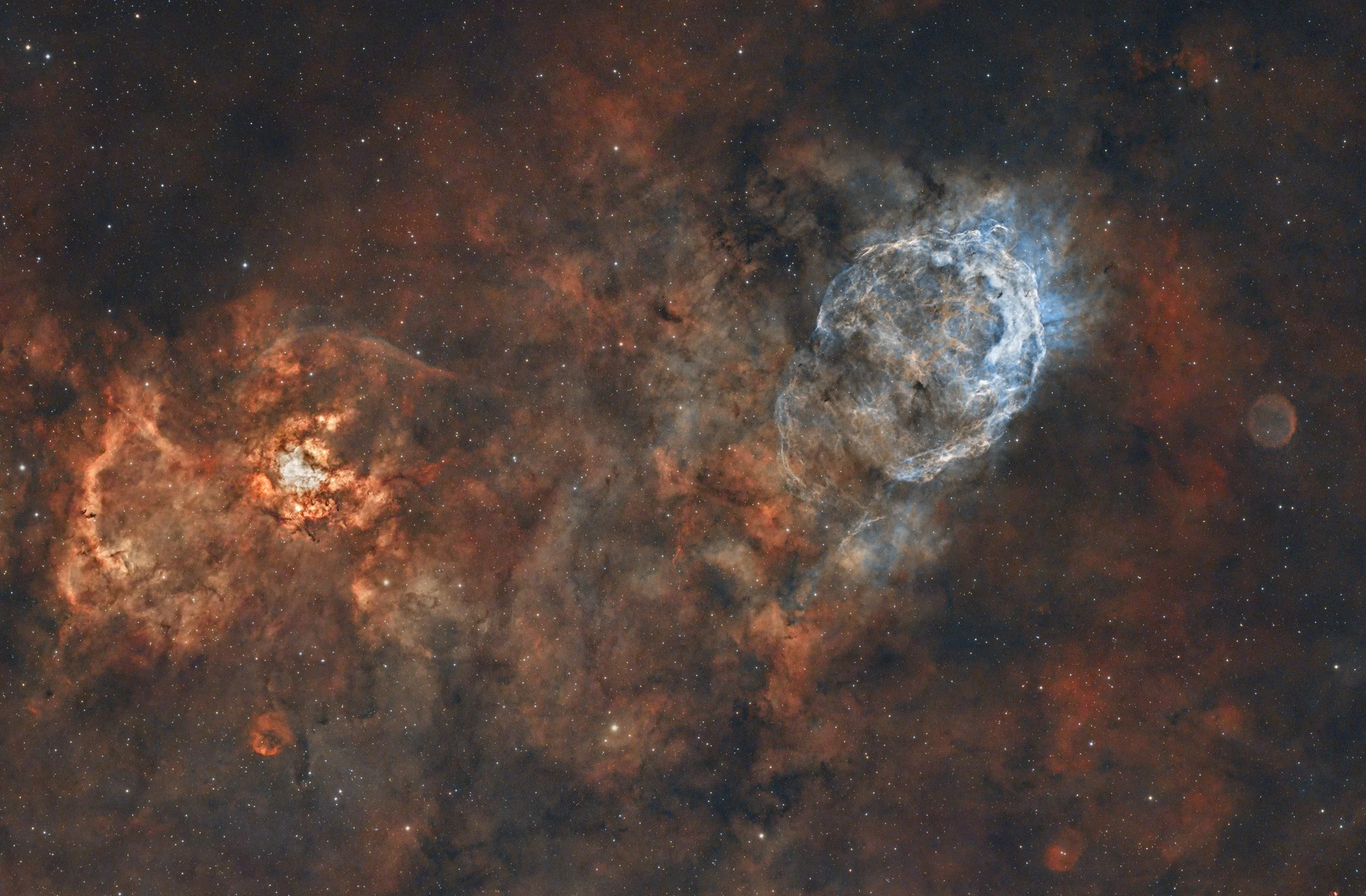
NGC 3199 – The Banana Nebula in Carina
Curving gracefully through the southern constellation of Carina, NGC 3199, often called the Banana Nebula—glows amid a sea of interstellar dust and gas. This wind-blown bubble of ionized gas surrounds a massive Wolf–Rayet star, whose fierce stellar winds carve and illuminate the nebula’s distinctive arc. Nearby, the faint planetary nebula PK 283 lies quietly within the same field, adding to the region’s rich tapestry of emission and reflection.
Captured under the pristine Kalahari skies of Namibia, this image was taken with a Takahashi FSQ-106 astrograph and an ASI 2600MC camera paired with an Optolong L-Ultimate filter. The final result, composed of thirty 420-second exposures, reveals both the vivid structure of NGC 3199 and the subtle background clouds where new stars are forming.
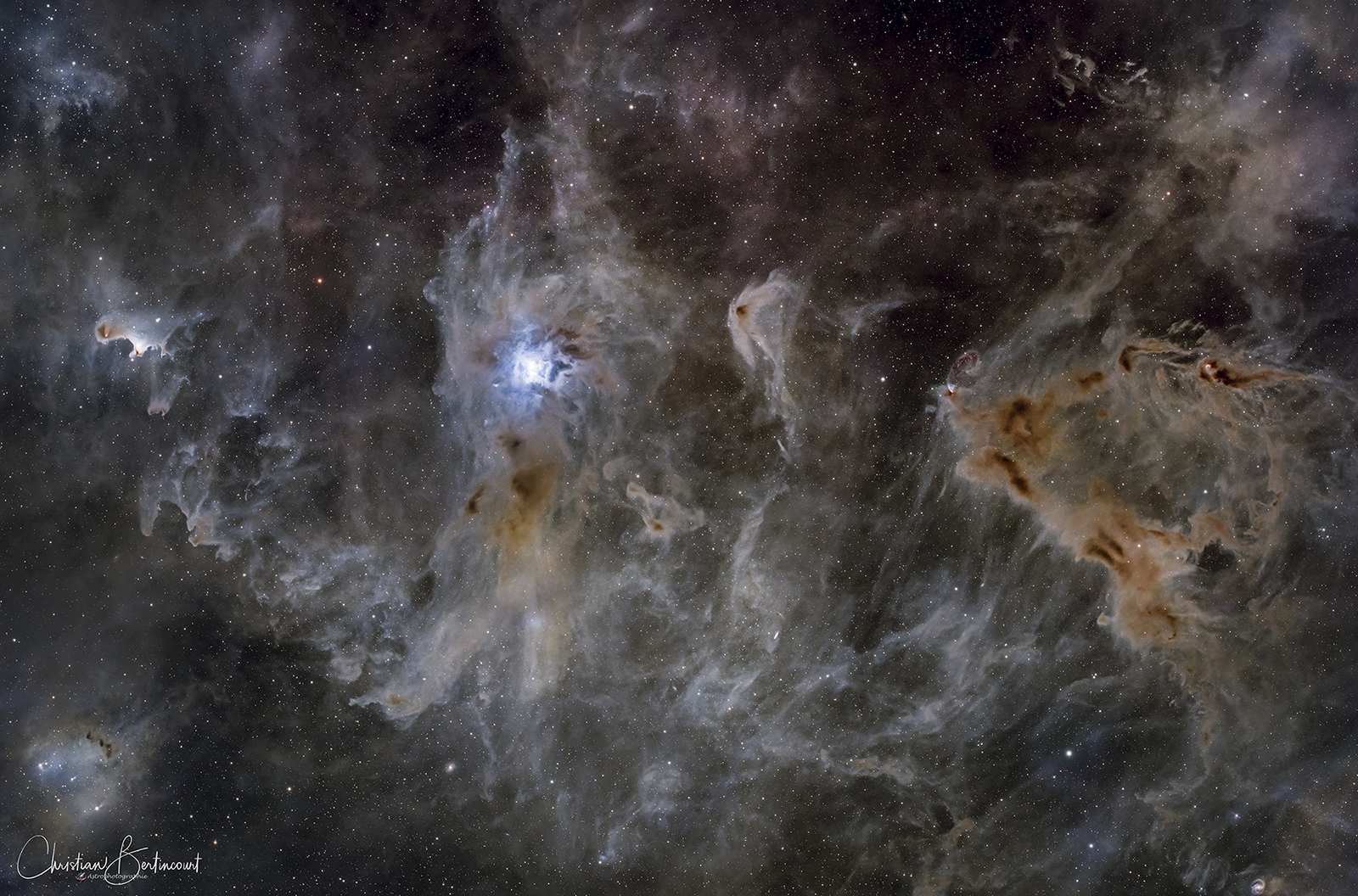
NGC 7023, the Iris Nebula
Iris Nebula and the Ghostly IFN
Among wisps of interstellar dust, the Iris Nebula (NGC 7023) blooms like a pale flower reflecting the light of its central star. Surrounding it is a vast network of faint, ghost-like clouds, integrated flux nebulae (IFN) that float above the plane of our Milky Way. These ethereal structures are made of fine cosmic dust reflecting the combined glow of the galaxy itself.
Captured with over 20 hours of total exposure, this deep image reveals the full extent of the faint IFN wrapping around the Iris. The delicate interplay of blue reflection and sepia dust gives the scene an almost haunting presence, as if the cosmos itself were cloaked in mist.
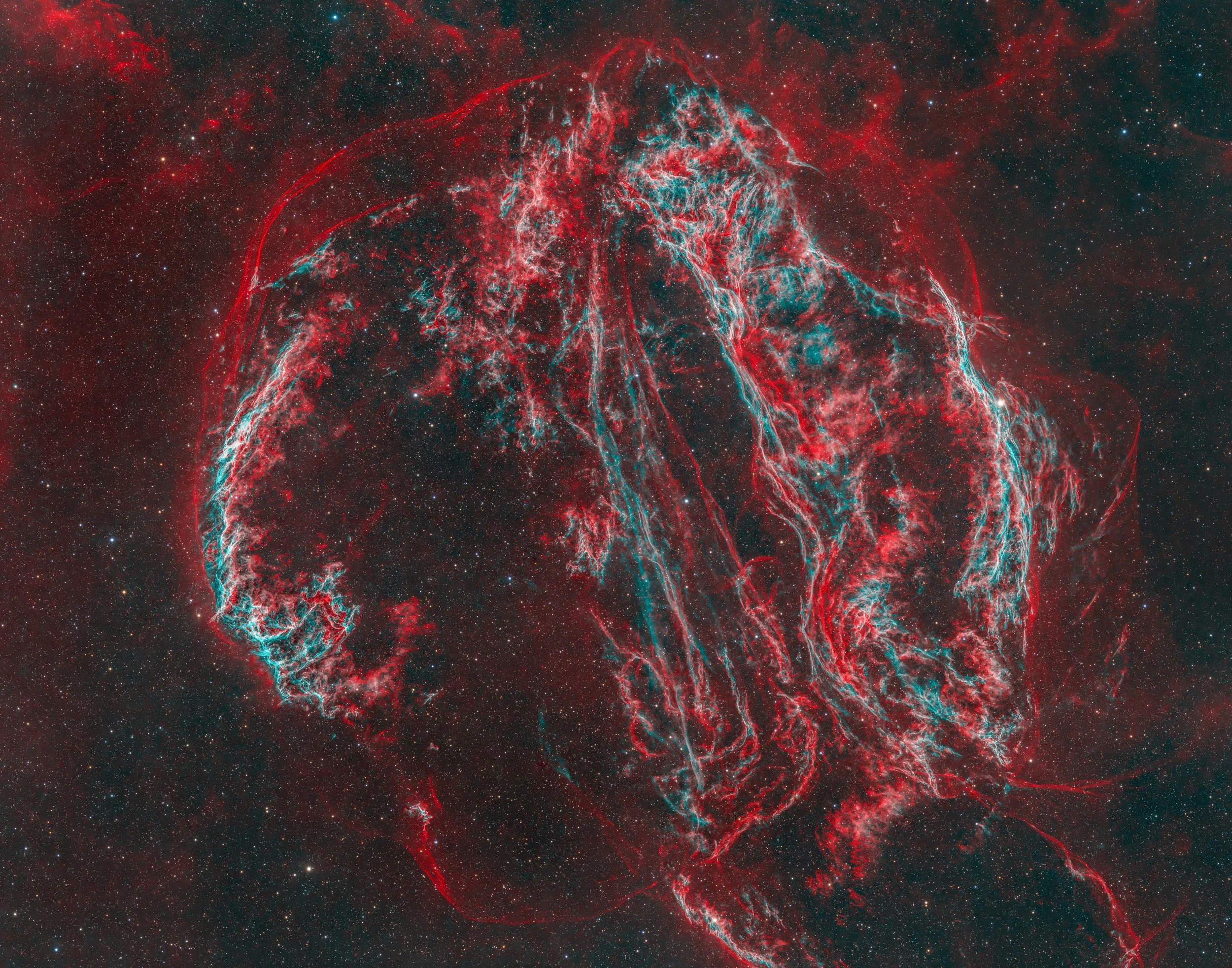
Veil Nebula in HOO
Like a cosmic ghost drifting through Cygnus, the Veil Nebula’s tangled filaments glow eerily in red and teal light—remnants of a massive star that met its end about 10,000 years ago. The nebula’s delicate structure traces the expanding shock waves from that ancient supernova, its wispy forms resembling torn veils or spectral smoke.
Captured under Bortle 7 skies, this two-panel mosaic spans over 25 hours of integration in HOO narrowband. The contrasting hydrogen and oxygen emissions lend the scene an otherworldly, almost haunted glow—perfect for Halloween night, when even the cosmos seems to wear a ghostly disguise.

The Andromeda Galaxy (M31) in HOO+RGB
Our neighboring spiral, the Andromeda Galaxy (M31), lies about 2.5 million light-years away and dominates this detailed composite image. Captured over seven clear nights in September for a total of more than 27 hours of exposure, the frame combines HOO and RGB data to reveal the galaxy’s structure in striking color. The rich red knots scattered along the spiral arms mark vast H II regions—nebulae of ionized hydrogen where new stars are forming. Dust lanes and bluish star clusters trace Andromeda’s immense disk, while its small companion M110 glows below.
Andromeda is the largest member of the Local Group and is moving toward the Milky Way at over 100 km per second. In roughly four billion years, the two galaxies are expected to merge into a single giant elliptical system. This image, blending natural color with narrowband enhancement, highlights both the galaxy’s familiar beauty and its dynamic role in the ongoing evolution of our galactic neighborhood.
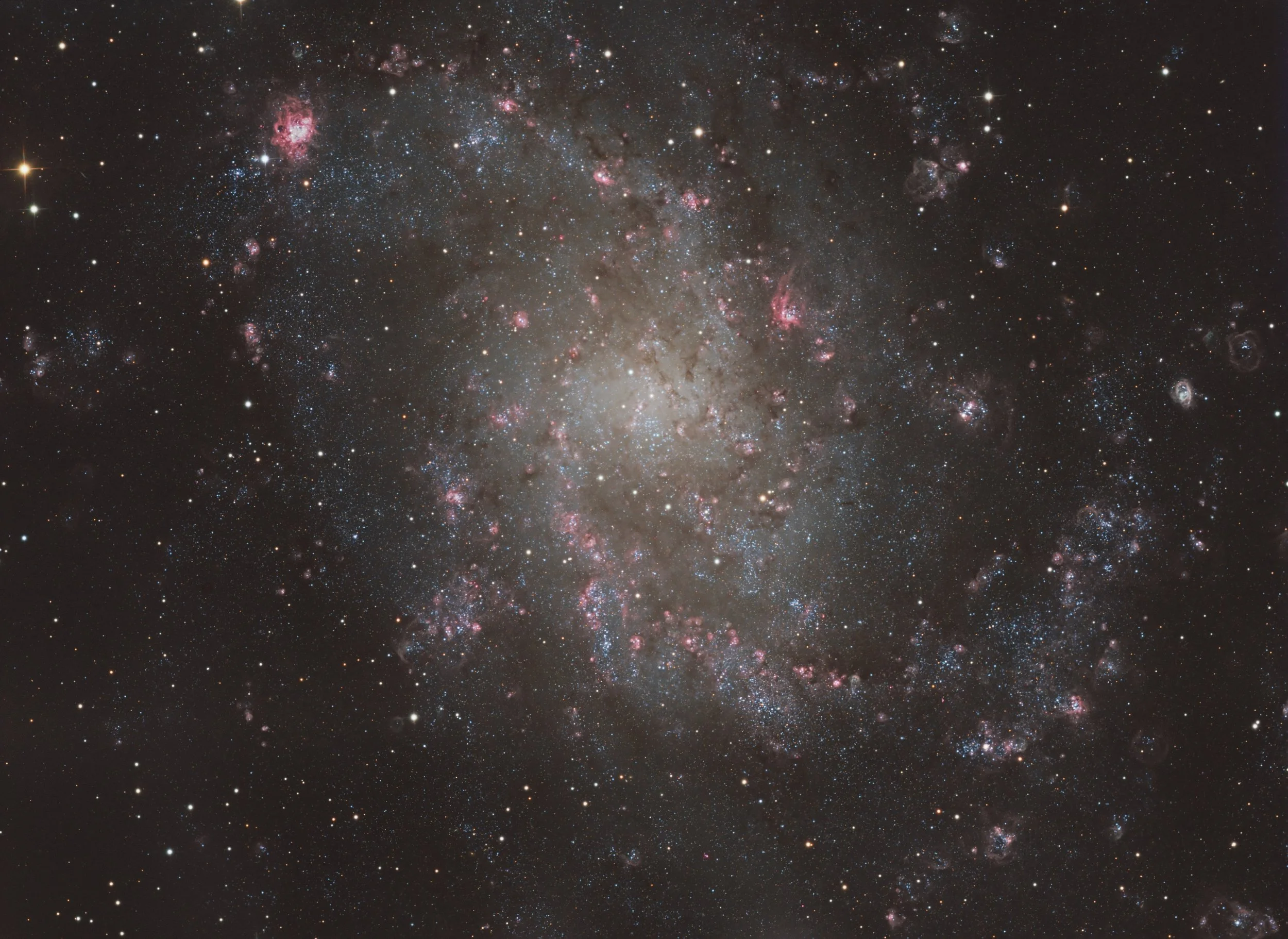
The Triangulum Galaxy (M33) from Fregenal de la Sierra, Spain
Captured under the dark skies of Fregenal de la Sierra, Spain, this deep exposure reveals the Triangulum Galaxy (M33) in remarkable detail. At a distance of about 2.7 million light-years, M33 is the third-largest member of the Local Group after Andromeda and the Milky Way. The image shows its loosely wound spiral arms traced by glowing H II regions, blue star-forming clusters, and intricate dust lanes extending from the bright core. The subtle pinkish patches mark vast clouds of ionized hydrogen where new stars are being born.
Using a 20-inch Ritchey-Chrétien telescope, a total of 21 hours and 40 minutes of LRGB and Hα data were gathered through 10-minute guided exposures. This long integration highlights the galaxy’s faint outer arms and extended halo structure, bringing out M33’s complex web of emission nebulae and delicate color gradients. The result offers a vivid portrait of one of the nearest and most photogenic spiral galaxies beyond our own.
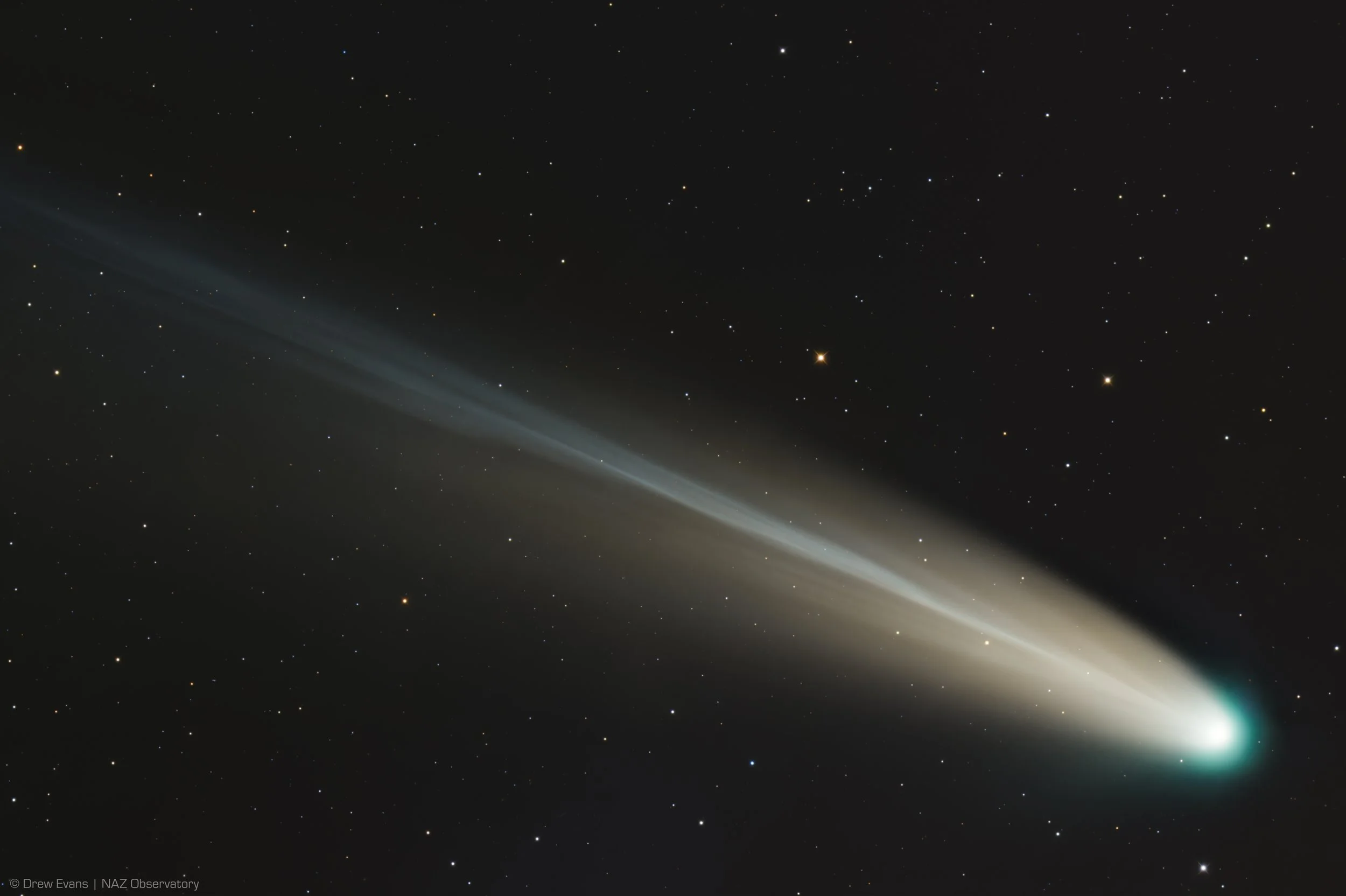
Comet C/2025 A6 (Lemmon) from Flagstaff, Arizona
Gliding through the faint star fields of Serpens Cauda, Comet C/2025 A6 (Lemmon) displays its soft green glow as it approaches its November 2025 perihelion. The color results from diatomic carbon fluorescing in sunlight, while a pale dust tail streams away from the nucleus. Captured under the crisp, dark skies of Flagstaff, Arizona, this image reveals the comet as it drifts among the distant stars of Serpens, a subtle reminder of the dynamic nature of our Solar System.
A long-period comet originating in the Oort Cloud, C/2025 A6 (Lemmon) circles the Sun roughly every 1,350 years. Around this date it lay about 0.6 AU from Earth and 0.53 AU from the Sun, shining near 5th magnitude, visible through binoculars to northern observers after dusk. As it continues toward perihelion, its tail and coma are expected to brighten and lengthen, providing a rewarding target for wide-field imaging through early November.
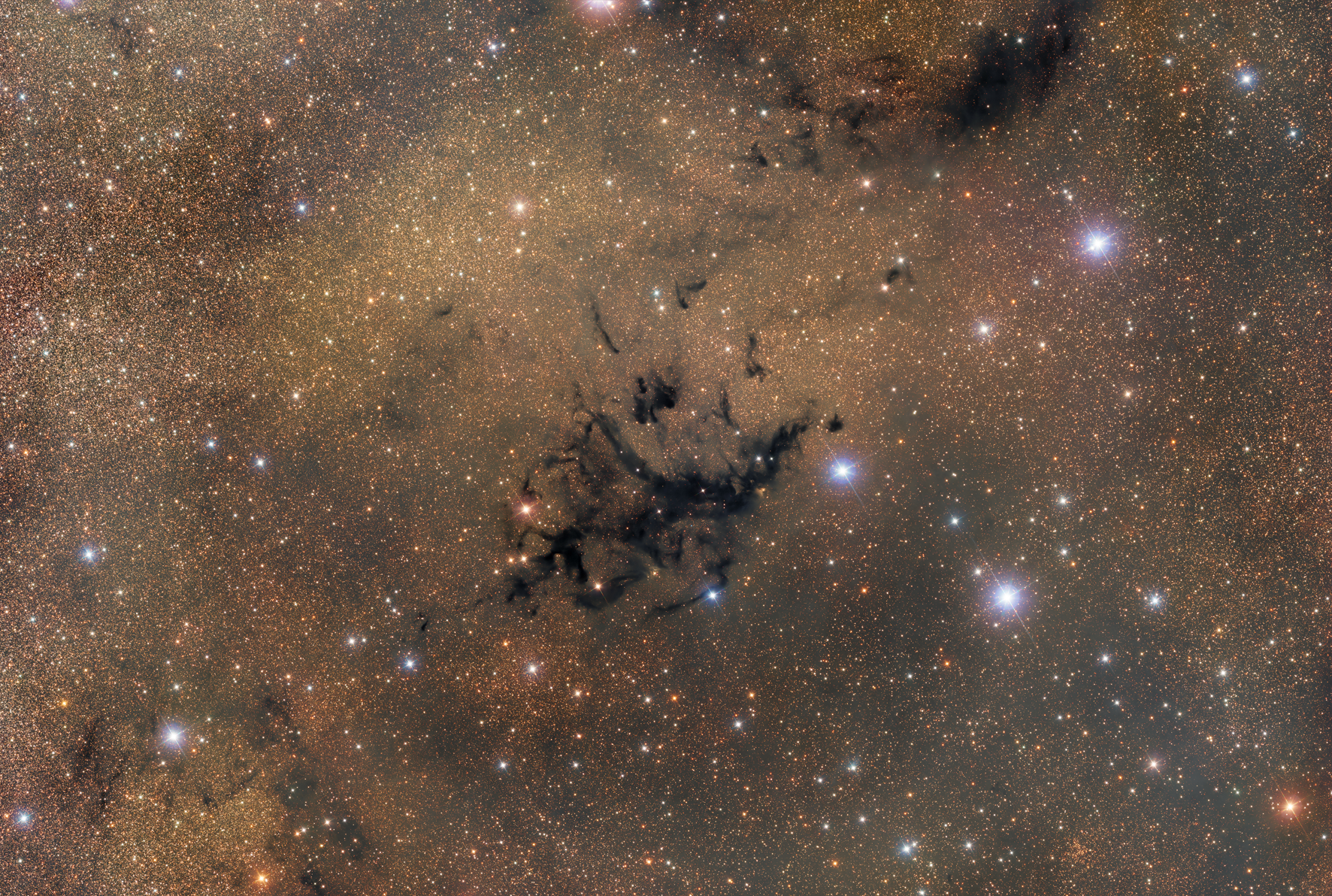
The Dark Clouds of LDN 673
Drifting among the glittering star fields of the Milky Way in Aquila, the dark nebula LDN 673 forms a striking contrast against the golden background of countless distant suns. This dense region of interstellar dust blocks visible starlight, revealing complex, filamentary shapes where gravity is slowly gathering gas into the seeds of future stars.
Captured over 20 hours of RGB integration from a backyard observatory in Eastern Oregon under Bortle 4 skies, this image highlights both the subtle color gradients of the surrounding galactic plane and the haunting opacity of the dark nebula itself. LDN 673 stands as a reminder that even the darkest regions of the night sky are places of quiet creation, silhouetted against the glow of the Milky Way.
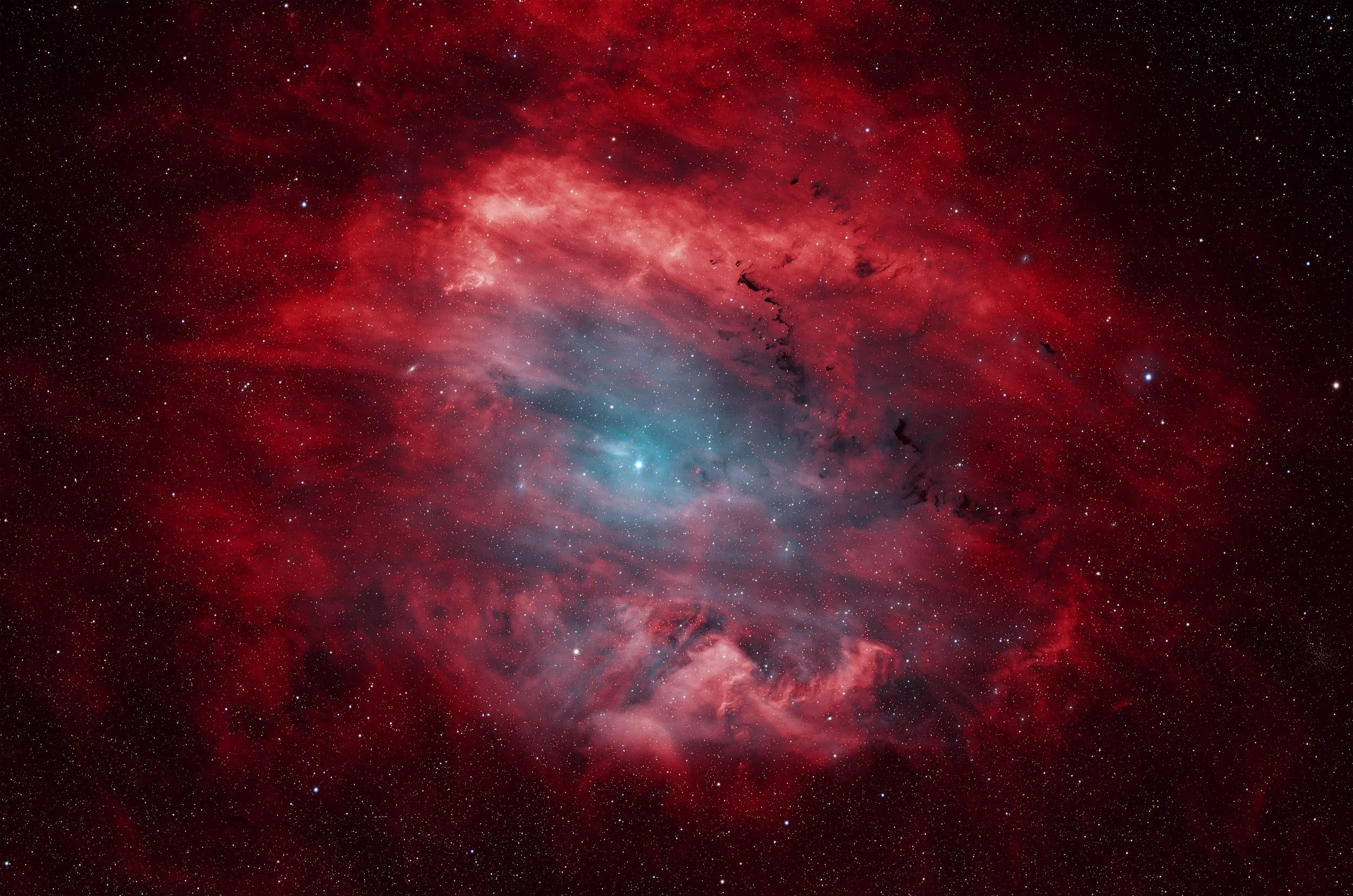
The Clamshell Nebula — Sh2-119 in Cygnus
The Clamshell Nebula (Sh2-119) lies just east of the famous North America Nebula in the constellation Cygnus. Stretching across roughly four degrees of sky, this vast emission region glows in the light of ionized hydrogen and oxygen excited by the hot O-type star 68 Cygni. Intricate waves of gas and dust sculpt the nebula’s shell-like structure, giving rise to its evocative nickname.
This deep 68-hour exposure, captured through a dual narrowband filter, reveals the delicate interplay between hydrogen’s crimson glow and the cooler blue tones of doubly ionized oxygen. The Clamshell’s layered filaments trace the complex feedback between massive stars and the surrounding interstellar medium, a vivid portrait of how stellar radiation shapes the Milky Way’s bright heart.
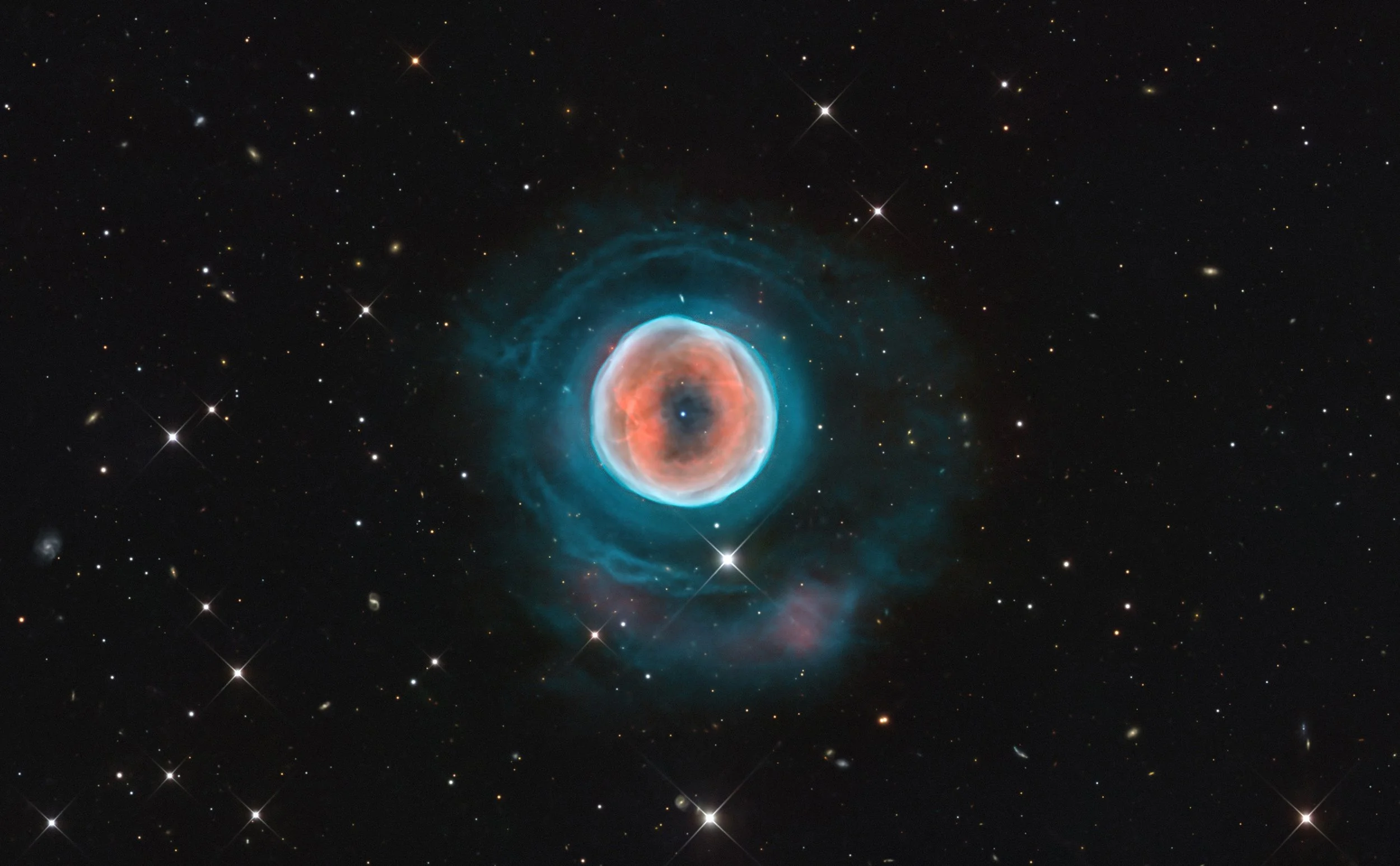
The Helix in the Peacock — Planetary Nebula IC 5148
IC 5148, often called the “Helix in the Peacock,” is a bright planetary nebula about 3,000 light-years away in the constellation Grus. It represents the final, graceful stage of a Sun-like star’s evolution as it sheds its outer layers into space. The nebula spans nearly two light-years and expands rapidly through the surrounding interstellar medium, creating a spherical shell of glowing gas illuminated by its hot central white dwarf.
Special processing that reveals only the excess H-alpha emission highlights delicate inner structures nested within the dominant OIII glow. This technique unveils the complex interplay of ionized gases shaped by stellar winds and radiation. The result is a strikingly detailed portrait of a dying star enriching its cosmic neighborhood with the elements that will seed future generations of stars and planets.
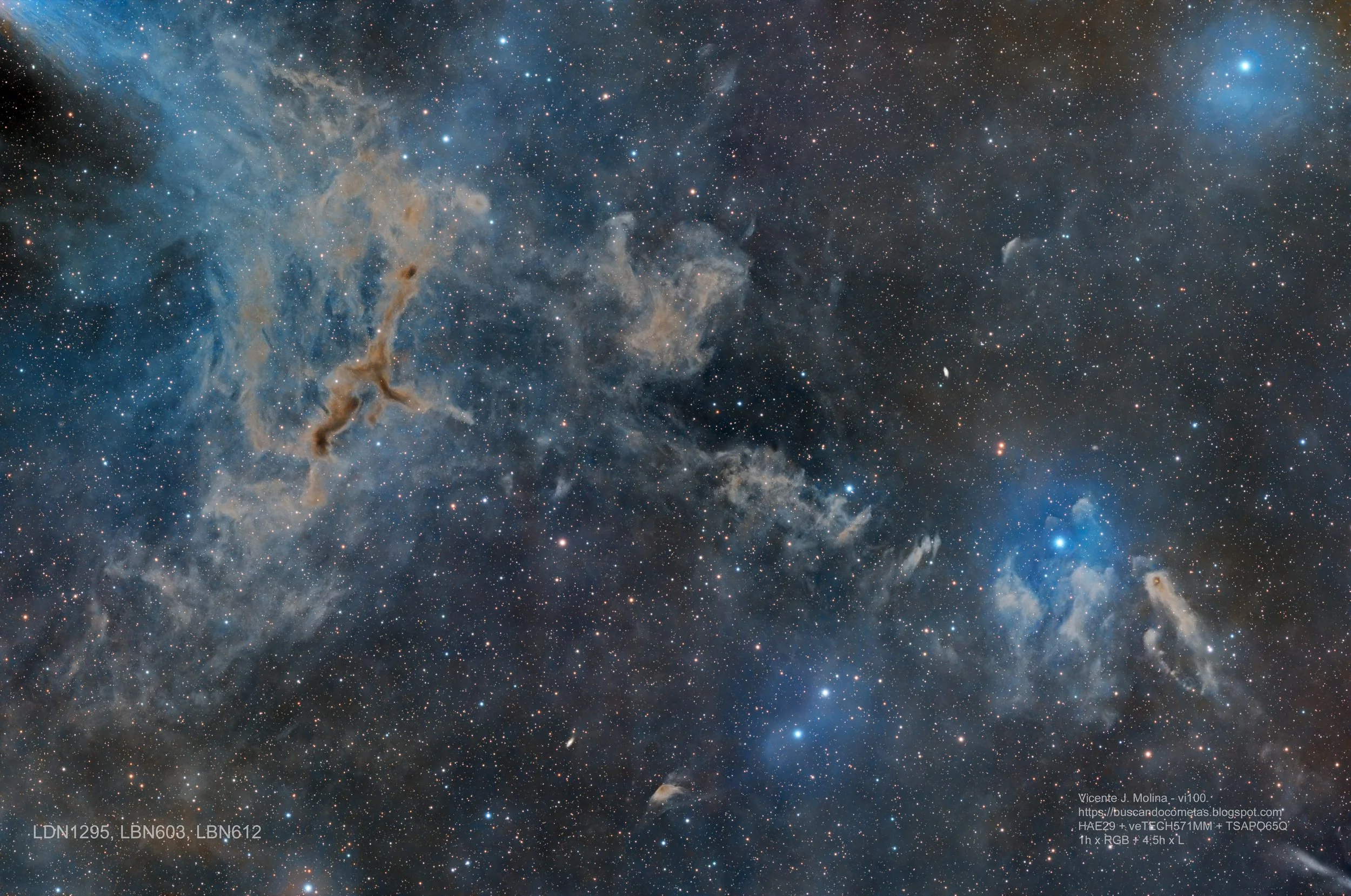
The Giraffe Nebula — LDN 1295 in Camelopardalis
Amid the quiet reaches of the constellation Camelopardalis lies the dark nebula LDN 1295, part of a vast network of molecular clouds often called the Giraffe Nebula. Intertwined with reflection nebulae LBN 603 and LBN 612, this dusty region stretches over several light-years, sculpted by faint starlight and the slow collapse of dense gas. The delicate filaments and dark tendrils of dust obscure the background stars, hinting at the hidden process of star formation within.
This deep exposure reveals the subtle interplay between dark and reflective clouds, the brown lanes of cold dust contrasting with the faint blue light scattered by nearby young stars. Located in one of the most remote and least studied regions of the northern Milky Way, the Giraffe Nebula stands as a quiet but beautiful reminder that even the darkest parts of the sky are alive with creation.
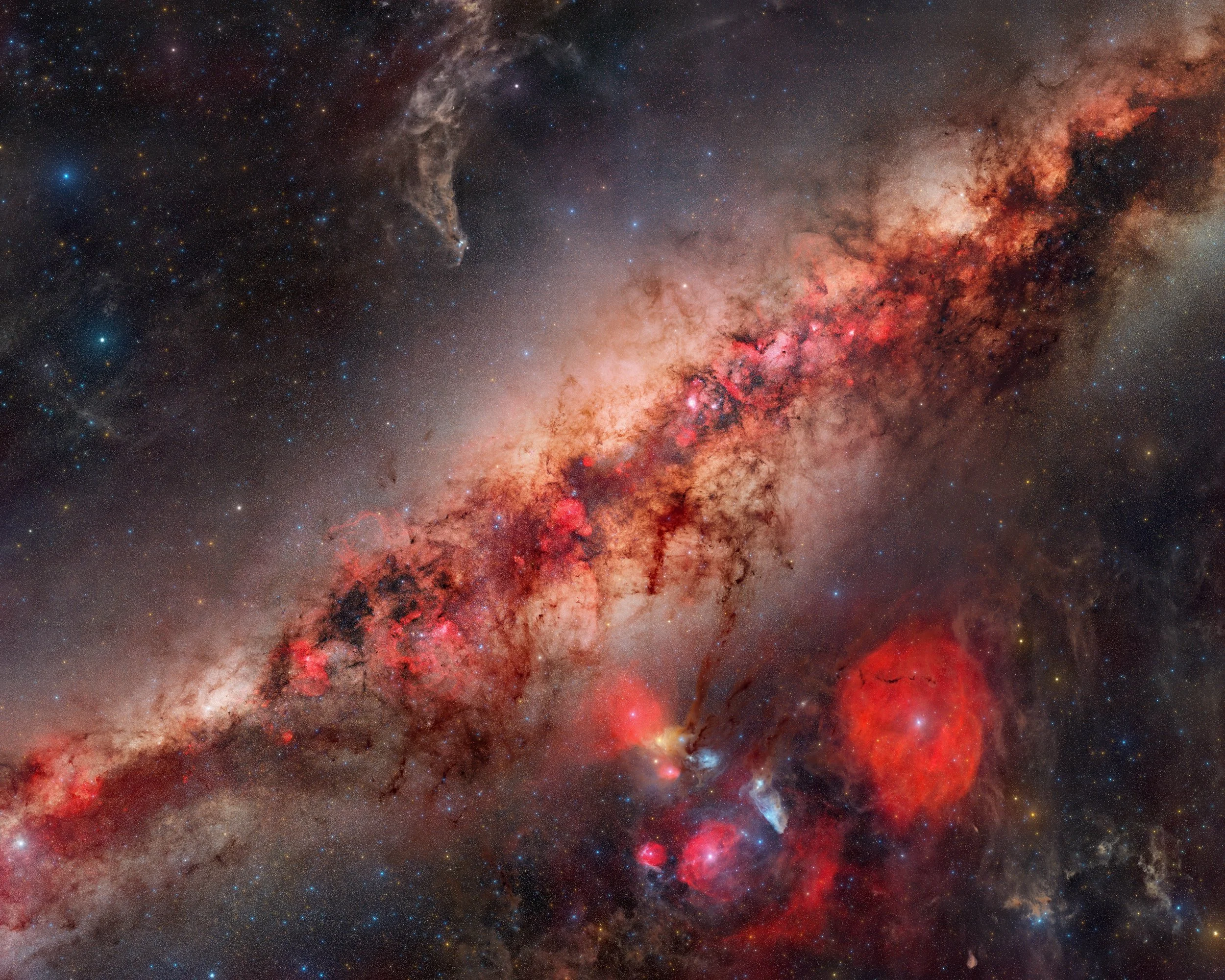
A deep look at the Milky Way Core HaRGB Mosaic
A breathtaking high-resolution mosaic reveals the glowing heart of our galaxy, the Milky Way. Captured through a 135mm HaRGB setup, the image highlights a complex web of ionized hydrogen gas (shown in red), dark dust lanes, and star-forming regions. The galactic core, rich in emission nebulae and dense molecular clouds, sits shrouded in interstellar dust that obscures visible light but glows brilliantly in this composite view.
Stretching across the field, the image captures the interplay between dark and luminous regions, offering a sense of the immense scale and structure of the Milky Way’s inner spiral arms. This deep and carefully assembled mosaic brings the hidden beauty of the galactic center into sharp focus, revealing both the chaos and order at the core of our home galaxy.
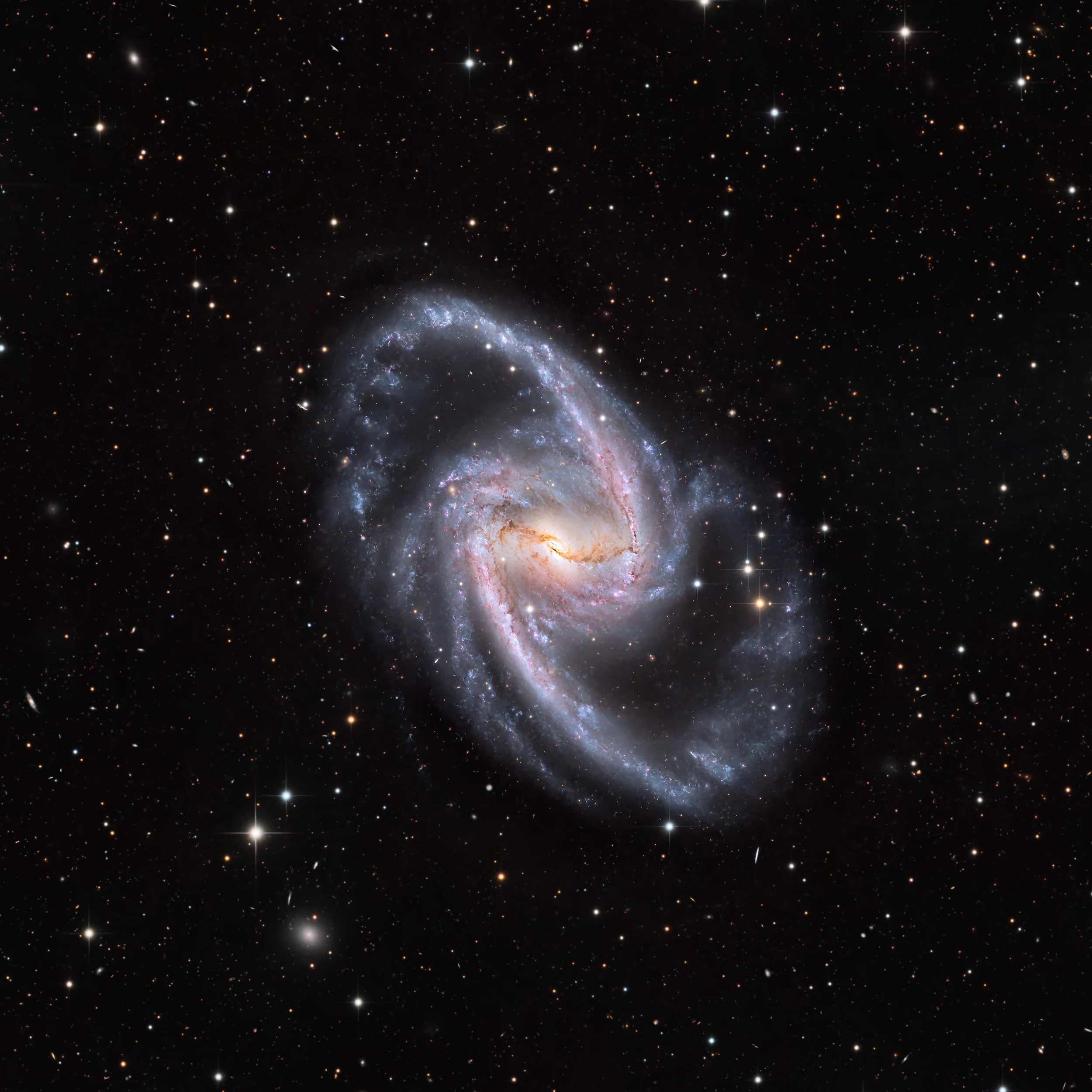
NGC 1365
Known as the Great Barred Spiral Galaxy, NGC 1365 lies about 56 million light-years away in the constellation Fornax. This magnificent island universe spans over 200,000 light-years, making it one of the largest and most striking barred spirals in the sky. Prominent dust lanes cut across its glowing arms, which are rich in hydrogen emission and sites of active star formation. The bright central bar channels gas inward, fueling both stellar birth and a supermassive black hole at the galaxy’s core.
This deep view reveals the galaxy’s dynamic structure in remarkable detail, from red star-forming regions to the subtle extensions of its faint outer arms. Astronomers study NGC 1365 as a textbook example of barred spiral evolution, providing clues to how bars drive galactic growth and transformation over cosmic time.
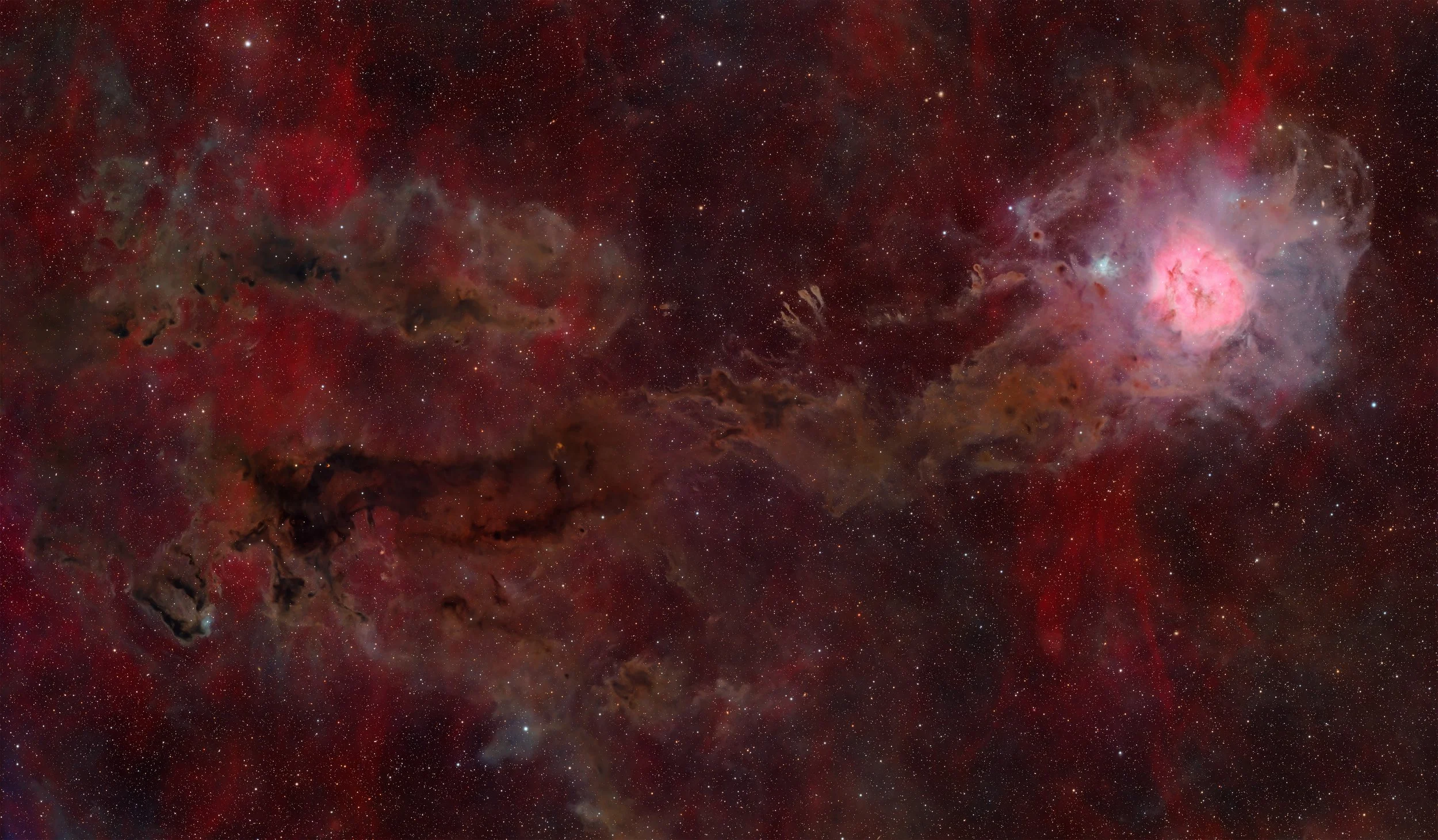
IC 5146: Cocoon Nebula in a River of Dust 4 Panel Mosaic
The Cocoon Nebula (IC 5146) floats about 4,000 light-years away in the constellation Cygnus, a luminous nursery where new stars emerge from clouds of gas and dust. At its core, a bright young star illuminates the surrounding hydrogen, oxygen, and dust, forming the radiant cocoon that gives the nebula its name.
This extraordinary four-panel mosaic spans over 224 hours of total integration time, revealing both the glowing core and the long, dark molecular filaments that stretch westward like a cosmic river. Captured in LRGB and H-alpha, the image traces the full life cycle of interstellar matter, dense dust lanes collapsing into stars and their radiation sculpting the surrounding nebula into intricate, colorful forms.
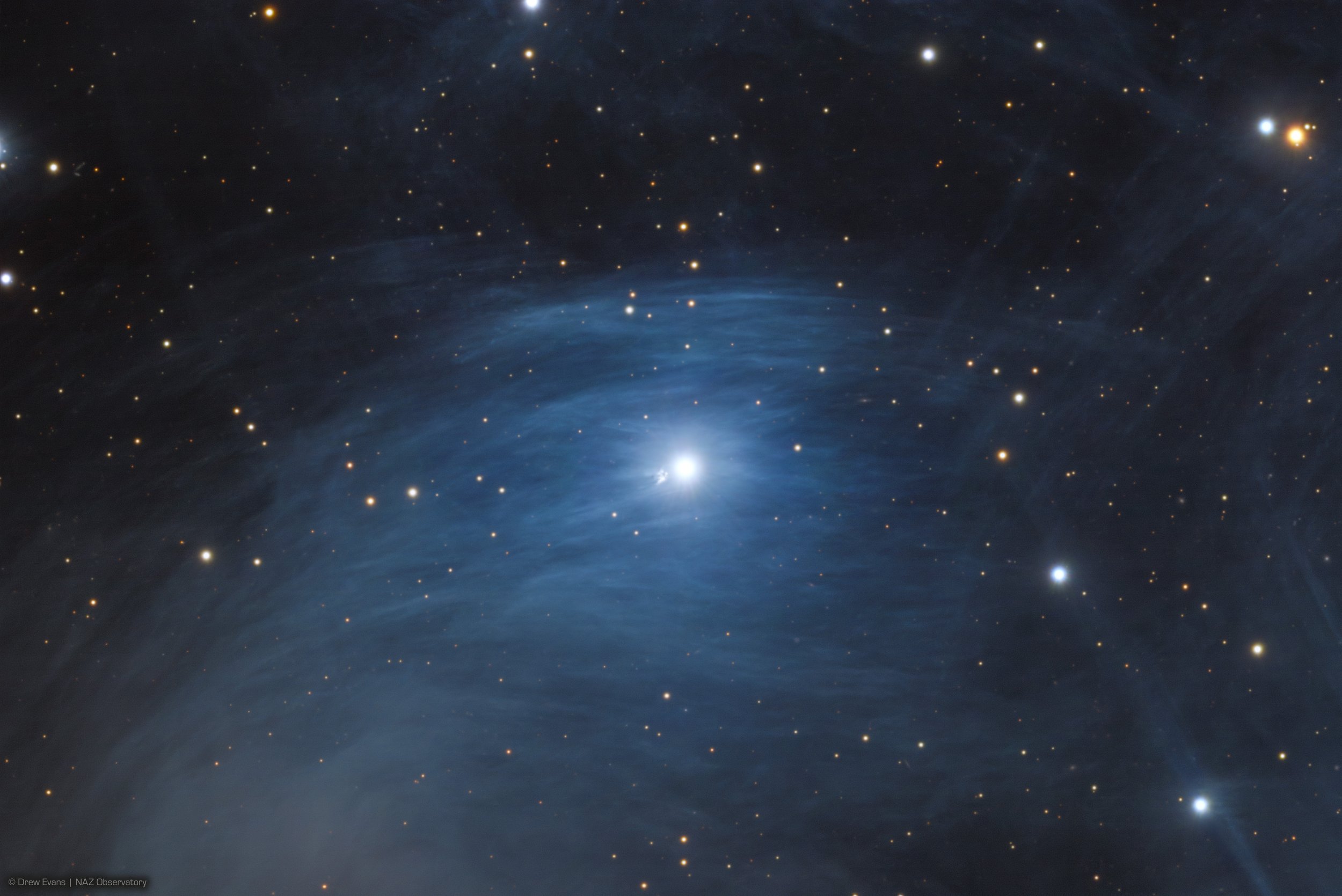
Barnard's Merope Nebula (IC 349)
Illuminated by the bright Pleiades star Merope, IC 349—also known as Barnard’s Merope Nebula, is a small reflection nebula about 400 light-years away in Taurus. The nebula’s delicate blue glow comes from interstellar dust scattering starlight, while its intricate filaments trace the fine structure of gas and dust interacting with the intense radiation from Merope. Because of its proximity to such a luminous star, IC 349 is one of the brightest and most detailed examples of a reflection nebula known.
Discovered in 1890 by E. E. Barnard, this faint wisp lies only about 0.06 light-years from Merope itself, making it a challenge to capture without the star’s brilliance overwhelming the view. Long exposures and careful processing reveal the subtle arcs and eddies in the surrounding dust, shaped by the star’s wind and radiation pressure. The scene highlights the beauty and fragility of starlight filtering through the remnants of the interstellar medium.

Theophilus Crater — Lunar Sunrise Over the Central Peaks
Carved into the lunar surface near Mare Nectaris, the Theophilus Crater spans nearly 100 kilometers in diameter and rises over 3,200 meters from its floor to rim. This young impact structure is among the Moon’s most striking features, displaying a terraced wall and a central mountain complex formed when the lunar surface rebounded after the colossal impact.
Captured from Mazan, France, this high-resolution image reveals fine details illuminated by the low angle of lunar sunrise, accentuating the rugged relief of the crater’s rim and peaks. The image was obtained on October 11, 2025, using a 625 mm Newtonian telescope with a Barlow 4×, IR685 filter, and QHY5-III 678M camera. From 3,000 frames, 360 were stacked to achieve this sharp result, offering a close look at one of the Moon’s most dramatic geological landmarks.
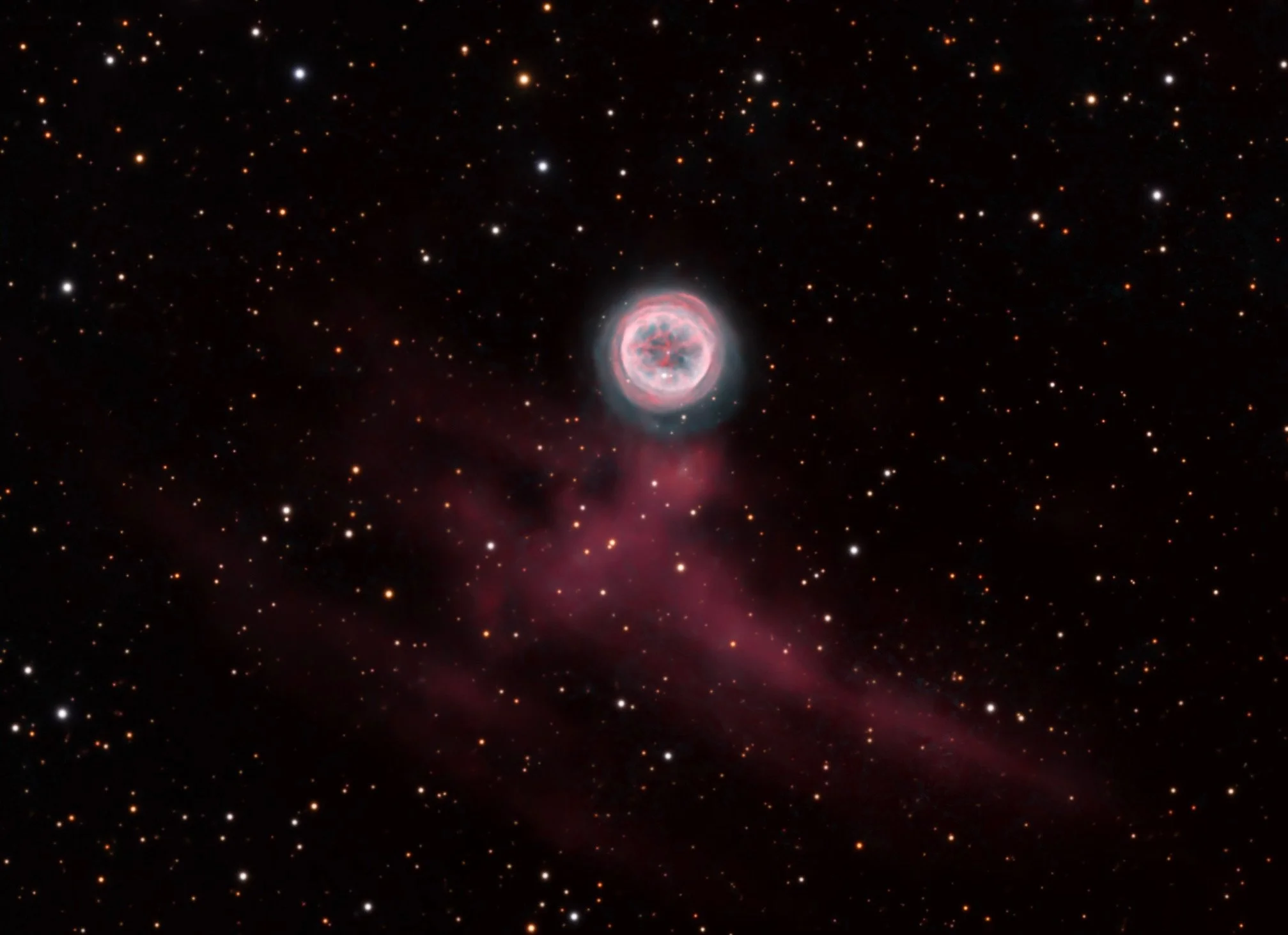
NGC 6894 — Planetary Nebula in Cygnus
Floating within the rich star fields of Cygnus, NGC 6894 is a faint planetary nebula roughly 1,800 light-years away. The nebula’s nearly perfect circular shell marks the final breath of a dying sunlike star, now collapsed into a white dwarf at its center. Surrounding filaments of hydrogen and oxygen trace shock fronts where stellar winds interact with earlier ejected gas, creating the glowing sphere seen in the image.
Recent deep exposures have revealed that NGC 6894 is not an isolated bubble, but rather connected to a faint extended hydrogen tail stretching several arcminutes southward, likely formed as the nebula drifts through the interstellar medium. This feature shows that the nebula’s ejected material continues to shape and be shaped by its galactic environment, offering a glimpse of stellar death in motion amid the crowded Milky Way.
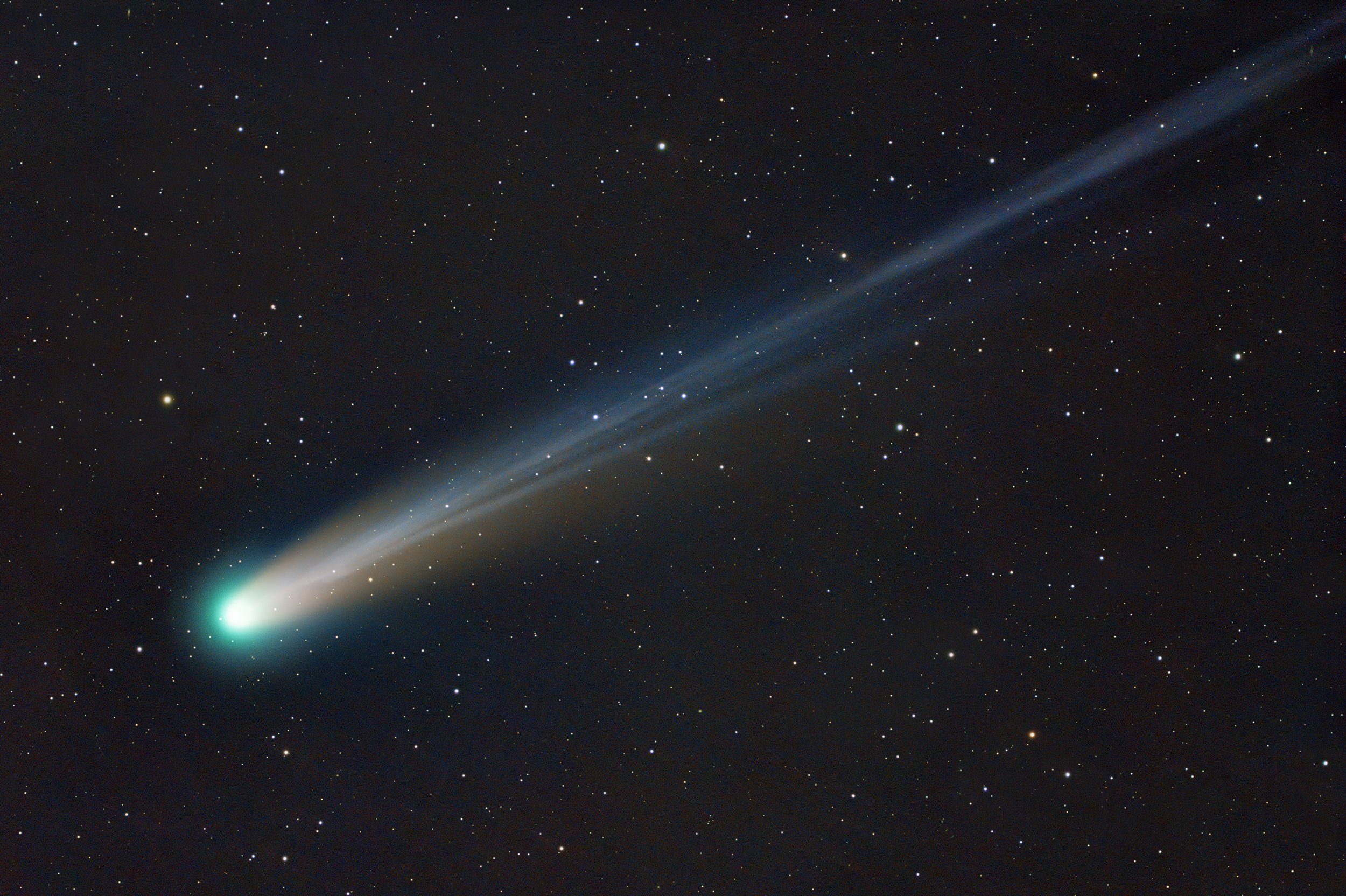
Comet C/2025 A6 (Lemmon) — October 13, 2025
Captured from the Aosta Valley in the western Alps, this image reveals Comet Lemmon streaking through the northern sky, displaying a striking contrast of colors: a vivid green coma and a beautifully extended blue ion tail. The cyan–blue tail, rich in ionized molecules such as CO⁺, forms under the influence of the solar wind, while the green glow arises from diatomic carbon (C₂) fluorescing in sunlight. The complex, braided structure of the tail reflects the comet’s active nucleus as it responds to changing solar conditions.
Discovered on January 3, 2025 by the Mount Lemmon Survey, C/2025 A6 (Lemmon) is now rapidly brightening as it approaches perihelion on November 8, 2025, when it will pass just 0.53 AU from the Sun. Its closest approach to Earth occurs on October 21, at a distance of about 0.60 AU, making it an easily observable comet for northern observers. Currently around magnitude 5–5.7, it may peak between magnitude 3.5 and 4.5, potentially visible to the naked eye under dark alpine skies. With an orbital period of roughly 1,350 years, Comet Lemmon offers a rare glimpse of a visitor from the outer Solar System, its glowing trail marking both its journey and the Sun’s invisible wind.
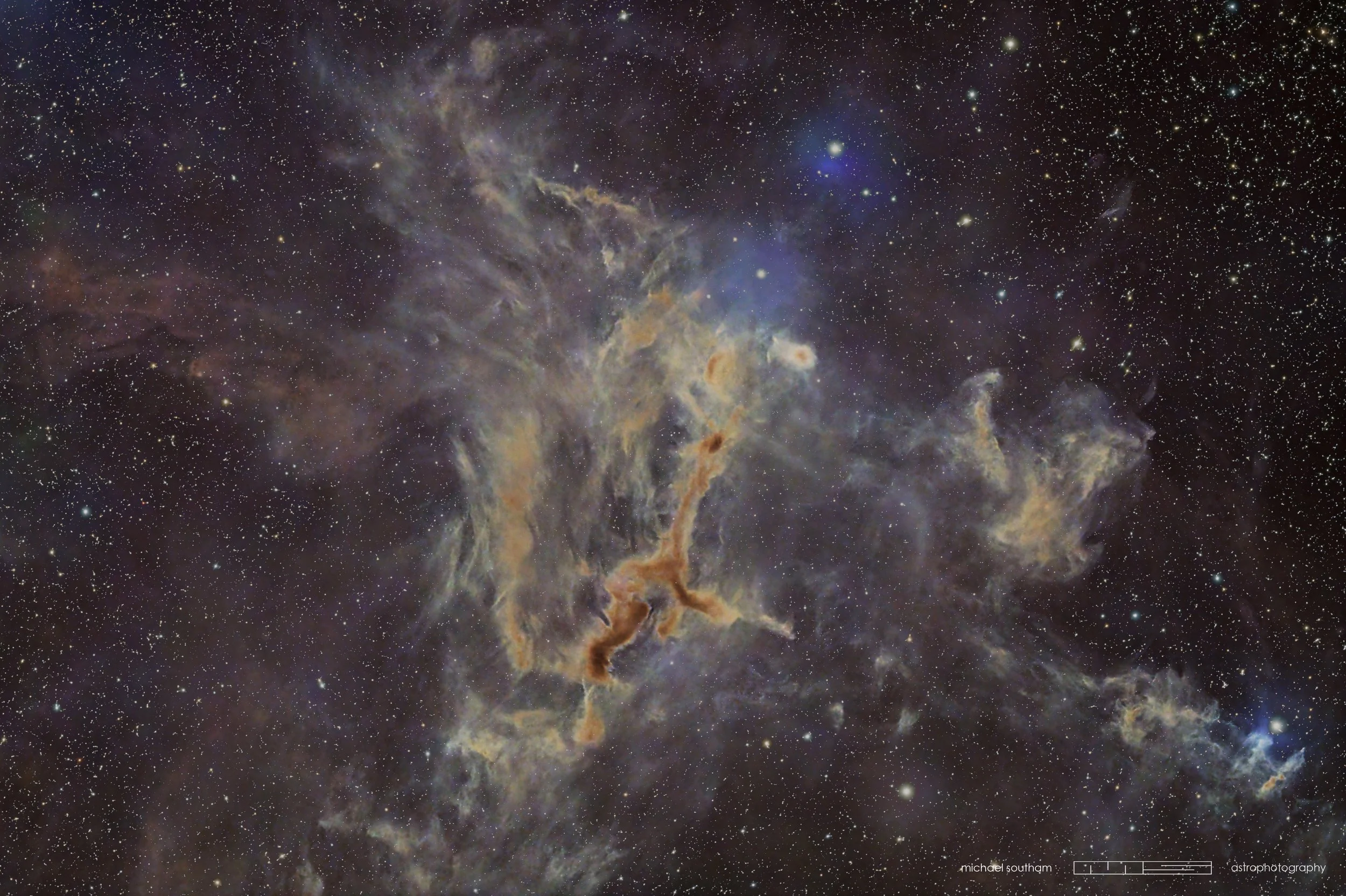
LDN 1295 Giraffe Nebula
Drifting quietly through the northern constellation of Cepheus, LDN 1295 is a dark molecular cloud embedded within a complex web of reflection and emission nebulae. The structure’s intricate dust lanes trace cold interstellar matter—raw material for future stars—while faint blue and golden hues emerge from starlight scattering through the cloud. Its shape, reminiscent of a long-necked creature, gives rise to the nickname “The Giraffe Nebula.”
This region lies about 3,000 light-years away and forms part of a larger star-forming complex near the Cepheus Flare, where turbulence and gravity weave new suns from the darkness.
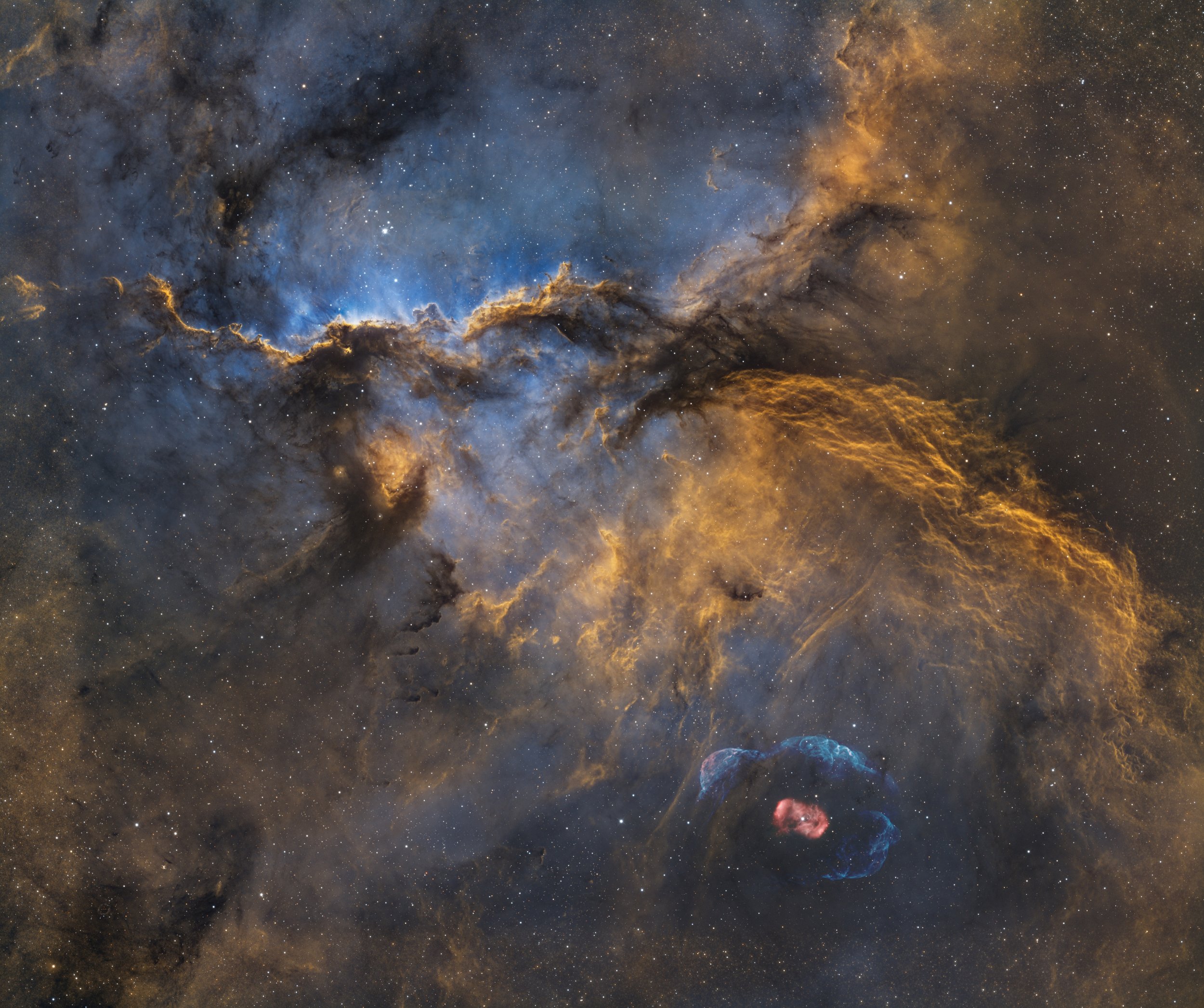
The Dragon of Ara
Stretching across 400 light-years, the vast emission nebula NGC 6188 glows in intricate filaments of hydrogen, sulfur, and oxygen. Sculpted by fierce stellar winds and radiation from the nearby young cluster NGC 6193, its form evokes a dragon soaring through the stars, a fitting image for this rich star-forming region in the constellation Ara. Within its glowing arcs, new generations of massive stars ignite, continuing to reshape the surrounding interstellar medium.
Below this sprawling cloud lies an unexpected jewel: the planetary nebula NGC 6164/6165, a symmetrical bubble of gas expelled by the massive O-type star HD 148937. Together, these neighboring objects create a striking juxtaposition, a stellar nursery giving birth to new suns above a dying star shedding its outer layers below, a vivid portrait of the cosmic cycle of stellar evolution.
This image is a two-panel mosaic, carefully captured and processed to reveal both the luminous H II structures of NGC 6188 and the delicate shell of NGC 6164/6165 in remarkable detail.

Saturn and Enceladus under Exceptional Seeing
Captured on the morning of September 18, 2025, this detailed image of Saturn reveals the gas giant at its finest under exceptionally steady skies. Over 75 minutes of data, approximately 70,000 frames, were collected, with the best 30 % stacked and de-rotated to achieve high-resolution clarity.
The icy moon Enceladus appears just to the right of the planet, while Mimas hides behind Saturn’s rings. Subtle atmospheric activity can be seen across the globe, including diffuse bright spots in the southern hemisphere and several storms tracing the equatorial belts. This view captures the dynamism and beauty of Saturn’s ever-changing atmosphere.