

AAPOD2 Image Archives
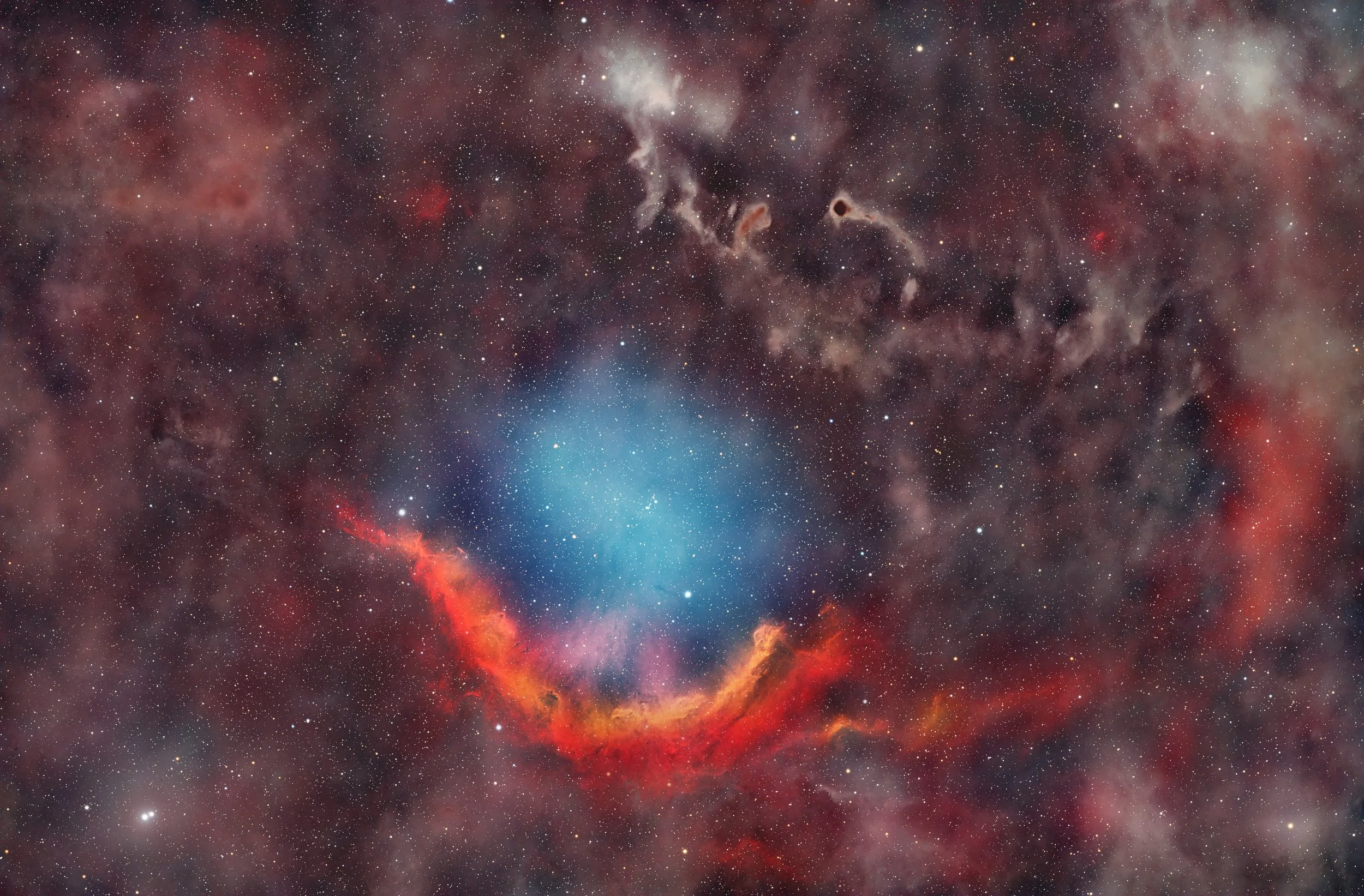
Fire Shrimp nebula Sh2-204
Sh2-204 is a compact emission nebula in Camelopardalis, glowing primarily in hydrogen alpha and sculpted by the intense radiation of nearby massive stars. Its curved, asymmetric form is created by the pressure of stellar winds sweeping through the cloud, compressing the gas into this distinctive shrimp-like arc. The region sits along the outer Milky Way and is often overlooked because of its faint surface brightness, but long integrations reveal complex filaments and a surprisingly rich ionization front.
The blue accents often seen in images come from oxygen emission that outlines parts of the shock front, while the deeper reds trace hydrogen heated by ultraviolet light. Sh2-204 is part of a larger network of clouds in the Camelopardalis OB1 association, an area filled with young, energetic stars that continue to shape the surrounding gas. Capturing it cleanly requires both dark skies and patience, but when it comes together, the structure is one of the more unusual forms in the northern sky.
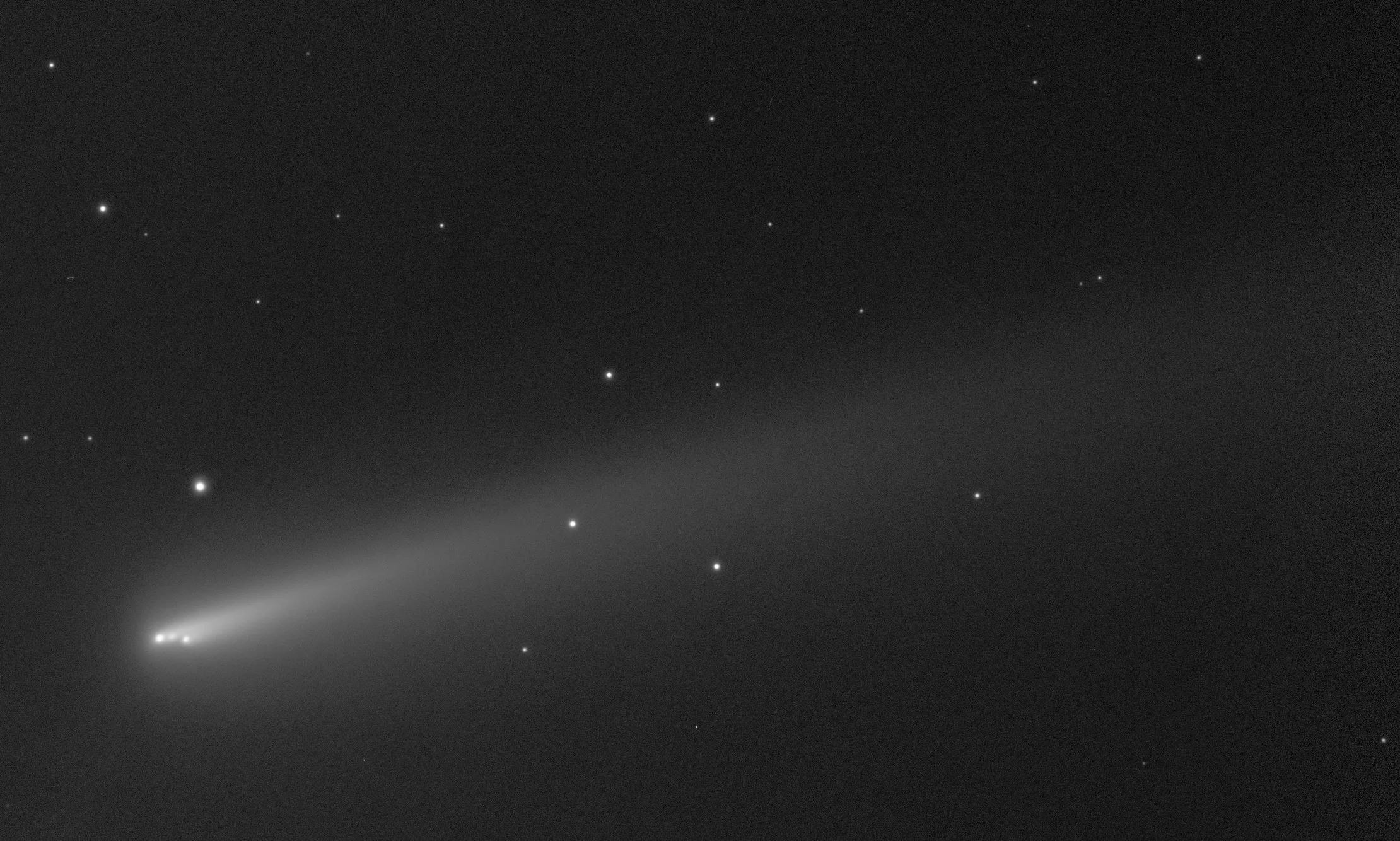
Breakup of Comet C/2025 K1 (ATLAS)
Comet C/2025 K1 (ATLAS) dramatically revealed its fragile nature when it fragmented in late November, splitting into multiple bright components that now drift together inside a fading envelope of dust. This luminance image, built from 140 twenty-second exposures taken on November 21, 2025, captures the comet at the moment its nucleus was visibly separating. The twin points of light at the head are the individual fragments, each shedding material as solar heating pulled the comet apart from within.
Trailing behind the breakup is a broad, soft dust tail stretched by the solar wind into a smooth gradient of scattered sunlight. The surrounding starfield offers a stark contrast to the comet’s disrupted core, emphasizing how quickly the structure of a seemingly solid nucleus can collapse when exposed to the stresses of a close approach to the Sun. Breakup events like this offer a rare chance to study the internal weakness, composition, and thermal response of dynamically young comets from the outer solar system.
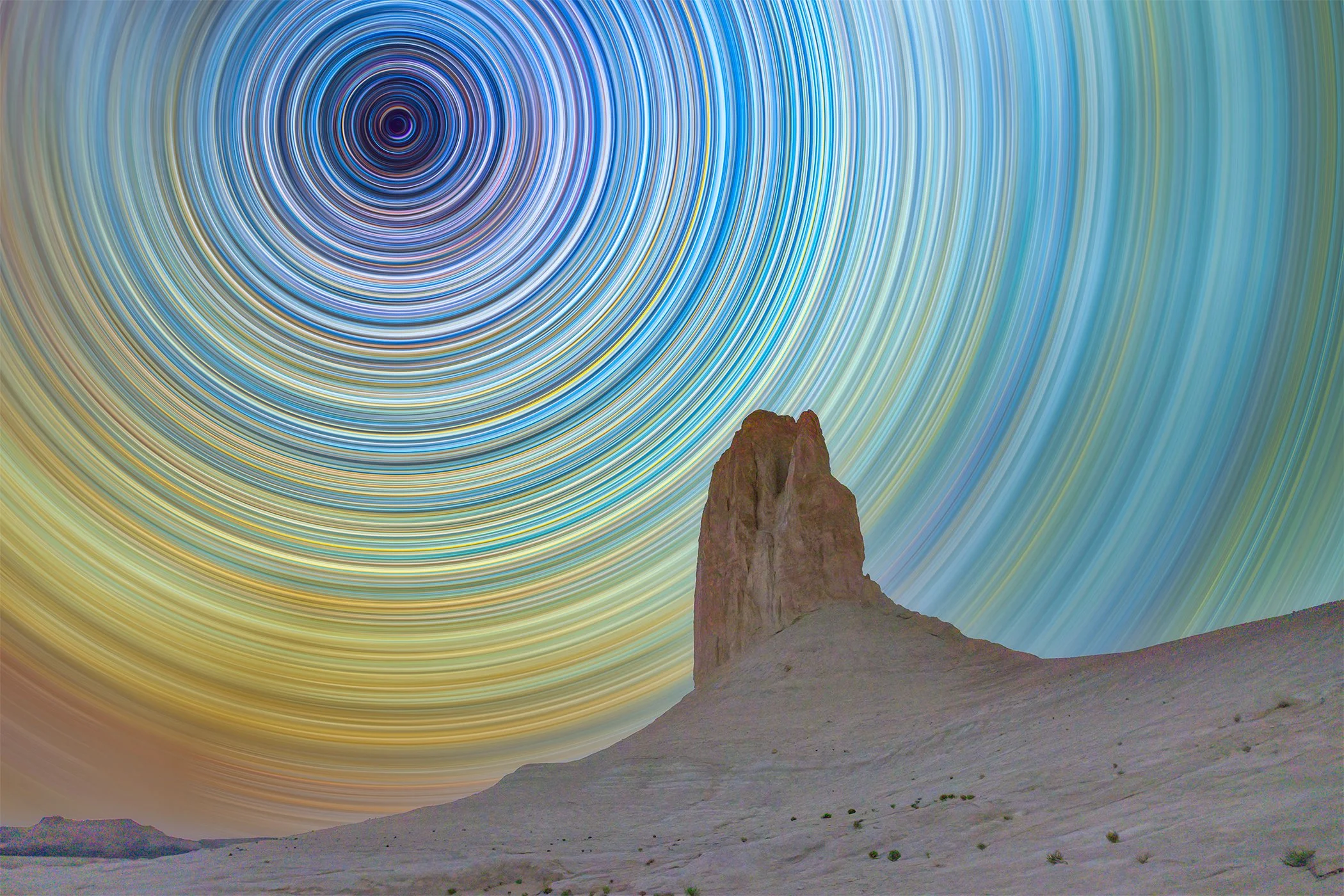
Perfect Circles Above Kyzylkyp Tiramisu Canyon
This long-exposure star trail composition from the vibrant Kyzylkyp Tiramisu Canyon reveals an extraordinary display of concentric circular arcs centered on the north celestial pole. The near-mathematical precision of these rings comes from the steady rotation of Earth, which causes the stars to trace out perfectly nested circles across the sky. The result is a powerful reminder of the exactness of our universe. Even across hours of exposure, the sky maintains a level of consistency and stability that allows these seamless and almost mechanical patterns to emerge.
The rich palette of colors in the trails is produced by the stars themselves. Blue and white arcs originate from hotter young stars, while yellow and amber streaks come from cooler, older stars burning at lower temperatures. Together they form a natural spectrum that sweeps across the sky, surrounding the towering canyon monolith and creating a vivid contrast between our rotating heavens and the ancient rock below.

The Andromeda Galaxy: Extended Dust and Hα Emission
The Andromeda Galaxy, cataloged as M31, stretches across this wide field along with its companions M32 and M110. The long dust lanes that cut through its disk appear sharply defined, while an extended halo of faint particulate material surrounds the galaxy and blends into the background. Careful processing brings out subtle hydrogen alpha regions that trace knots of star formation and hint at the dynamic activity within Andromeda’s spiral arms.
Combining broadband and narrowband data reveals both the classic structure of M31 and the diffuse outer features that are often lost in shorter exposures. The satellite galaxies stand out with their own distinct profiles, adding depth and balance to the frame. This view offers a detailed look at our nearest major galactic neighbor and the complex environment that surrounds it.
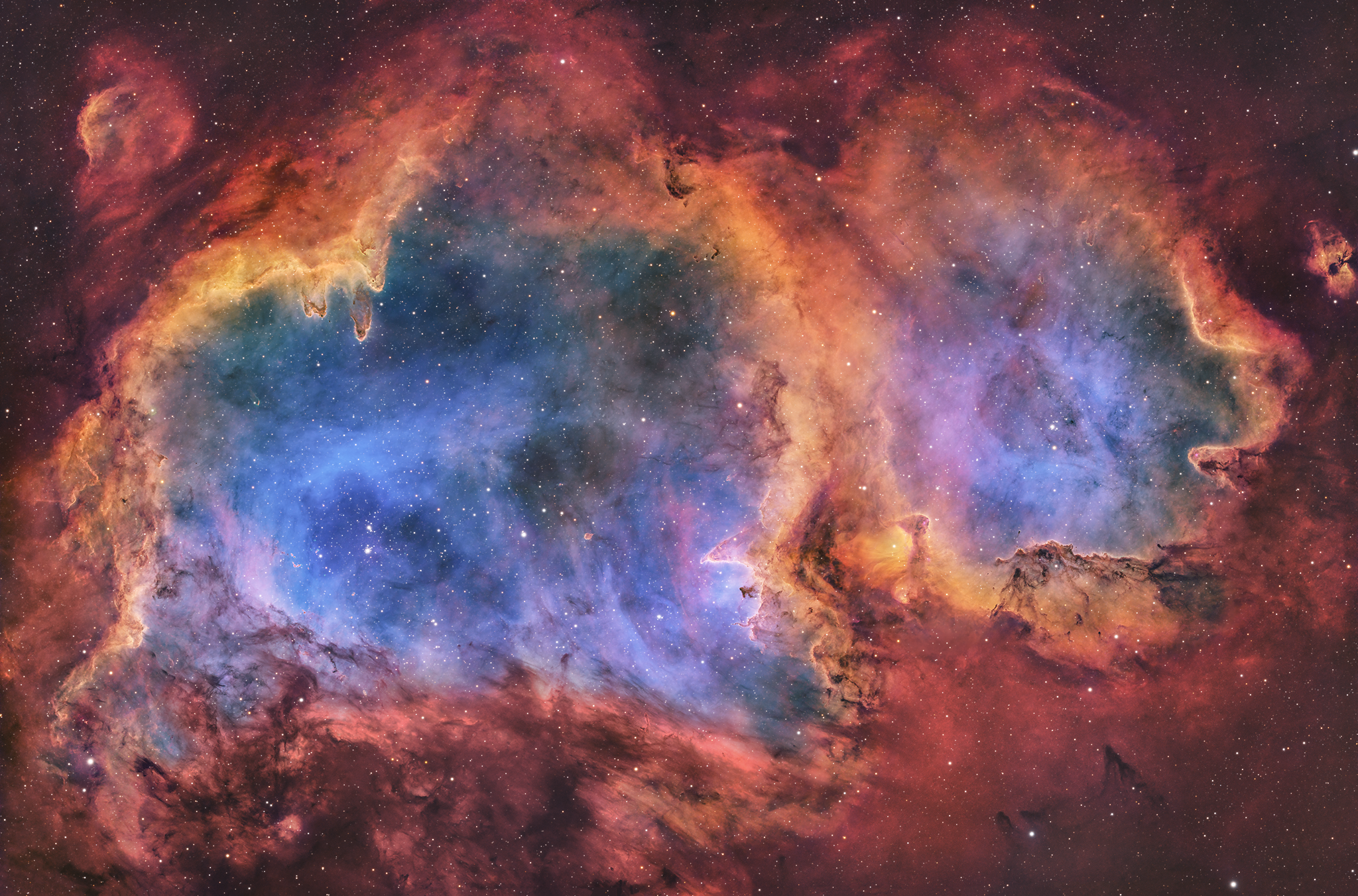
A deep dive into the Soul Nebula: 234h 55m
The Soul Nebula, cataloged as IC 1848, spreads across a rich star forming complex in Cassiopeia about 6,000 light years from Earth. This field highlights long ribbons of hydrogen emission, windswept cavities carved by young clusters, and faint dust channels that become visible only after long integration. Captured from a Bortle 8.5 backyard in Nashville, the data pushes deep enough to show the layered structure of the nebula and the delicate interplay between ionizing radiation and the surrounding gas.
Across 34 nights and 235 hours of exposure, this result is a remarkably clean and detailed look at a target that is notoriously difficult from heavy light pollution. The depth here makes the Soul feel almost sculpted, with subtle gradients and transitions that rarely show up outside of remote dark sky imagery.
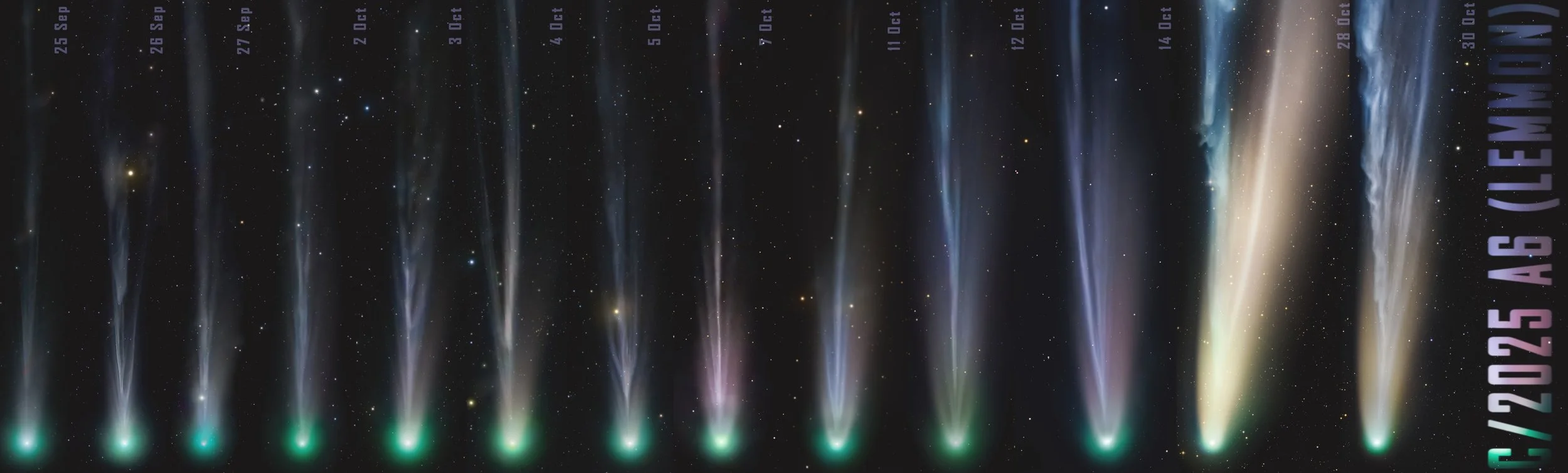
Goodbye Lemmon
Between September 25 and October 30, 2025, this sequence of thirteen images follows the week by week transformation of comet C/2025 A6 Lemmon as it moved deeper into the inner solar system. Each frame captures the growing brightness of the coma along with dramatic changes in the tail as sunlight and the solar wind stripped gas and dust from the nucleus. Subtle streamers early in the series gave way to long, sharply defined ion structures and broader dust fans. The shifting colors across the dates reflect a mix of carbon dominated green emission from the coma and the blue glow of ionized gases driven outward at high speed.
This kind of single frame time lapse is rare because most comets simply do not show so much structural variation over such a short period. Lemmon surprised observers with recurring outbursts that fed new material into the tail and produced those twisting filaments and forked jets seen toward the end of the series. Watching these changes across a month offers a front row view of how dynamic cometary physics can be when a fresh nucleus interacts with the solar wind. It also helps researchers refine dust release models for a comet that has only recently been characterized and continues to deliver surprises.
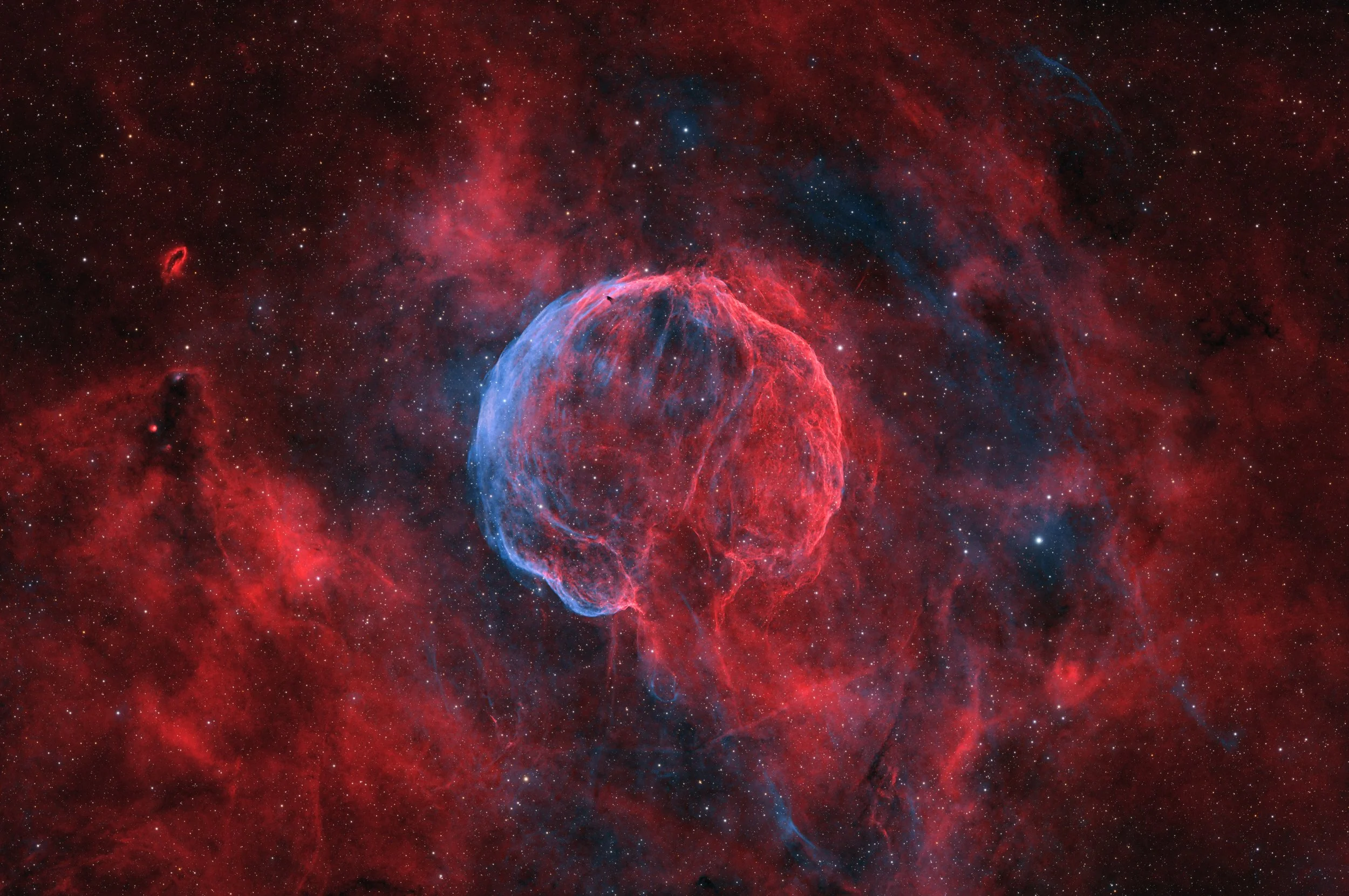
CTB-1 - Abell 85 - Garlic nebula
CTB 1, also known as Abell 85 or the Garlic Nebula, is a supernova remnant about ten thousand light years away in Cassiopeia. What you are seeing is the expanding shell of gas left behind after a massive star exploded thousands of years ago. The blue structures trace oxygen rich filaments while the red reveals glowing hydrogen shaped by shock fronts racing through the surrounding interstellar medium. The asymmetric bubble and the long trailing filament suggest the original blast expanded into a lopsided environment where dense clouds slowed one side of the shock while the other burst freely into space.
Captured from Nerpio, Spain at the AstroCamp hosting facility, this field shows just how intricate a supernova remnant can be on large scales. The surrounding hydrogen landscape forms a deep red canvas where faint tendrils and rippling waves continue to drift outward. CTB 1 is relatively faint compared to iconic remnants, but its complex structure has made it a favorite for astrophotographers who want to reveal the fine turbulence left behind after a star’s final act.
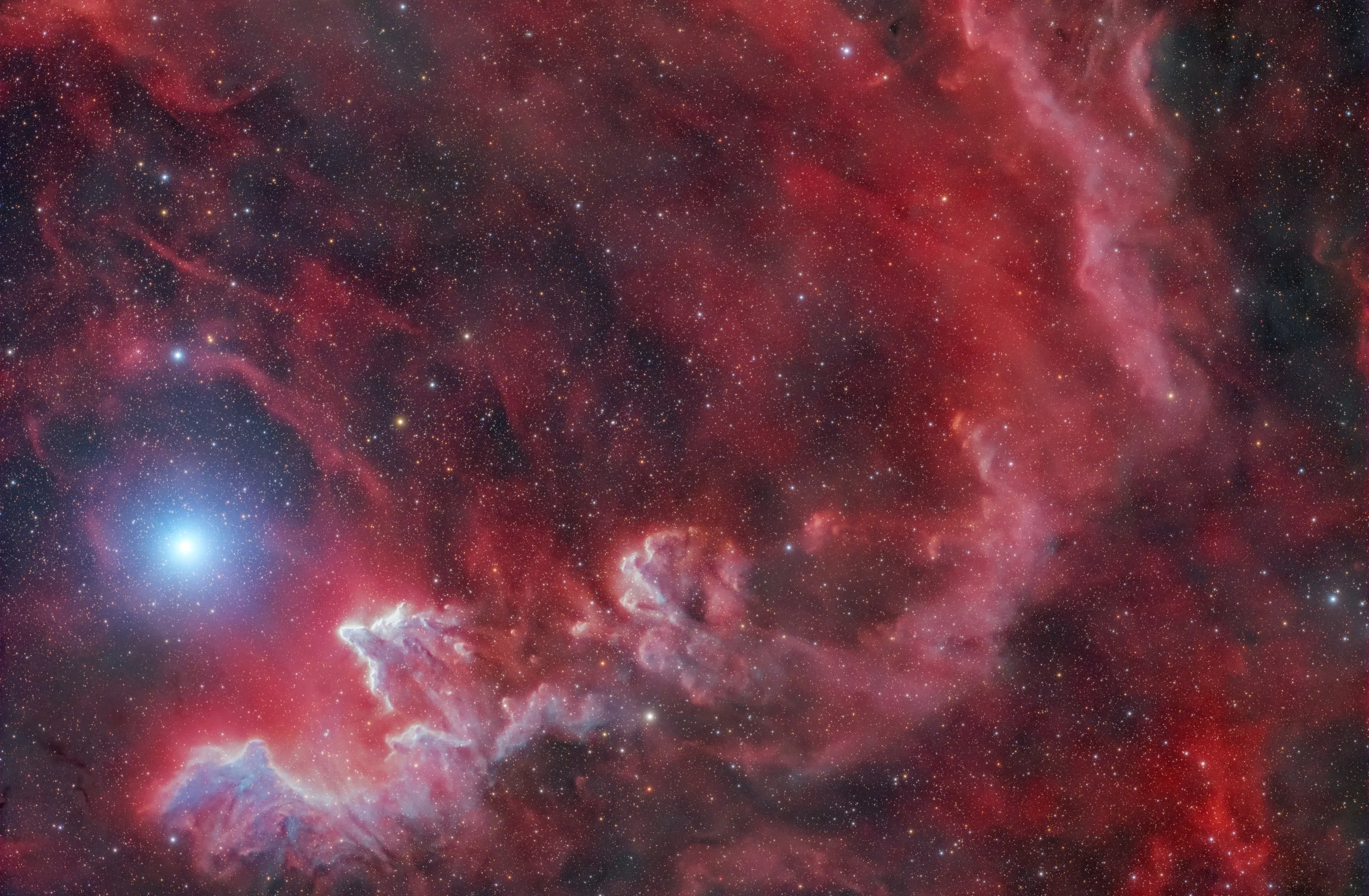
IC 59 and IC 63 - Ghost of Cassiopeia
IC 63, often called the Ghost Nebula, sits about 550 light years away in Cassiopeia and glows under the intense radiation from the nearby bright star Gamma Cassiopeiae. The nebula’s red tones come from hydrogen excited by that ultraviolet light while the delicate blue and lavender highlights mark regions where dust reflects starlight. The sculpted shapes across the frame reveal how Gamma Cas is slowly eroding and reshaping the cloud, creating wispy ridges and curling fronts that seem to billow outward.
This field captures the quiet drama of a photodissociation region where energetic light and cold gas collide. The fine textures drifting through the red emission form a striking backdrop for the bright foreground star, which dominates the scene without overpowering the subtle structure within the nebula. IC 63 is a small and fragile object but it tells a very detailed story about how massive stars influence their surroundings even across great distances.
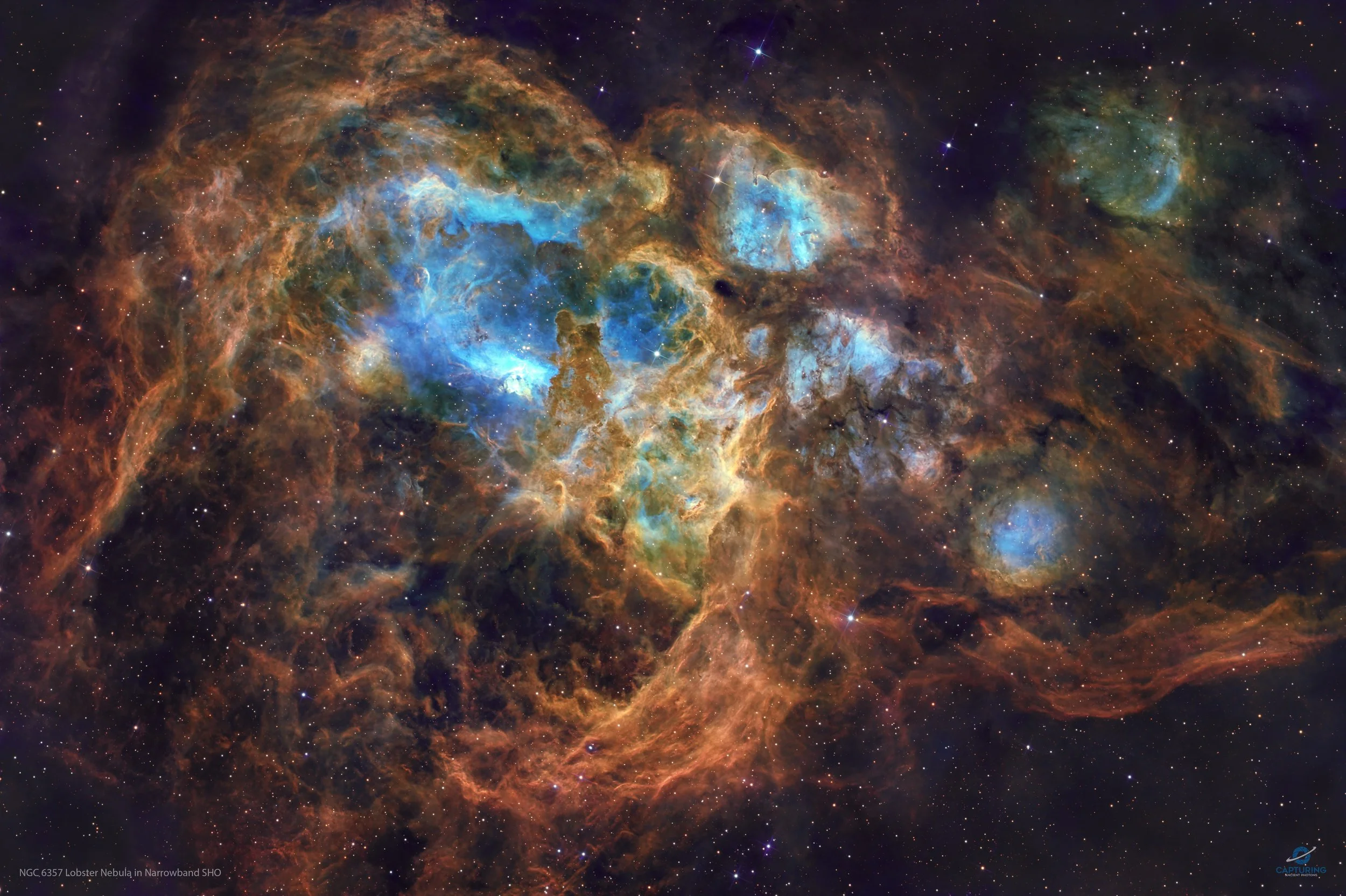
NGC 6357 Lobster Nebula in Narrowband SHO
NGC 6357, the Lobster Nebula, glows with a mix of sculpted ionized gas and newborn stars in the constellation Scorpius. This massive star forming complex contains several young open clusters whose radiation carves the surrounding clouds into intricate cavities and filaments. The brilliant blue regions correspond to doubly ionized oxygen while the warmer gold and copper tones reveal the distributions of hydrogen and sulfur captured in narrowband SHO. These processes highlight the turbulent interplay between stellar winds, radiation pressure, and gravity in one of the Milky Way’s most active nurseries.
Captured from Perth, Western Australia, this field exposes the vast reach of the nebula’s outer tendrils which extend far beyond its bright central cavities. The combination of detailed structure and extreme color contrast gives viewers a clear look at the dynamic environment shaping early stellar evolution. With its dramatic textures and luminous knots, the Lobster Nebula remains one of the most compelling examples of how massive stars reshape the interstellar medium around them.
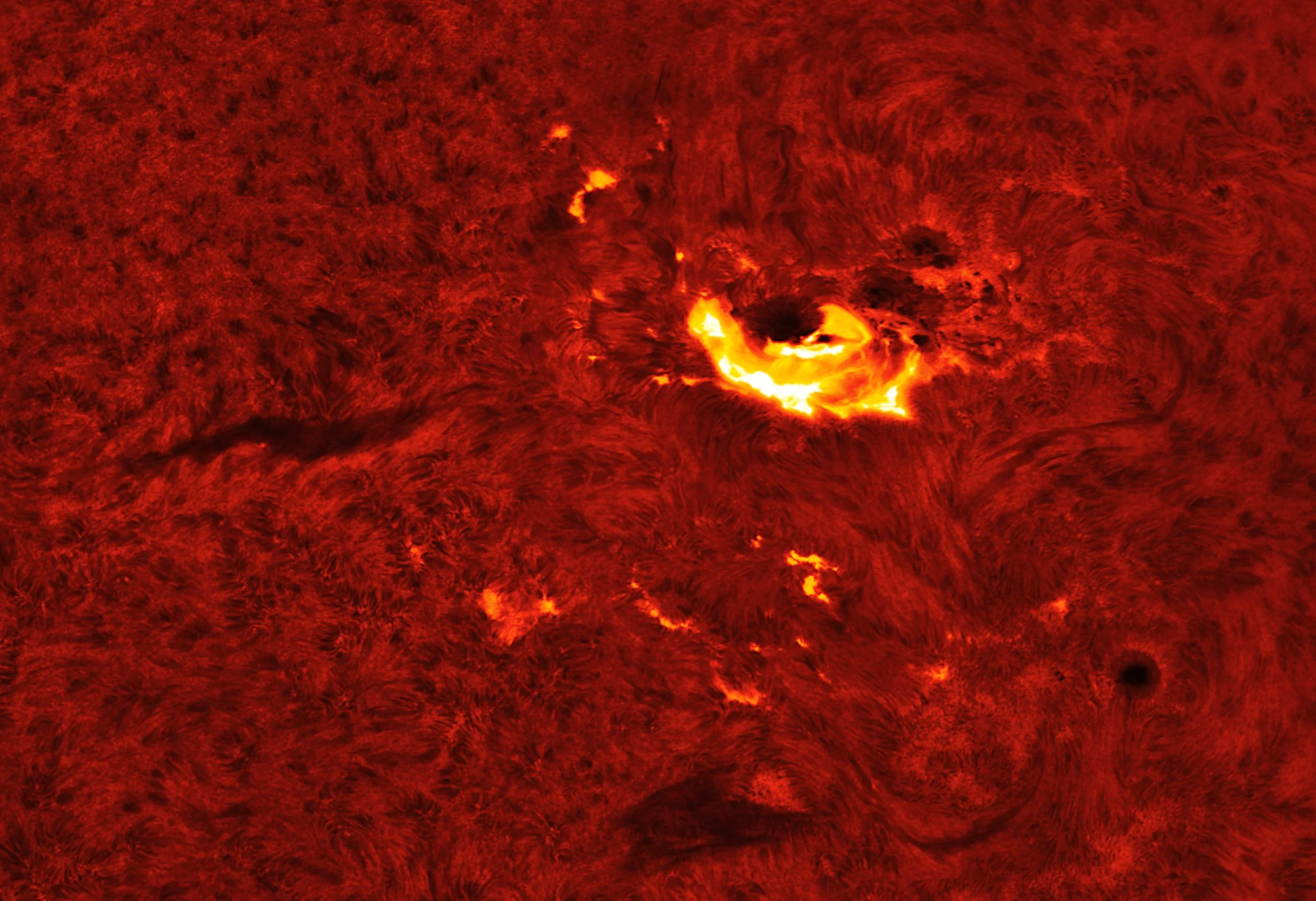
X5.16 Class Flare
On November 12, 2025, the Sun unleashed an X5.16-class flare, the most powerful of the year and the sixth most energetic event of the current solar cycle. Captured here at 10:08 UTC, precisely at the peak of its emissions in the H-alpha line, the image reveals the immense outburst erupting from the solar surface. This flare originated from a highly active sunspot region that continues to generate intense coronal mass ejections (CMEs).
The blast’s charged particles struck Earth’s magnetic field roughly a day later, sparking brilliant auroras visible as far south as South Florida, an exceptionally rare sight for the region. Skywatchers across North America and Europe reported vivid red and green curtains of light sweeping across the horizon, a dramatic reminder of our Sun’s dynamic power as Solar Maximum approaches.
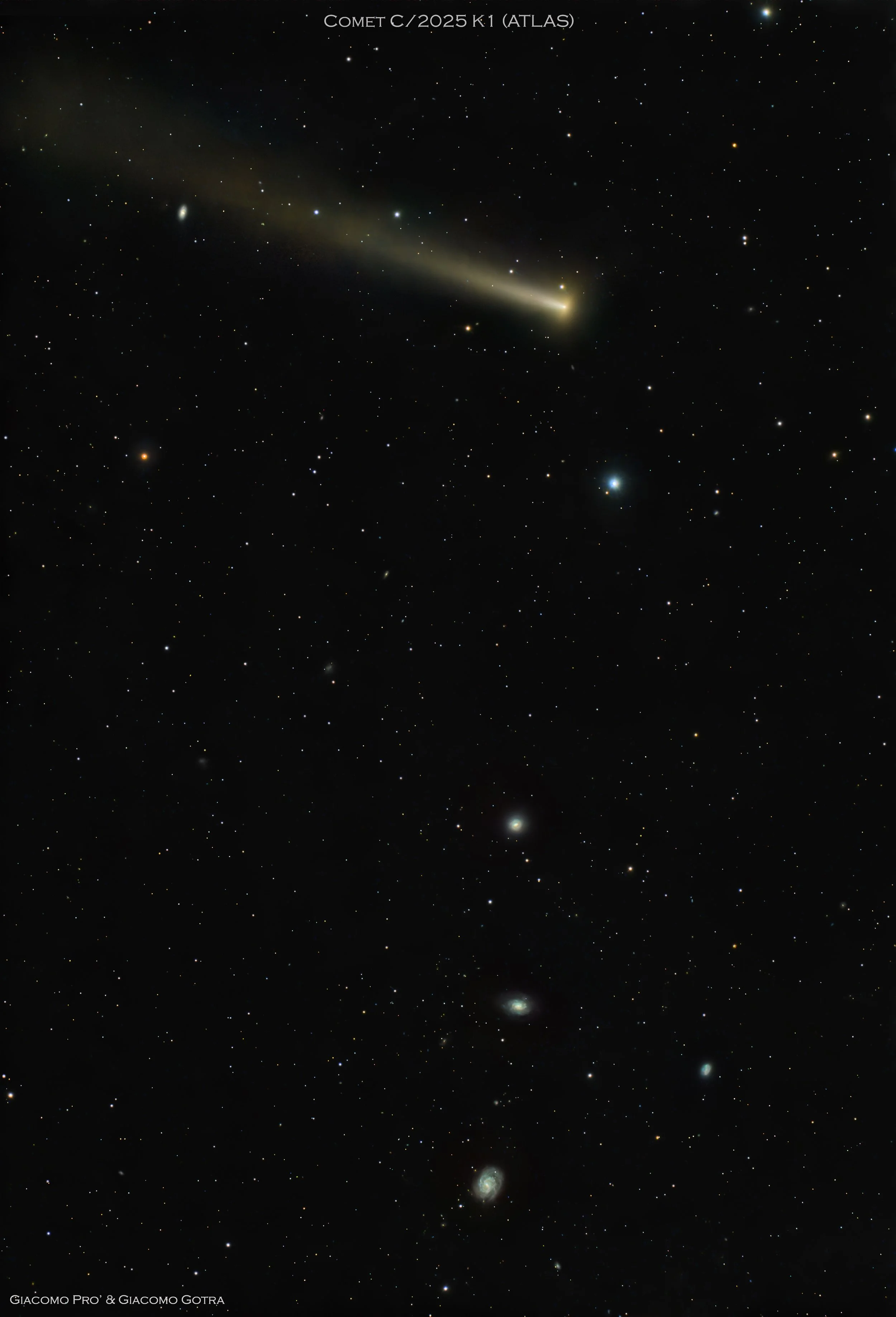
Comet C/2025 K1 (ATLAS)
Discovered by the ATLAS survey in May 2025, Comet C/2025 K1 is one of the most intriguing new visitors to the inner Solar System. Unlike short-period comets bound to the Sun for millennia, K1 follows a long, hyperbolic path suggesting it may be making its first—and possibly only—trip through our neighborhood before heading back into interstellar space. The bright nucleus glows with reflected sunlight while the yellow-tinged dust tail extends millions of kilometers, formed as solar radiation pushes dust away from the comet’s core.
In this image, the comet passes through a star-rich field sprinkled with distant galaxies, including the spiral galaxies visible in the lower half of the frame. The scene highlights how dynamic and interconnected the cosmos is—objects from the cold outer reaches of the Solar System momentarily crossing paths with galaxies billions of light-years away.
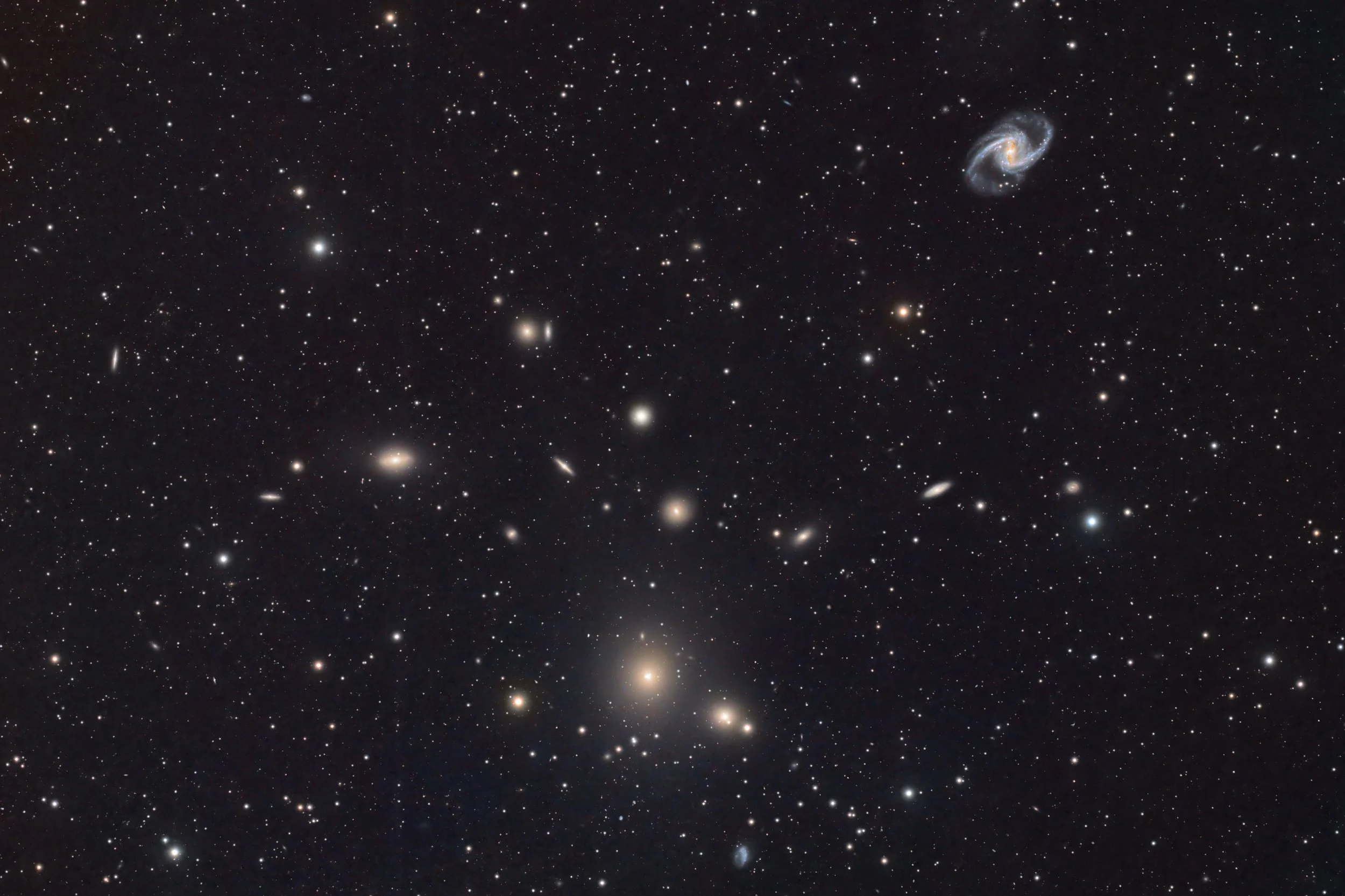
Fornax Galaxy Cluster – Abell S0373
Located about 60 million light-years away in the southern constellation Fornax, the Fornax Galaxy Cluster (Abell S0373) is one of the richest nearby clusters of galaxies. Its core is dominated by the giant elliptical galaxy NGC 1399, surrounded by numerous spirals, lenticulars, and dwarf galaxies, all bound together by their mutual gravity. Unlike many distant clusters filled with elliptical galaxies alone, Fornax still shows ongoing star formation in several of its spiral members.
Captured from Kiripotib Astrofarm, Namibia, this deep image reveals hundreds of background galaxies extending far beyond the cluster itself. The Fornax Cluster provides astronomers a unique window into galaxy evolution in environments where gravitational interactions continue to shape their fate.
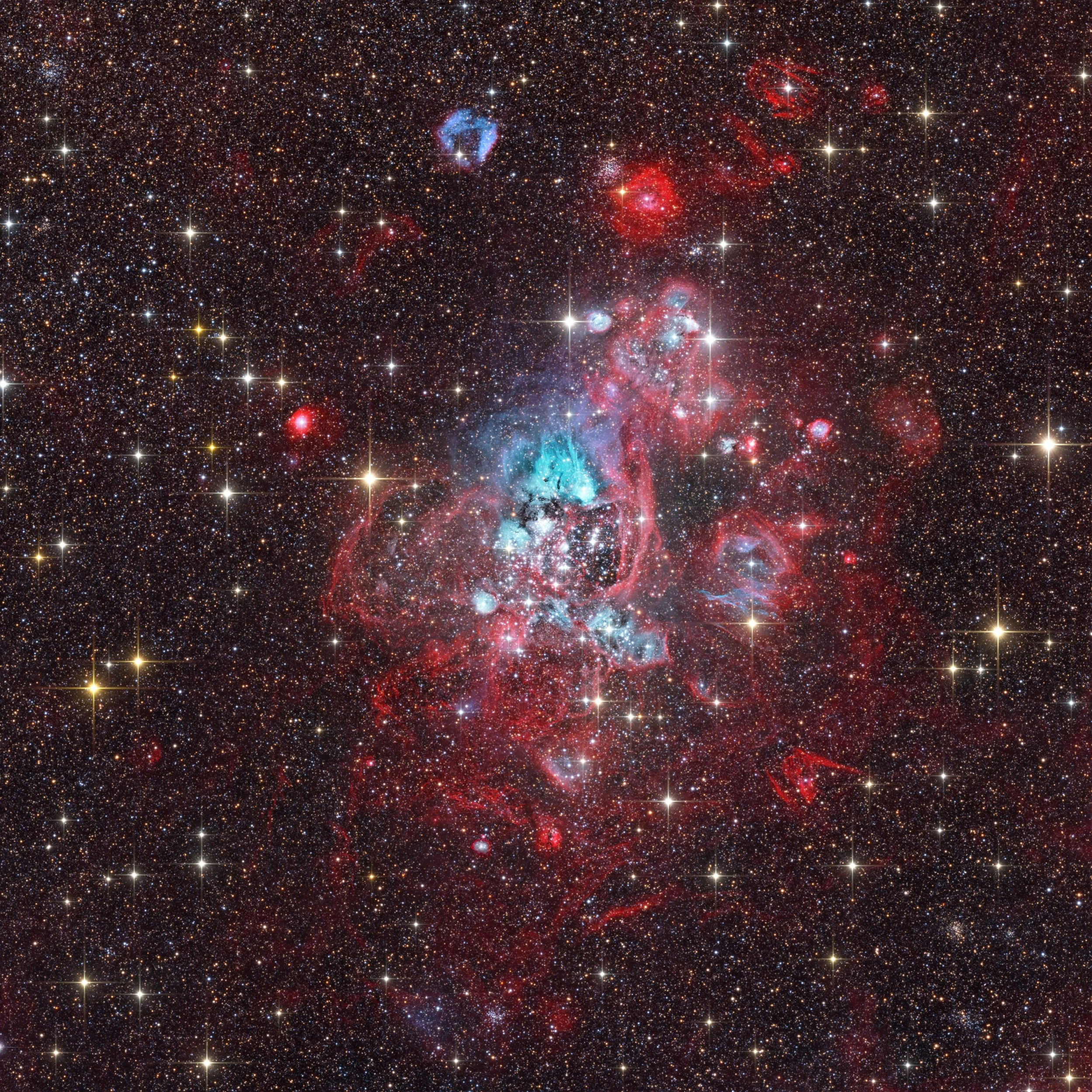
N44 and the Superbubble in the Large Magellanic Cloud
N44 is a massive emission nebula in the Large Magellanic Cloud, a satellite galaxy of the Milky Way about 160,000 light-years away. Spanning nearly 1,000 light-years across, this turbulent region glows with energized hydrogen gas sculpted by powerful stellar winds. Near its center lies a vast cavity known as a superbubble, carved out by intense radiation and multiple supernova explosions from clusters of young, massive stars.
The intricate structures of N44 reveal the interplay between star birth and stellar destruction, with bright knots of blue-green oxygen and red hydrogen tracing the expanding shock fronts. This delicate balance of energy and gas recycling makes N44 a vivid laboratory for understanding how galaxies sustain new generations of stars.
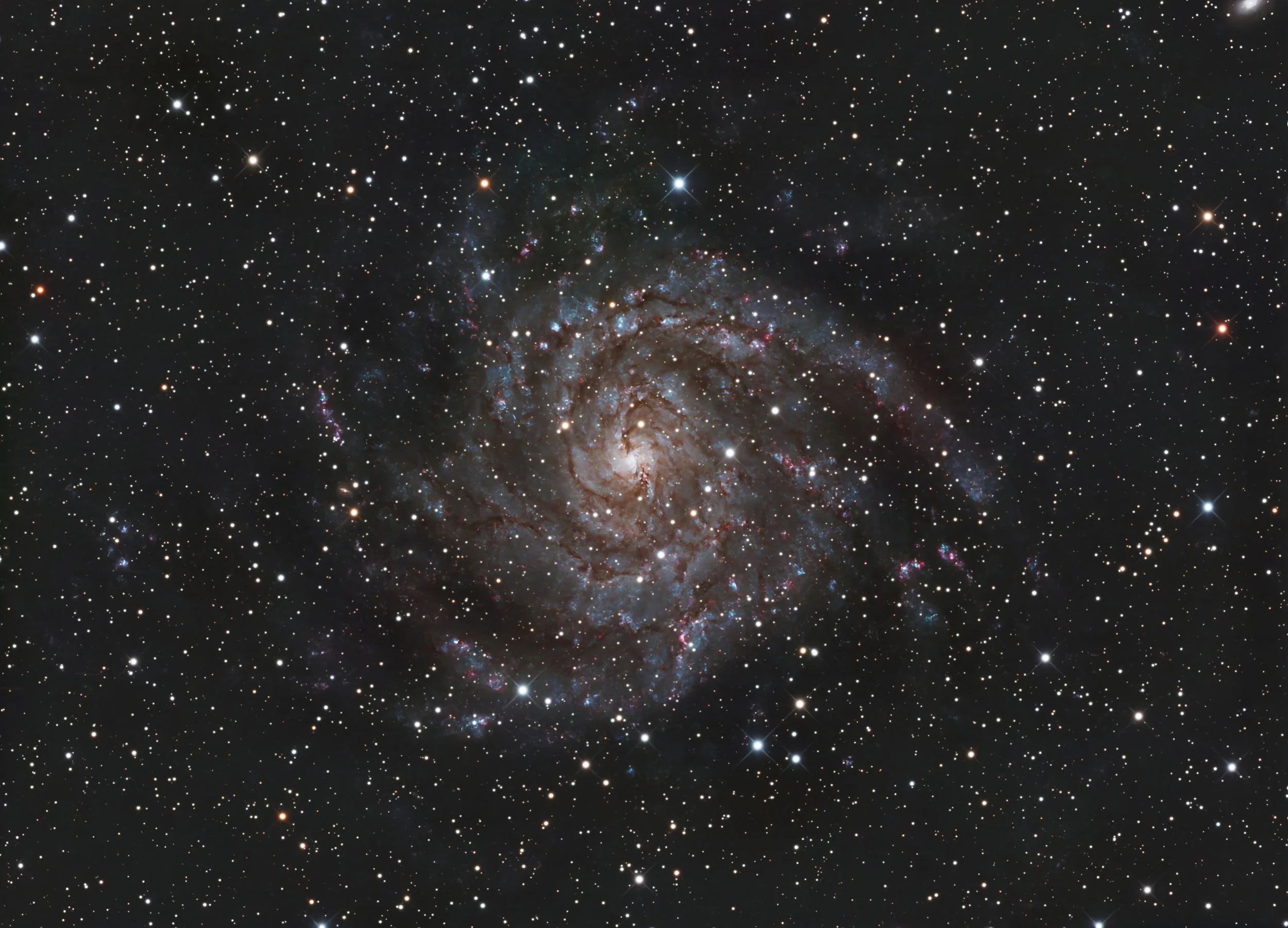
IC 342 – The Hidden Galaxy
IC 342, often called the Hidden Galaxy, lies just 10 million light-years away in the constellation Camelopardalis. Despite its proximity, it is shrouded behind the dense dust of the Milky Way, making it challenging to observe. Its sprawling spiral arms emerge faintly through the obscuring dust, revealing star-forming regions and the complex structure of this nearby galaxy.
This image was captured under dark Bortle-class skies in West Texas using a ROCS 16-inch Ruggedized Military telescope and a QHY600m camera. Careful calibration and long-exposure imaging allowed the faint details of this hidden neighbor to emerge from the galactic foreground, unveiling its subtle luminosity and structure.
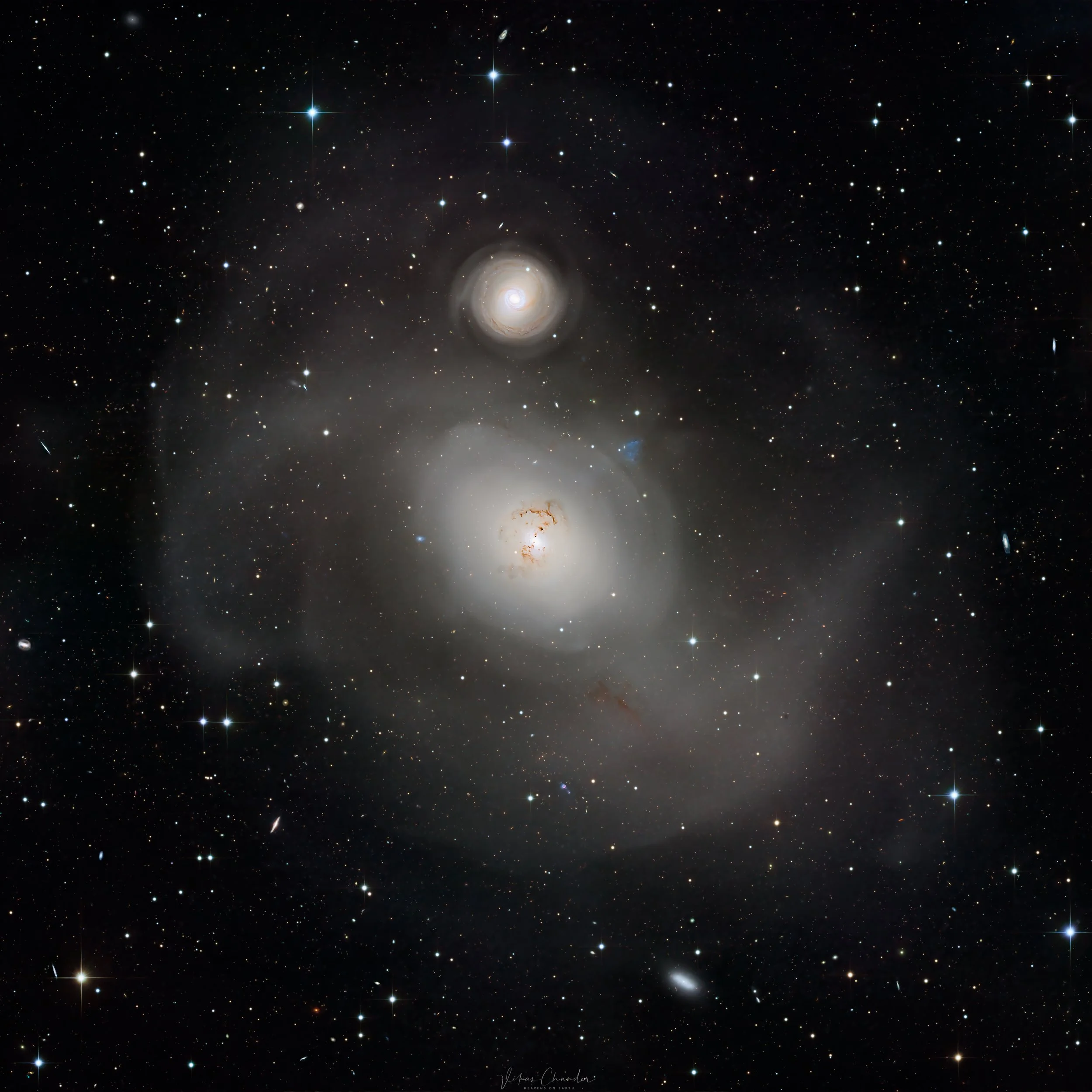
Fornax A and B Galaxies
Fornax A and Fornax B are two distinct galaxies within the Fornax Cluster, a compact assembly of galaxies located about 62 million light-years from Earth. Fornax A, a massive elliptical galaxy, dominates the field with its extended radio lobes, while Fornax B, a smaller companion, adds contrast to this dynamic galactic neighborhood. The image reveals fine structural details and subtle intergalactic features, providing a glimpse into the complexity of this nearby galaxy cluster.
This deep exposure was captured with a Planewave CDK 24-inch telescope and a Moravian C5A-100 mono camera. LRGB and OIII data were obtained through Chroma filters with exposures totaling 44 hours and 30 minutes (Luminance: 208 × 120 s, Red: 208 × 120 s, Green: 207 × 120 s, Blue: 202 × 120 s, OIII: 102 × 600 s). Observations were conducted using a Planewave L-600 mount at Obstech Observatory, and the dataset was processed using NINA and PixInsight for precise calibration, alignment, and combination.

Iris Nebula and Neighborhood
The Iris Nebula (NGC 7023) glows softly amid a delicate tapestry of interstellar dust in the constellation Cepheus. Its central star illuminates the surrounding filaments of gas and dust, producing the characteristic bluish reflection nebula, while fainter tendrils of the surrounding clouds hint at the subtle complexity of this star-forming region. This field also captures the neighboring faint nebulae, revealing the intricate structures of the local interstellar medium.
This image was composed from 380 exposures of 300 seconds in Luminance with drizzle applied twice, along with 90 exposures of 300 seconds each in RGB, also drizzled twice. Calibration frames included 20 flats of 5 seconds at -10°C, 30 dark flats of 5 seconds at -10°C, and 30 dark frames of 300 seconds at -10°C, ensuring precise background and color fidelity.
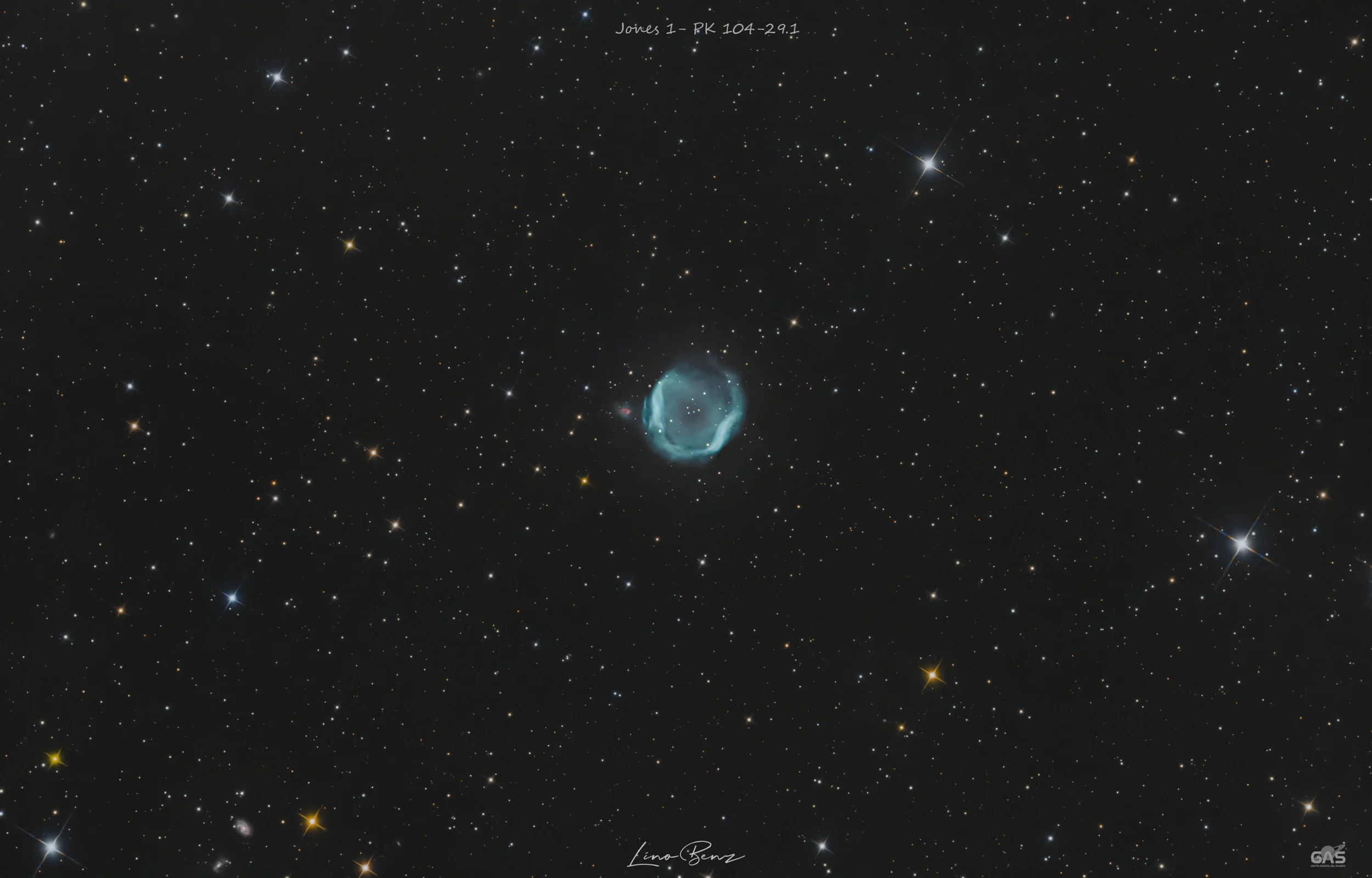
Jones 1 PK 104-29.1
Drifting quietly in the constellation Pegasus, Jones 1 (PK 104–29.1) is a delicate planetary nebula about 2,300 light-years from Earth. Discovered in 1941 by astronomer Rebecca Jones, this expansive structure spans roughly four light-years across. Its faint, filamentary shell marks the remnants of a sunlike star that has shed its outer layers, leaving behind a small, hot white dwarf at the center.
Seen in long exposures, the nebula’s ghostly arcs trace the final breaths of stellar evolution, glowing softly as ultraviolet light from the white dwarf excites the surrounding gas. Though barely visible through small telescopes, Jones 1 reveals its full complexity in deep images, where its ethereal loops and knots seem to float against the rich starfield of Pegasus.
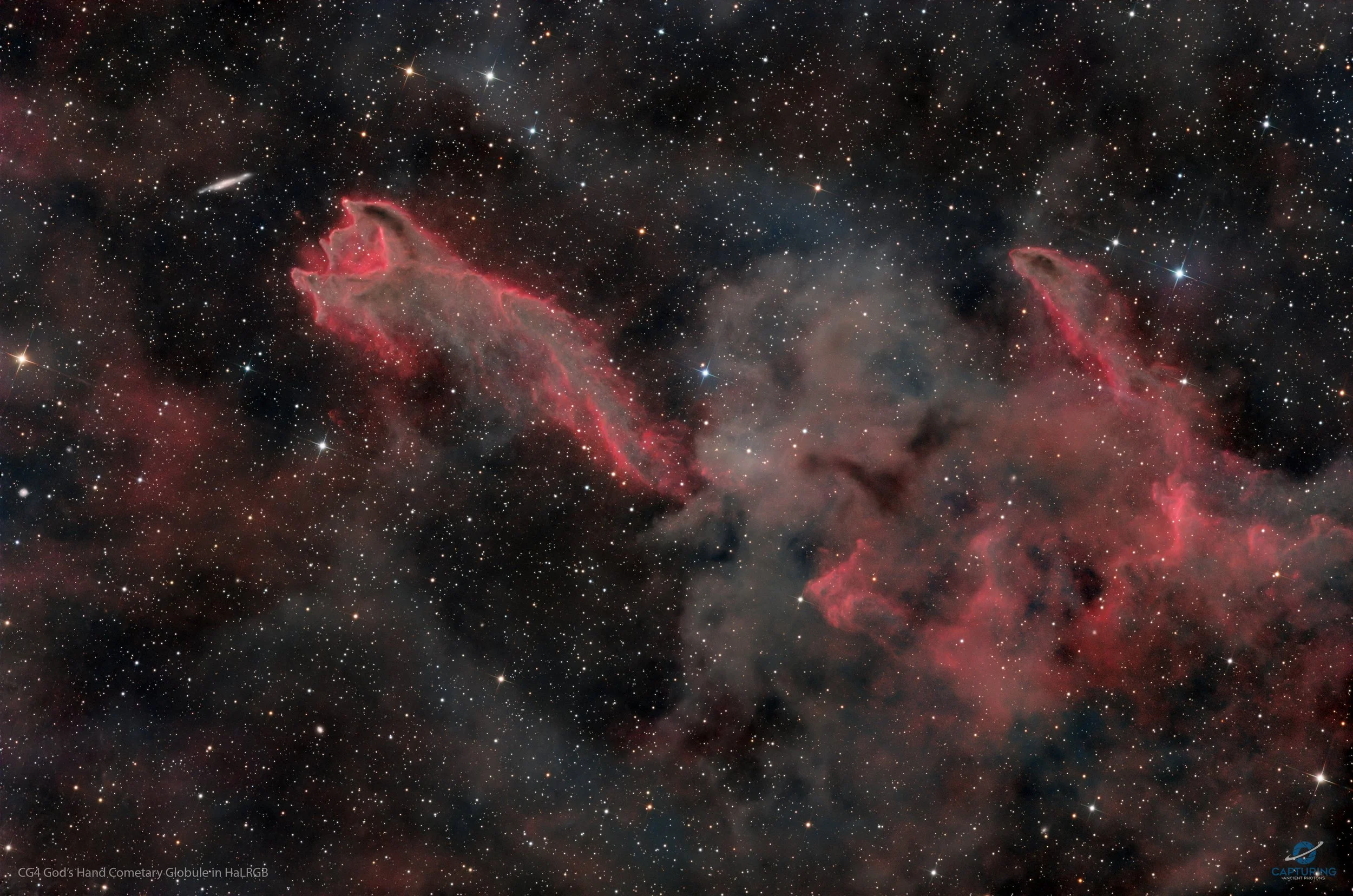
CG4 – The Hand of Creation
In the southern constellation Puppis, about 1,300 light-years away, lies the striking cometary globule CG4, often nicknamed God’s Hand. This peculiar formation of dust and gas appears to reach across space as if grasping toward the small edge-on galaxy seen near its fingertips. The globule’s glowing rim is illuminated by nearby hot stars, while its dense interior—rich in molecular gas—remains dark, concealing the raw material for potential future star formation.
Captured from Perth, Western Australia, this HaLRGB composition reveals the faint red emission of hydrogen gas surrounding the dusty structure. CG4 is part of the broader Gum Nebula complex, a vast region shaped by ancient supernova explosions. Despite its ominous, reaching form, this cosmic hand is a cradle of creation, slowly sculpted by stellar winds and radiation over millions of years.
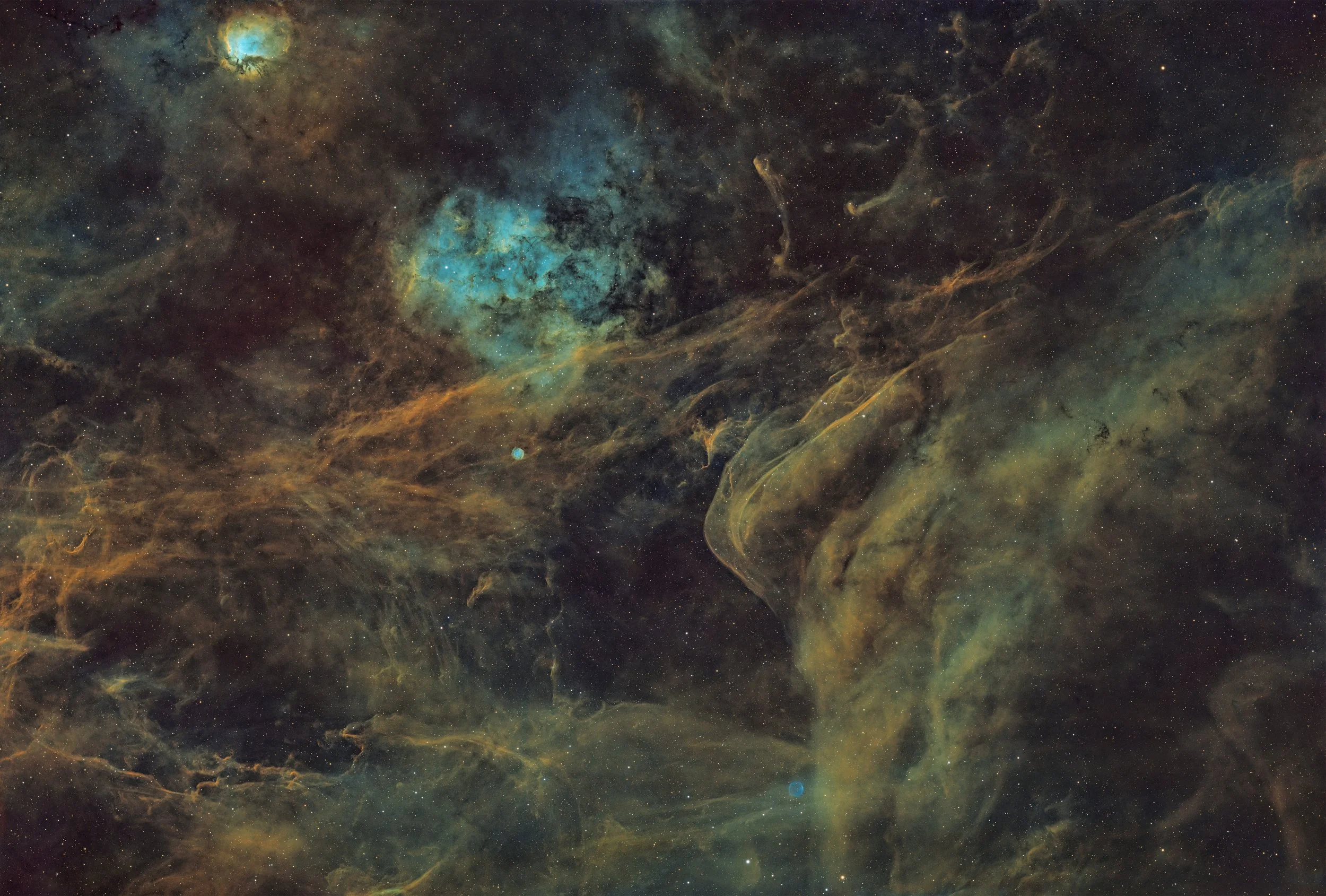
Cosmic Structures in the Sh2-115 Region
Located in the constellation Cygnus, the emission nebula Sh2-115 stretches across a rich region of the Milky Way filled with glowing gas, dark filaments, and young stars. This vast cloud of ionized hydrogen lies about 7,500 light-years away and is energized by the ultraviolet radiation from nearby hot, massive stars. Complex pillars and wisps of interstellar material sculpted by stellar winds give this nebula a distinctly textured appearance, revealing the dynamic processes at play within star-forming regions of our galaxy.
This detailed narrowband image combines 100×10-minute exposures in H-alpha (7nm), 70×10-minute in OIII (3nm), and 38×10-minute in SII (3nm). The resulting SHO composition highlights subtle differences in chemical composition and temperature, mapping hydrogen in red, oxygen in blue, and sulfur in gold. Together they unveil the intricate cosmic structures hidden within Sh2-115.
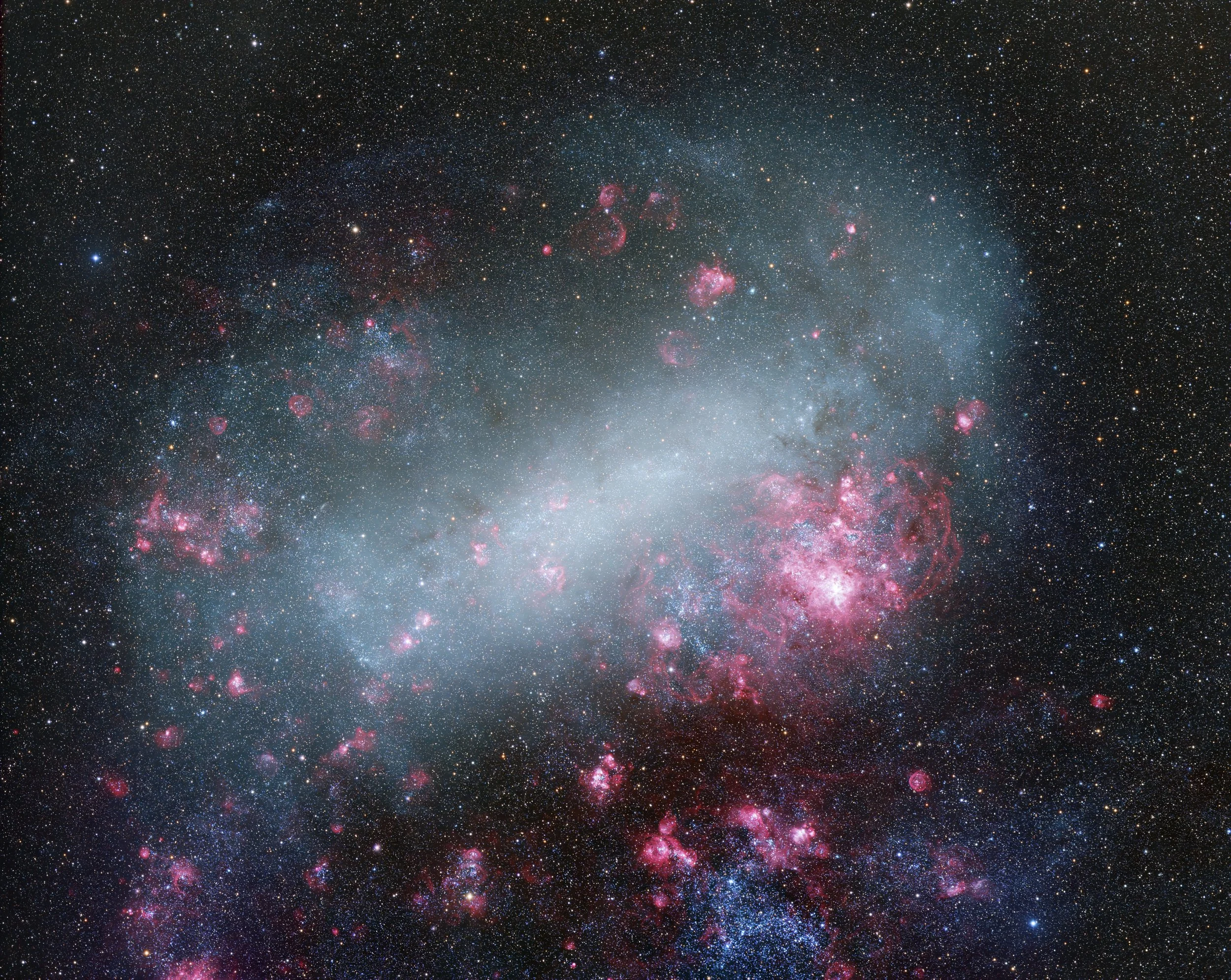
The Large Magellanic Cloud in HLRGB and HDR
Spanning over 14,000 light-years, the Large Magellanic Cloud (LMC) is one of the Milky Way’s closest galactic neighbors, orbiting at a distance of roughly 160,000 light-years. This irregular dwarf galaxy is rich in star-forming regions, the most famous being the bright pink Tarantula Nebula (NGC 2070) seen near the center. Waves of hydrogen emission and intricate dust lanes trace massive stellar nurseries that continue to shape the galaxy’s dynamic structure.
This HLRGB and HDR composition reveals the LMC’s complex interplay of glowing gas, young blue star clusters, and older stellar populations scattered throughout its disk. The careful combination of data layers allows both the bright star-forming regions and the faint galactic halo to be visible in a single image, offering a balanced and detailed portrait of our neighboring galaxy.