

AAPOD2 Image Archives
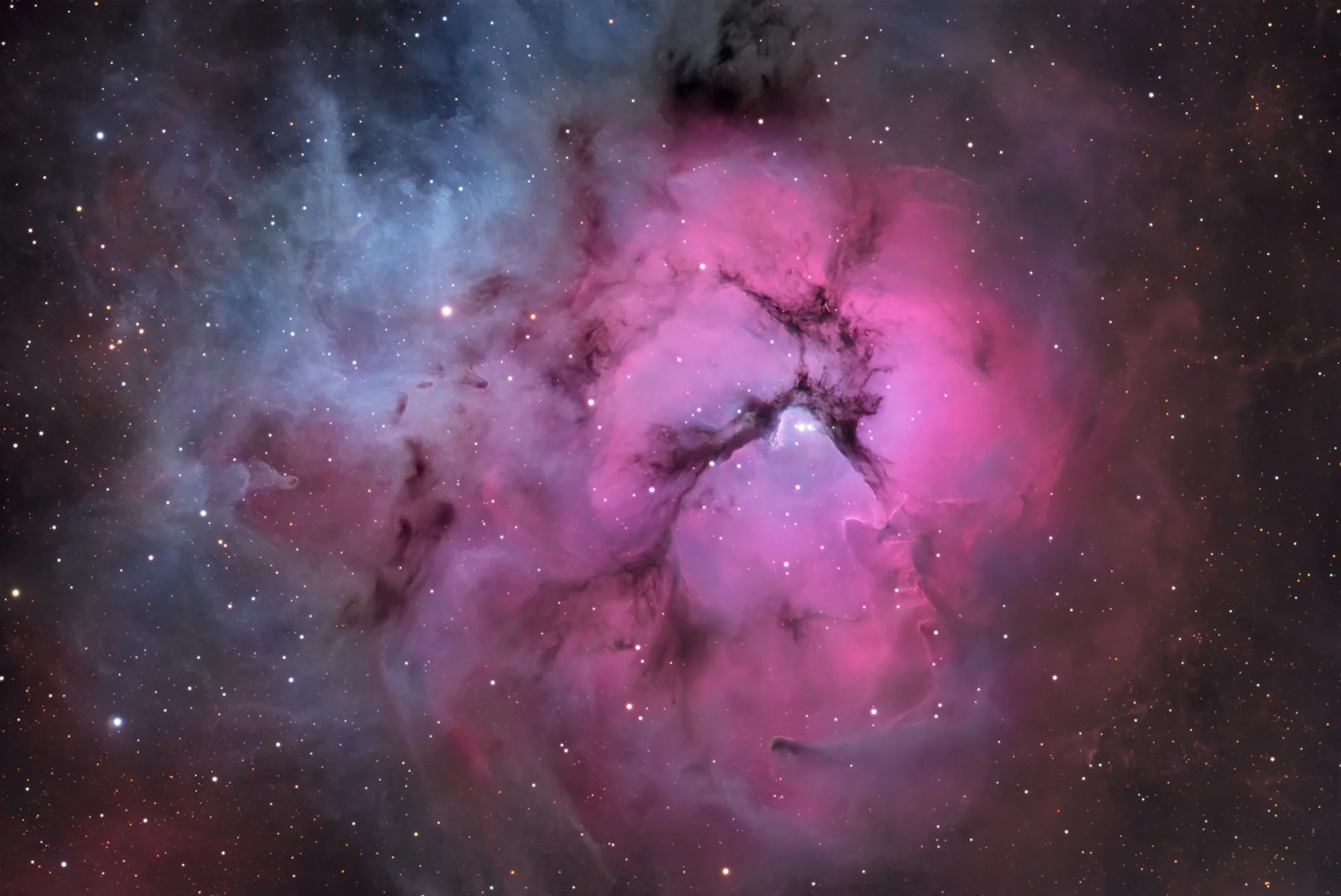
M20 Trifid Nebula
This high-contrast image of the Trifid Nebula (Messier 20) captures a dynamic star-forming region in the constellation Sagittarius, showcasing the complex interplay between young, massive stars and interstellar matter. The distinct tri-lobed emission region shines vividly in characteristic reddish-pink tones, powered by intense ultraviolet radiation from a central massive star that ionizes surrounding hydrogen gas (H II region). Adjacent to the emission nebula, brilliant blue reflection regions illuminate dusty clouds of fine silicate and carbonaceous grains that scatter starlight. Cutting through the bright core are striking dark absorption lanes—dense, opaque filaments of cosmic dust blocking background light, where cold molecular gas continues to collapse to seed future generations of stars.
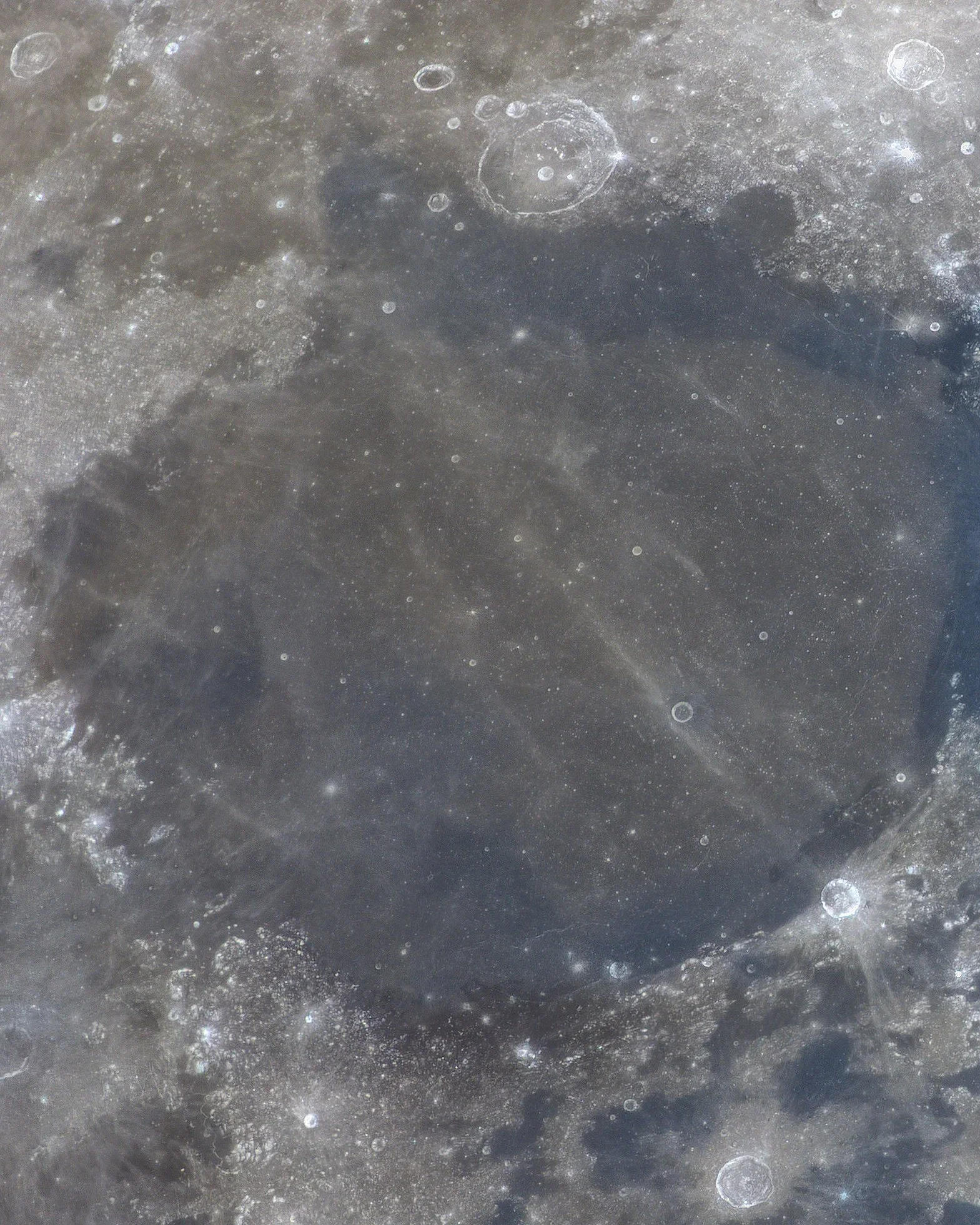
Sea of Serenity in mineral detail
This high-contrast mineral image of Mare Serenitatis (Sea of Serenity) captures the rich geological history of an ancient lunar impact basin flooded by volcanic basalt. The distinct tonal variations across the basaltic plains highlight regional differences in mineral chemistry, where darker, low-albedo deposits signify high concentrations of titanium dioxide and iron-rich minerals such as ilmenite and pyroxene. In contrast, bright impact features and crater rims—such as Posidonius and Bessel—display high-albedo ejecta blankets composed of pulverized, pristine silicate minerals like plagioclase feldspar (anorthosite) excavated from beneath the regolith, illustrating the interplay between volcanic effusion and impact cratering on the lunar surface.
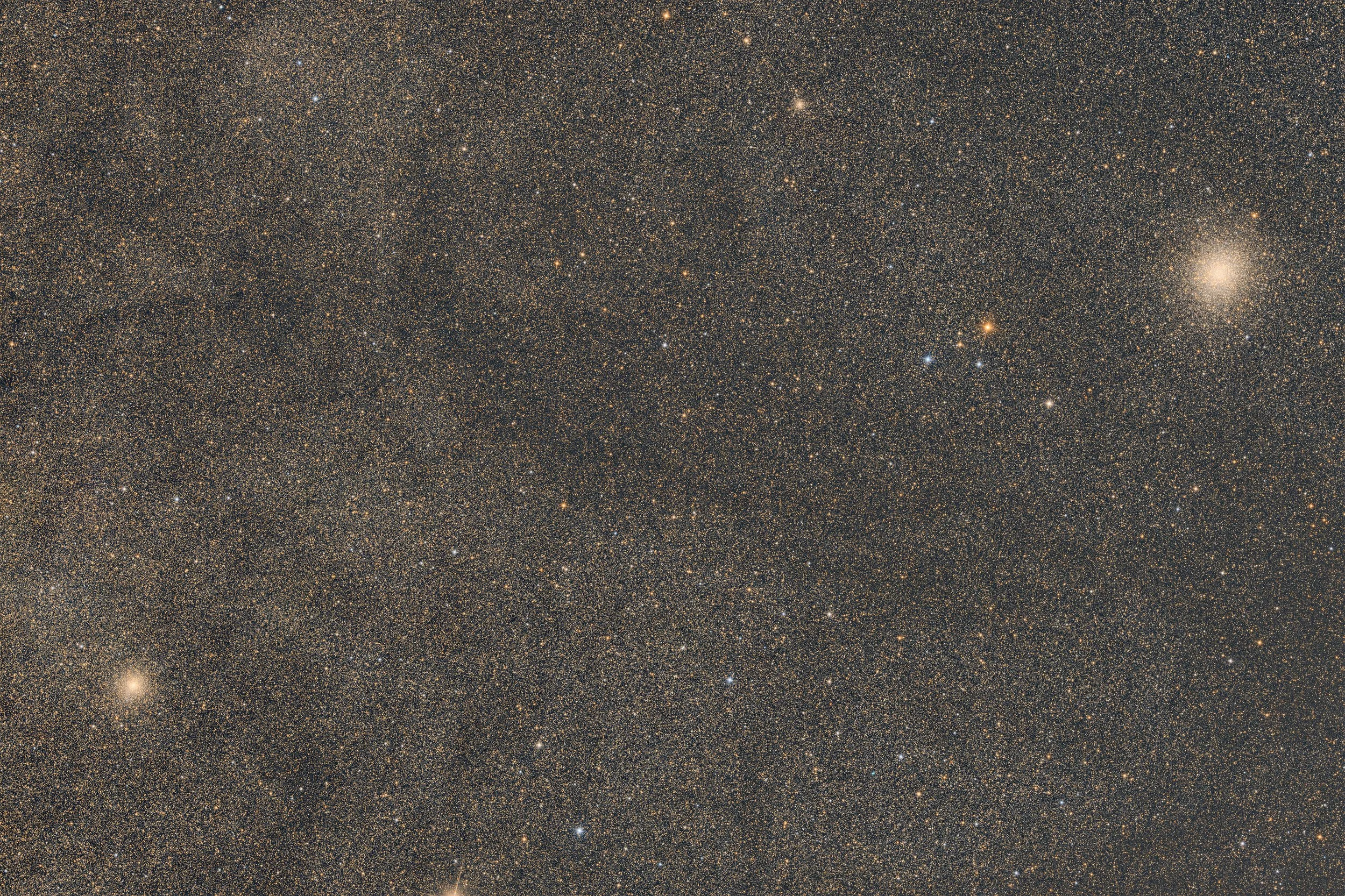
Clusters in a Sea of Stars – M22 + M28
This wide-field deep-sky image captures two of the southern sky's finest globular clusters, Messier 22 (M22) and Messier 28 (M28), set against the dense star fields of the Milky Way's central bulge in the constellation Sagittarius.
Located approximately 10,600 light-years away, M22 is one of the closest and brightest globular clusters to Earth, containing hundreds of thousands of ancient stars. Nearby lies M28, a more compact cluster located roughly 18,000 light-years away. Embedded across this field are several notable deep-sky objects, including the planetary nebulae NGC 6629, NGC 6644, and the intracluster planetary nebula GJJC 1, alongside numerous variable and carbon stars.
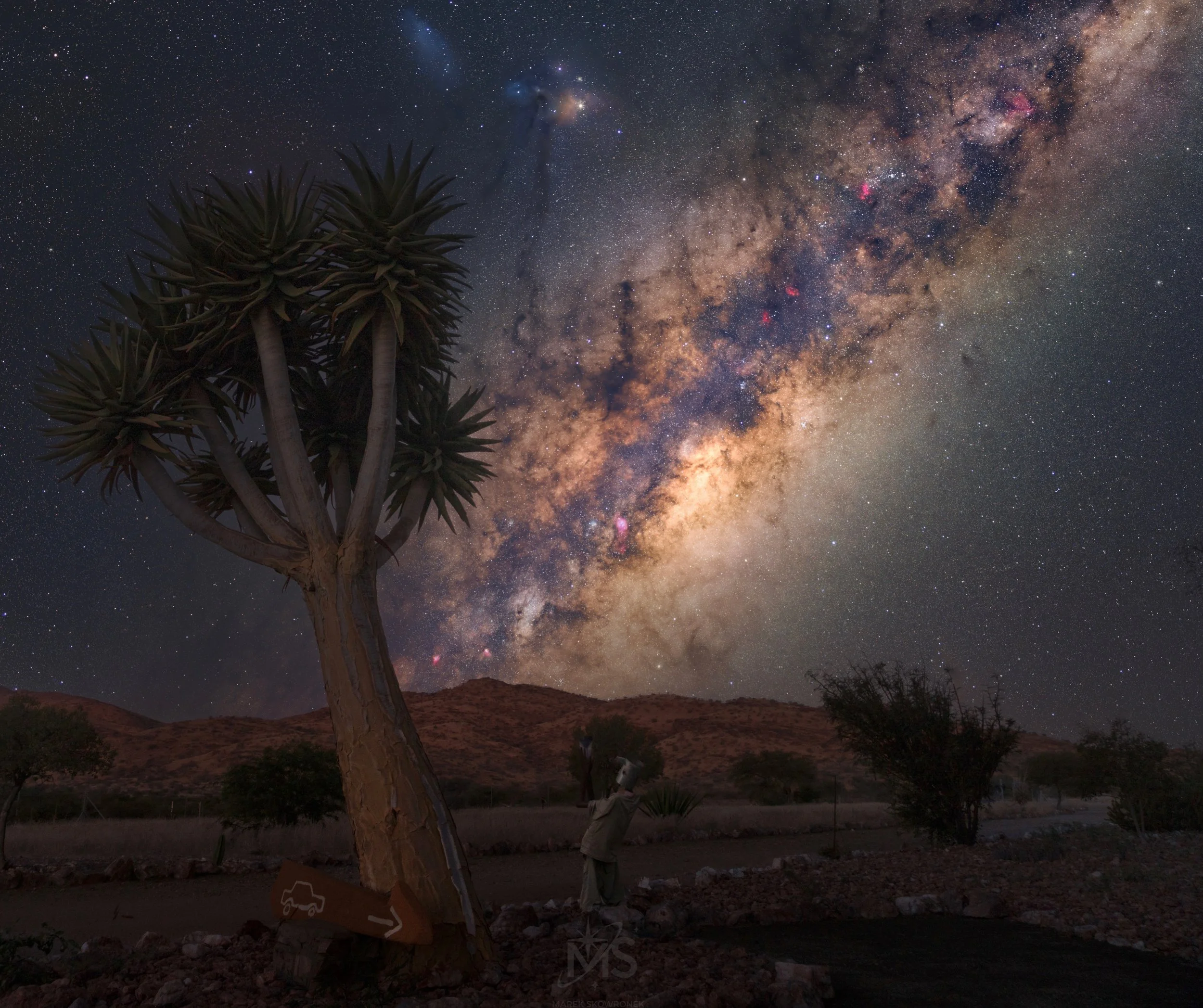
Kokerboom Under the Namibian Milky Way
Captured from the deep, dark skies of the Namib Desert at the Rooisand Desert Ranch in Namibia, this striking composite image highlights a native quiver tree (Aloe dichotoma) silhouetted against the core of the Milky Way. Known locally as the Kokerboom, these iconic desert aloe plants store water in their fleshy trunks to endure extreme heat and can live for hundreds of years.
Rho Ophiuchi dancing in Hydrogen-alpha
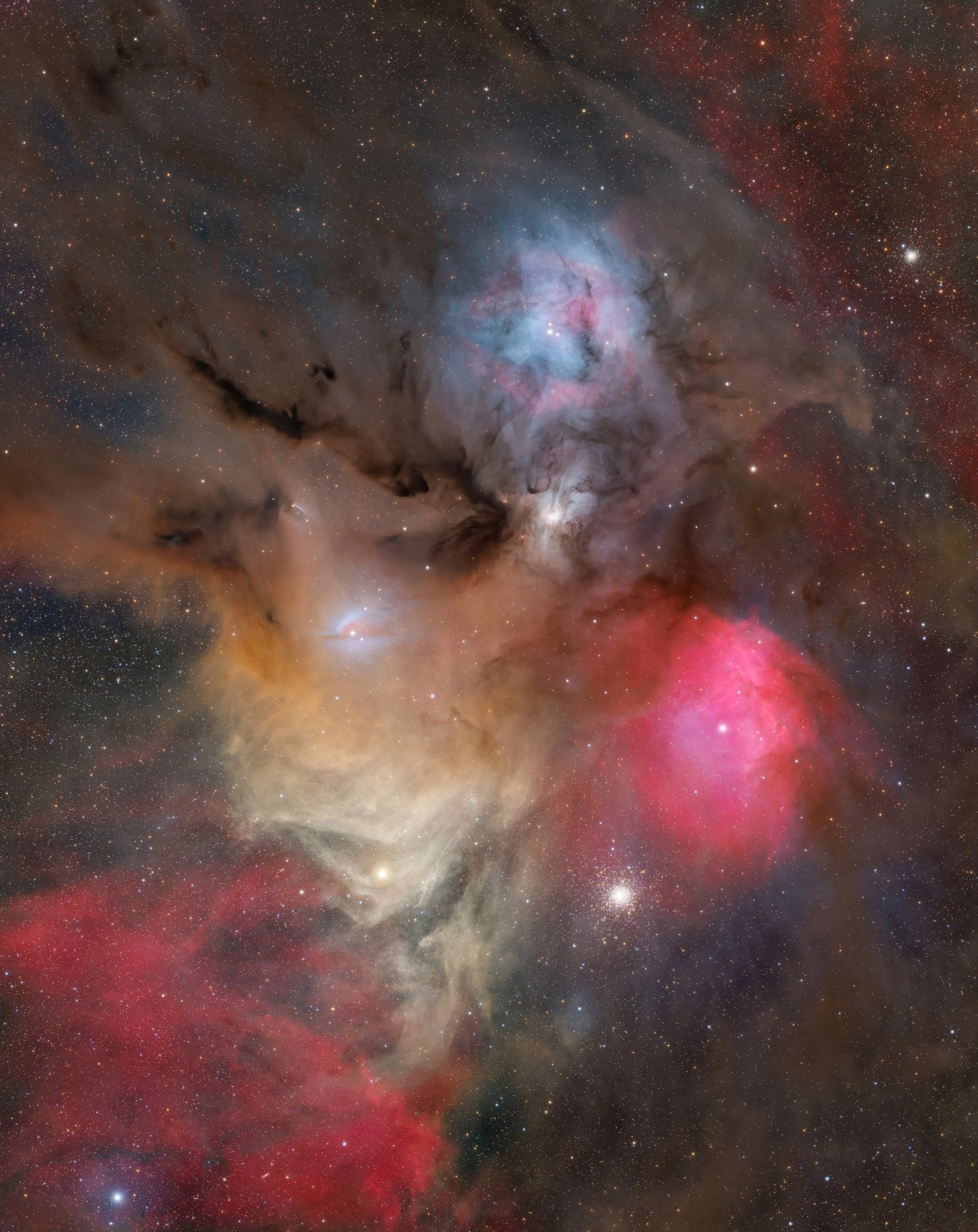
Located approximately 460 light-years away in the constellation Ophiuchus, the Rho Ophiuchi cloud complex is one of the closest active star-forming regions to our solar system. Captured here in narrow-band Hydrogen-alpha (H$\alpha$) emission along with RGB broadband data, the image highlights the glowing ionized hydrogen gas ($\text{H II}$) energetic young stars carve out as intense ultraviolet radiation strips electrons from neutral hydrogen atoms. As these electrons recombine, they emit light at the characteristic Balmer-alpha wavelength of 656.3 nanometers, tracing the turbulent shock fronts, wispy filaments, and expanding cavity walls where radiation pressure and stellar winds sculpt the surrounding molecular cloud. Interspersed with dense lane structures of interstellar dust that absorb background starlight, this region provides a clear view into the early dynamic stages of stellar evolution and protostellar disk formation
Comet 10P-Temple
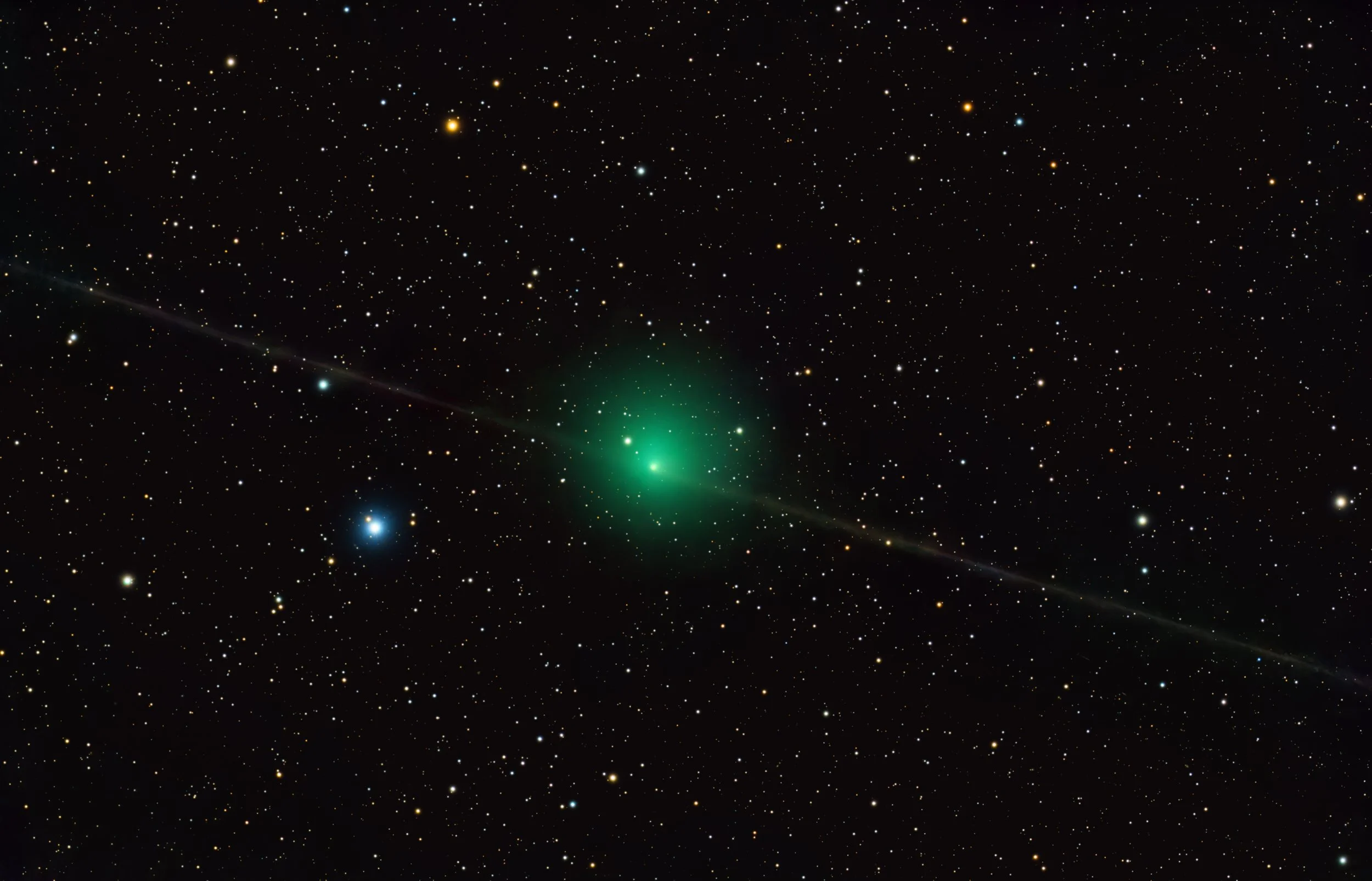
Comet 10P/Tempel 2 is a short-period, Jupiter-family comet with an orbital period of approximately 5.4 years. Captured in this telescopic exposure from July 21, 2026, the comet displays a bright, well-condensed nuclear region surrounded by a characteristic greenish coma, a hue primarily produced by the fluorescence of diatomic carbon and cyanogen gases as volatile ice sublimates under solar ultraviolet radiation. Extending across the nucleus is a thin, linear feature—not a typical radiation-driven dust tail, but a permanent debris trail composed of larger millimeter- to centimeter-sized particles deposited over past perihelion passages. Because Earth crossed the comet’s orbital plane around July 20, this edge-on viewing geometry enhanced the trail's apparent surface brightness, projecting it as a striking, narrow spike while the comet shone at magnitude 13.4 in the constellation Capricornus, roughly 64.4 million kilometers from Earth.
Flaming Skull Nebula SH2-68 with cometary like tail
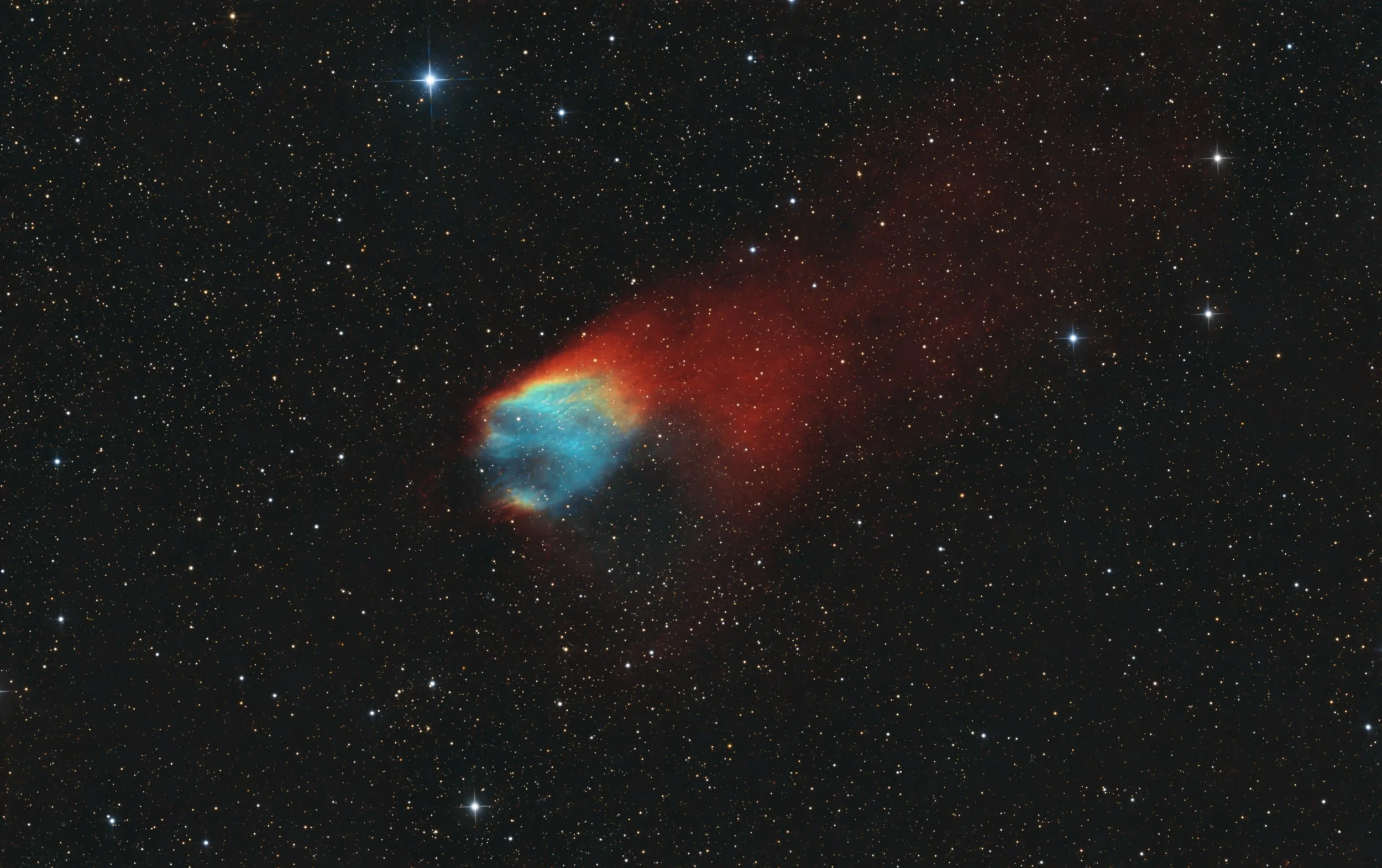
Located roughly 1,100 light-years away in the constellation Serpens, Sh2-68—dramatically nicknamed the Flaming Skull Nebula—is an ancient, low-surface-brightness planetary nebula estimated to be at least 45,000 years old.
What makes this target particularly fascinating is its strong interaction with the surrounding interstellar medium. As its high-proper-motion central white dwarf star travels through space, the expanding shell of ionized gas is stripped back, trailing an extended, cometary-like tail of hydrogen emission behind a glowing, blue oxygen-rich core.
NGC 7129: Cosmic Rose in Cepheus
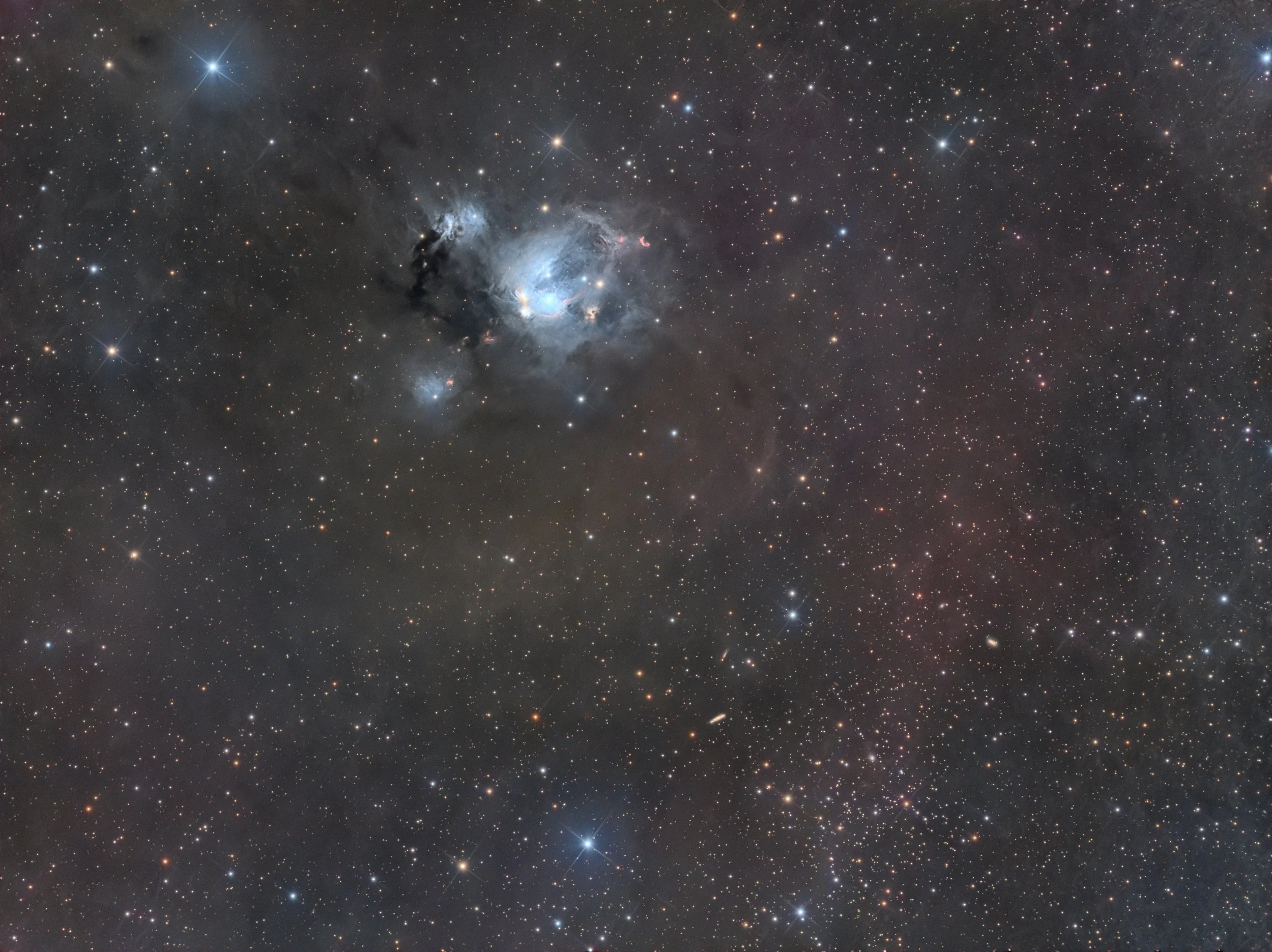
NGC 7129: Cosmic Rose in Cepheus
Nestled roughly 3,300 light-years away in the constellation Cepheus, NGC 7129 is a striking reflection nebula illuminated by a young open cluster of stars. Glowing like a stellar rose amidst cosmic dust, this active star-forming region features vibrant blue light reflected off interstellar dust clouds surrounding a cluster of stars only a few million years old.
Captured over 11.6 hours of exposure using a broad-band LRGB setup from the backyard observatory "Videre Videnda" in Oisterwijk, Netherlands, this image reveals the delicate, intricate structures and ambient dust trailing through the rich field of Cepheus.
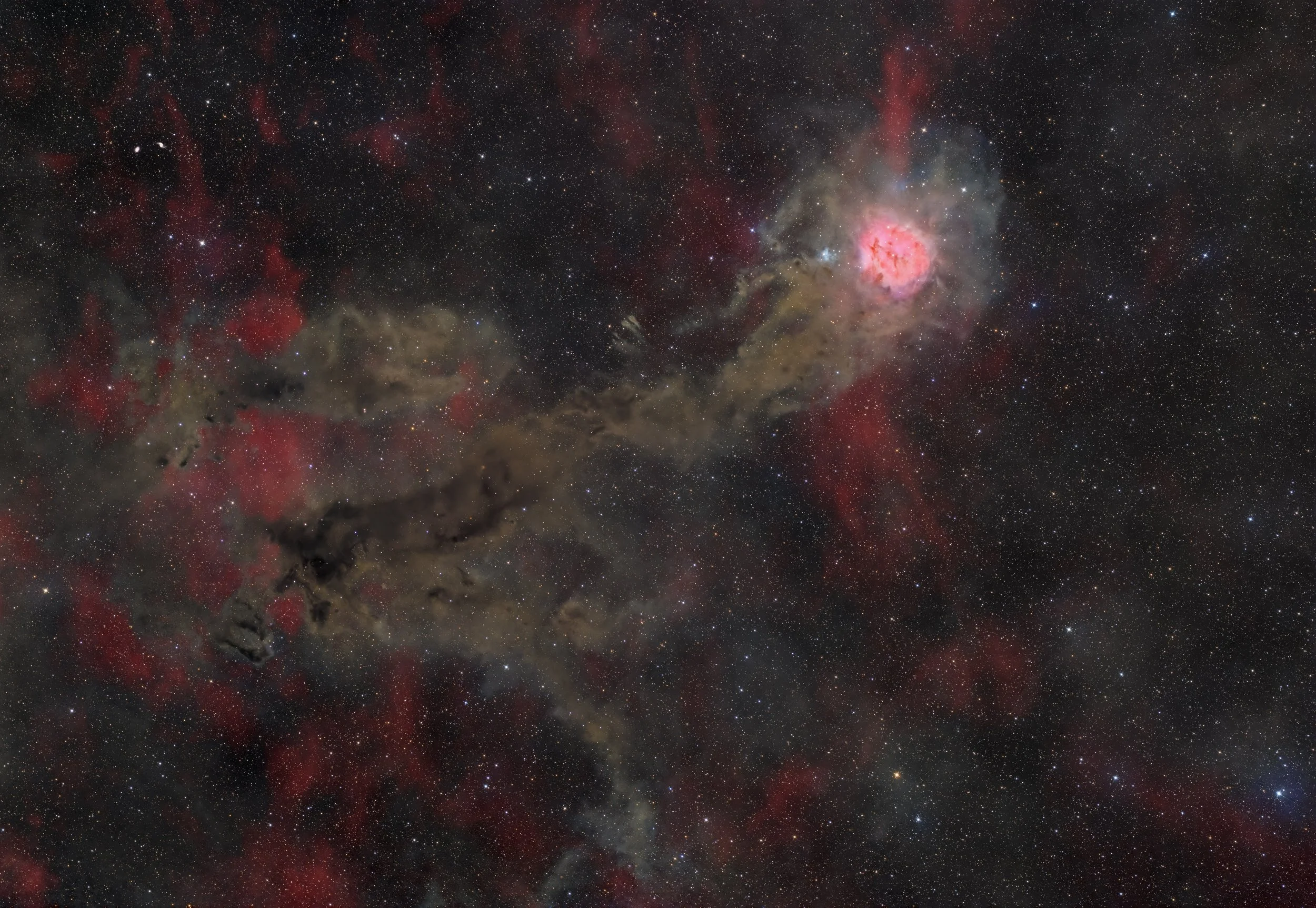
Ic 5146 HA RGB - The cocoon nebula
Located approximately 4,000 light-years away in the constellation Cygnus, IC 5146—famously known as the Cocoon Nebula—presents a striking cosmic display of emission, reflection, and absorption nebulae. Glowing softly at the end of a long dark dust cloud, this star-forming region shines with vibrant pinkish-red Hydrogen-alpha emissions surrounding a central cluster of young stars.
Captured over 11 hours of exposure using a broad-band RGB and dual-band narrowband filter setup, this image beautifully highlights the intricate dark dust lanes trailing into the dense, star-filled cosmic backdrop.
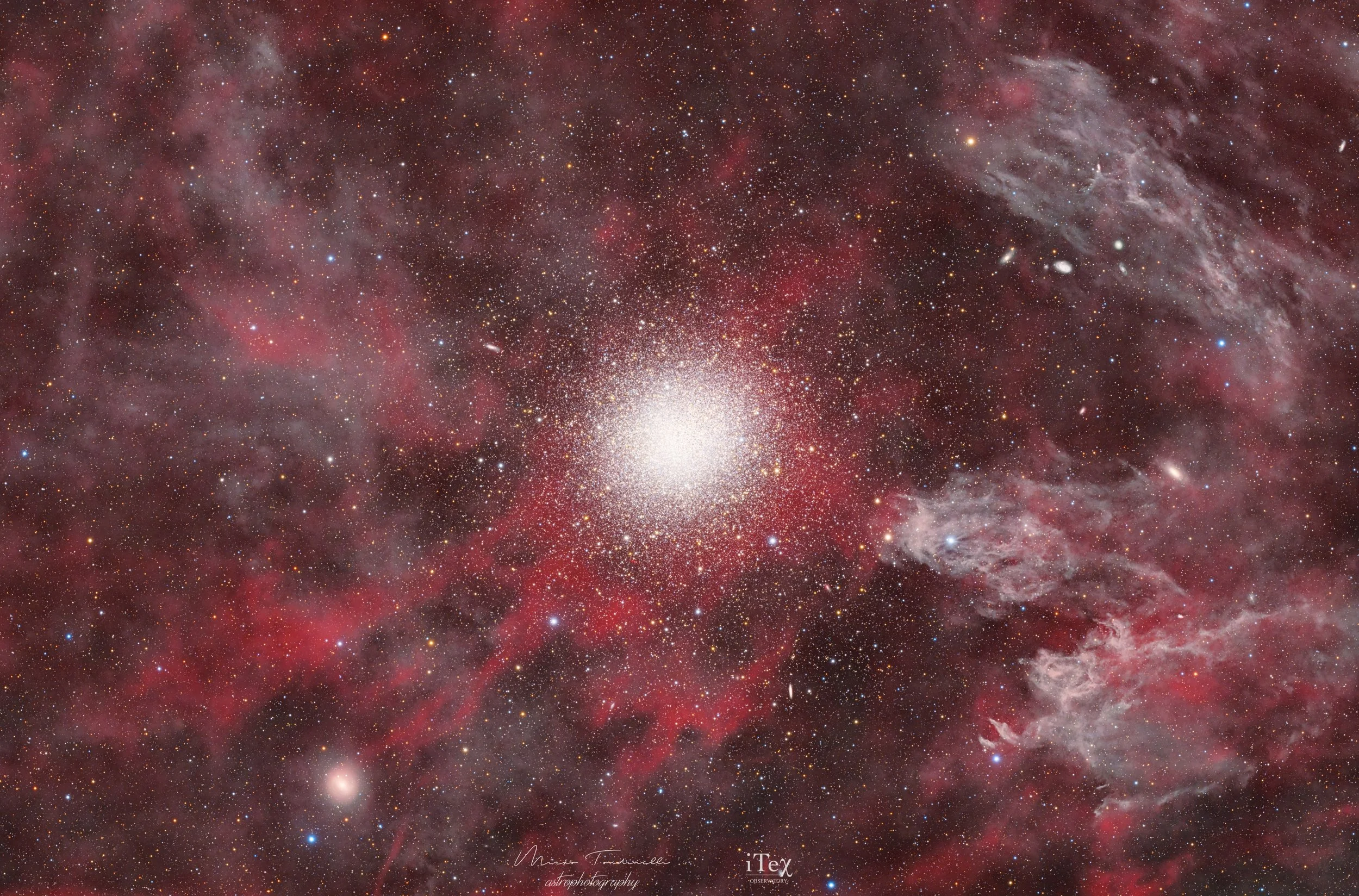
OMEGA CENTAURI HALRGB
Located roughly 17,000 light-years away in the constellation Centaurus, Omega Centauri (NGC 5139) is the largest and most luminous globular cluster in the Milky Way, housing over 10 million stars. This deep H-alpha and LRGB (HALRGB) composite reveals the brilliant, densely packed stellar core alongside subtle surrounding interstellar structures and faint atmospheric glow across the deep field.
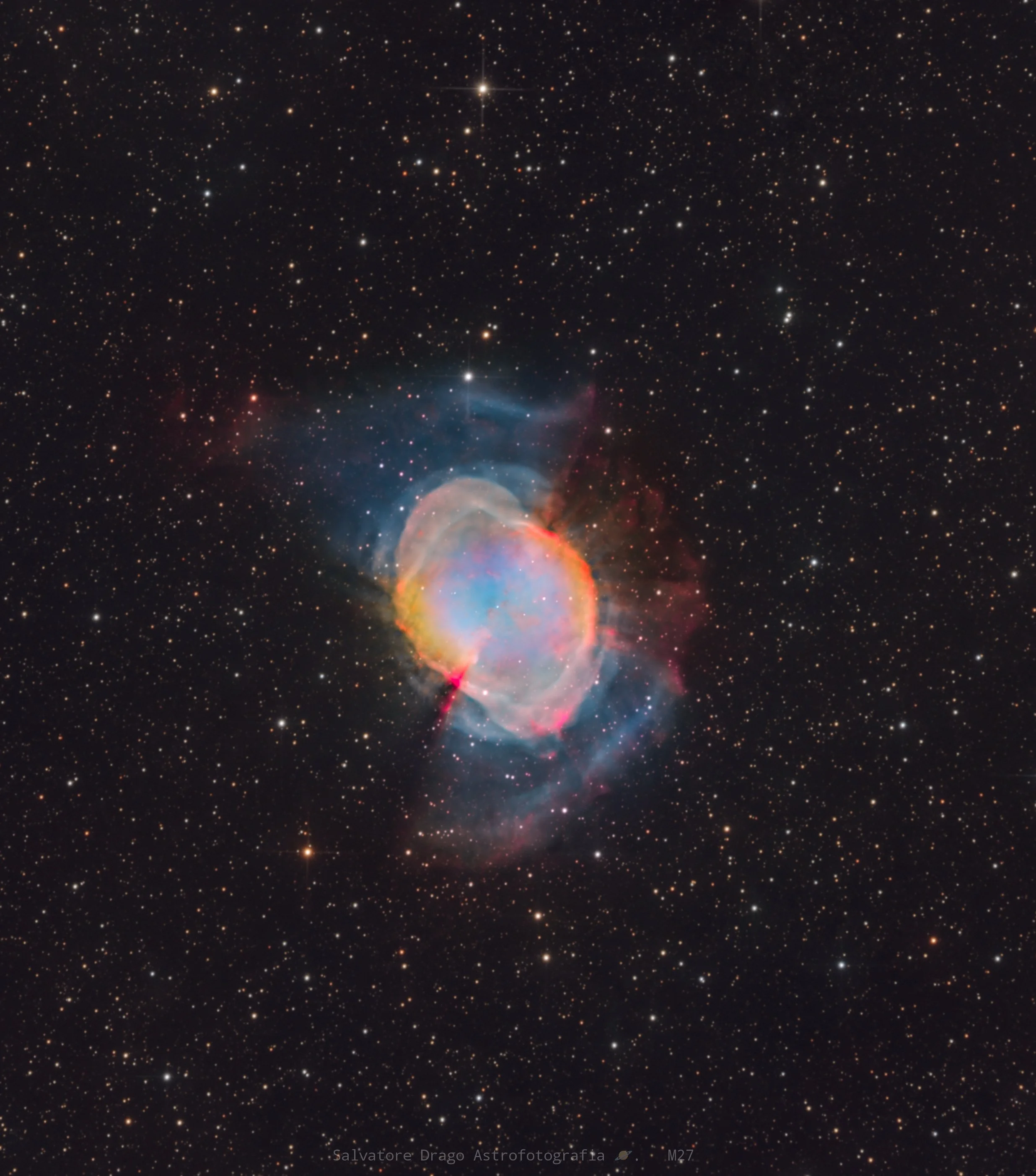
Whispers of a Dying Star: Messier 27
Messier 27 is a prominent planetary nebula representing the late evolutionary stage of an intermediate-mass, Sun-like star. The object features a classic bipolar expansion geometry, driven by stellar wind ejection from the hot central white dwarf remnant. The image shows a bright, double-lobed central core surrounded by faint, low-surface-brightness outer halos, illustrating the dynamic mass-loss history during the asymptotic giant branch (AGB) phase.
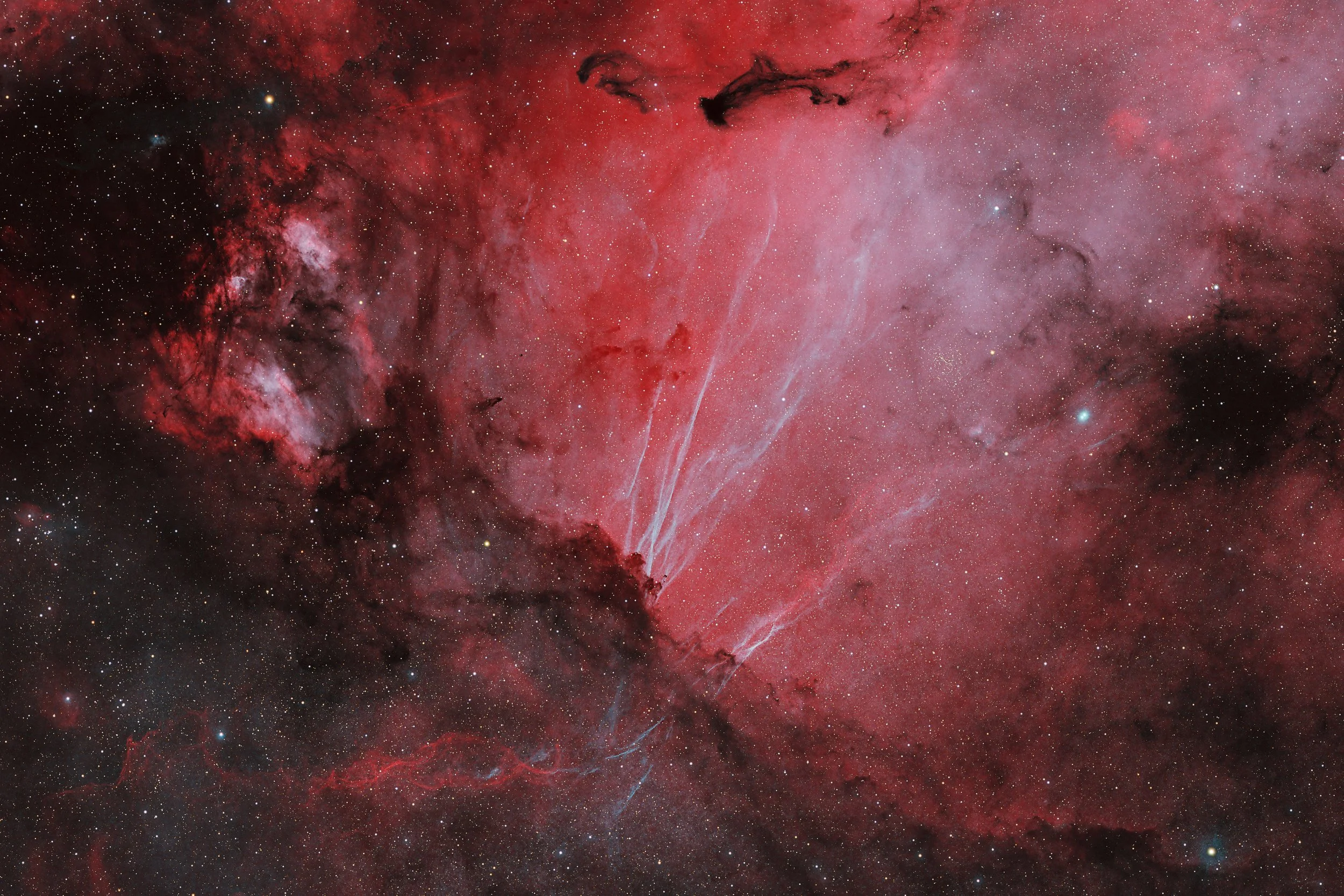
SNR G013.3-01.3 and its long, tightly grouped, glowing filaments
Tangled in the crowded starfields near M24 in Sagittarius, SNR G013.3-01.3 showcases delicate, tightly grouped ribbons of glowing interstellar gas. Swept up and heated by an expanding supernova shockwave, these faint filaments offer a vivid window into the dramatic lifecycle of massive stars.
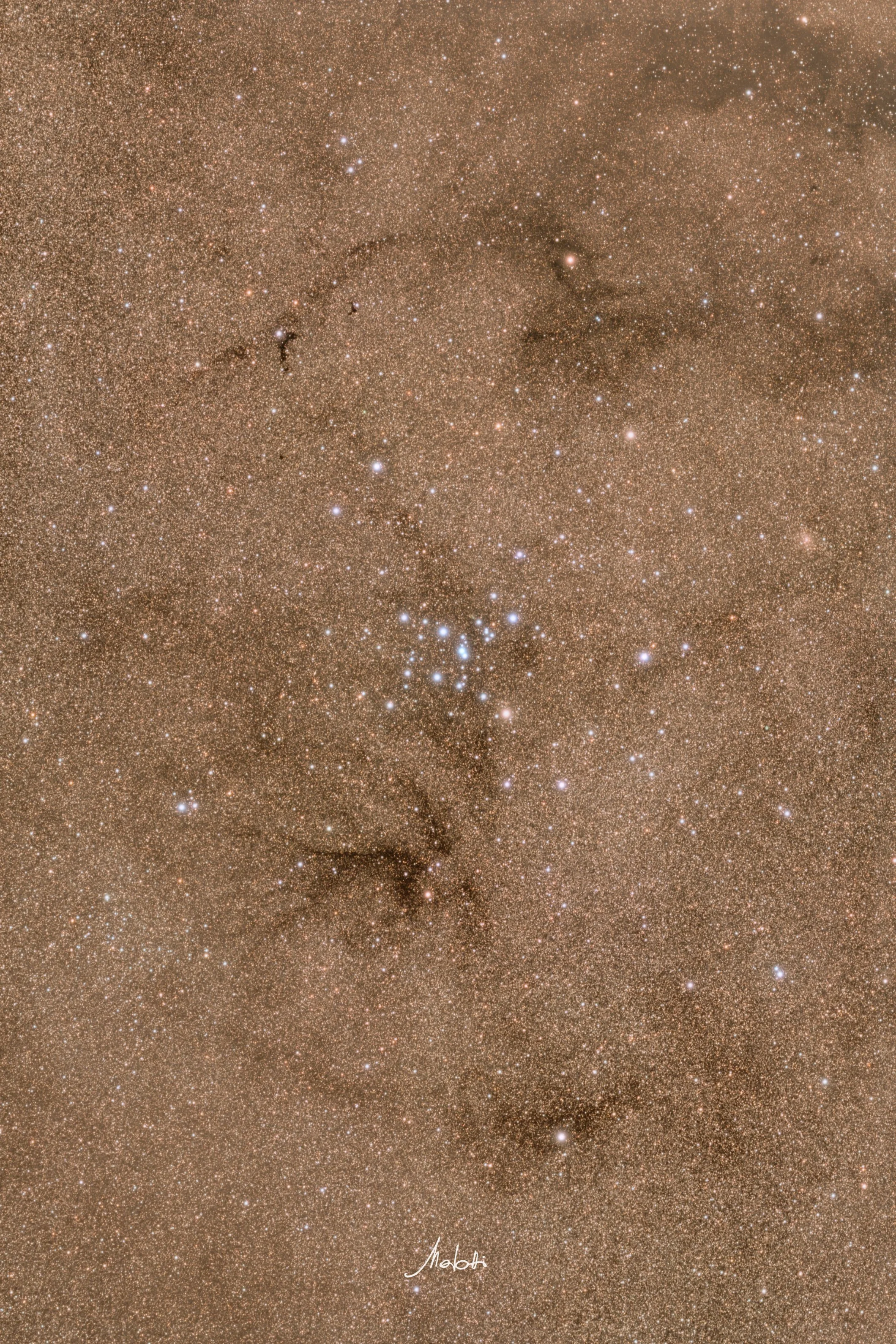
Ptolemy's Cluster (M7)
Ptolemy's Cluster (Messier 7 / NGC 6475) is a prominent open cluster situated approximately 980 light-years away in the constellation Scorpius, near the tail of the celestial scorpion. Spanning an estimated diameter of 25 light-years (with an angular size of 80 arcminutes), this gravitationally bound stellar grouping contains around 80 to 100 member stars that co-formed approximately 220 million years ago from the same interstellar gas and dust cloud. Projected directly against the rich star fields and dark absorption lanes of the inner Milky Way, the cluster is dominated by luminous, main-sequence stars, primarily spectral class A0, along with evolving yellow giants, the most massive of which will eventually terminate as supernovae while weaker gravitational pull slowly allows the remaining population to disperse into the galactic field over time.
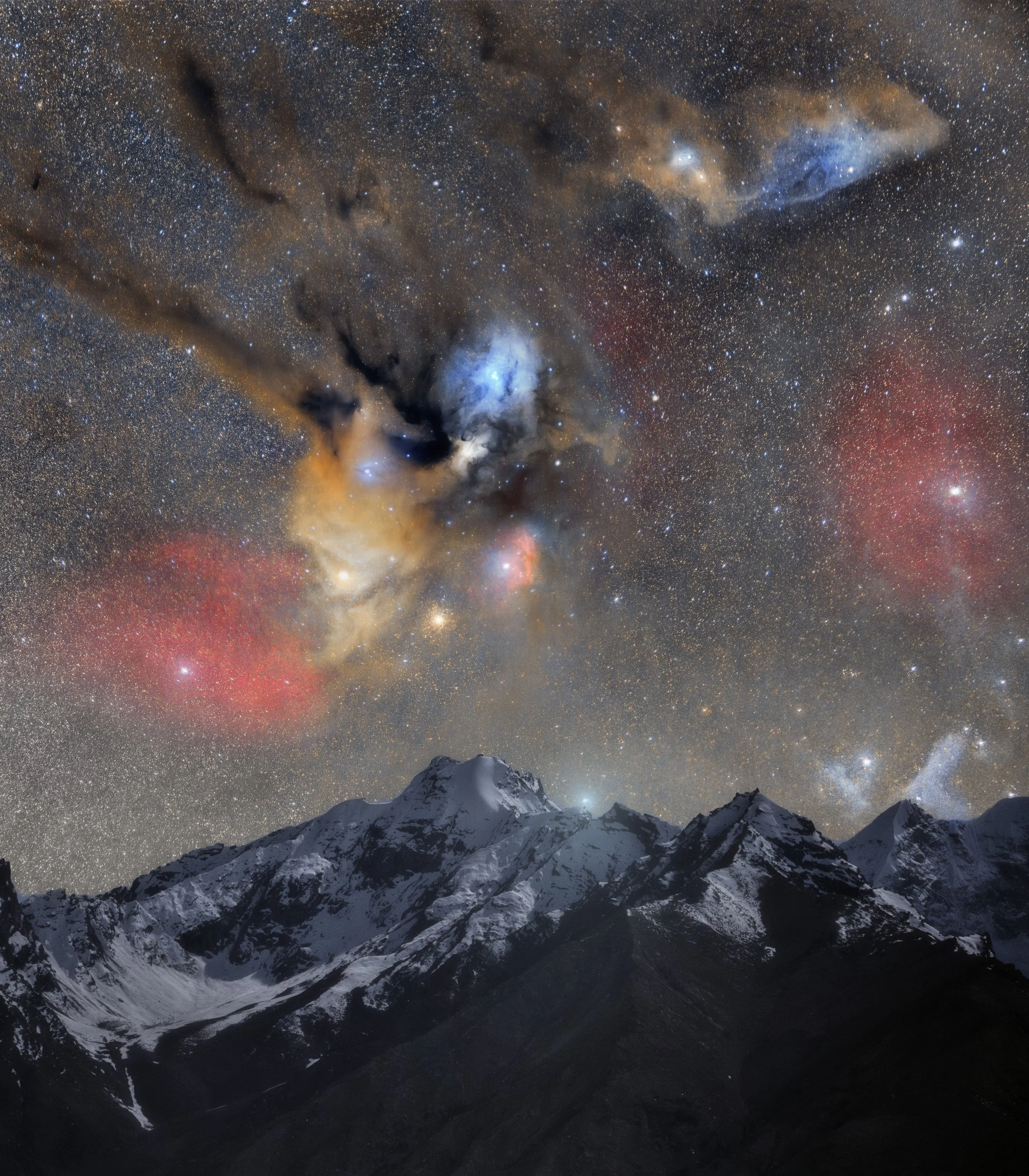
Garden of Nebulae
The Rho Ophiuchi dark and emission nebulae complex, featuring at least seven distinct nebulae, sets gracefully behind the snow-capped peaks of Padum, Zanskar, India.
Captured using a Sony A7C II with a Samyang 135mm lens at f/1.8 mounted on a star tracker, a fast aperture proved essential for pulling out faint dust lanes and nebular glow, combining a tracked 200-frame sky stack with a sharp foreground exposure.
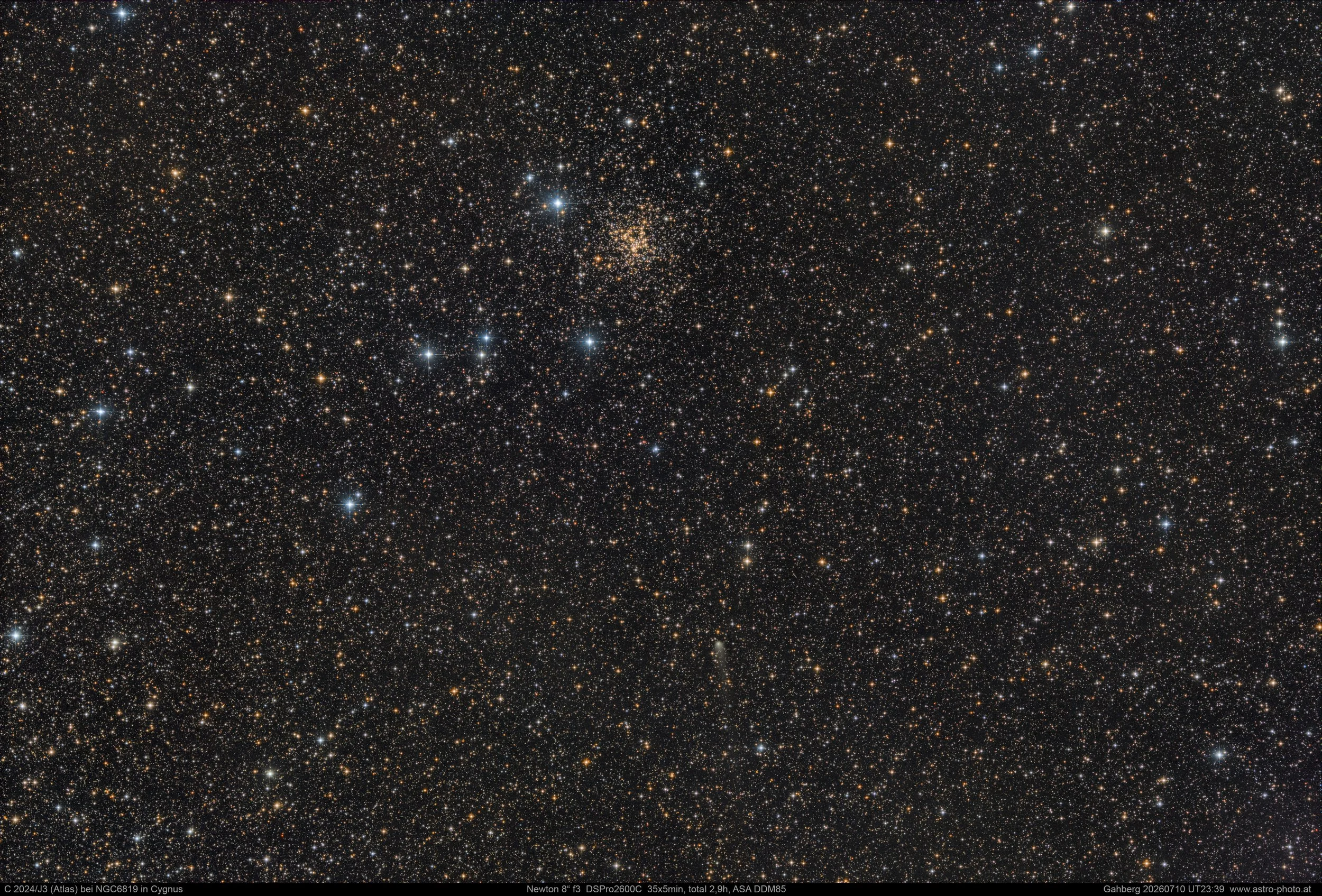
C/2024 J3 Atlas & NGC6819 in Cygnus
Caught streaking across the northern sky, Comet C/2024 J3 (ATLAS) makes a fleeting appearance alongside the rich open star cluster NGC 6819 in the constellation Cygnus. Captured on July 10, 2026, from Gahberg, Austria, this deep-sky portrait showcases the icy visitor as it sweeps through our inner solar system. Traveling on a highly eccentric, hyperbolic orbit, this Oort cloud native has no return date; it is making a single, open-ended pass around the Sun before escaping into the permanent chill of interstellar space.
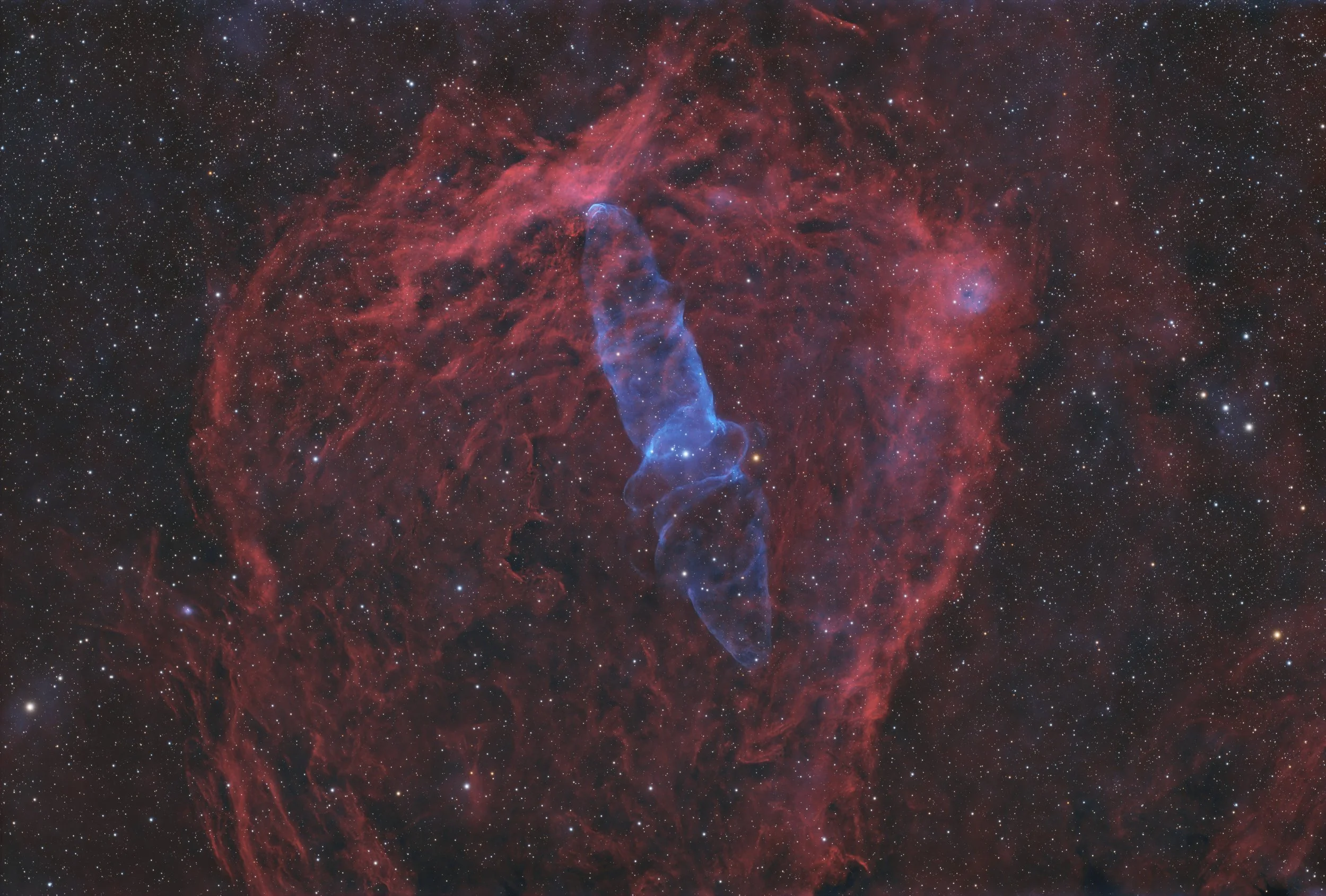
Squid Nebula
An elusive giant of the night sky, the mysterious Squid Nebula (Ou4) swims through a sea of ionized gas in the royal constellation Cepheus, appearing as an ethereal blue-green structure nestled within the deep reddish folds of the larger hydrogen emission region Sh2-129 (the Flying Bat Nebula). Discovered recently in 2011 by French amateur astronomer Nicolas Outters, this incredibly faint bipolar outflow stretches nearly 50 light-years across and shines with the unmistakable signature of emission from doubly ionized oxygen atoms ([O III]). Driven by a powerful triple system of hot, young, and massive stars cataloged as HR 8119 at its core, capturing this ghostly cosmic geometry required a true masterclass in patience from Zielona Góra, Poland. This spectacular deep-sky portrait represents an incredible 63 hours and 25 minutes of total integration time, with 47 hours and 45 minutes strictly to the ultra-faint [OIII] channel to pull the elusive Squid from the cosmic background.
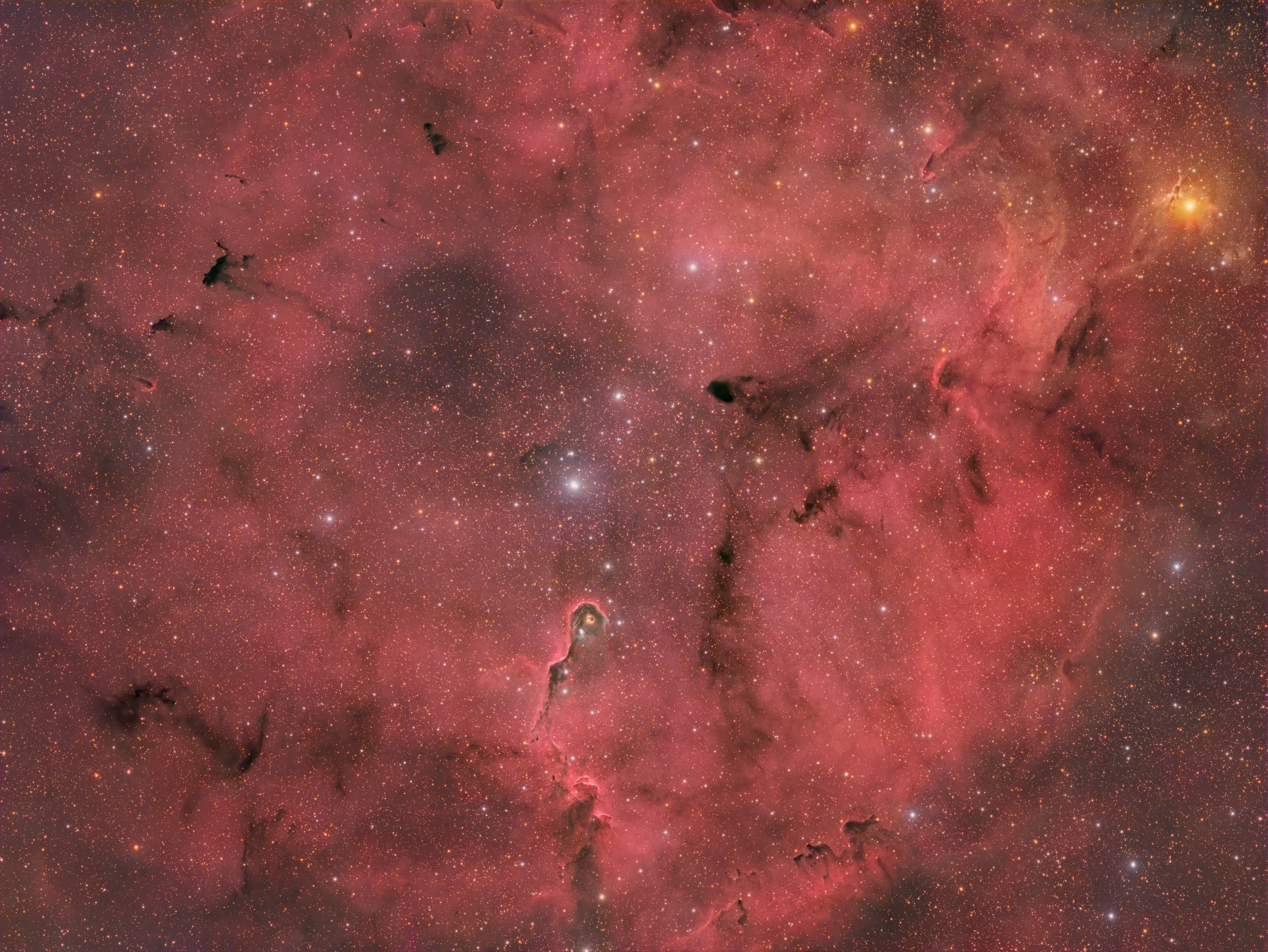
IC 1396 - An Elephant´s Trunk
A stunning 2-panel mosaic of IC 1396, the iconic Elephant's Trunk Nebula in Cepheus. Captured by Oli B as a "first light" benchmark for a new equipment setup, this image beautifully highlights the intricate dance between vibrant, ionized gas and dense, dark interstellar dust lanes. The feature showcases the intense radiation from a massive central star compressing the surrounding molecular cloud, sculpting the distinctive, wind-sheared globules where a new generation of proto-stars is actively forming.
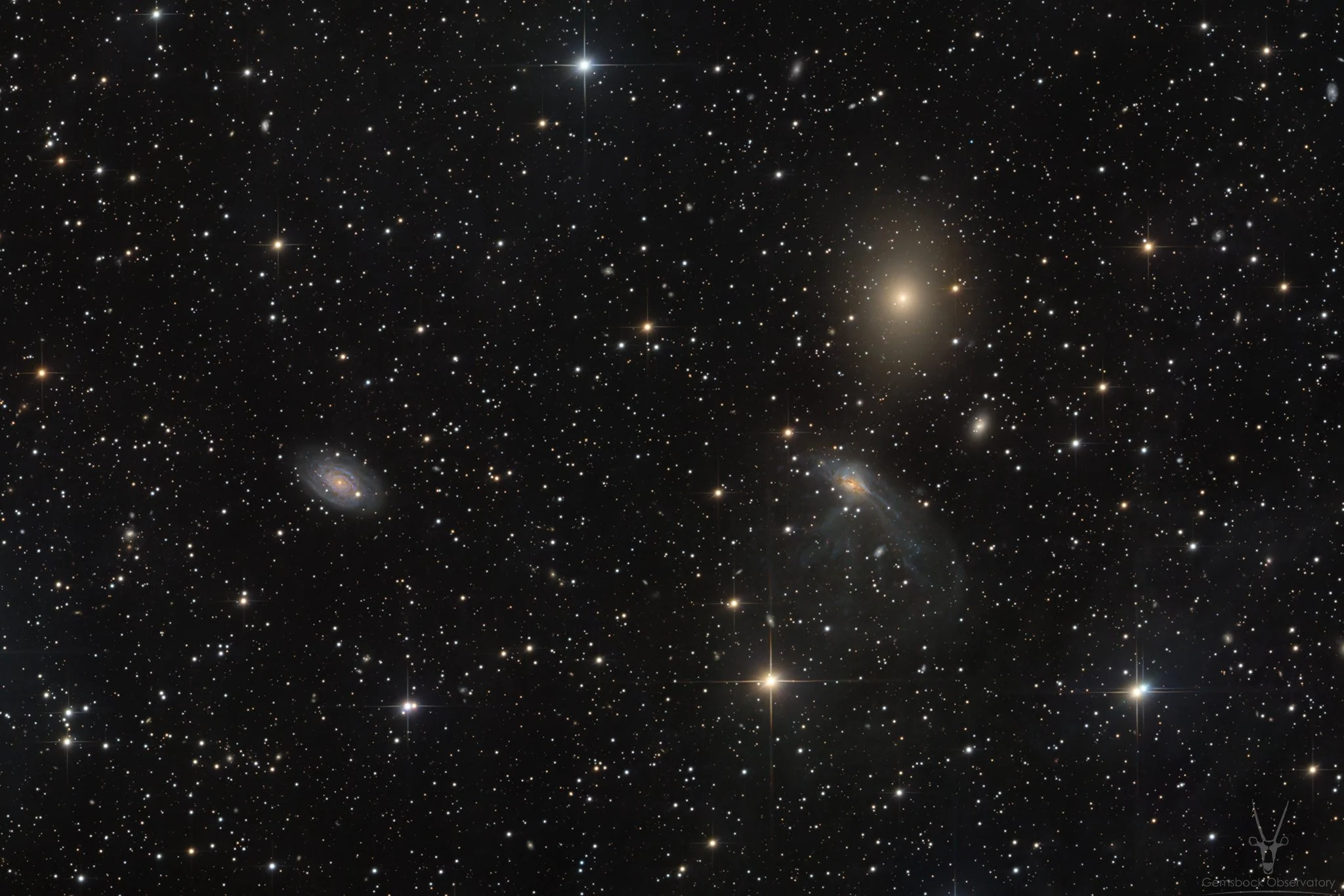
IC 4705 - distorted galaxy with 2 different neighbors
Located in the southern constellation of Pavo, the peculiar barred spiral galaxy IC 4705 (type SB(s)a? pec) exhibits a heavily distorted structure. Discovered in 1900 by DeLisle Stewart, it features distinct tidal tails or "streamers" stretching from its core, vivid indicators of past gravitational interactions with its diverse neighbors, the elliptical IC 4704 and the fine spiral IC 4712.
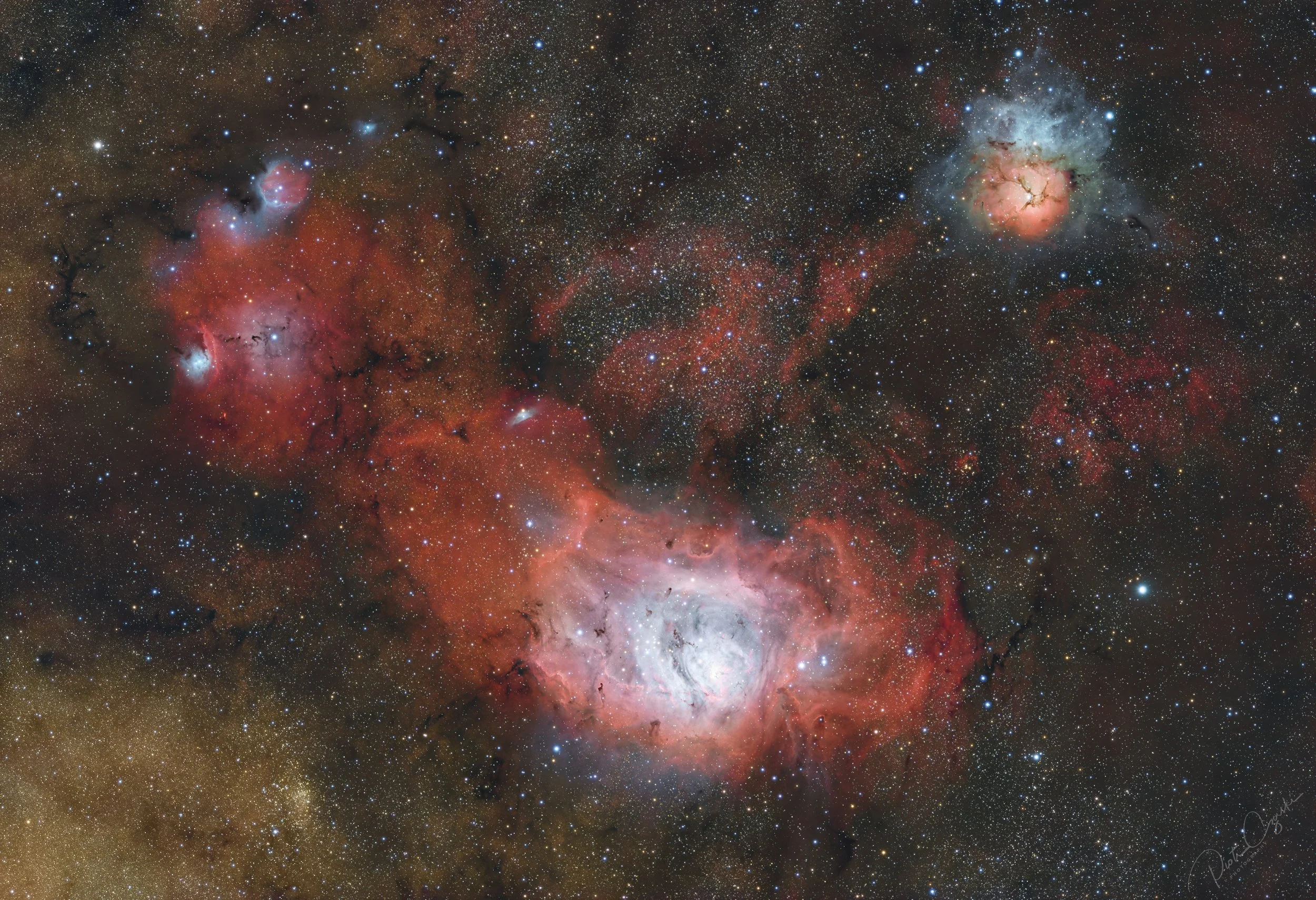
Lagoon and companion from Bortle 0 sky
Under the pristine, ultra-dark skies of the Rooisand Desert Ranch in Namibia, photographer Piotr Czerski captured this breathtaking view of the magnificent Lagoon Nebula (M8) and its cosmic companion. Remarkably, this incredibly rich and detailed view was achieved with only two hours of total integration time, entirely without the use of filters—a testament to the pristine Bortle 0 conditions of the southern desert. Utilizing an Askar 103 APO telescope with a 0.6x reducer and a ZWO ASI 2600MC Pro camera, the shot beautifully resolves the glowing, intricate gas clouds and dark dust lanes of this classic stellar nursery in spectacular clarity.
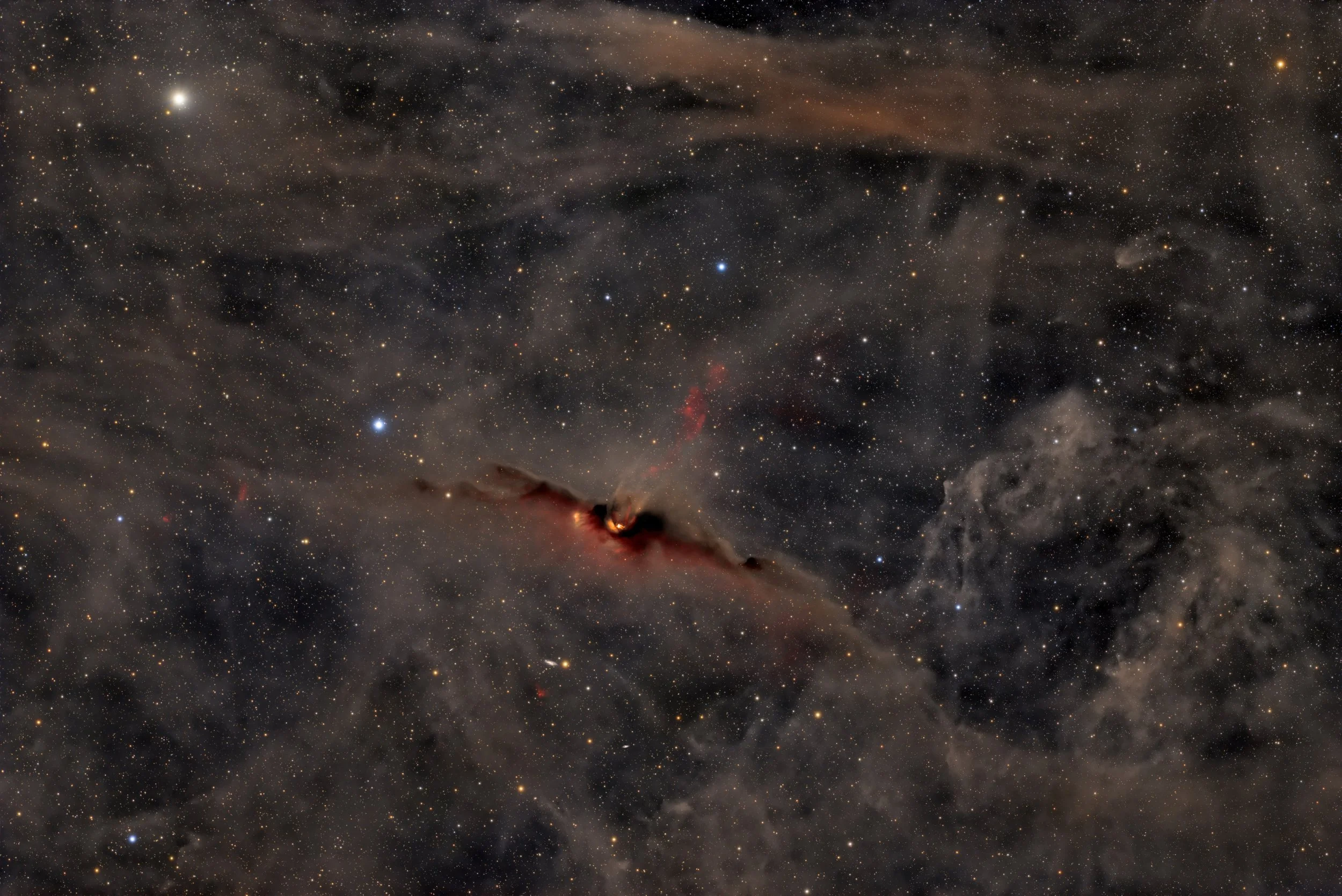
LDN 43 The cosmic bat nebula
Here is an APOD-style description of the image:
LDN 43: The Cosmic Bat Nebula
Hovering like a shadow against the brilliant, star-studded backdrop of the Milky Way, the cosmic bat spreads its dark wings across the constellation Ophiuchus. Cataloged as LDN 43 (Lynds' Dark Nebula 43), this striking silhouette is not an empty void, but a dense, opaque cloud of interstellar dust positioned roughly 1,400 light-years from Earth. By blocking the light of the stars behind it, the cold cosmic dust creates a dramatic, skeletal contrast. Far from being a quiet graveyard, the heart of this dark nebula is an active stellar nursery. Young, newly forming stars—still cocooned in their natal envelopes of gas and dust—locally illuminate their surroundings, while the faint, surrounding reflection nebula (LBN 7) reveals the delicate, intricate structures of this magnificent star-forming region.