

AAPOD2 Image Archives
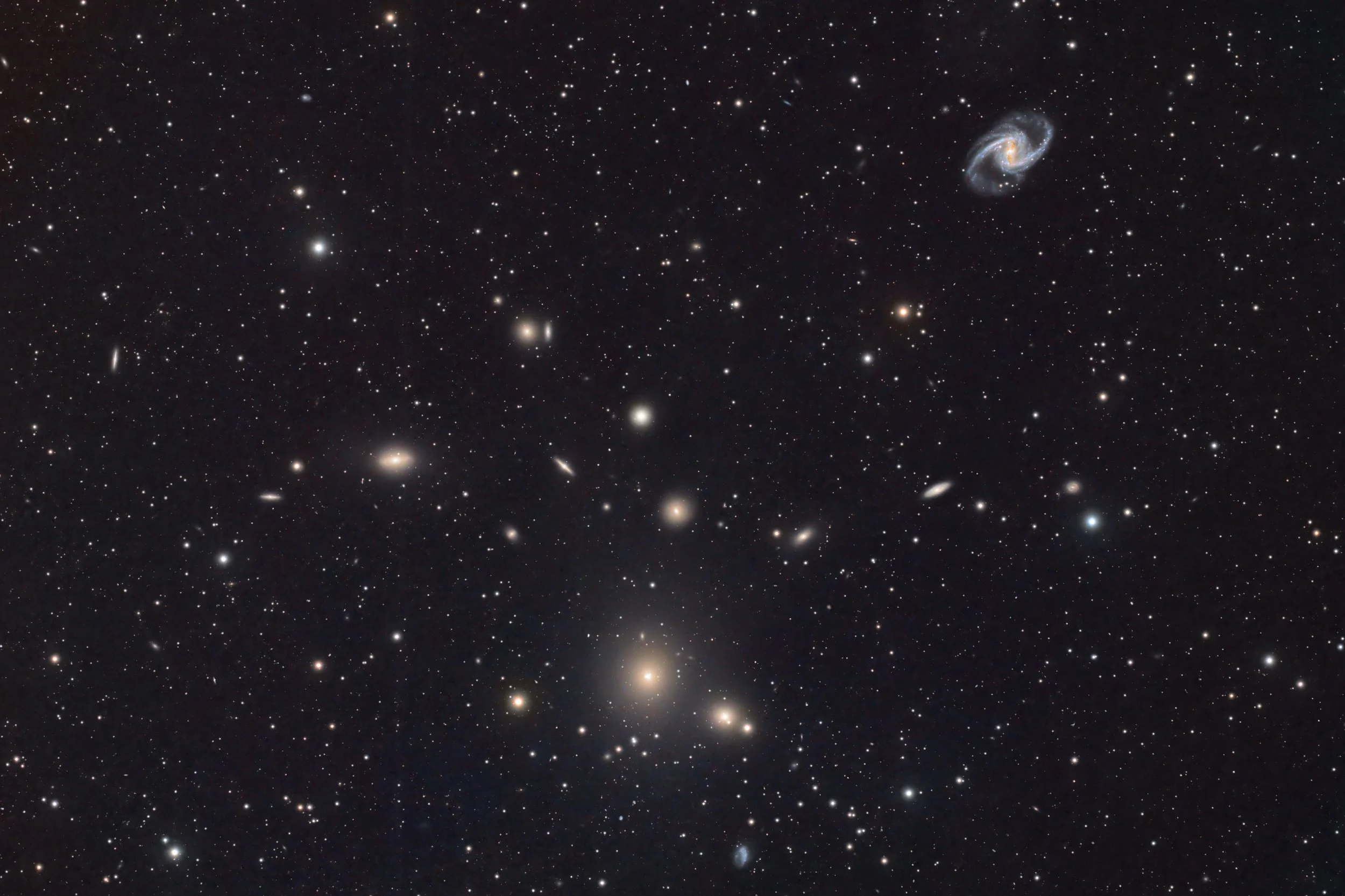
Fornax Galaxy Cluster – Abell S0373
Located about 60 million light-years away in the southern constellation Fornax, the Fornax Galaxy Cluster (Abell S0373) is one of the richest nearby clusters of galaxies. Its core is dominated by the giant elliptical galaxy NGC 1399, surrounded by numerous spirals, lenticulars, and dwarf galaxies, all bound together by their mutual gravity. Unlike many distant clusters filled with elliptical galaxies alone, Fornax still shows ongoing star formation in several of its spiral members.
Captured from Kiripotib Astrofarm, Namibia, this deep image reveals hundreds of background galaxies extending far beyond the cluster itself. The Fornax Cluster provides astronomers a unique window into galaxy evolution in environments where gravitational interactions continue to shape their fate.
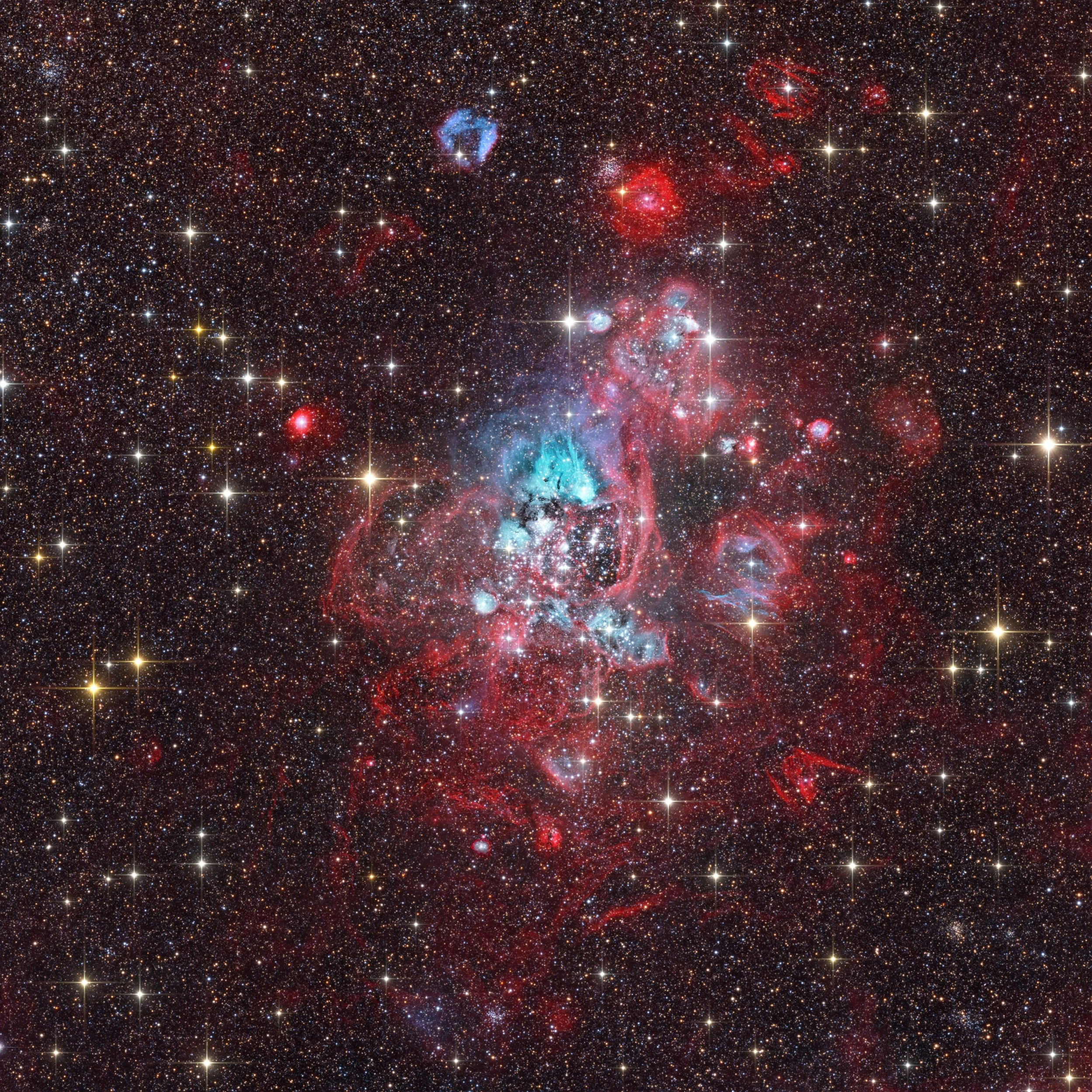
N44 and the Superbubble in the Large Magellanic Cloud
N44 is a massive emission nebula in the Large Magellanic Cloud, a satellite galaxy of the Milky Way about 160,000 light-years away. Spanning nearly 1,000 light-years across, this turbulent region glows with energized hydrogen gas sculpted by powerful stellar winds. Near its center lies a vast cavity known as a superbubble, carved out by intense radiation and multiple supernova explosions from clusters of young, massive stars.
The intricate structures of N44 reveal the interplay between star birth and stellar destruction, with bright knots of blue-green oxygen and red hydrogen tracing the expanding shock fronts. This delicate balance of energy and gas recycling makes N44 a vivid laboratory for understanding how galaxies sustain new generations of stars.
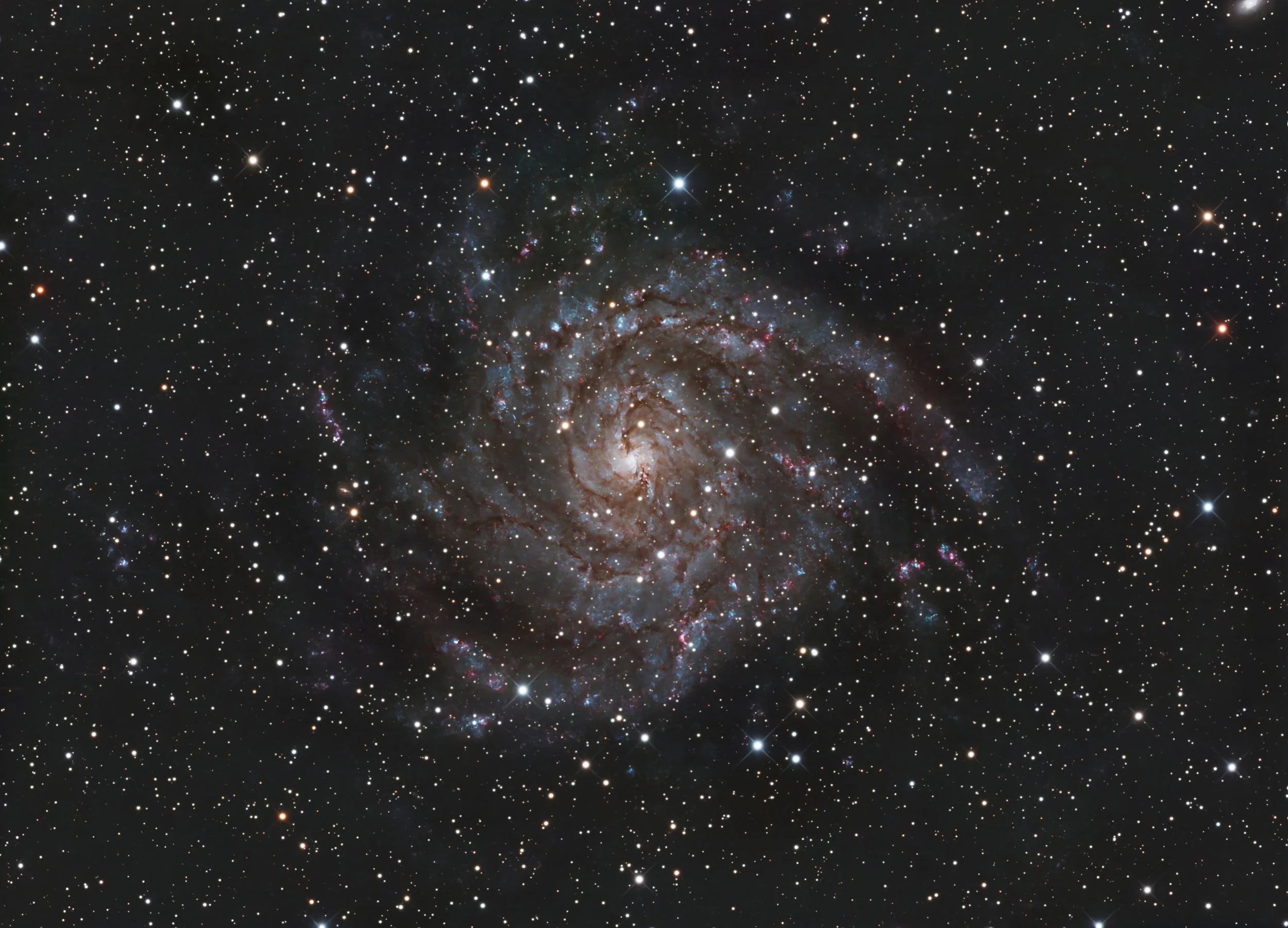
IC 342 – The Hidden Galaxy
IC 342, often called the Hidden Galaxy, lies just 10 million light-years away in the constellation Camelopardalis. Despite its proximity, it is shrouded behind the dense dust of the Milky Way, making it challenging to observe. Its sprawling spiral arms emerge faintly through the obscuring dust, revealing star-forming regions and the complex structure of this nearby galaxy.
This image was captured under dark Bortle-class skies in West Texas using a ROCS 16-inch Ruggedized Military telescope and a QHY600m camera. Careful calibration and long-exposure imaging allowed the faint details of this hidden neighbor to emerge from the galactic foreground, unveiling its subtle luminosity and structure.
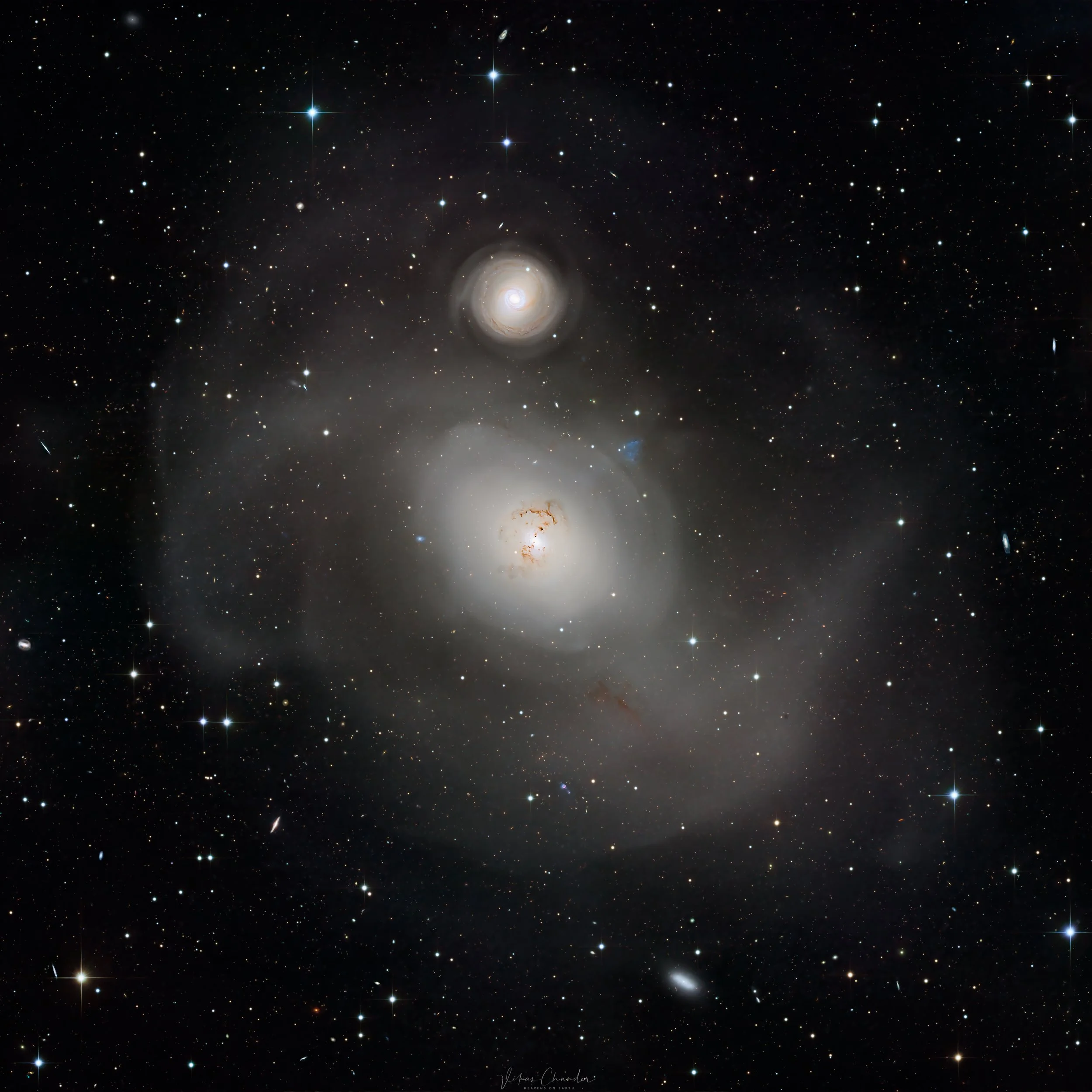
Fornax A and B Galaxies
Fornax A and Fornax B are two distinct galaxies within the Fornax Cluster, a compact assembly of galaxies located about 62 million light-years from Earth. Fornax A, a massive elliptical galaxy, dominates the field with its extended radio lobes, while Fornax B, a smaller companion, adds contrast to this dynamic galactic neighborhood. The image reveals fine structural details and subtle intergalactic features, providing a glimpse into the complexity of this nearby galaxy cluster.
This deep exposure was captured with a Planewave CDK 24-inch telescope and a Moravian C5A-100 mono camera. LRGB and OIII data were obtained through Chroma filters with exposures totaling 44 hours and 30 minutes (Luminance: 208 × 120 s, Red: 208 × 120 s, Green: 207 × 120 s, Blue: 202 × 120 s, OIII: 102 × 600 s). Observations were conducted using a Planewave L-600 mount at Obstech Observatory, and the dataset was processed using NINA and PixInsight for precise calibration, alignment, and combination.

Iris Nebula and Neighborhood
The Iris Nebula (NGC 7023) glows softly amid a delicate tapestry of interstellar dust in the constellation Cepheus. Its central star illuminates the surrounding filaments of gas and dust, producing the characteristic bluish reflection nebula, while fainter tendrils of the surrounding clouds hint at the subtle complexity of this star-forming region. This field also captures the neighboring faint nebulae, revealing the intricate structures of the local interstellar medium.
This image was composed from 380 exposures of 300 seconds in Luminance with drizzle applied twice, along with 90 exposures of 300 seconds each in RGB, also drizzled twice. Calibration frames included 20 flats of 5 seconds at -10°C, 30 dark flats of 5 seconds at -10°C, and 30 dark frames of 300 seconds at -10°C, ensuring precise background and color fidelity.
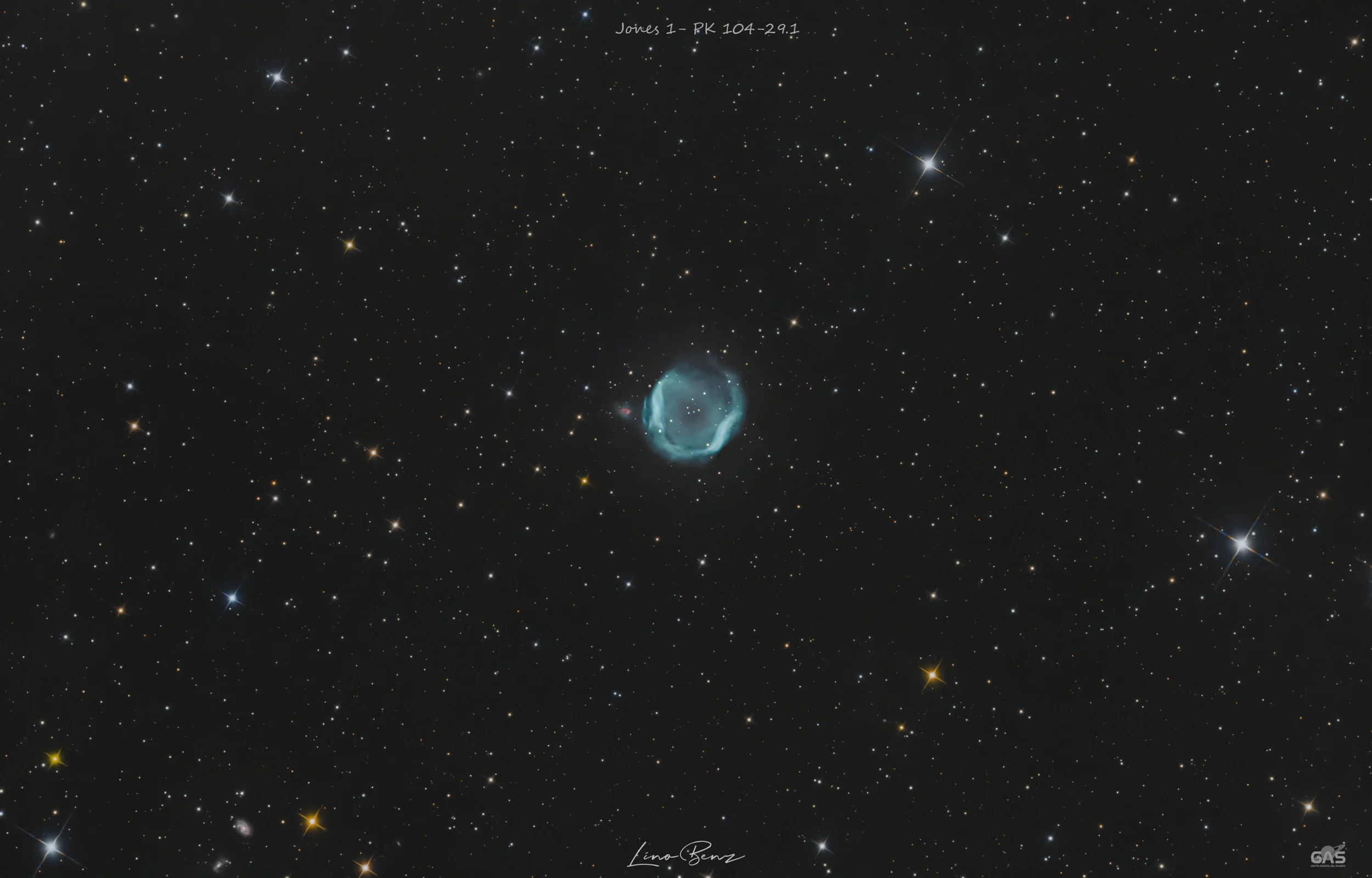
Jones 1 PK 104-29.1
Drifting quietly in the constellation Pegasus, Jones 1 (PK 104–29.1) is a delicate planetary nebula about 2,300 light-years from Earth. Discovered in 1941 by astronomer Rebecca Jones, this expansive structure spans roughly four light-years across. Its faint, filamentary shell marks the remnants of a sunlike star that has shed its outer layers, leaving behind a small, hot white dwarf at the center.
Seen in long exposures, the nebula’s ghostly arcs trace the final breaths of stellar evolution, glowing softly as ultraviolet light from the white dwarf excites the surrounding gas. Though barely visible through small telescopes, Jones 1 reveals its full complexity in deep images, where its ethereal loops and knots seem to float against the rich starfield of Pegasus.
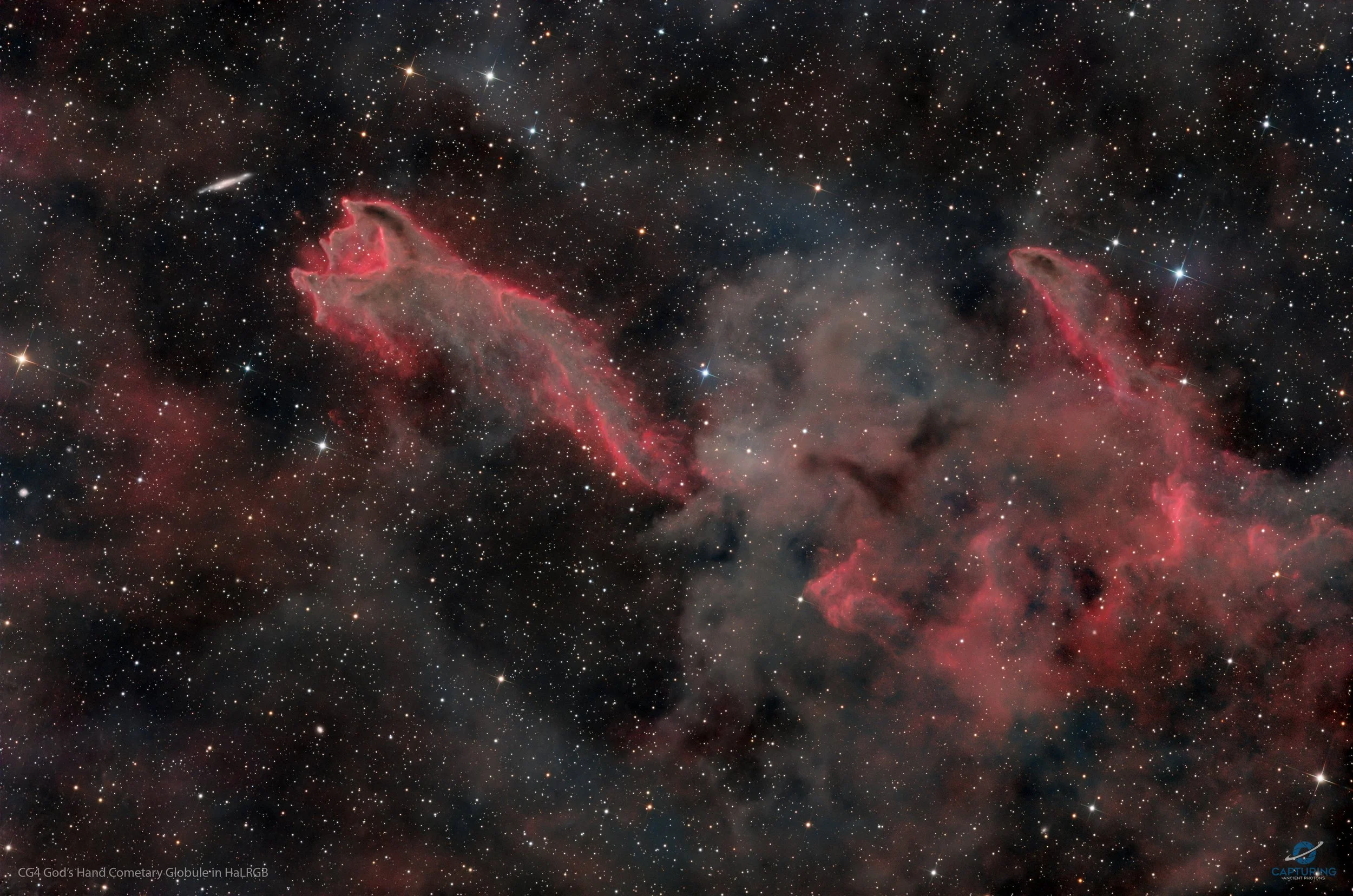
CG4 – The Hand of Creation
In the southern constellation Puppis, about 1,300 light-years away, lies the striking cometary globule CG4, often nicknamed God’s Hand. This peculiar formation of dust and gas appears to reach across space as if grasping toward the small edge-on galaxy seen near its fingertips. The globule’s glowing rim is illuminated by nearby hot stars, while its dense interior—rich in molecular gas—remains dark, concealing the raw material for potential future star formation.
Captured from Perth, Western Australia, this HaLRGB composition reveals the faint red emission of hydrogen gas surrounding the dusty structure. CG4 is part of the broader Gum Nebula complex, a vast region shaped by ancient supernova explosions. Despite its ominous, reaching form, this cosmic hand is a cradle of creation, slowly sculpted by stellar winds and radiation over millions of years.
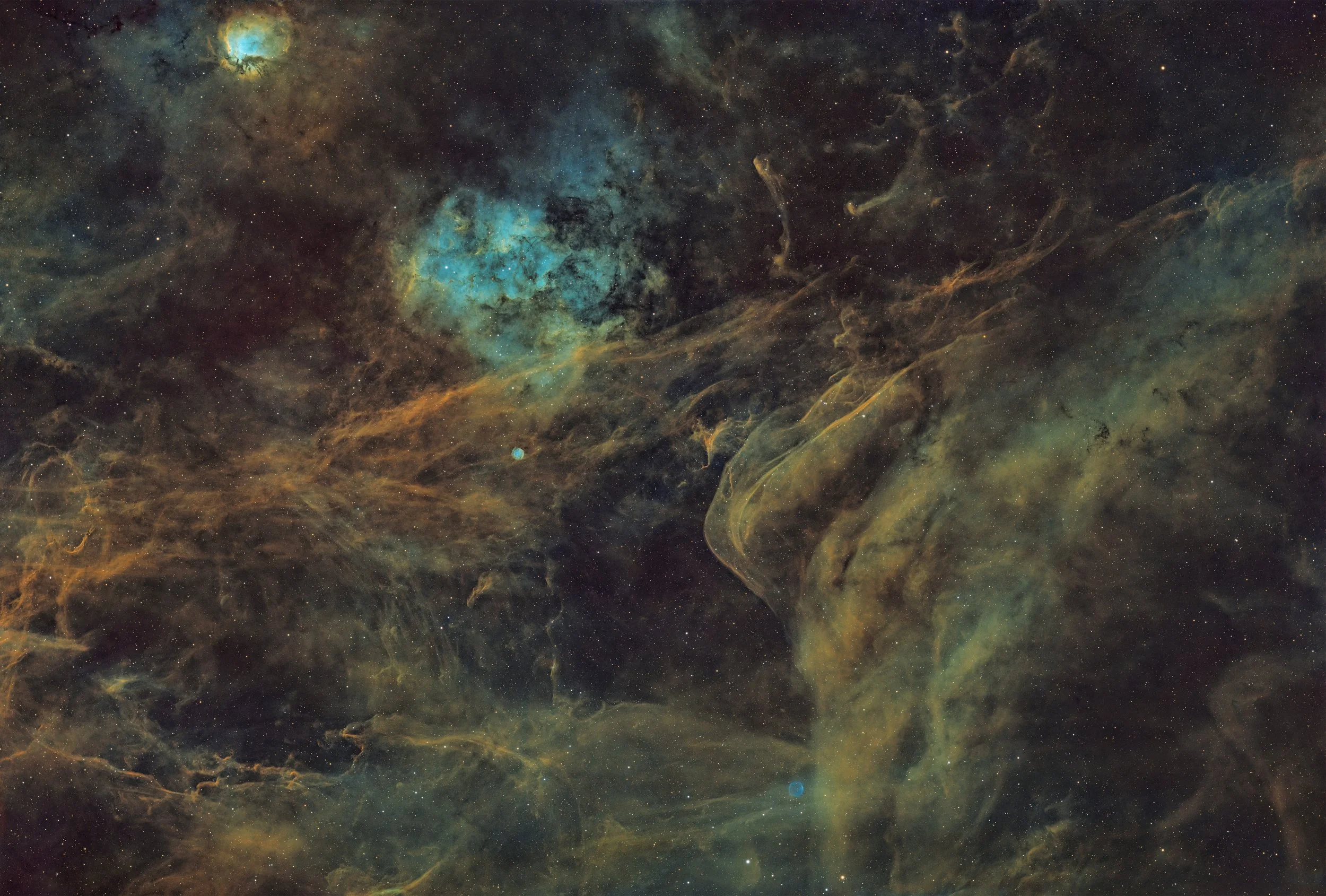
Cosmic Structures in the Sh2-115 Region
Located in the constellation Cygnus, the emission nebula Sh2-115 stretches across a rich region of the Milky Way filled with glowing gas, dark filaments, and young stars. This vast cloud of ionized hydrogen lies about 7,500 light-years away and is energized by the ultraviolet radiation from nearby hot, massive stars. Complex pillars and wisps of interstellar material sculpted by stellar winds give this nebula a distinctly textured appearance, revealing the dynamic processes at play within star-forming regions of our galaxy.
This detailed narrowband image combines 100×10-minute exposures in H-alpha (7nm), 70×10-minute in OIII (3nm), and 38×10-minute in SII (3nm). The resulting SHO composition highlights subtle differences in chemical composition and temperature, mapping hydrogen in red, oxygen in blue, and sulfur in gold. Together they unveil the intricate cosmic structures hidden within Sh2-115.
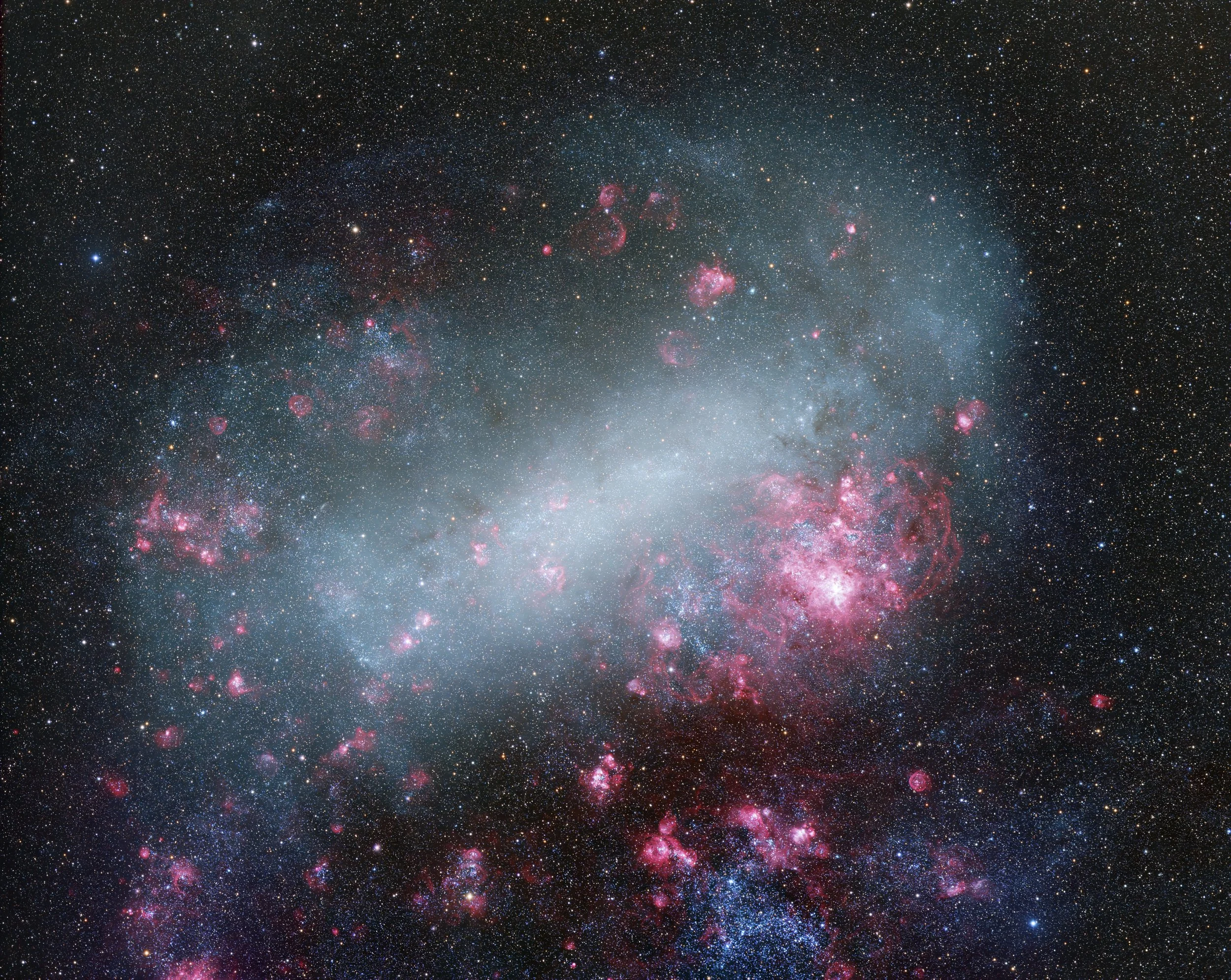
The Large Magellanic Cloud in HLRGB and HDR
Spanning over 14,000 light-years, the Large Magellanic Cloud (LMC) is one of the Milky Way’s closest galactic neighbors, orbiting at a distance of roughly 160,000 light-years. This irregular dwarf galaxy is rich in star-forming regions, the most famous being the bright pink Tarantula Nebula (NGC 2070) seen near the center. Waves of hydrogen emission and intricate dust lanes trace massive stellar nurseries that continue to shape the galaxy’s dynamic structure.
This HLRGB and HDR composition reveals the LMC’s complex interplay of glowing gas, young blue star clusters, and older stellar populations scattered throughout its disk. The careful combination of data layers allows both the bright star-forming regions and the faint galactic halo to be visible in a single image, offering a balanced and detailed portrait of our neighboring galaxy.
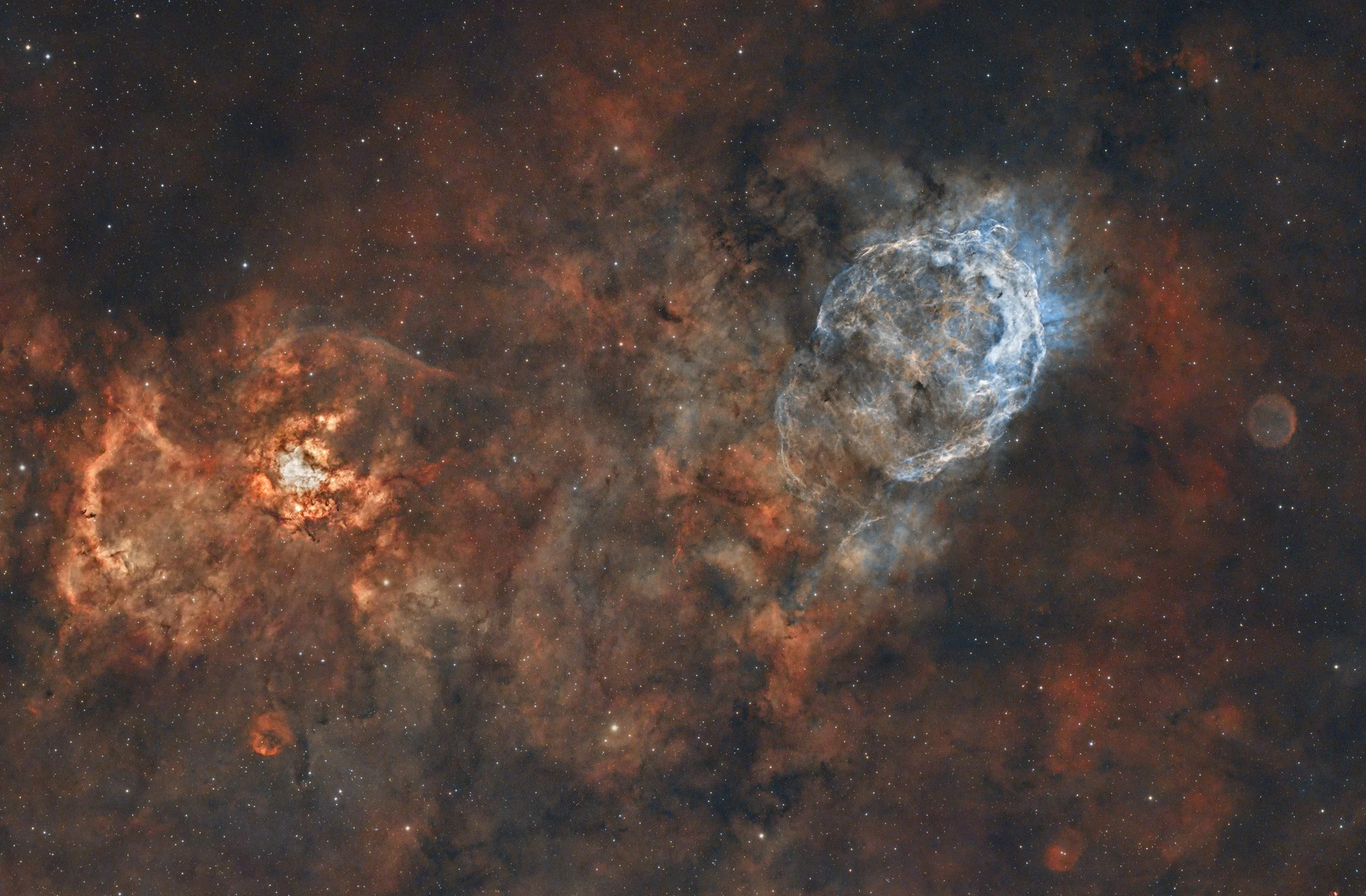
NGC 3199 – The Banana Nebula in Carina
Curving gracefully through the southern constellation of Carina, NGC 3199, often called the Banana Nebula—glows amid a sea of interstellar dust and gas. This wind-blown bubble of ionized gas surrounds a massive Wolf–Rayet star, whose fierce stellar winds carve and illuminate the nebula’s distinctive arc. Nearby, the faint planetary nebula PK 283 lies quietly within the same field, adding to the region’s rich tapestry of emission and reflection.
Captured under the pristine Kalahari skies of Namibia, this image was taken with a Takahashi FSQ-106 astrograph and an ASI 2600MC camera paired with an Optolong L-Ultimate filter. The final result, composed of thirty 420-second exposures, reveals both the vivid structure of NGC 3199 and the subtle background clouds where new stars are forming.
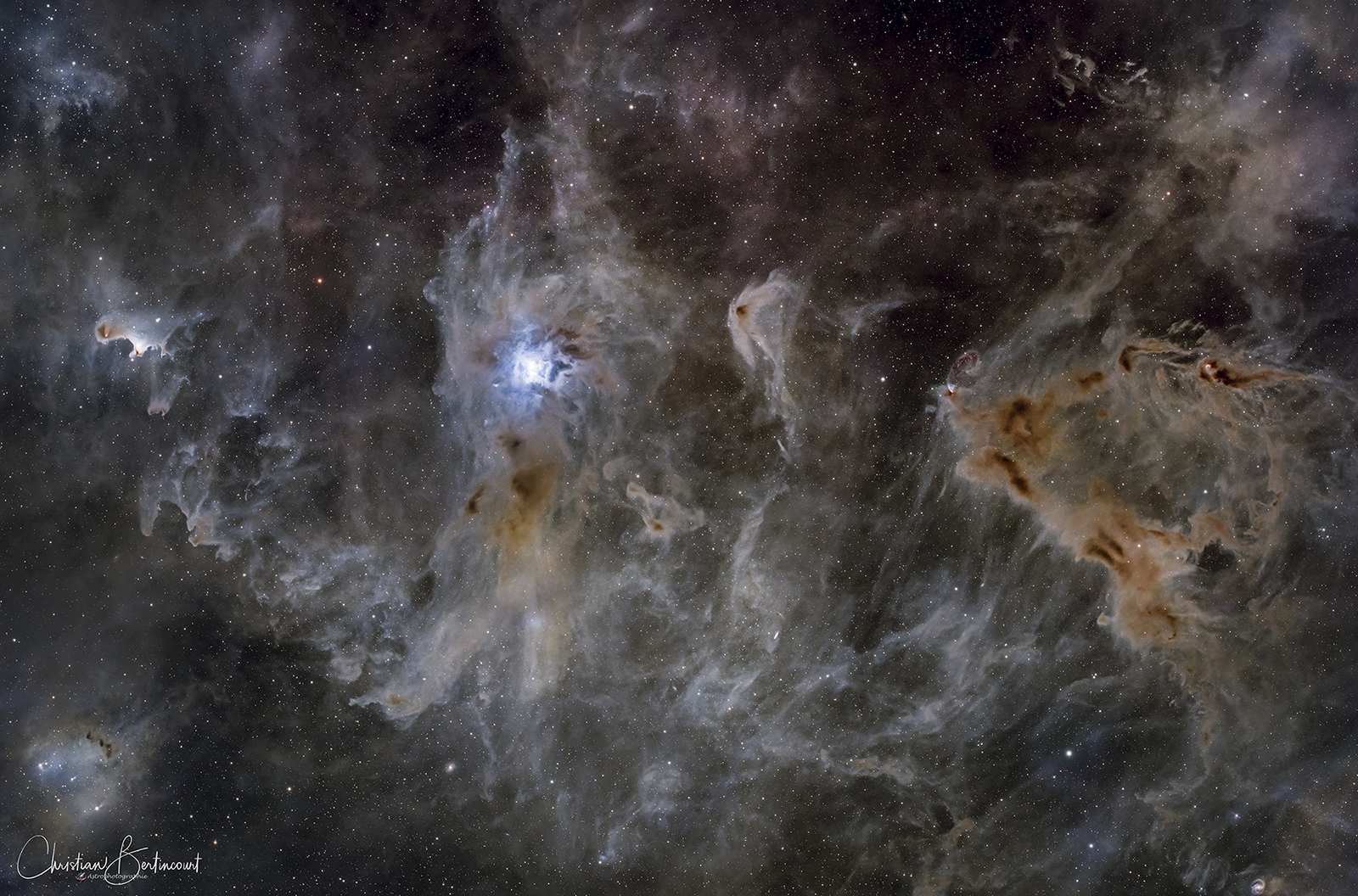
NGC 7023, the Iris Nebula
Iris Nebula and the Ghostly IFN
Among wisps of interstellar dust, the Iris Nebula (NGC 7023) blooms like a pale flower reflecting the light of its central star. Surrounding it is a vast network of faint, ghost-like clouds, integrated flux nebulae (IFN) that float above the plane of our Milky Way. These ethereal structures are made of fine cosmic dust reflecting the combined glow of the galaxy itself.
Captured with over 20 hours of total exposure, this deep image reveals the full extent of the faint IFN wrapping around the Iris. The delicate interplay of blue reflection and sepia dust gives the scene an almost haunting presence, as if the cosmos itself were cloaked in mist.
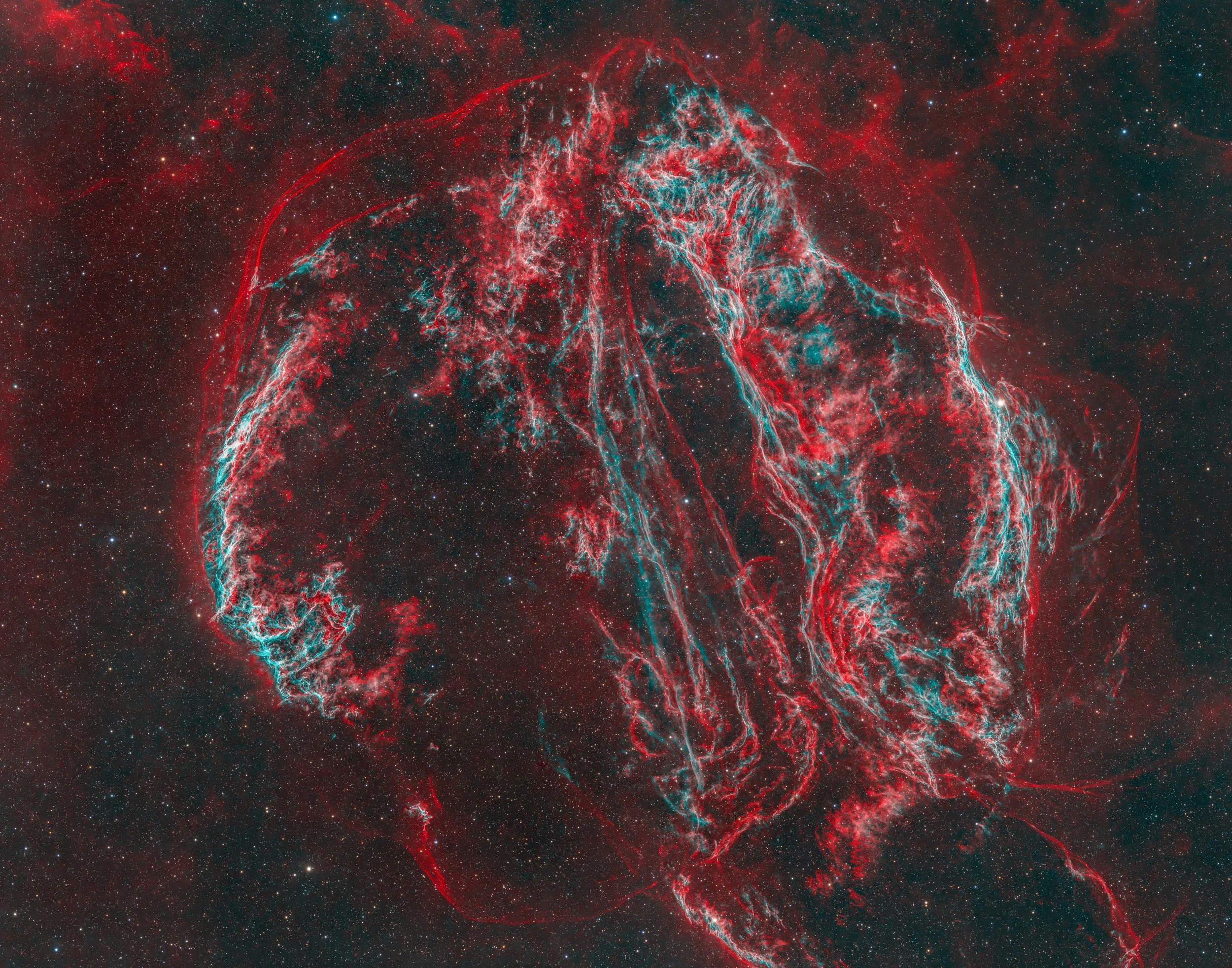
Veil Nebula in HOO
Like a cosmic ghost drifting through Cygnus, the Veil Nebula’s tangled filaments glow eerily in red and teal light—remnants of a massive star that met its end about 10,000 years ago. The nebula’s delicate structure traces the expanding shock waves from that ancient supernova, its wispy forms resembling torn veils or spectral smoke.
Captured under Bortle 7 skies, this two-panel mosaic spans over 25 hours of integration in HOO narrowband. The contrasting hydrogen and oxygen emissions lend the scene an otherworldly, almost haunted glow—perfect for Halloween night, when even the cosmos seems to wear a ghostly disguise.

The Andromeda Galaxy (M31) in HOO+RGB
Our neighboring spiral, the Andromeda Galaxy (M31), lies about 2.5 million light-years away and dominates this detailed composite image. Captured over seven clear nights in September for a total of more than 27 hours of exposure, the frame combines HOO and RGB data to reveal the galaxy’s structure in striking color. The rich red knots scattered along the spiral arms mark vast H II regions—nebulae of ionized hydrogen where new stars are forming. Dust lanes and bluish star clusters trace Andromeda’s immense disk, while its small companion M110 glows below.
Andromeda is the largest member of the Local Group and is moving toward the Milky Way at over 100 km per second. In roughly four billion years, the two galaxies are expected to merge into a single giant elliptical system. This image, blending natural color with narrowband enhancement, highlights both the galaxy’s familiar beauty and its dynamic role in the ongoing evolution of our galactic neighborhood.
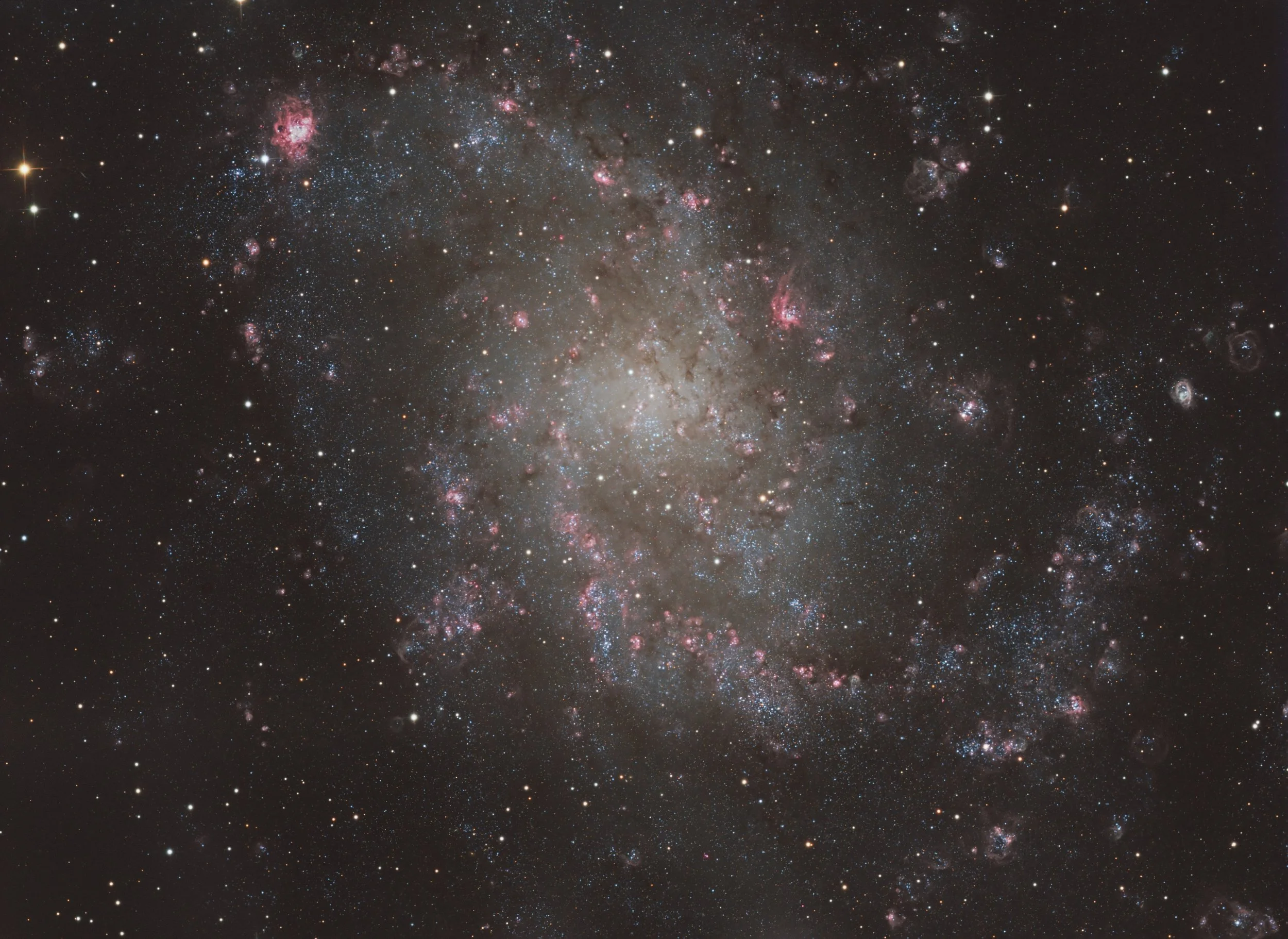
The Triangulum Galaxy (M33) from Fregenal de la Sierra, Spain
Captured under the dark skies of Fregenal de la Sierra, Spain, this deep exposure reveals the Triangulum Galaxy (M33) in remarkable detail. At a distance of about 2.7 million light-years, M33 is the third-largest member of the Local Group after Andromeda and the Milky Way. The image shows its loosely wound spiral arms traced by glowing H II regions, blue star-forming clusters, and intricate dust lanes extending from the bright core. The subtle pinkish patches mark vast clouds of ionized hydrogen where new stars are being born.
Using a 20-inch Ritchey-Chrétien telescope, a total of 21 hours and 40 minutes of LRGB and Hα data were gathered through 10-minute guided exposures. This long integration highlights the galaxy’s faint outer arms and extended halo structure, bringing out M33’s complex web of emission nebulae and delicate color gradients. The result offers a vivid portrait of one of the nearest and most photogenic spiral galaxies beyond our own.
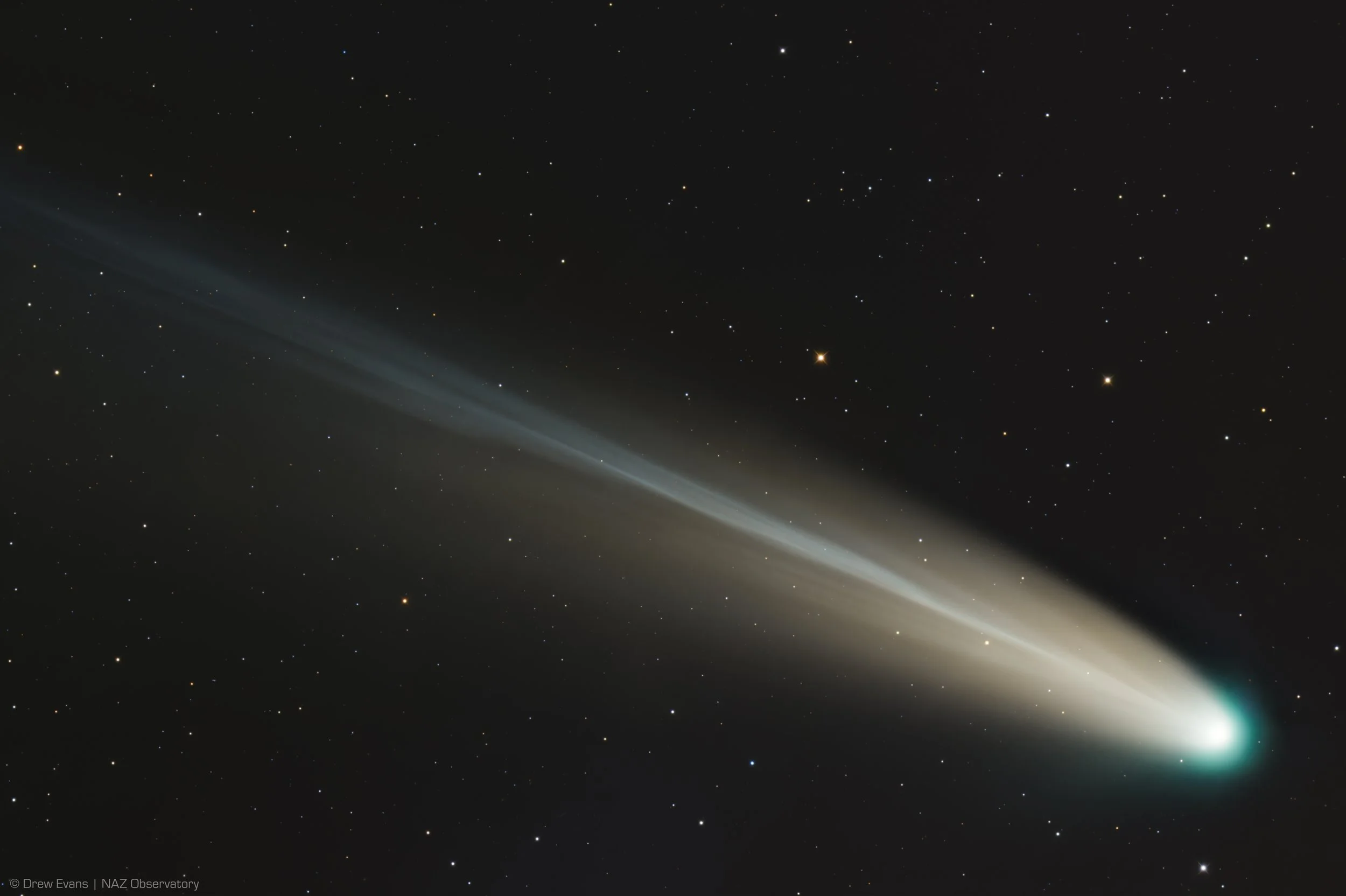
Comet C/2025 A6 (Lemmon) from Flagstaff, Arizona
Gliding through the faint star fields of Serpens Cauda, Comet C/2025 A6 (Lemmon) displays its soft green glow as it approaches its November 2025 perihelion. The color results from diatomic carbon fluorescing in sunlight, while a pale dust tail streams away from the nucleus. Captured under the crisp, dark skies of Flagstaff, Arizona, this image reveals the comet as it drifts among the distant stars of Serpens, a subtle reminder of the dynamic nature of our Solar System.
A long-period comet originating in the Oort Cloud, C/2025 A6 (Lemmon) circles the Sun roughly every 1,350 years. Around this date it lay about 0.6 AU from Earth and 0.53 AU from the Sun, shining near 5th magnitude, visible through binoculars to northern observers after dusk. As it continues toward perihelion, its tail and coma are expected to brighten and lengthen, providing a rewarding target for wide-field imaging through early November.
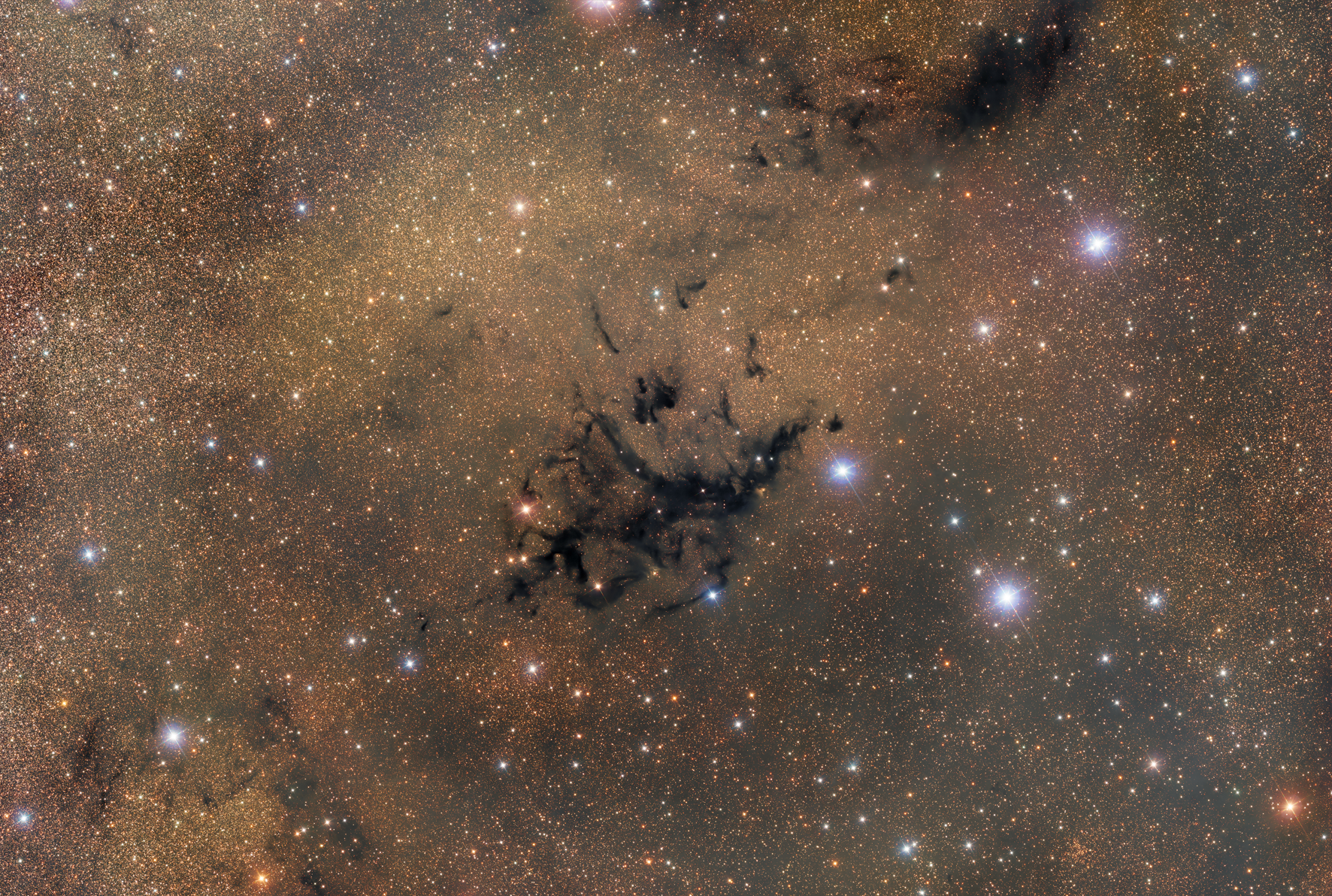
The Dark Clouds of LDN 673
Drifting among the glittering star fields of the Milky Way in Aquila, the dark nebula LDN 673 forms a striking contrast against the golden background of countless distant suns. This dense region of interstellar dust blocks visible starlight, revealing complex, filamentary shapes where gravity is slowly gathering gas into the seeds of future stars.
Captured over 20 hours of RGB integration from a backyard observatory in Eastern Oregon under Bortle 4 skies, this image highlights both the subtle color gradients of the surrounding galactic plane and the haunting opacity of the dark nebula itself. LDN 673 stands as a reminder that even the darkest regions of the night sky are places of quiet creation, silhouetted against the glow of the Milky Way.
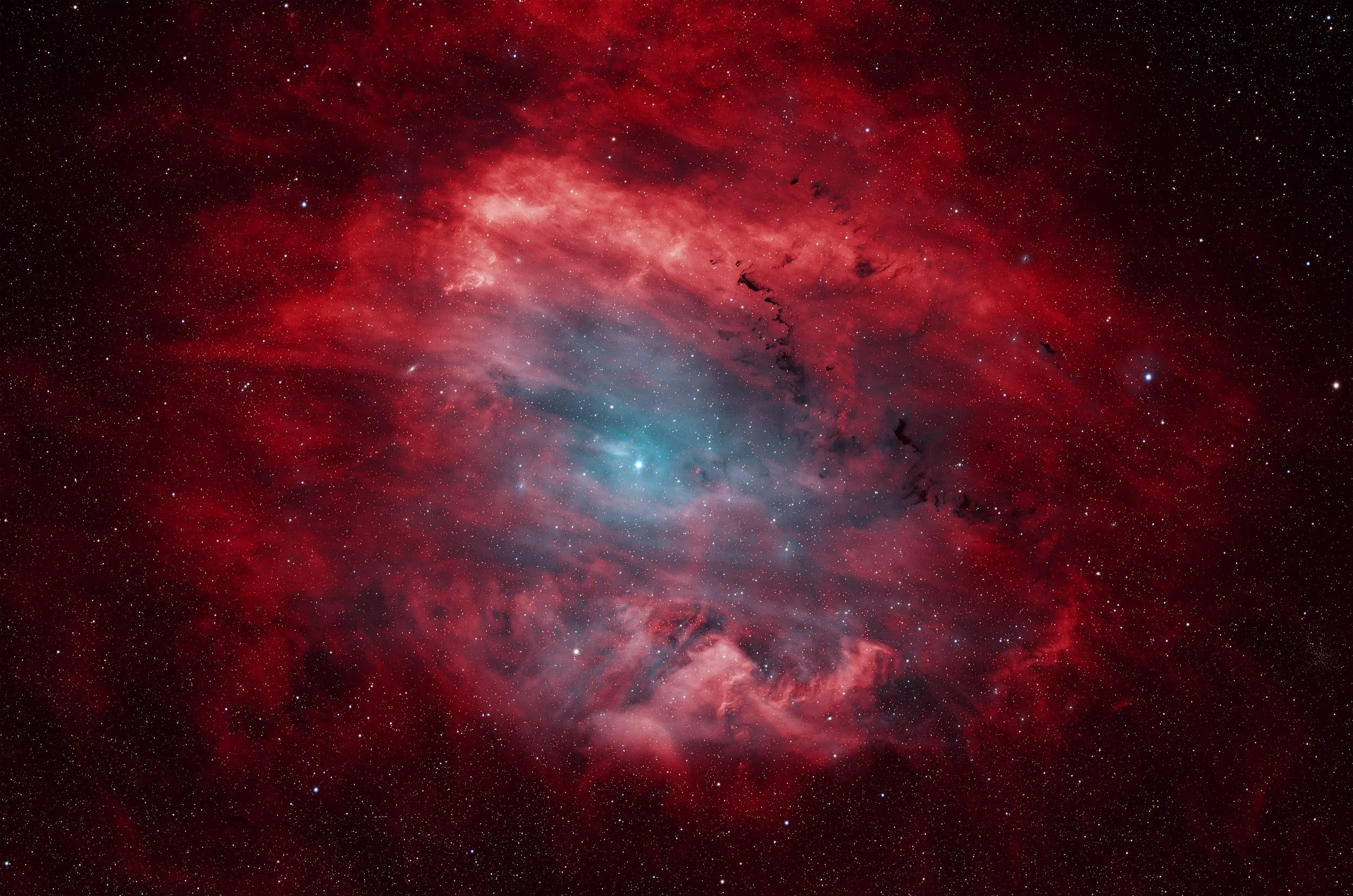
The Clamshell Nebula — Sh2-119 in Cygnus
The Clamshell Nebula (Sh2-119) lies just east of the famous North America Nebula in the constellation Cygnus. Stretching across roughly four degrees of sky, this vast emission region glows in the light of ionized hydrogen and oxygen excited by the hot O-type star 68 Cygni. Intricate waves of gas and dust sculpt the nebula’s shell-like structure, giving rise to its evocative nickname.
This deep 68-hour exposure, captured through a dual narrowband filter, reveals the delicate interplay between hydrogen’s crimson glow and the cooler blue tones of doubly ionized oxygen. The Clamshell’s layered filaments trace the complex feedback between massive stars and the surrounding interstellar medium, a vivid portrait of how stellar radiation shapes the Milky Way’s bright heart.
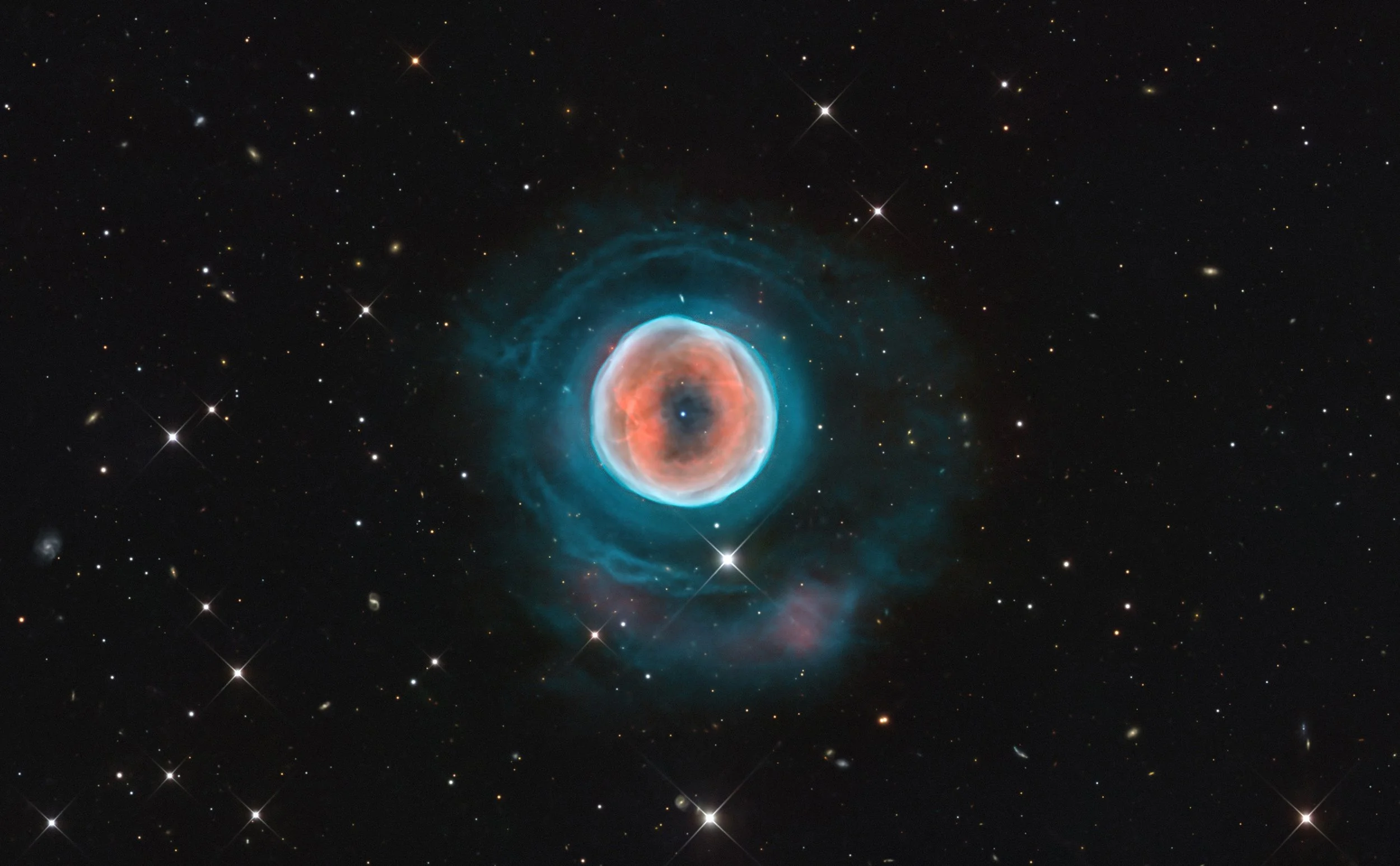
The Helix in the Peacock — Planetary Nebula IC 5148
IC 5148, often called the “Helix in the Peacock,” is a bright planetary nebula about 3,000 light-years away in the constellation Grus. It represents the final, graceful stage of a Sun-like star’s evolution as it sheds its outer layers into space. The nebula spans nearly two light-years and expands rapidly through the surrounding interstellar medium, creating a spherical shell of glowing gas illuminated by its hot central white dwarf.
Special processing that reveals only the excess H-alpha emission highlights delicate inner structures nested within the dominant OIII glow. This technique unveils the complex interplay of ionized gases shaped by stellar winds and radiation. The result is a strikingly detailed portrait of a dying star enriching its cosmic neighborhood with the elements that will seed future generations of stars and planets.
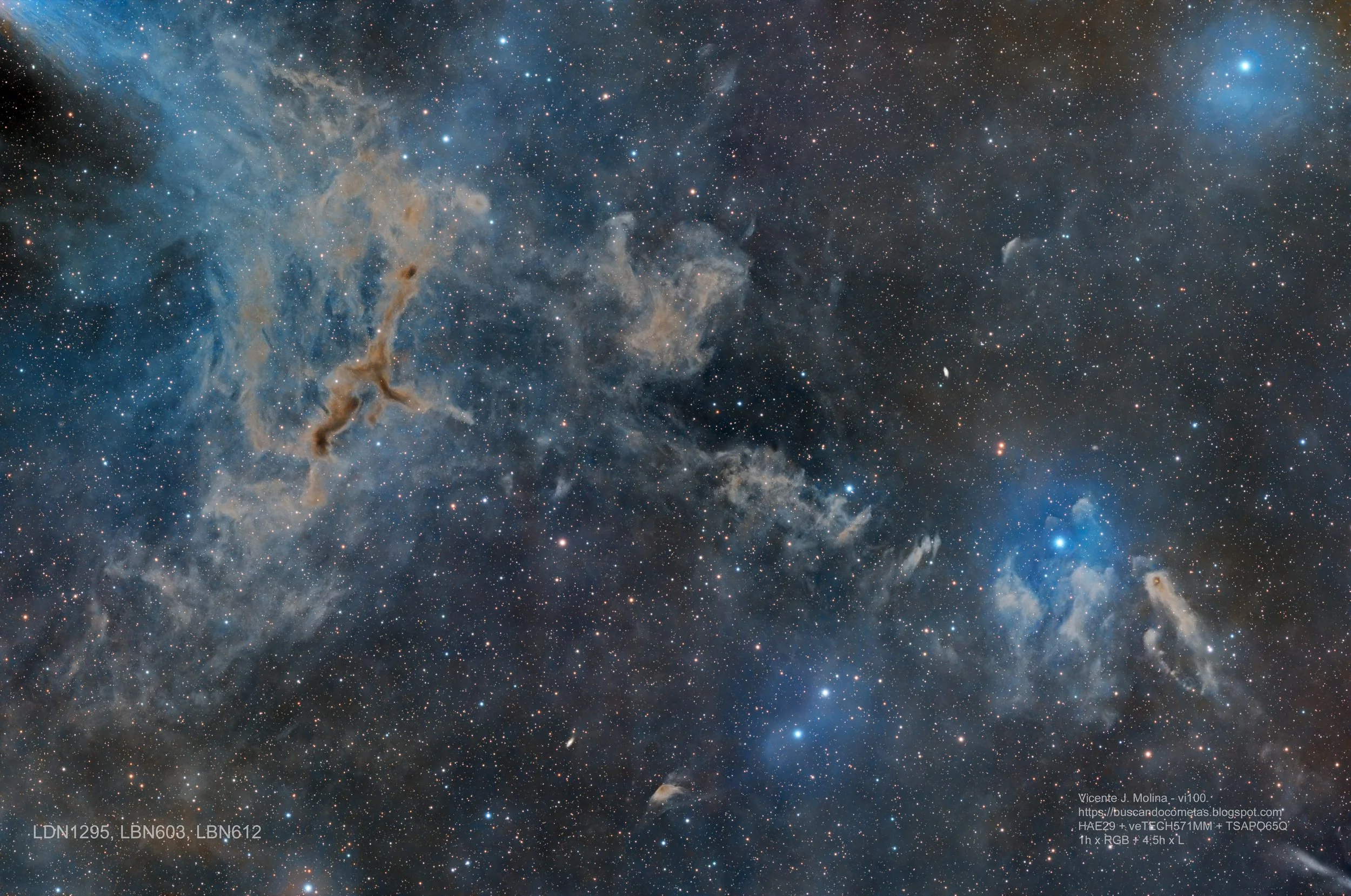
The Giraffe Nebula — LDN 1295 in Camelopardalis
Amid the quiet reaches of the constellation Camelopardalis lies the dark nebula LDN 1295, part of a vast network of molecular clouds often called the Giraffe Nebula. Intertwined with reflection nebulae LBN 603 and LBN 612, this dusty region stretches over several light-years, sculpted by faint starlight and the slow collapse of dense gas. The delicate filaments and dark tendrils of dust obscure the background stars, hinting at the hidden process of star formation within.
This deep exposure reveals the subtle interplay between dark and reflective clouds, the brown lanes of cold dust contrasting with the faint blue light scattered by nearby young stars. Located in one of the most remote and least studied regions of the northern Milky Way, the Giraffe Nebula stands as a quiet but beautiful reminder that even the darkest parts of the sky are alive with creation.
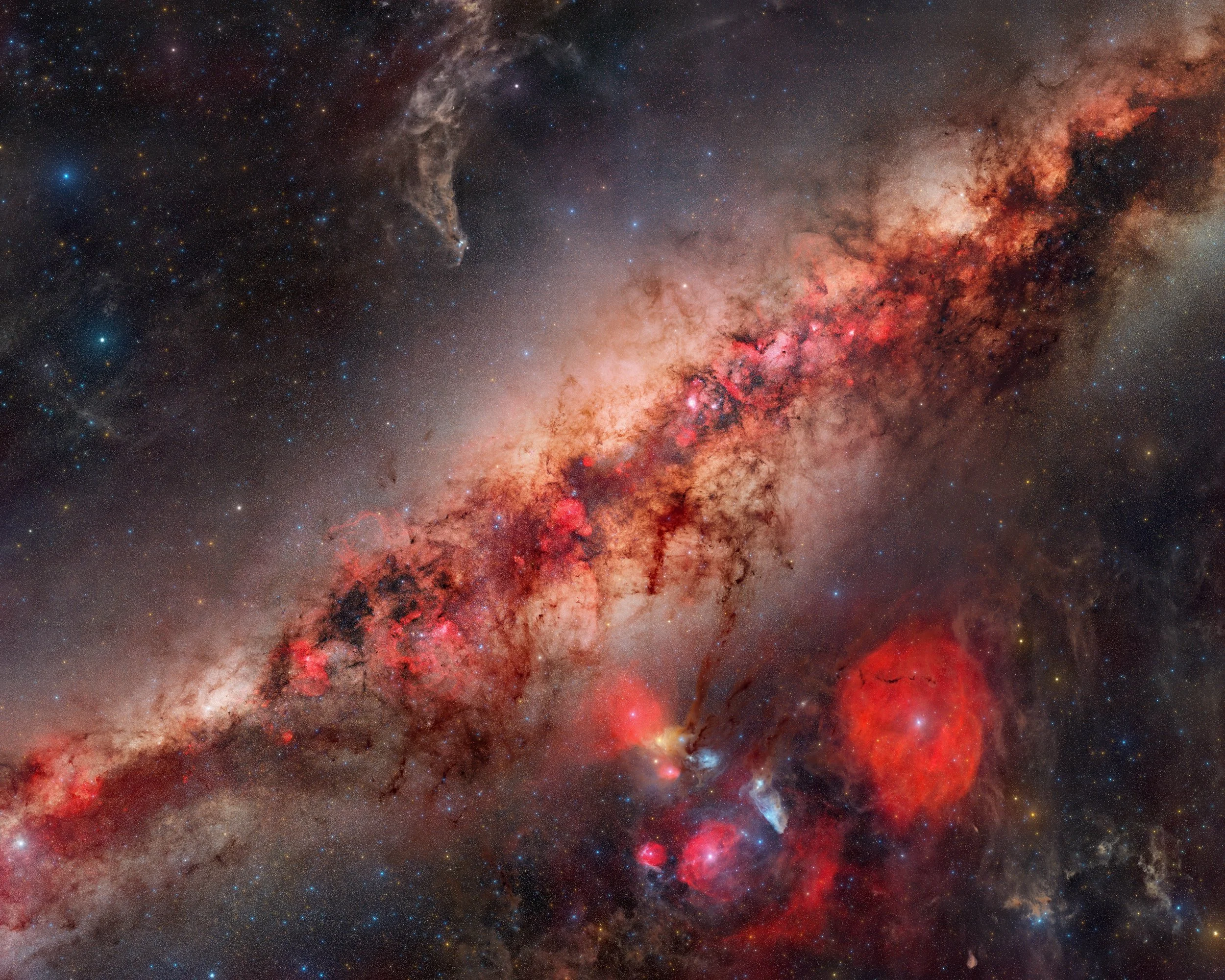
A deep look at the Milky Way Core HaRGB Mosaic
A breathtaking high-resolution mosaic reveals the glowing heart of our galaxy, the Milky Way. Captured through a 135mm HaRGB setup, the image highlights a complex web of ionized hydrogen gas (shown in red), dark dust lanes, and star-forming regions. The galactic core, rich in emission nebulae and dense molecular clouds, sits shrouded in interstellar dust that obscures visible light but glows brilliantly in this composite view.
Stretching across the field, the image captures the interplay between dark and luminous regions, offering a sense of the immense scale and structure of the Milky Way’s inner spiral arms. This deep and carefully assembled mosaic brings the hidden beauty of the galactic center into sharp focus, revealing both the chaos and order at the core of our home galaxy.