

AAPOD2 Image Archives
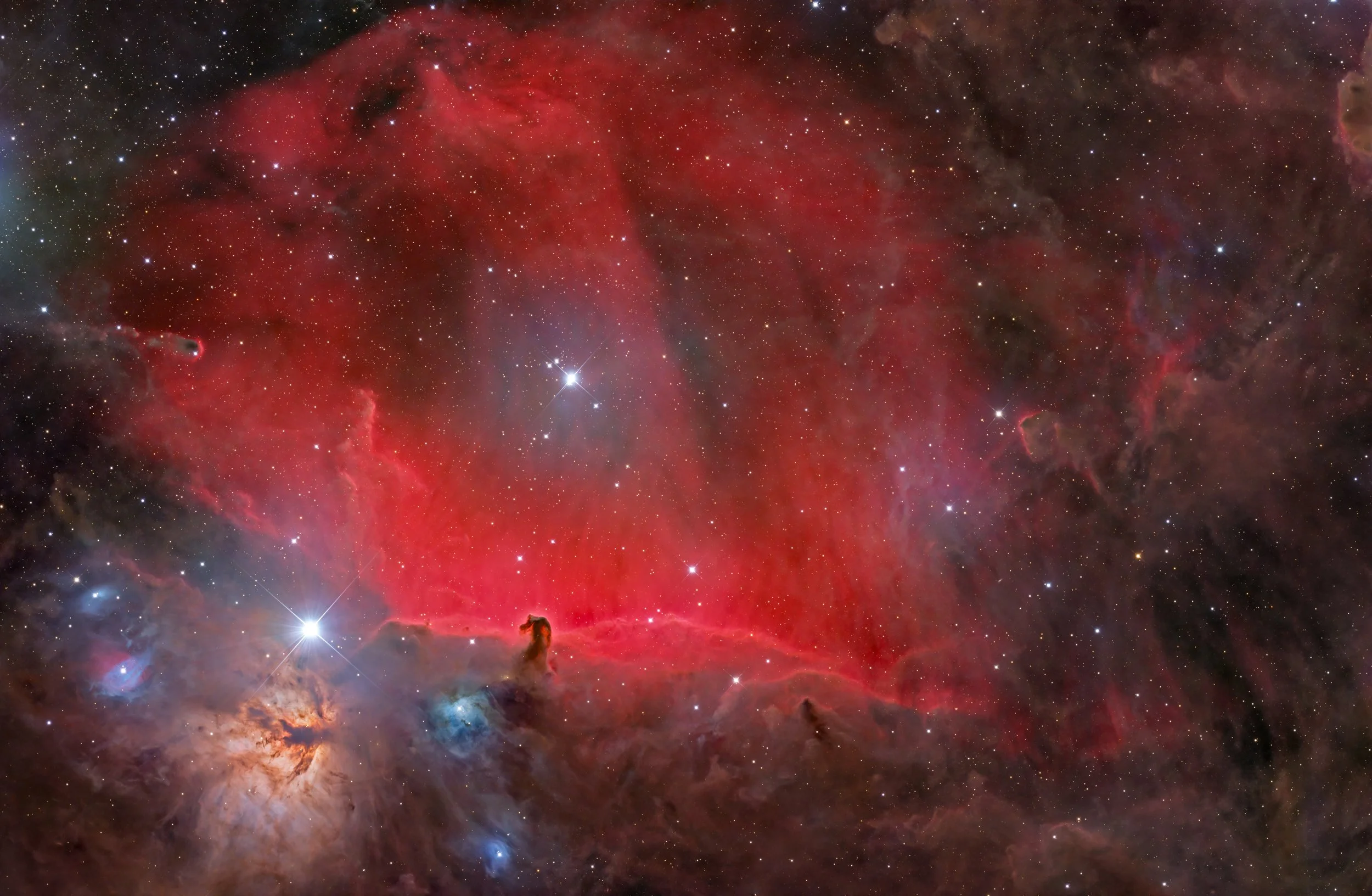
The Horsehead in Hydrogen Light (IC 434)
Rising from the glowing curtain of IC 434, the iconic Horsehead Nebula (Barnard 33) appears here in a detailed Ha-RGB composition that blends narrowband hydrogen-alpha with natural color stars and dust. Located about 1,300 light-years away in Orion, this dense knot of cold molecular gas is silhouetted against the ionized hydrogen emission behind it, creating one of the most recognizable profiles in the night sky. The bright star Sigma Orionis, part of a young OB association, provides much of the ultraviolet radiation that excites the surrounding hydrogen, causing the deep crimson glow that defines this vast emission region.
Beneath the Horsehead lies NGC 2023, a luminous blue reflection nebula powered by the hot star HD 37903, while intricate lanes of interstellar dust weave through the wider field. The Ha-RGB approach enhances faint hydrogen structures while preserving stellar color, revealing delicate shock fronts, wispy filaments, and subtle gradients within the nebula. Together, these elements showcase an active stellar nursery where radiation, gravity, and dust interact to sculpt the cloud, offering both a scientifically rich and visually striking portrait of ongoing star formation.
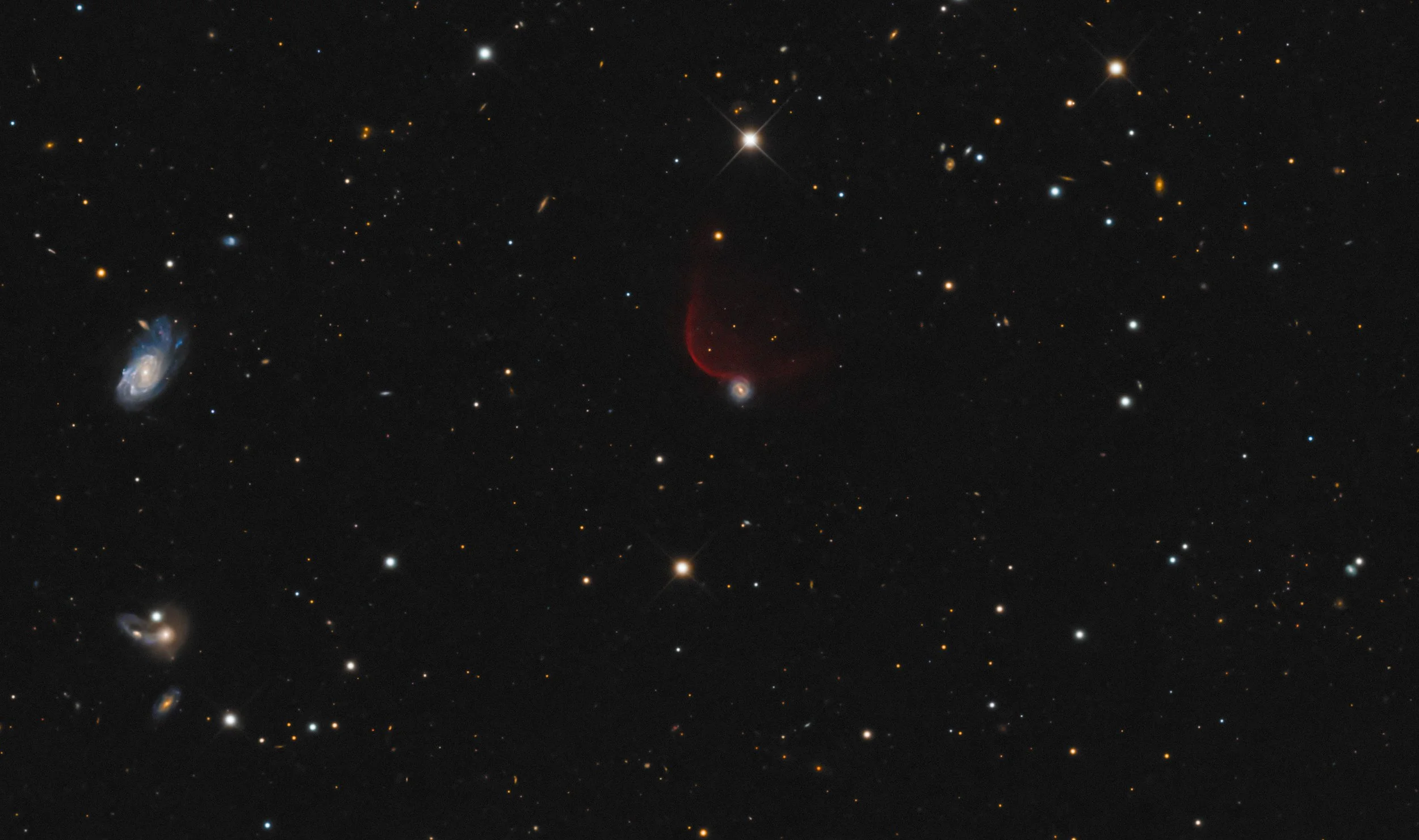
Pulsar J0437-4715 with Bow Shock
Racing through interstellar space at hundreds of kilometers per second, PSR J0437-4715 is one of the nearest known millisecond pulsars to Earth, located about 500 light-years away in the constellation Pavo. This rapidly spinning neutron star, the dense remnant of a supernova explosion, emits powerful winds of charged particles. As it plows through the thin gas between stars, those winds collide with the surrounding medium, creating the faint red arc seen here: a hydrogen bow shock formed where the pulsar’s particle outflow compresses and excites interstellar hydrogen.
Beyond the pulsar itself, this deep-field image reveals a rich background of distant galaxies scattered across the frame, emphasizing both the local and extragalactic scales captured in a single exposure. The contrast between the delicate bow shock and the myriad galaxies highlights the dynamic nature of our Milky Way’s stellar remnants against the vast, static backdrop of the universe. This image was captured from ObsTech in Chile using the RCOS 24" f/7.8 Ritchey-Chrétien telescope, showcasing how high-resolution ground-based imaging can trace the subtle interactions between extreme stellar objects and their cosmic environment.
Location: ObsTech, Chile
Credit: Adam Block, Optics RCOS 24" f/7.8 Carbon Truss Ritchey-Chrétien (Harris Telescope)Racing through interstellar space at hundreds of kilometers per second, PSR J0437-4715 is one of the nearest known millisecond pulsars to Earth, located about 500 light-years away in the constellation Pavo. This rapidly spinning neutron star, the dense remnant of a supernova explosion, emits powerful winds of charged particles. As it plows through the thin gas between stars, those winds collide with the surrounding medium, creating the faint red arc seen here: a hydrogen bow shock formed where the pulsar’s particle outflow compresses and excites interstellar hydrogen.
Beyond the pulsar itself, this deep-field image reveals a rich background of distant galaxies scattered across the frame, emphasizing both the local and extragalactic scales captured in a single exposure. The contrast between the delicate bow shock and the myriad galaxies highlights the dynamic nature of our Milky Way’s stellar remnants against the vast, static backdrop of the universe. This image was captured from ObsTech in Chile using the RCOS 24" f/7.8 Ritchey-Chrétien telescope, showcasing how high-resolution ground-based imaging can trace the subtle interactions between extreme stellar objects and their cosmic environment.
Location: ObsTech, Chile
Credit: Adam Block, and the Harris Telescope
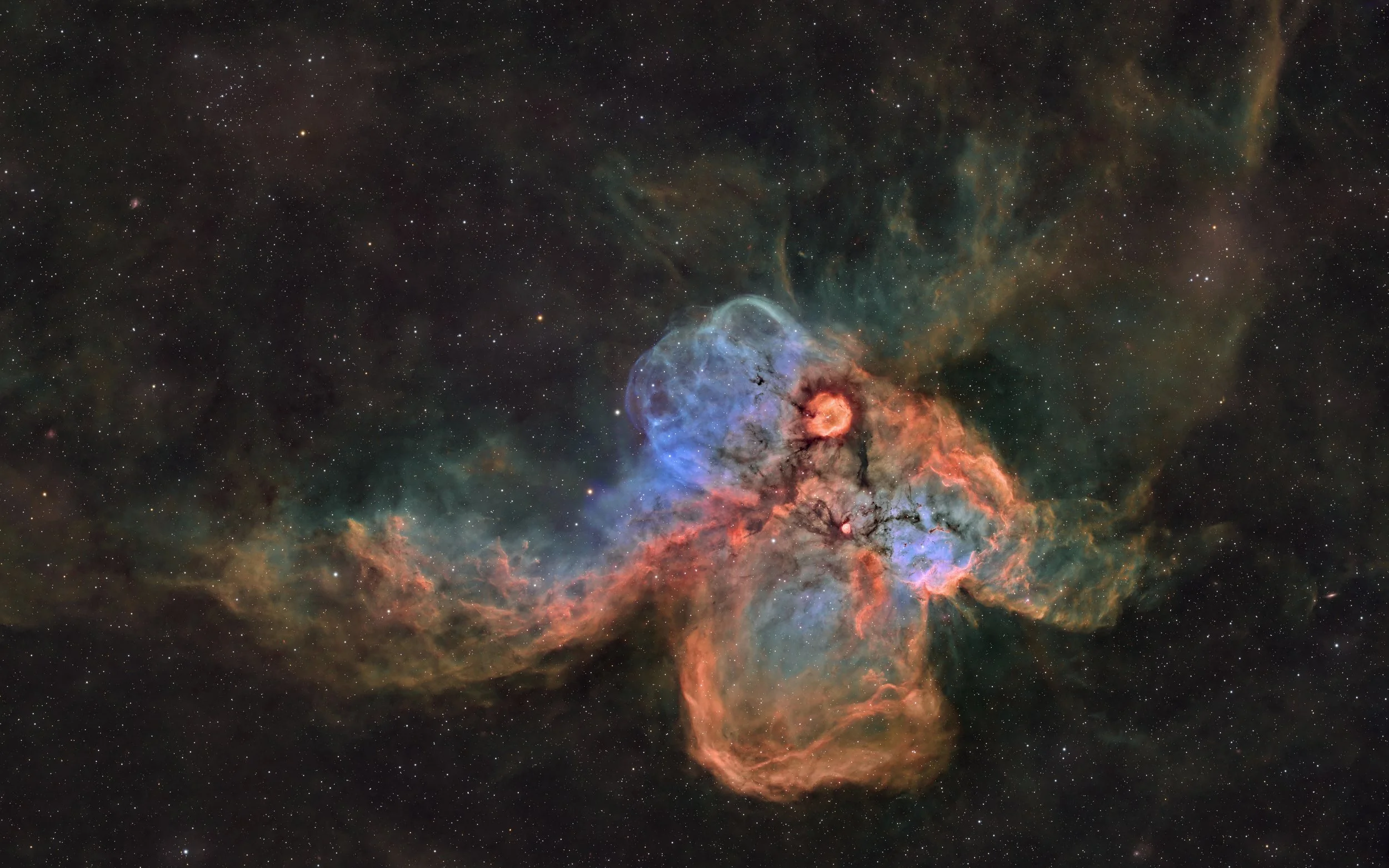
NGC2467 - Skull and Crossbones Nebula
NGC 2467, often called the Skull and Crossbones Nebula, is a dynamic star-forming region located roughly 13,000 light-years away in the constellation Puppis. This complex emission nebula is part of a larger molecular cloud where intense ultraviolet radiation from young, massive stars ionizes surrounding hydrogen gas, producing the glowing red structures seen throughout the field. Embedded clusters sculpt the nebula’s shape through stellar winds and radiation pressure, carving cavities and bright rims while triggering new generations of star formation along compressed gas fronts.
Rendered here in a narrowband palette, the image highlights ionized hydrogen, oxygen, and sulfur, revealing intricate filaments, shock fronts, and dense dust lanes that give rise to the nebula’s skull-like appearance. Blue tones trace energized oxygen near the hottest stars, while warmer reds and golds map hydrogen-rich regions and expanding shells. Against a backdrop of faint Milky Way star fields, NGC 2467 appears as a turbulent crossroads of creation, where stellar feedback continuously reshapes the surrounding interstellar medium.
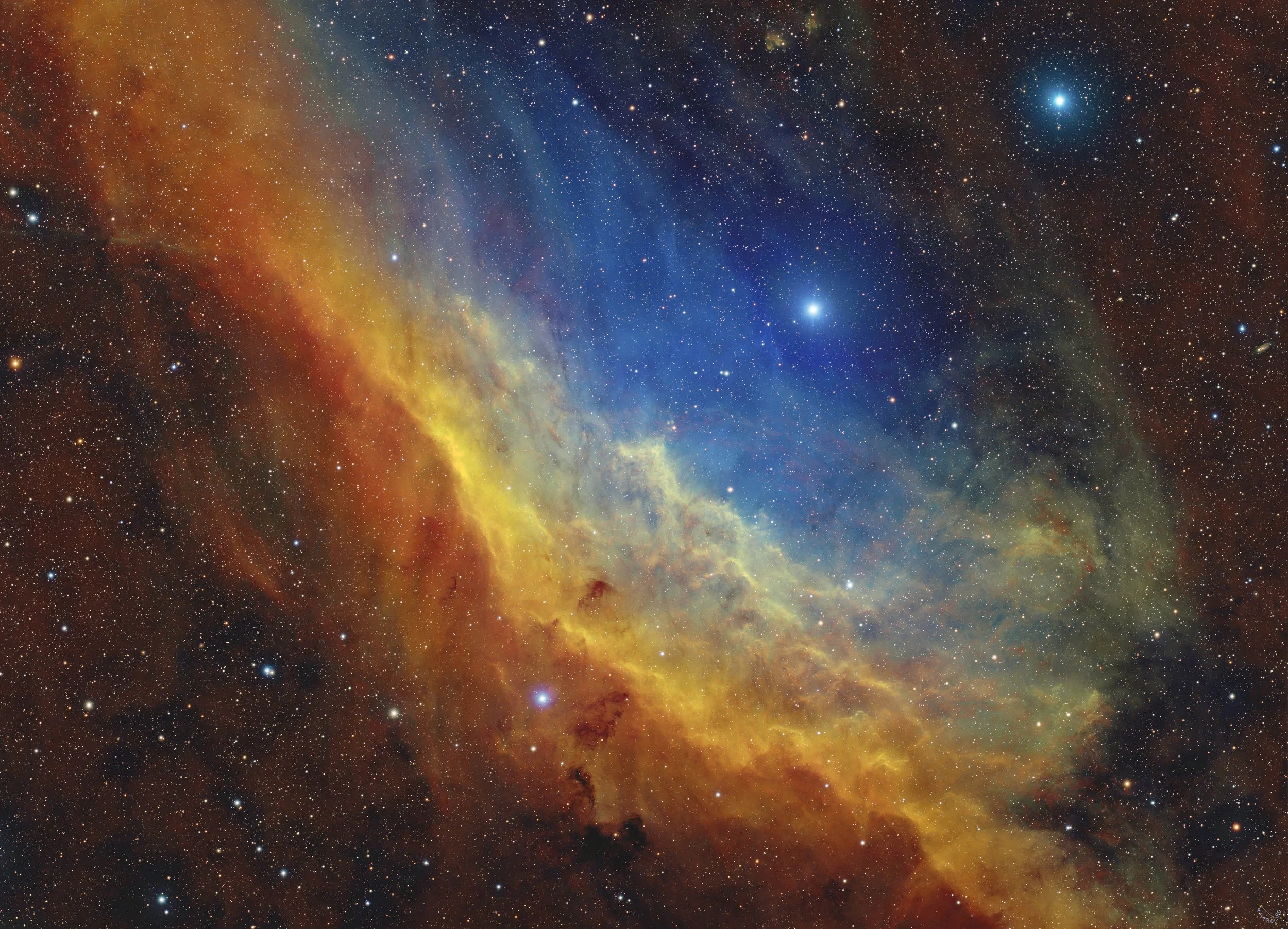
NGC 1499 in SHO | The California Nebula
NGC 1499, commonly known as the California Nebula, is a vast emission nebula stretching nearly 100 light-years across the constellation Perseus, located roughly 1,000 light-years from Earth. Its hydrogen-rich clouds glow intensely under ultraviolet radiation from the nearby hot O-type star Xi Persei, which energizes the surrounding gas and drives ongoing star formation. In this SHO presentation, sulfur, hydrogen, and oxygen emissions are mapped to gold, green, and blue tones, revealing the nebula’s layered ionization structure and highlighting the boundary where stellar radiation meets dense interstellar material.
The image showcases delicate shock fronts, filamentary ridges, and dark dust intrusions embedded within luminous hydrogen arcs, offering a detailed view of how massive stars sculpt their environments. Oxygen-rich regions trace the more diffuse outer envelope, while sulfur emphasizes denser, cooler pockets along the bright emission edge. Together, these elements form a sweeping cosmic shoreline, where turbulence, radiation, and gravity interact to shape one of Perseus’s most striking stellar nurseries.
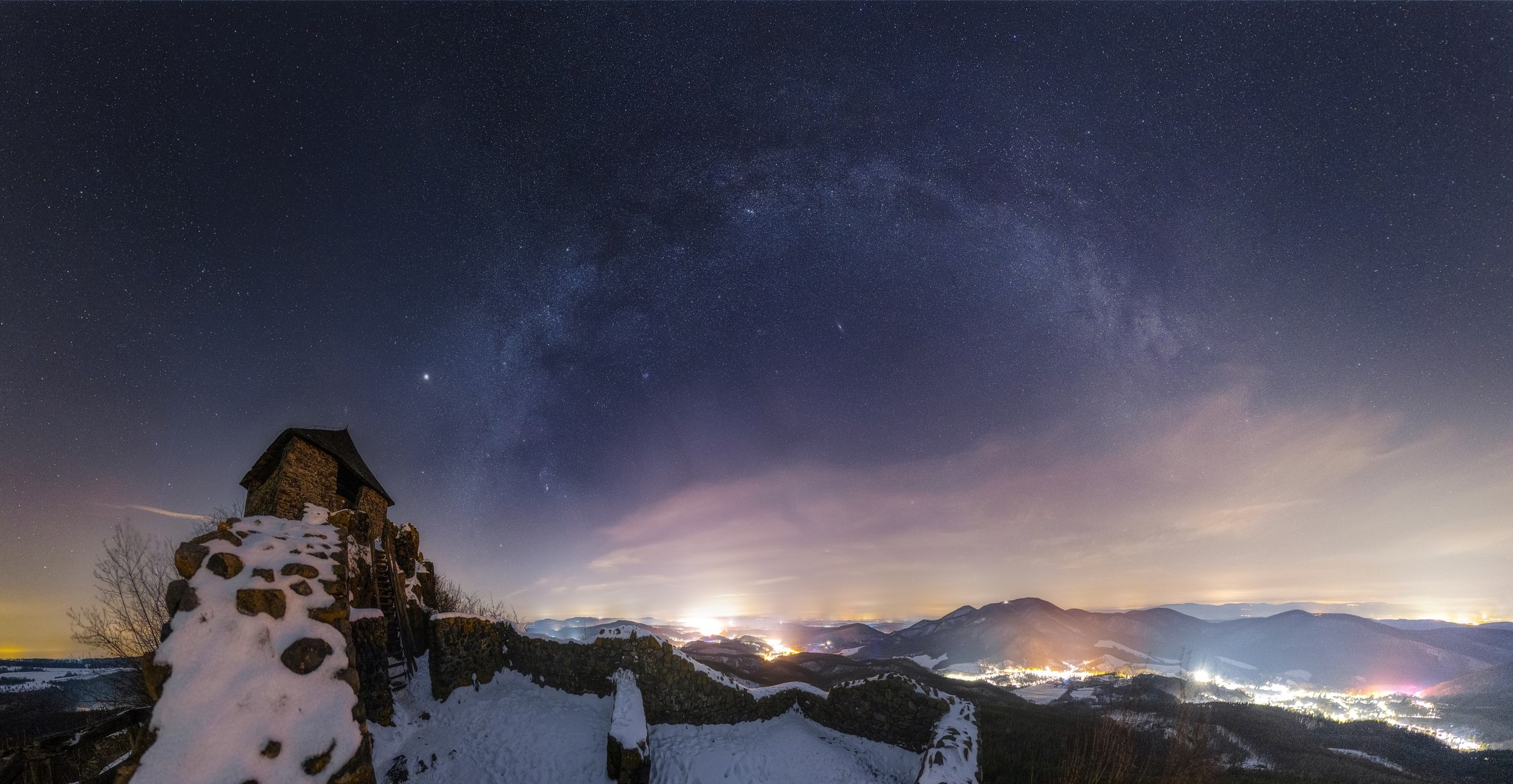
Winter Milky Way in Salgó castle
Rising in a graceful arc above the snow-covered ruins of Salgó Castle in northern Hungary, the winter Milky Way reveals our galaxy’s outer spiral structure, where starlight is softer and more diffuse than the bright summer core. This region of the sky is rich in nearby star fields and faint molecular dust clouds, with constellations such as Orion, Taurus, and Auriga contributing prominent features including emission nebulae, reflection nebulae, and young stellar clusters embedded in the galactic plane.
The medieval stone walls in the foreground provide a striking contrast between human history and cosmic scale, while distant town lights illuminate the surrounding mountain ridges beneath a calm winter atmosphere. Subtle airglow and thin cloud layers add pastel tones near the horizon, emphasizing the transition from Earth’s landscape to deep space. Together, the scene captures both the quiet beauty of a frozen night and the immense structure of our home galaxy stretching across the sky.
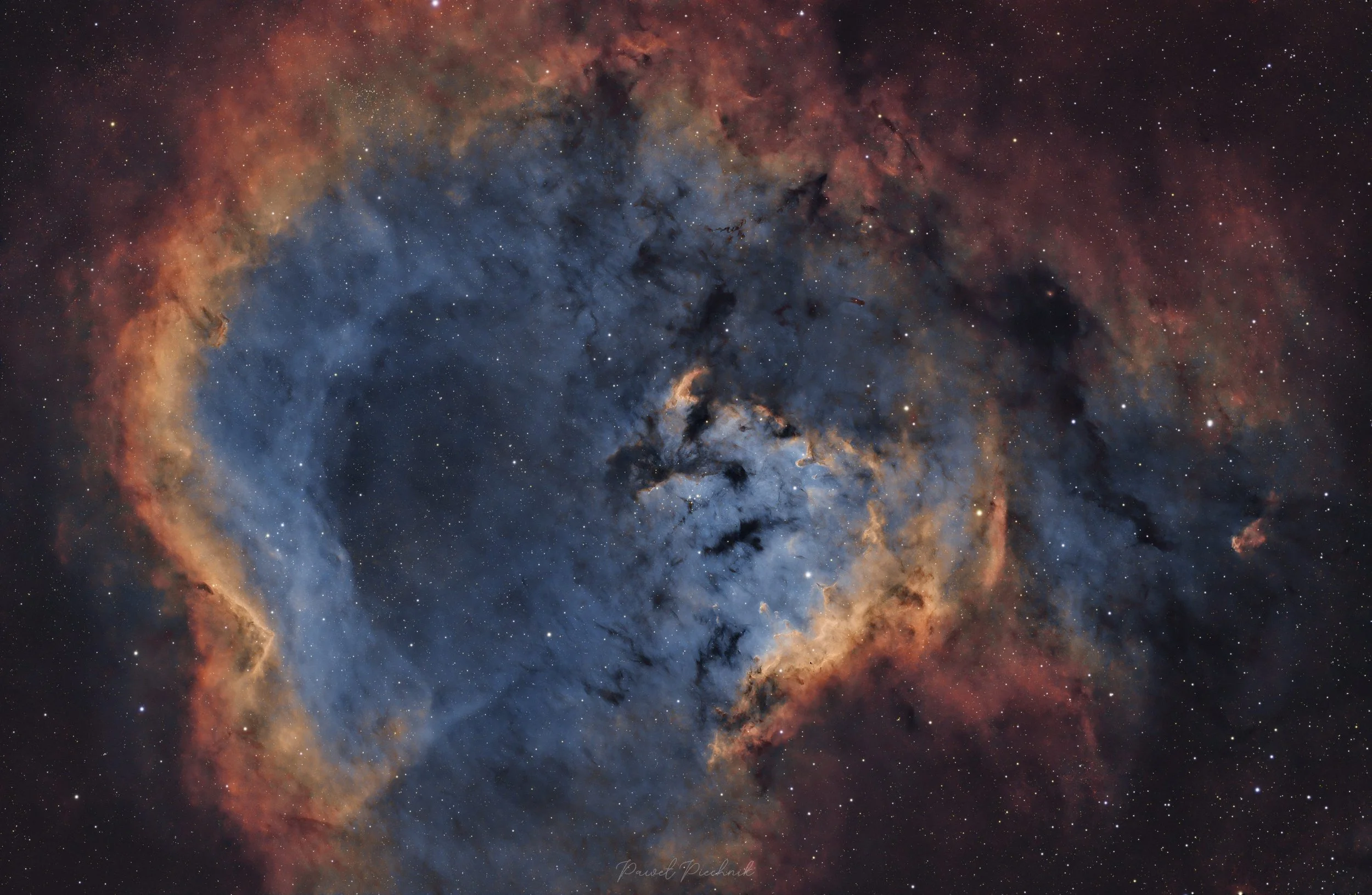
SH2-171 – The Teddy Bear Nebula in Cepheus
Located in the constellation Cepheus, SH2-171, commonly known as the Teddy Bear Nebula, is a complex region of ionized hydrogen, reflection nebulosity, and dense interstellar dust situated roughly 1,400 light-years from Earth. This area combines emission from energized hydrogen gas with soft blue reflection nebulae illuminated by nearby young stars. Dark molecular clouds weave through the scene, absorbing background starlight and outlining the nebula’s distinctive shape while highlighting zones where star formation is actively reshaping the surrounding medium.
Visually, the composition showcases a dramatic interplay between cool blue reflections, warm red hydrogen emission, and intricate black dust filaments that add depth and structure across the frame. Subtle gradients of light reveal turbulent gas flows and layered clouds, while countless faint stars pierce through translucent veils of cosmic material. The familiar teddy bear silhouette emerges organically from these interacting elements, creating a captivating blend of scientific insight and aesthetic beauty.
Artistically, the image reveals a striking contrast between the soft, luminous blues of reflected starlight and the warm, filamentary reds of hydrogen emission in the surrounding gas. Intricate dust structures thread through the scene, creating depth and motion across the frame, while countless faint stars sparkle through translucent veils of cosmic material. The nebula’s whimsical outline, reminiscent of a teddy bear, emerges naturally from these interacting clouds, making this both a scientifically rich and visually enchanting portrait of a quiet stellar nursery.
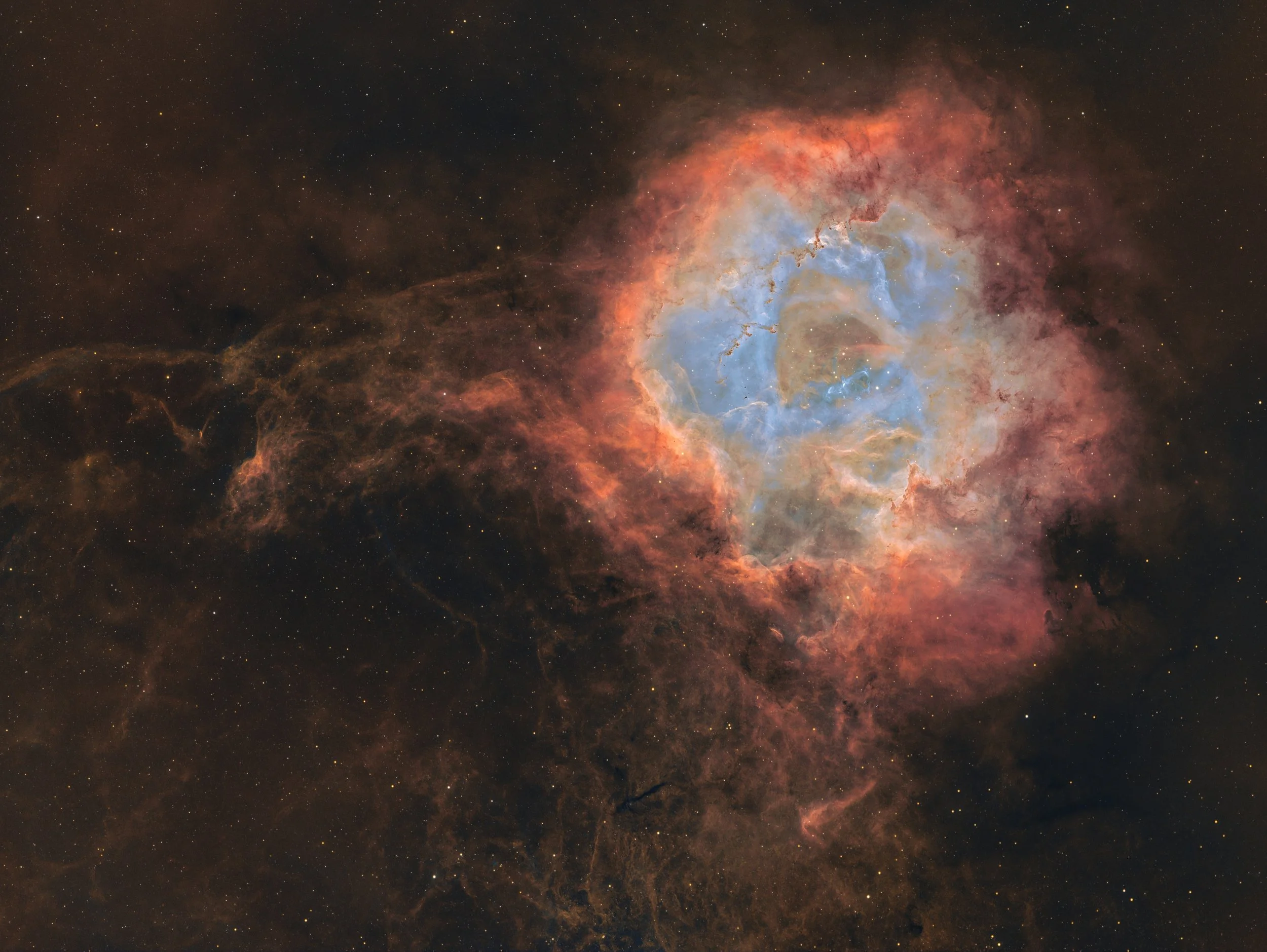
Rosette Nebula with Sulfur Extensions from Nyon
Captured from a rooftop in Nyon, Switzerland, this 25-hour deep integration reveals the Rosette Nebula (NGC 2237–9), a vast star-forming region about 5,200 light-years away in the constellation Monoceros. At its heart lies the young open cluster NGC 2244, whose hot, massive stars carve a hollowed cavity in the surrounding gas. The blue tones trace oxygen-rich regions, while the warm reds highlight hydrogen emission, outlining the nebula’s iconic rose-like structure. Faint sulfur extensions stretch outward, exposing shock fronts and tenuous filaments that mark the ongoing interaction between stellar radiation and the parent molecular cloud.
Aesthetically, the image balances a luminous central bubble with delicate, wind-swept tendrils that fade into the surrounding darkness, giving a strong sense of depth and scale. The added SII data enriches the outer shells and subtle streamers, emphasizing the nebula’s dynamic edges and revealing fragile structures often lost in shorter exposures. Against a finely resolved star field, the Rosette appears both serene and powerful, a cosmic bloom shaped by light, gravity, and time.
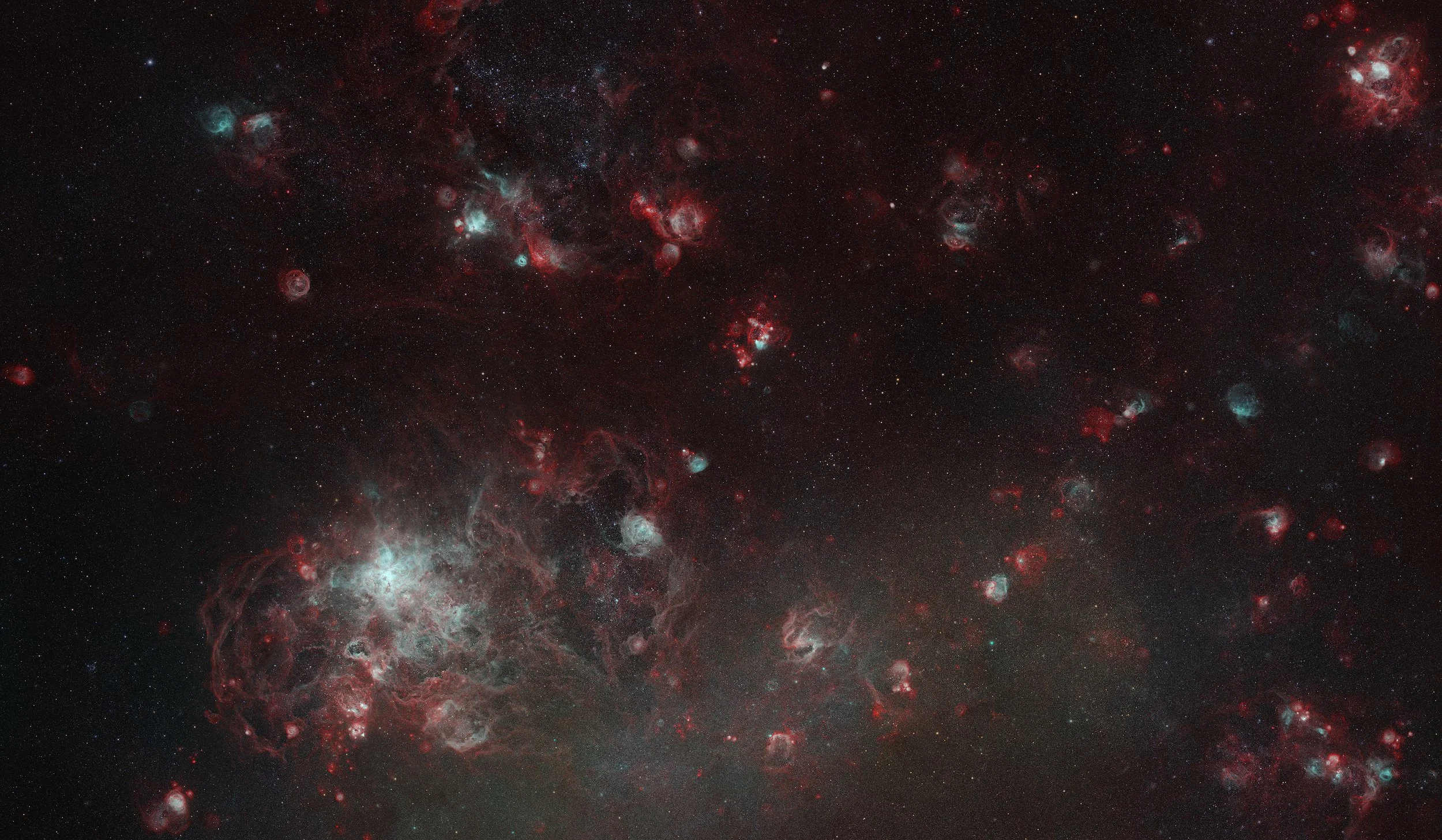
Starbirth and Shockwaves in the Large Magellanic Cloud
This expansive mosaic reveals a rich tapestry of nebulae scattered across the Large Magellanic Cloud, a satellite galaxy of the Milky Way located about 160,000 light years away. Dominated by glowing hydrogen emission in red and oxygen emission in cyan, the scene highlights vast star forming complexes, filamentary shells, and compact knots sculpted by intense ultraviolet radiation and stellar winds. Many of these structures trace the life cycles of massive stars, from deeply embedded nurseries to energized bubbles carved by young star clusters and supernova activity.
Captured as a 10 panel mosaic, the image combines deep narrowband and broadband data to balance scientific detail with natural star color. The strong H alpha signal maps ionized hydrogen gas heated by newborn stars, while OIII emphasizes regions of higher excitation shaped by powerful radiation and shocks. Together, these layers offer a wide field view of the dynamic interstellar medium within the Large Magellanic Cloud, showcasing how gravity, radiation, and stellar feedback continuously reshape this neighboring galaxy.
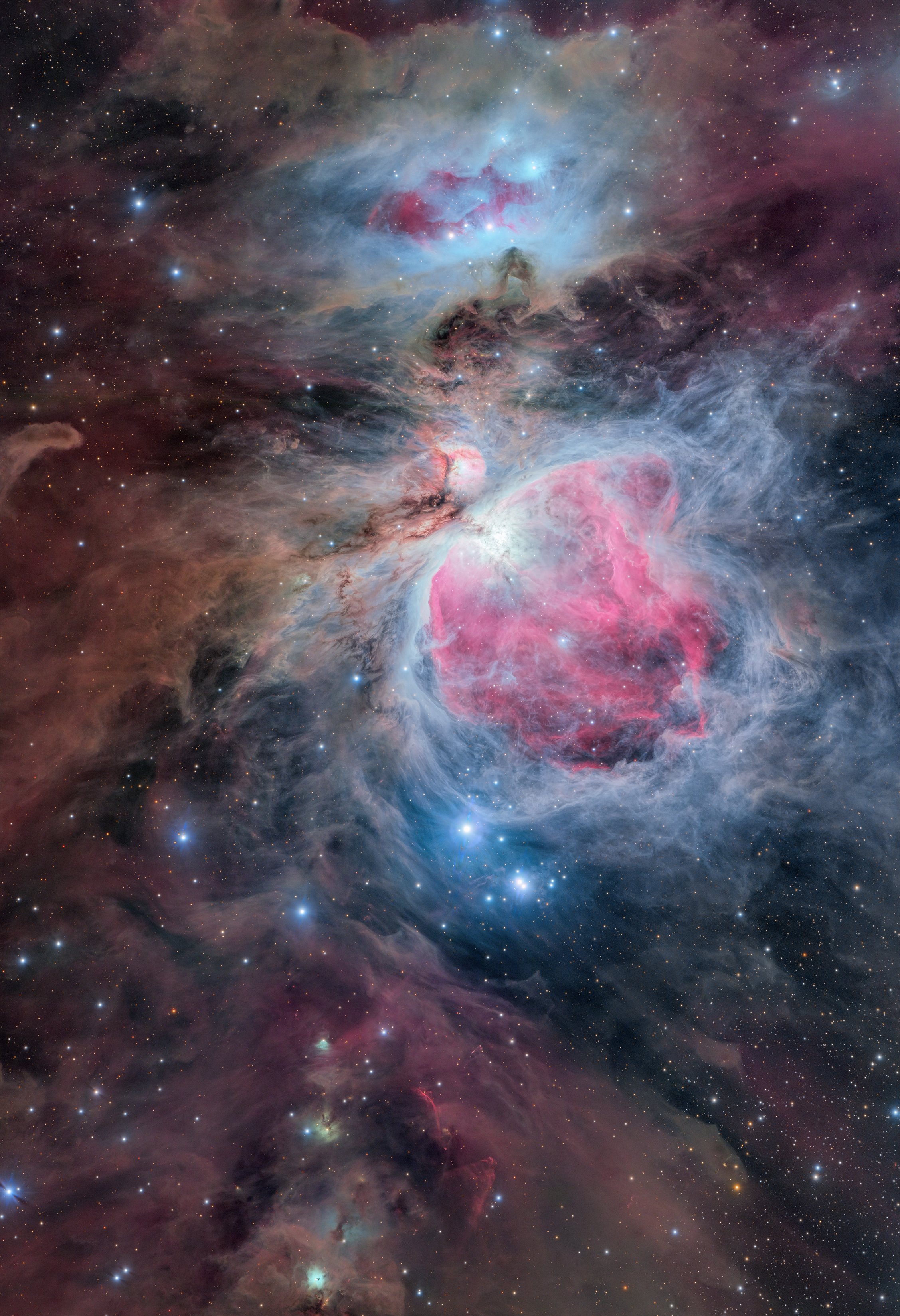
M42 Orion Nebula
The Orion Nebula, cataloged as M42, is one of the nearest and most studied stellar nurseries, located about 1,350 light years away in the constellation Orion. At its core lies the Trapezium Cluster, a group of young, massive stars whose intense ultraviolet radiation excites surrounding hydrogen gas, causing it to glow in shades of pink and red. These energetic stars also sculpt the nebula’s structure, carving cavities and sweeping arcs through the surrounding clouds of gas and dust.
Above M42 in this wide field view is NGC 1977, commonly known as the Running Man Nebula. Unlike the Orion Nebula, its bluish tones are produced primarily by reflected starlight rather than emission. Together, these regions trace different physical processes at work within the same molecular cloud complex, revealing how star formation both illuminates and reshapes its environment on scales of several light years.
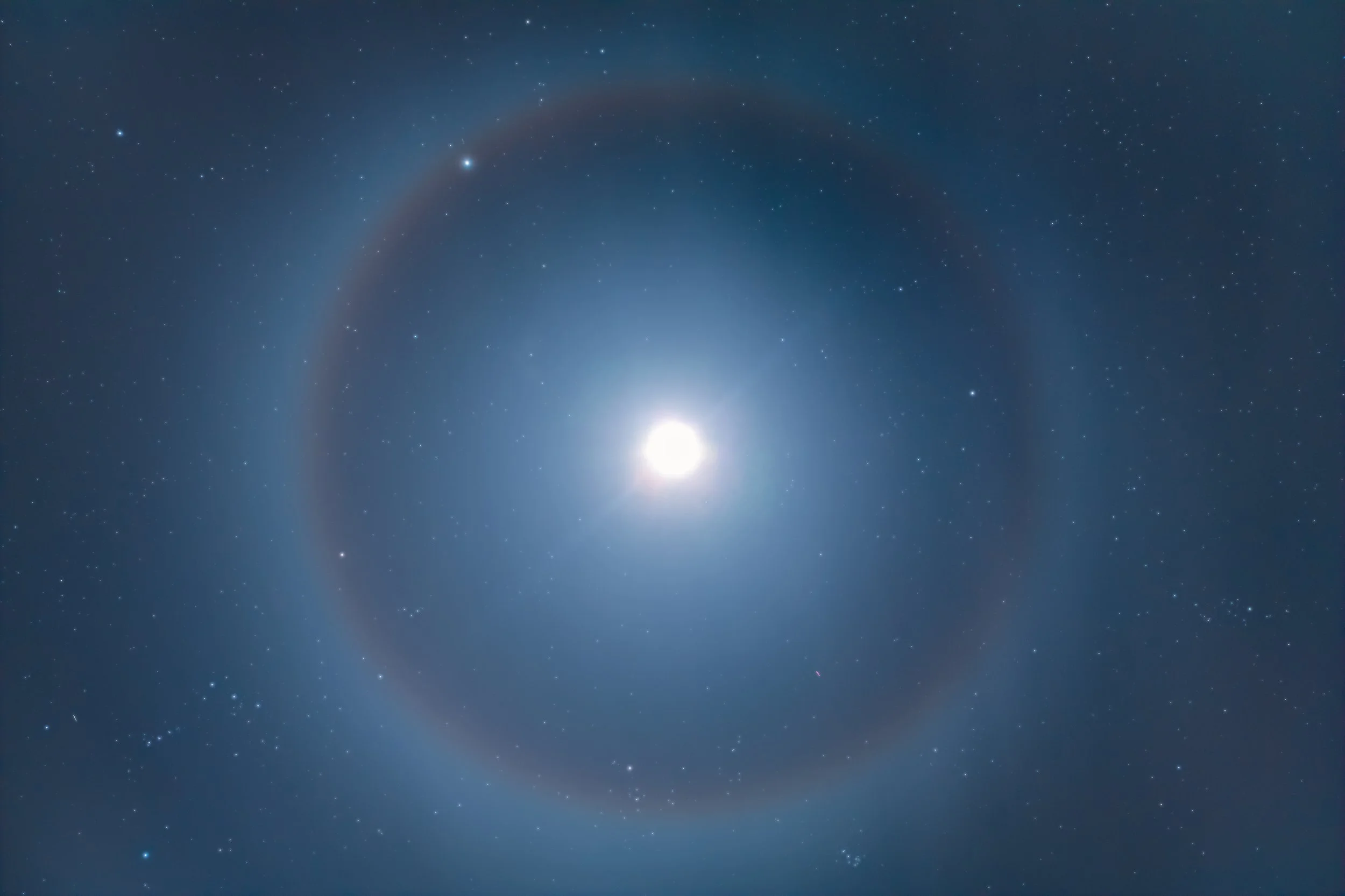
Lunar Halo over Snowbound Doda
A luminous lunar halo encircles the nearly full Moon above the snowbound landscape of Doda, forming a near-perfect ring against a star-filled winter sky. This atmospheric phenomenon occurs when moonlight is refracted by countless hexagonal ice crystals suspended in high, thin cirrostratus clouds. The geometry of these crystals bends the light by about 22 degrees, creating the softly glowing circle that frames the Moon while leaving surrounding stars still visible through the icy veil.
Beyond its visual elegance, a lunar halo is a subtle indicator of conditions aloft, often signaling widespread ice clouds associated with changing weather patterns. Here, the cold, clear air over Doda enhances contrast and clarity, allowing the halo to stand out with delicate color gradations from pale white to faint hints of red and blue along its rim. The scene blends atmospheric physics with quiet winter beauty, turning a familiar Moon into the centerpiece of a rare and memorable nocturnal display.
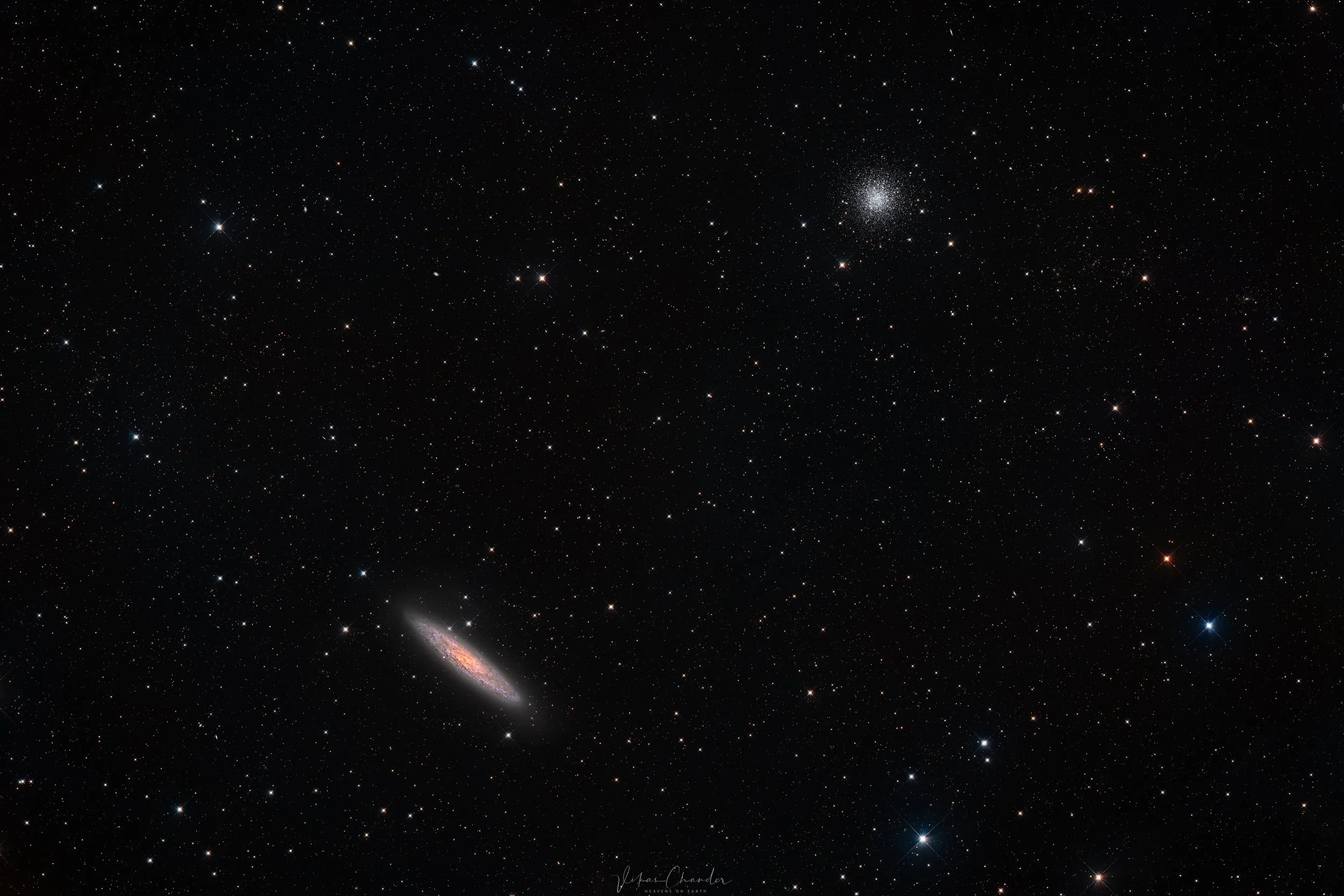
NGC 253 and NGC 288 in Sculptor
Set against the sparse star fields of the southern sky, this image pairs two very different residents of the Sculptor constellation. At lower left lies NGC 253, the Sculptor Galaxy, an edge-on spiral roughly 11 million light-years away. Its warm, mottled disk reveals lanes of interstellar dust and regions of active star formation, giving the galaxy a textured, almost turbulent appearance as it stretches across the frame.
Near the upper right is NGC 288, a compact globular cluster bound to the halo of the Milky Way at a distance of about 29,000 light-years. Composed of hundreds of thousands of ancient stars, it appears as a dense, spherical swarm with a granular core, sharply contrasting the elongated form of NGC 253. Captured from Deep Sky Chile under dark southern skies, the image highlights both the nearby relics of our own galaxy and a dynamic spiral beyond, sharing the same line of sight yet separated by vast cosmic distances.
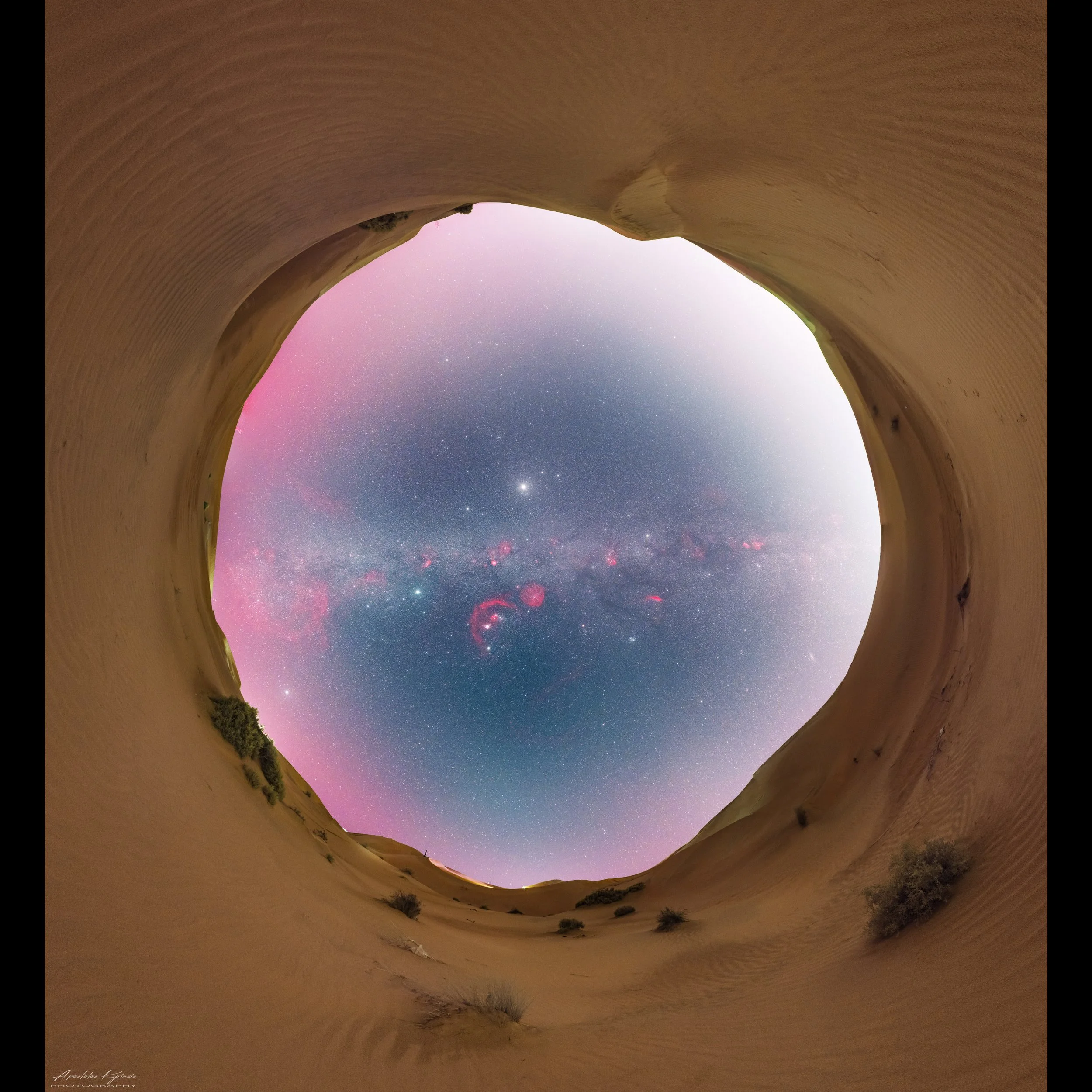
Milky Way Window Over the Rub Al Khali
This immersive 360° panorama looks straight up through a natural bowl formed by desert dunes in the Rub Al Khali, framing a richly detailed view of the Milky Way. The Galactic Plane arcs across the center of the scene, revealing dense star fields and prominent emission nebulae glowing in hydrogen alpha, including regions in Sagittarius and Scutum. The subtle color gradient in the sky reflects both natural airglow and the immense stellar density toward the galactic core, offering a striking contrast between the cool tones of the night sky and the warm, sculpted textures of the sand.
Captured from Razeen in the Rub Al Khali desert near Abu Dhabi, UAE, this image also tells a quiet human story. At the rim of the dune, roughly 100 meters away, a lone figure is visible, briefly illuminating his path with a light. The small scale of the person against the vast desert and galaxy emphasizes the sense of scale, placing human presence as a fleeting detail beneath a sky shaped by billions of years of cosmic evolution.
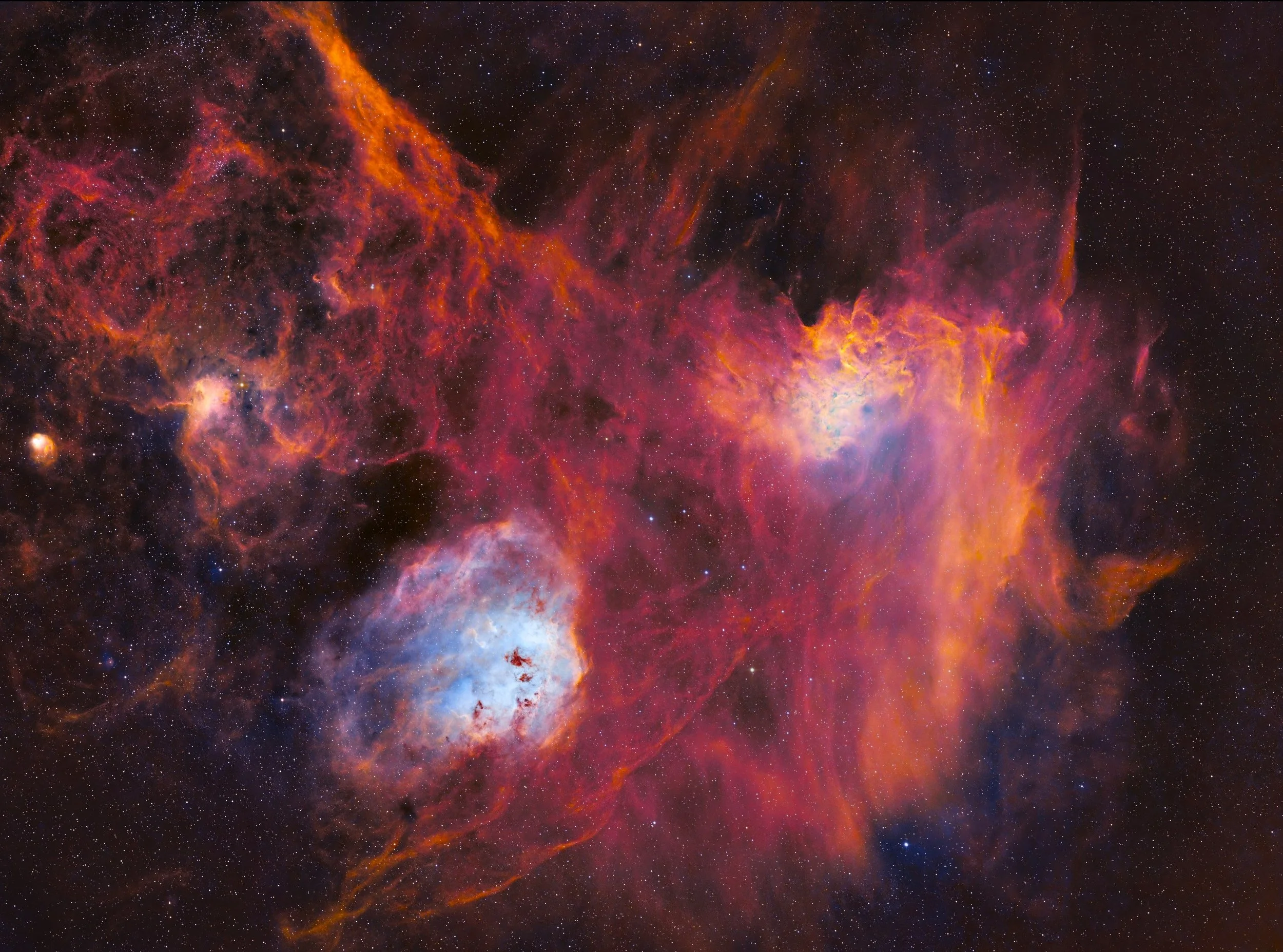
Auriga Nebular Complex
The Auriga Nebular Complex is a sprawling network of glowing emission nebulae, reflection nebulae, and dark molecular clouds located along the Milky Way in the constellation Auriga. Dominated by hydrogen alpha emission, the scene reveals vast sheets of ionized gas sculpted by stellar winds and radiation from young, massive stars embedded within the region. Pockets of blue reflection nebulosity trace dust grains scattering starlight, while dense, opaque filaments mark colder clouds where future generations of stars may eventually form.
Visually, the complex highlights the dynamic lifecycle of the interstellar medium. Expanding ionization fronts carve intricate boundaries between hot, energized gas and surrounding neutral material, producing sharp ridges, wisps, and cavities across tens of light years. Set against a rich star field, the contrasting colors and textures illustrate how stellar feedback both illuminates and reshapes its natal environment, making Auriga one of the more scientifically and aesthetically compelling wide-field nebular regions in the northern sky.
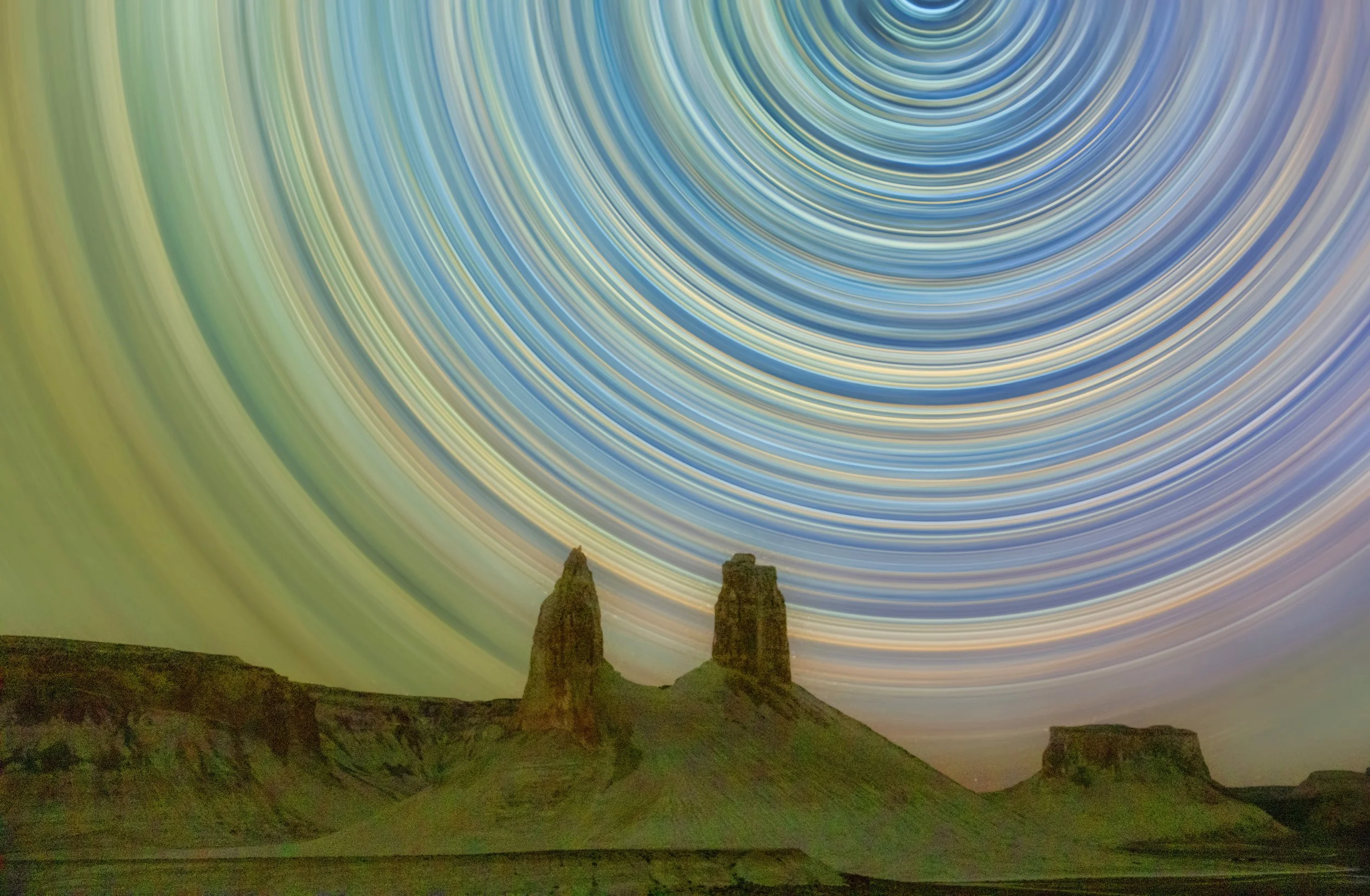
Star Trails Over Bozhira, Mangystau
This image captures concentric star trails arcing across the night sky above the dramatic rock formations of Bozhira in the Mangystau Region of Kazakhstan. The circular patterns are created by Earth’s rotation during a long exposure sequence, with stars tracing apparent paths around the south celestial pole. Subtle color variations within the trails reflect differences in stellar temperature and spectral type, blending cool blues with warmer yellow and white tones.
In the foreground, the eroded limestone buttes and plateaus of the Ustyurt Plateau stand motionless beneath the moving sky, emphasizing the contrast between geological time and celestial motion. The remote location and low light pollution of Mangystau allow the sky’s structure and color to emerge clearly, making this scene a striking illustration of Earth’s rotation written across the stars.
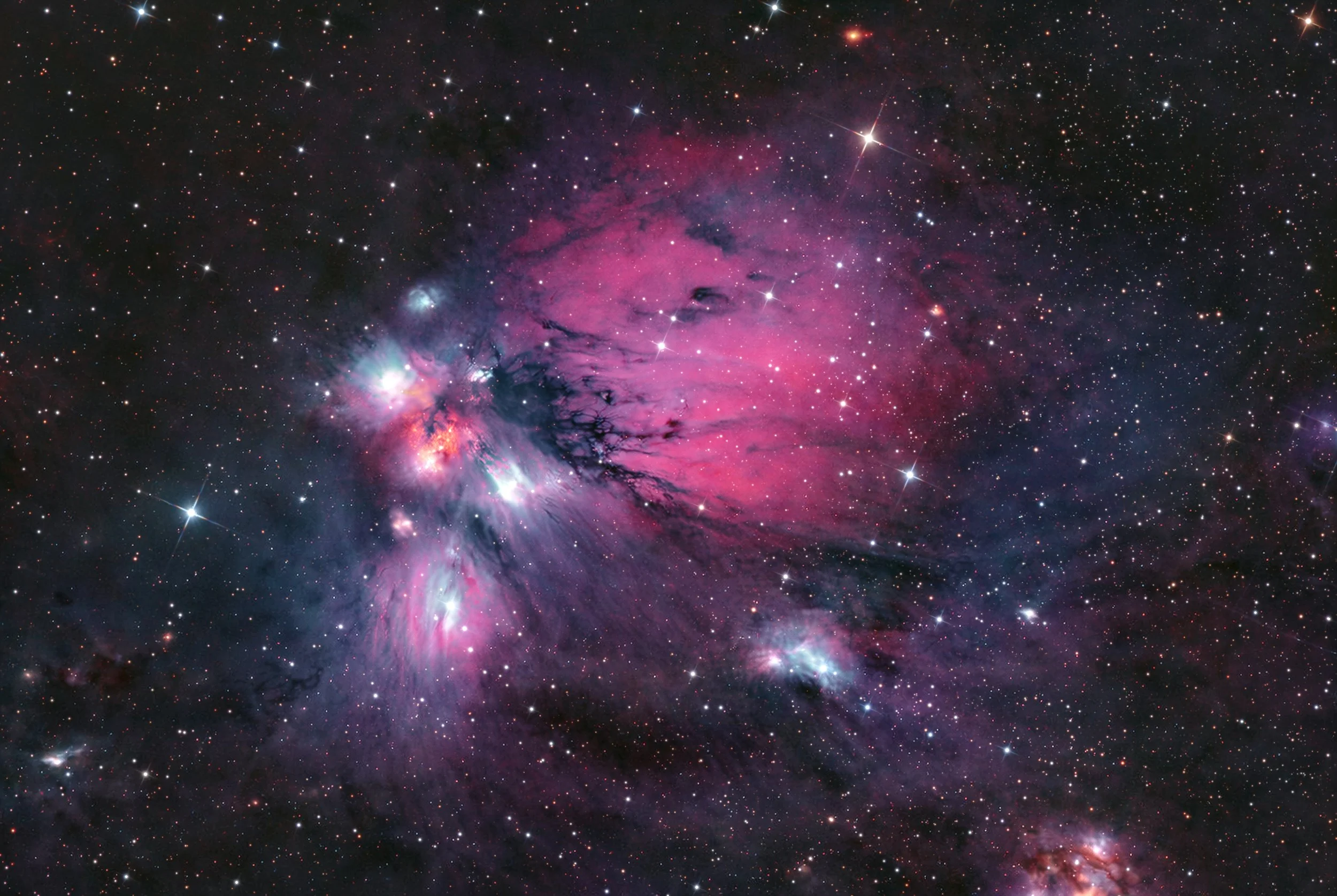
NGC 2170: Reflections and Shadows in Monoceros
NGC 2170 is a complex reflection nebula embedded within a rich star forming region in the constellation Monoceros. Unlike emission nebulae that glow from ionized hydrogen, NGC 2170 shines primarily by reflected starlight, scattering the light of nearby young stars off fine interstellar dust. The soft blue and violet tones trace dust grains illuminated by hot stars, while pink and red regions reveal pockets of hydrogen gas energized by ultraviolet radiation. Dark, branching lanes of cold molecular dust cut sharply through the glow, marking dense regions where future stars may still be forming.
This field is part of the larger Monoceros molecular cloud complex, a dynamic environment shaped by stellar winds, radiation pressure, and gravity. The intricate contrast between luminous nebulae and opaque dust highlights the ongoing cycle of star birth and cloud erosion. Captured from Perth, Western Australia, this view preserves both the delicate color gradients and fine structural detail that make NGC 2170 a striking example of how starlight interacts with the raw material of the galaxy.
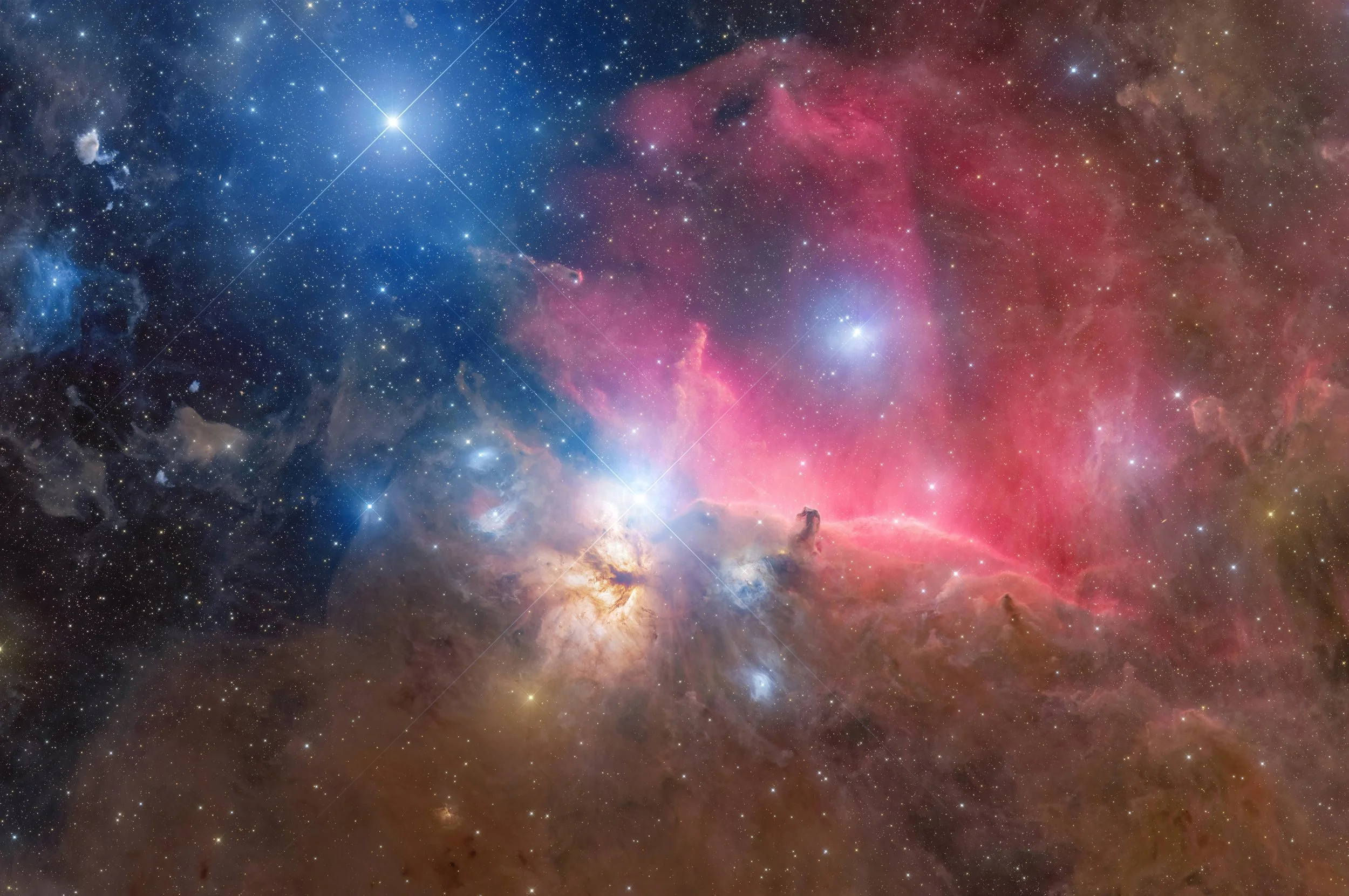
Orion’s Lesser-Known Nebulae in a Single Wide Field
This expansive field in Orion reveals a remarkably dense mix of nebular structures that often sit in the shadow of their more famous neighbors. Dominated by the glowing region around NGC 1990, the scene includes emission and reflection nebulae cataloged as IC 431 and IC 432, the Sharpless object Sh2-277, and several van den Bergh reflection nebulae including VdB 48, 51, and 52. Their soft blues and reds trace the interaction between energetic young stars and the surrounding interstellar medium, where ultraviolet radiation excites hydrogen gas and illuminates nearby dust.
Interwoven through this luminous backdrop is a complex network of Lynds Bright and Dark Nebulae, including LBN 921, 924, 927, 928, 944, 946, 950, 953, 958, 962, 965, and 967, along with dark clouds such as LDN 1614, 1620, 1635, and 1636. These opaque dust lanes carve intricate silhouettes against the glowing gas, marking regions where future stars may eventually form. Captured from Starfront Observatories in Texas, this image highlights the extraordinary depth and diversity of Orion’s lesser-known nebular landscape, where star formation, illumination, and obscuration coexist within a single rich field.
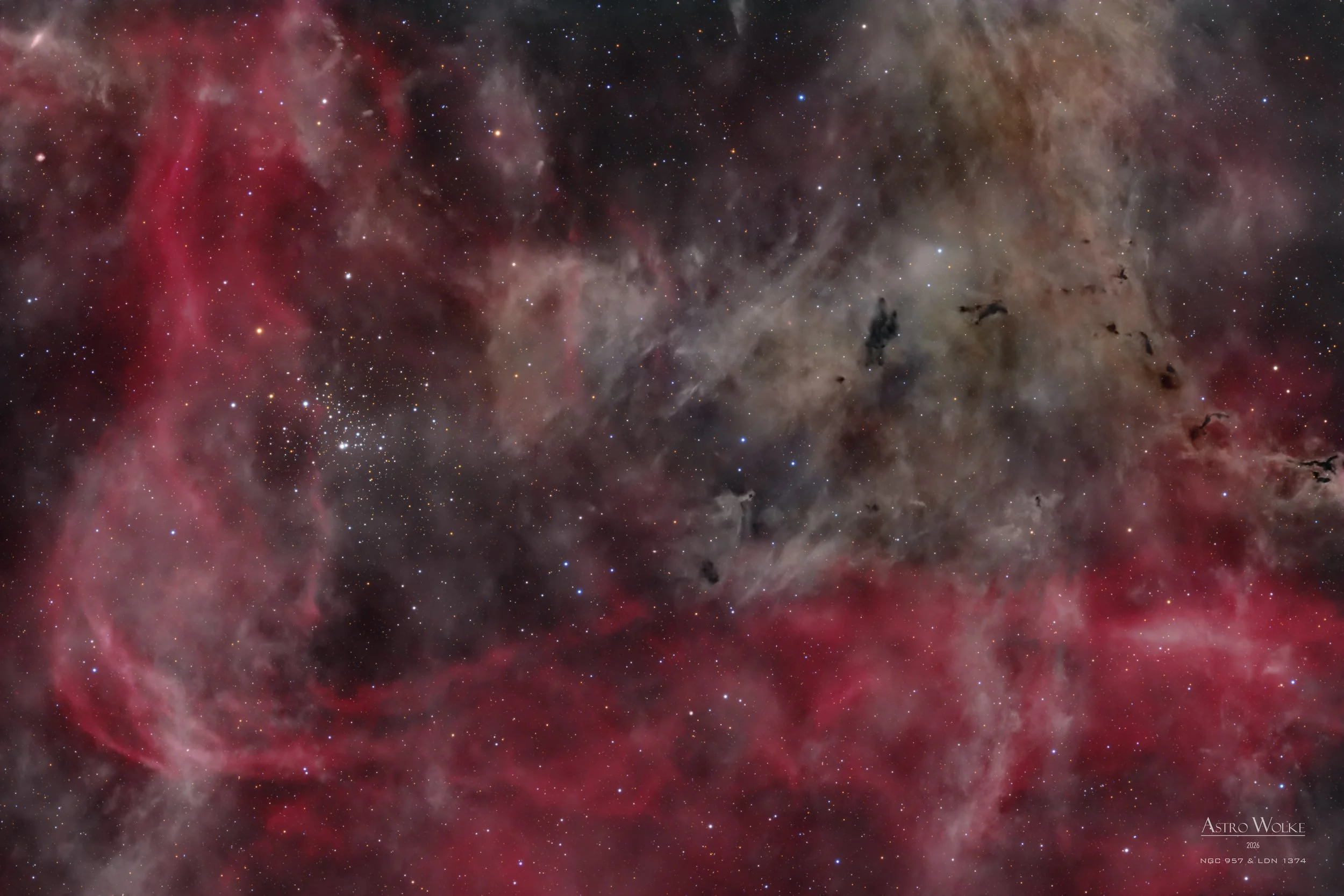
LDN 1374 and NGC 957 – Dust and Starlight in Perseus
This wide-field view captures a richly textured region of the Perseus constellation where luminous emission nebulae intertwine with dense lanes of interstellar dust. The deep red hydrogen-alpha glow traces vast clouds of ionized gas energized by nearby young stars, while the sinuous, smoky structures of Lynds Dark Nebula 1374 cut sharply across the background, absorbing and obscuring the starlight behind them. Embedded within this complex environment lies NGC 957, a compact open star cluster whose young, hot blue stars sparkle through the surrounding haze, offering a striking contrast between stellar birth and the cold dust from which such stars form.
LDN 1374 is part of a much larger network of dark molecular clouds, regions rich in gas and dust that serve as the raw material for future star formation. The interaction between these opaque dust lanes and the glowing emission regions highlights the layered structure of the Milky Way’s spiral arm in this direction. Captured from Moringen, Germany, the image reveals both the chaotic beauty and the underlying physical processes shaping this stellar nursery, where gravity, radiation, and dust sculpt the interstellar medium on scales of many light-years.
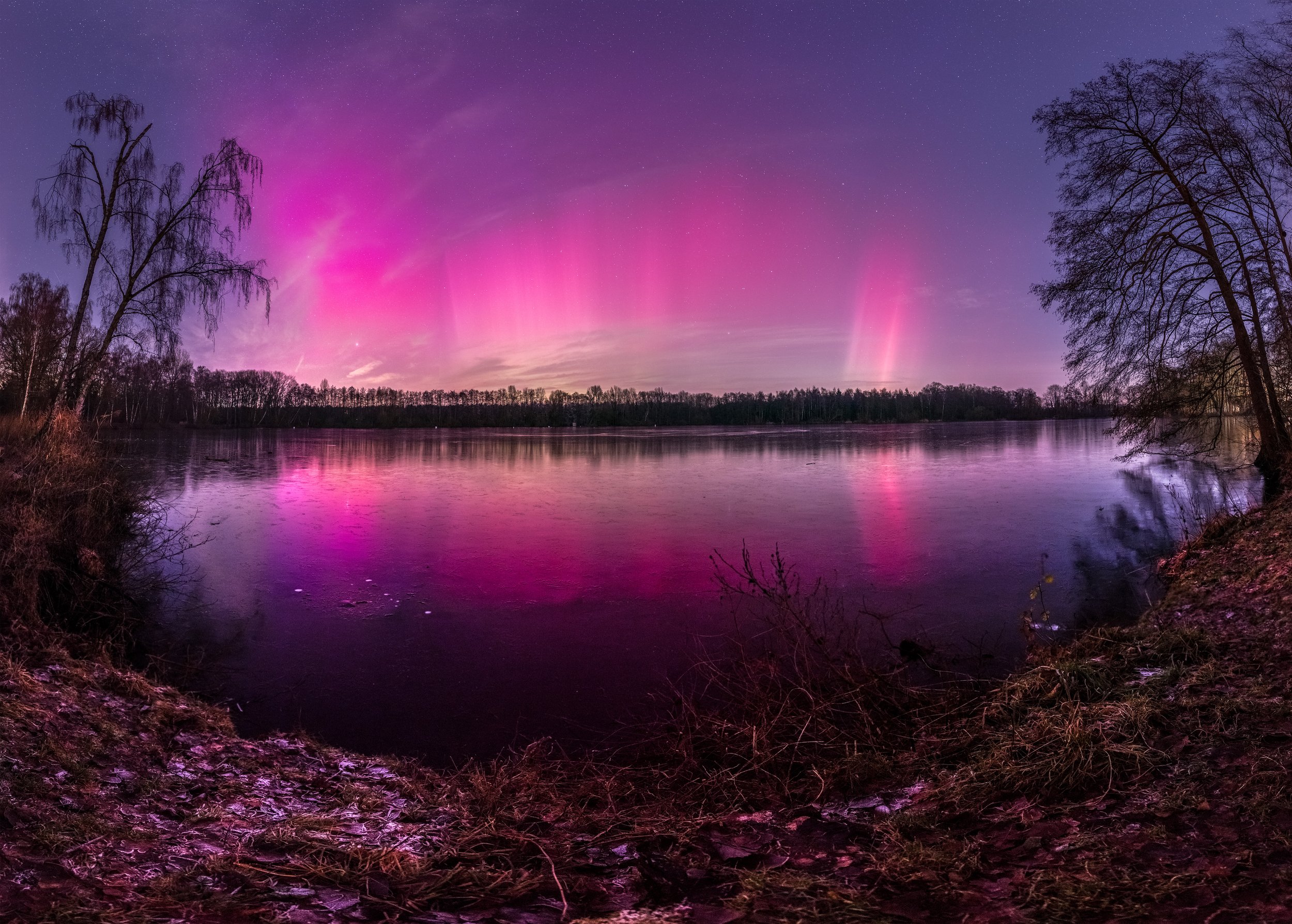
Pink Aurora Over Lüdinghausen, Germany
A brilliant pink aurora borealis dances above a still lake near Lüdinghausen in this wide angle, multi panel panoramic capture from January 20, 2026. The vibrant curtains of light rise from the northern horizon, reflecting soft magenta hues in the water and contrasting with the silhouetted winter trees. The colors are rich and unusual for mid-latitude skies, suggesting strong high-energy particle interactions in Earth’s upper atmosphere and a long exposure that brings out faint stars and fine auroral textures.
This stunning event coincided with one of the most severe geomagnetic storms of the current solar cycle. A powerful solar eruption on January 18 unleashed a full-halo coronal mass ejection (CME) that struck Earth’s magnetic field on January 19 and continued through the next day, driving geomagnetic activity to G4 (Severe) levels on the NOAA scale on January 20. Forecasters predicted strong auroral activity as the CME’s charged particles interacted with Earth’s magnetosphere, expanding the auroral oval farther equatorward than usual and allowing displays across much of Europe, including Germany. K-index values reached around 8, signaling intense magnetic fluctuation conducive to vivid aurora sightings. While residual storm effects eased later in the night, the conditions were ideal for dramatic red-pink and purple auroral emissions against the winter sky.
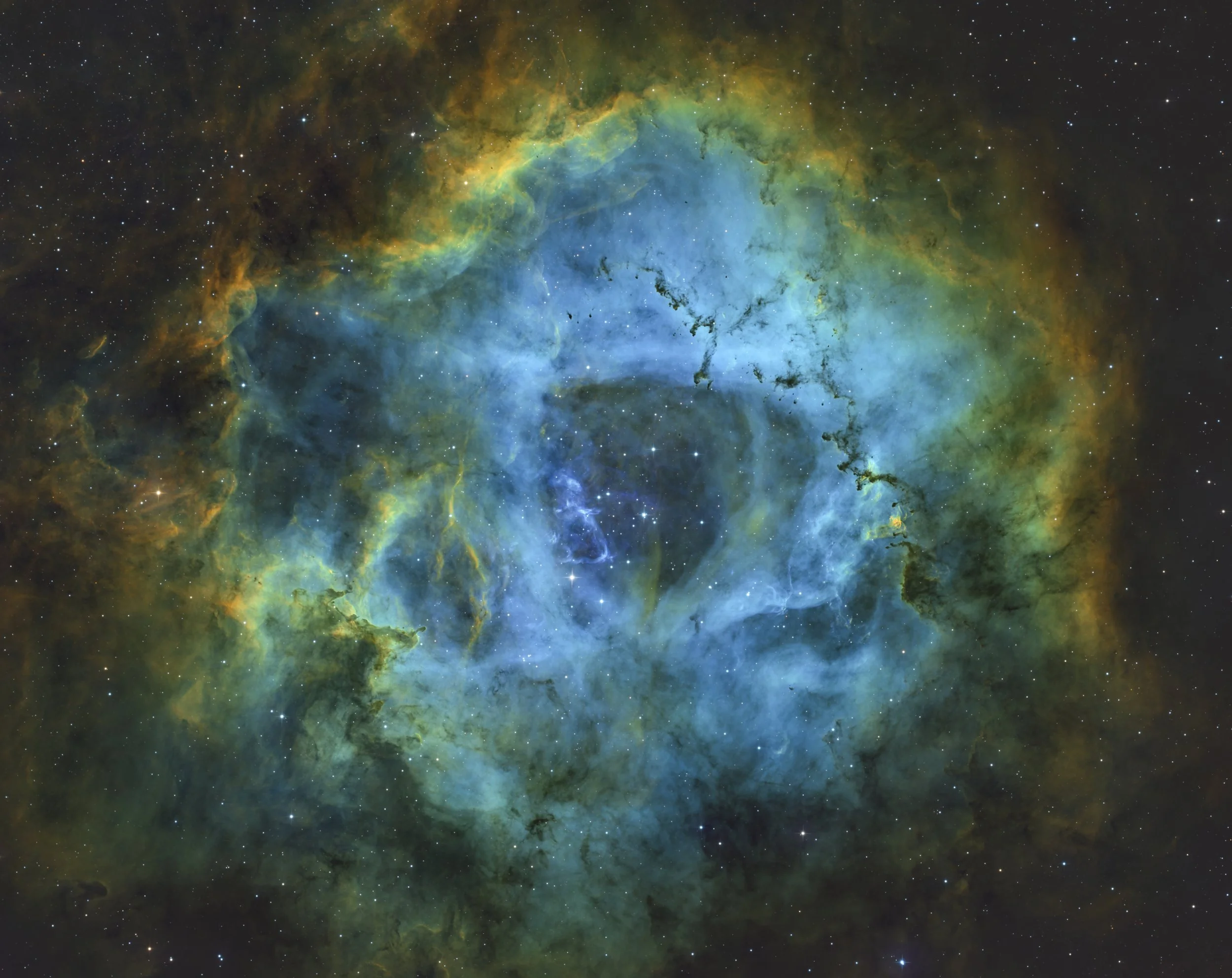
NGC 2237–2246 | The Rosette Nebula in Hubble Palette
The Rosette Nebula is a vast emission nebula located roughly 5,000 light years away in the constellation Monoceros. This image is presented in the popular Hubble SHO color palette, where sulfur, hydrogen, and oxygen emissions are mapped to red, green, and blue tones. At the center lies the young open star cluster NGC 2244, whose massive, hot stars flood the surrounding cloud with ultraviolet radiation, ionizing the gas and giving the nebula its luminous, sculpted appearance.
Powerful stellar winds from these stars have carved an enormous cavity within the nebula, compressing the surrounding gas into ridges, knots, and wispy filaments. These compressed regions are potential sites of future star formation, illustrating how stellar feedback both disrupts and triggers the birth of new stars. The false color palette enhances subtle chemical and structural differences, revealing the Rosette as a dynamic laboratory where gravity, radiation, and gas interact on interstellar scales.
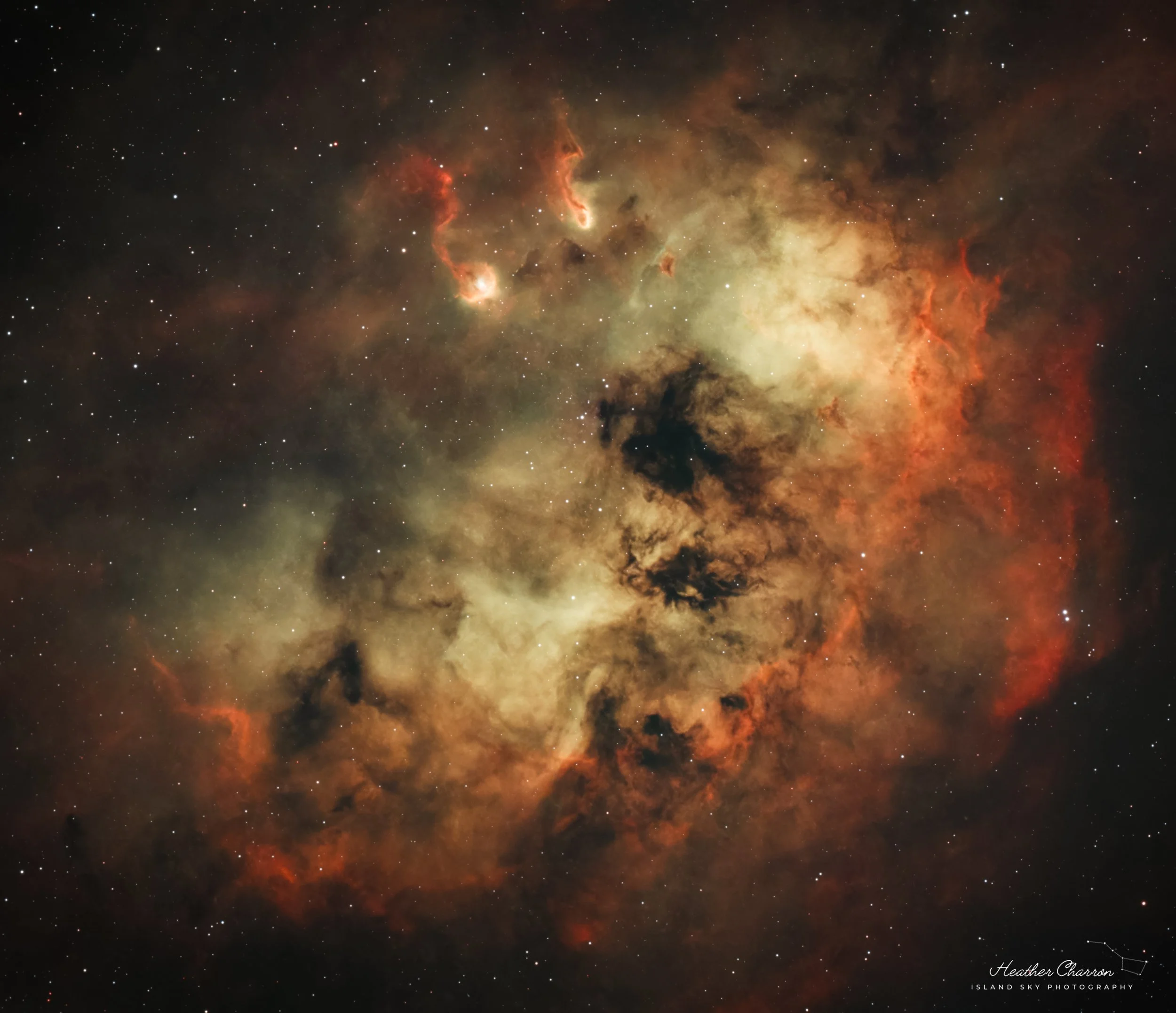
IC 410 | The Tadpole Nebula
IC 410, commonly known as the Tadpole Nebula, is a sprawling emission nebula located about 12,000 light years away in the constellation Auriga. The scene is dominated by glowing hydrogen gas energized by intense ultraviolet radiation from the young open star cluster NGC 1893 embedded within it. These massive, hot stars carve cavities into the surrounding cloud, illuminating intricate filaments of gas while leaving behind dense, opaque pockets of dust that appear as dark silhouettes against the luminous background.
The nebula’s most distinctive features are the elongated structures nicknamed the Tadpoles, pillars of cold gas and dust stretching several light years in length. These formations are shaped by stellar winds and radiation, slowly eroding their outer layers while potentially sheltering new generations of stars within their dense cores. Captured from Galveston, Texas, this image highlights the balance between stellar creation and destruction that defines active star forming regions across the Milky Way.