

AAPOD2 Image Archives
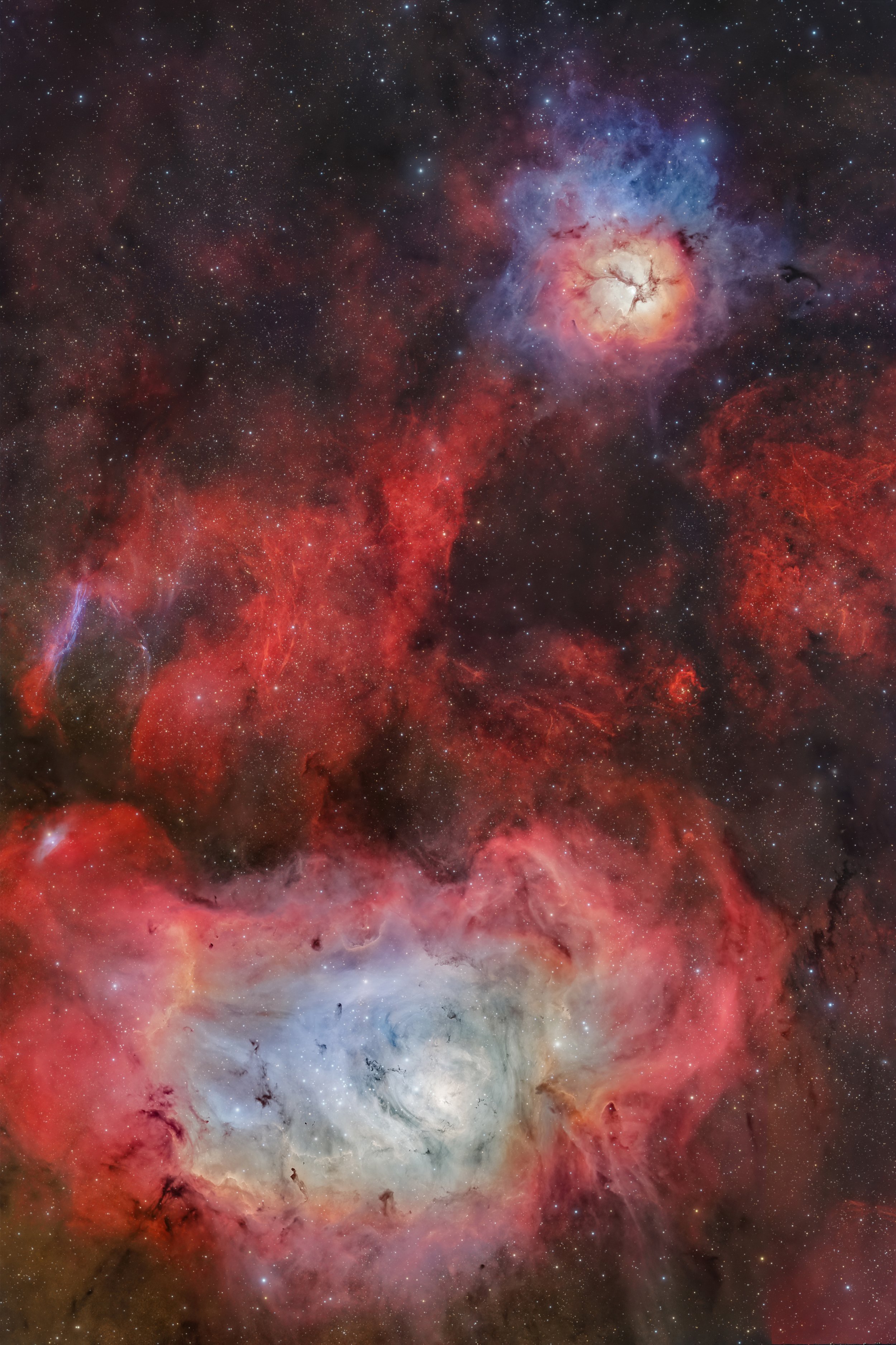
Stardust Odyssey in Sagittarius: From Lagoon (M8) to Trifid (M20)
The Lagoon Nebula (M8) and the Trifid Nebula (M20) are two of the most photogenic star-forming regions in the constellation Sagittarius. Separated by less than two degrees on the sky, they lie roughly 4,100 and 5,200 light-years away, respectively. M8 dominates the lower half of the frame, showcasing turbulent clouds of ionized gas, reflection nebulae, and embedded star clusters. At the top, M20 features a rare combination of emission, reflection, and dark nebulae, intersected by thick dust lanes.
This rendition combines LRGB data with narrowband emission mapped to a Foraxx-inspired palette, enhancing the contrast between ionized hydrogen, oxygen, and sulfur. The resulting image highlights the dynamic interplay of radiation and stellar winds shaping these regions, where stars are actively forming within dense molecular clouds.
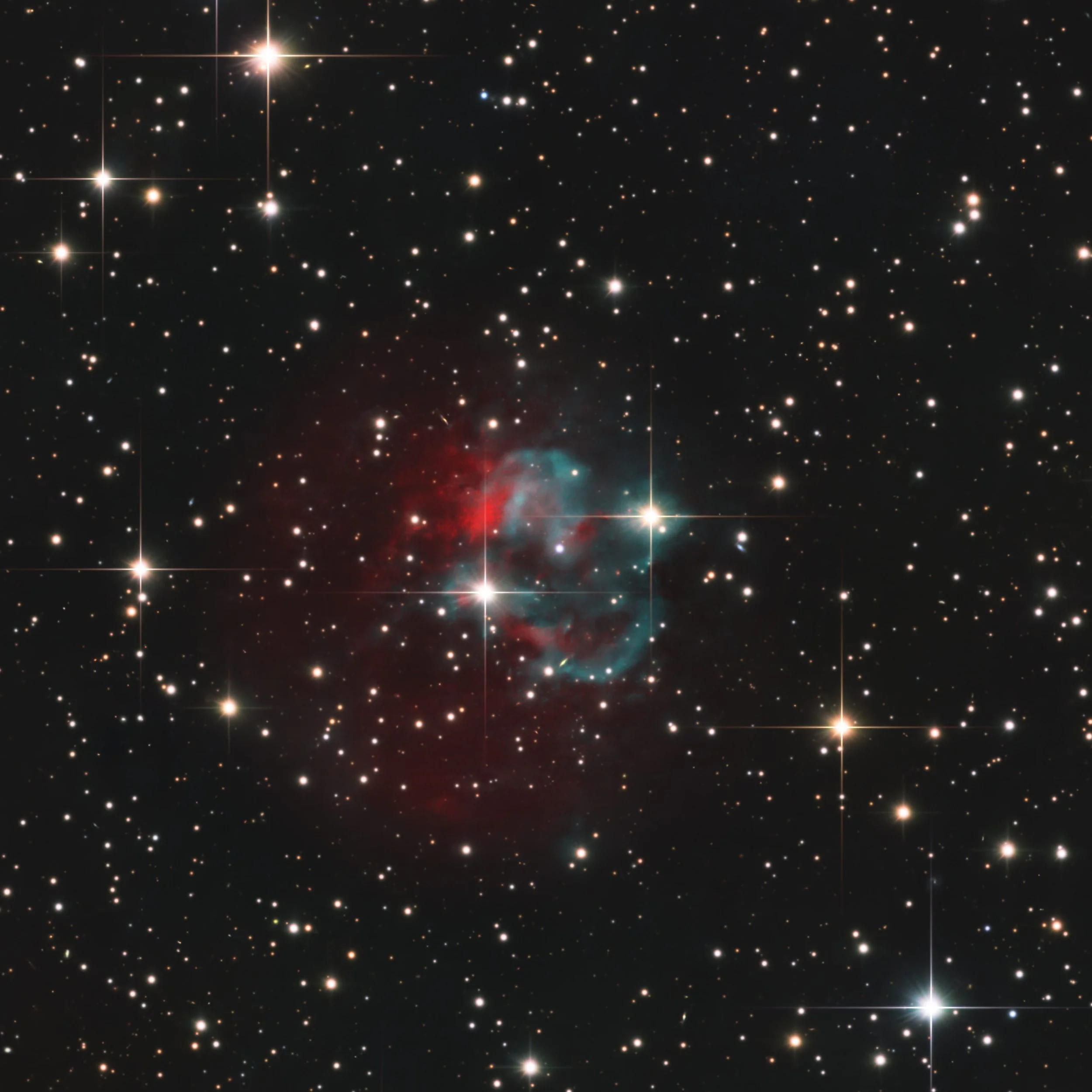
New Discovery of Faint Nebulosity Around a Cataclysmic Variable Star
Amid a rich starfield, faint red and teal wisps of ionized gas swirl around ASASSN-19ds, a cataclysmic variable (CV) star centered between two brighter foreground stars. This rare nebulosity, revealed through over 55 hours of deep exposure, marks an extraordinary discovery. CVs seldom show extended emission, making this a significant find. The intricate structure and color separation suggest a mix of ionized hydrogen (Hα, red) and oxygen (OIII, teal), hinting at complex interactions from past outbursts or surrounding interstellar material.
The image was part of a collaboration between Daniel Stern, Jon Talbot, and Dana Patchick, and the discovery was formally analyzed in a recent academic paper by Dr. Howard Bond (arXiv:2506.11306). Taken from Chile with a CDK-24 telescope, the data reveal subtle filaments and diffuse structures often missed in shorter exposures. This observation adds a rare specimen to the catalog of nebulae associated with CVs and contributes valuable insight into the life cycles of these energetic binary systems.
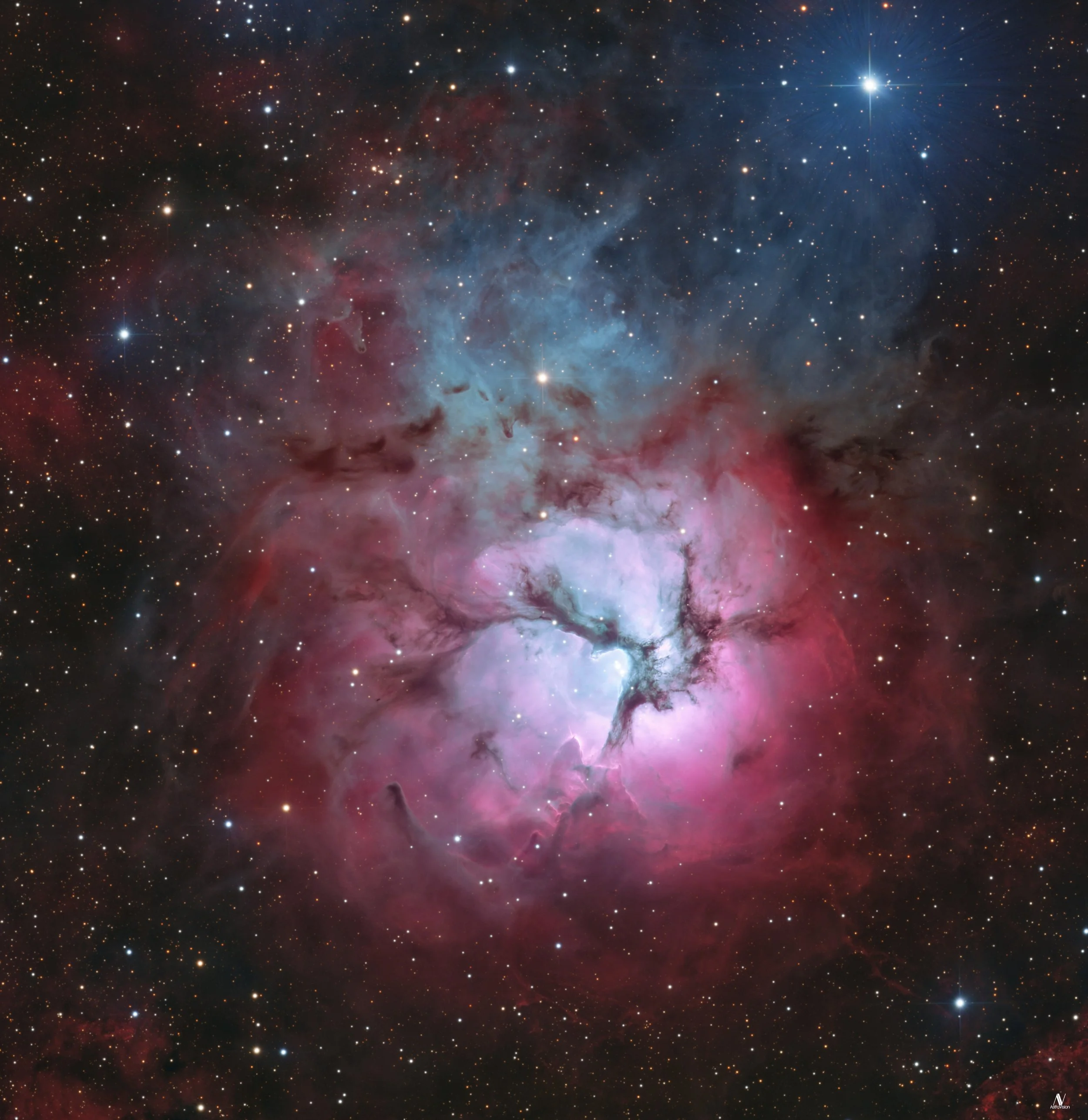
The Trifid Nebula in 81 Hours
The Trifid Nebula, also known as M20, is a rare combination of emission, reflection, and dark nebulae located in the constellation Sagittarius. This deep view reveals the intricate structure of the nebula, including the red glow of ionized hydrogen gas (Hα), the bluish reflection from nearby starlight, and the dense dust lanes that divide its bright core into three lobes. These dust lanes are responsible for the nebula’s common name, derived from the Latin word trifidus, meaning "divided into three lobes."
Captured with a total of 81 hours of exposure in Hα, RGB, and [OIII] filters, this image showcases both the rich star field of the Milky Way and the dynamic processes at play in this active star-forming region. Newborn stars within the nebula irradiate the surrounding gas and dust, triggering additional waves of star formation and sculpting the surrounding material into dramatic shapes.
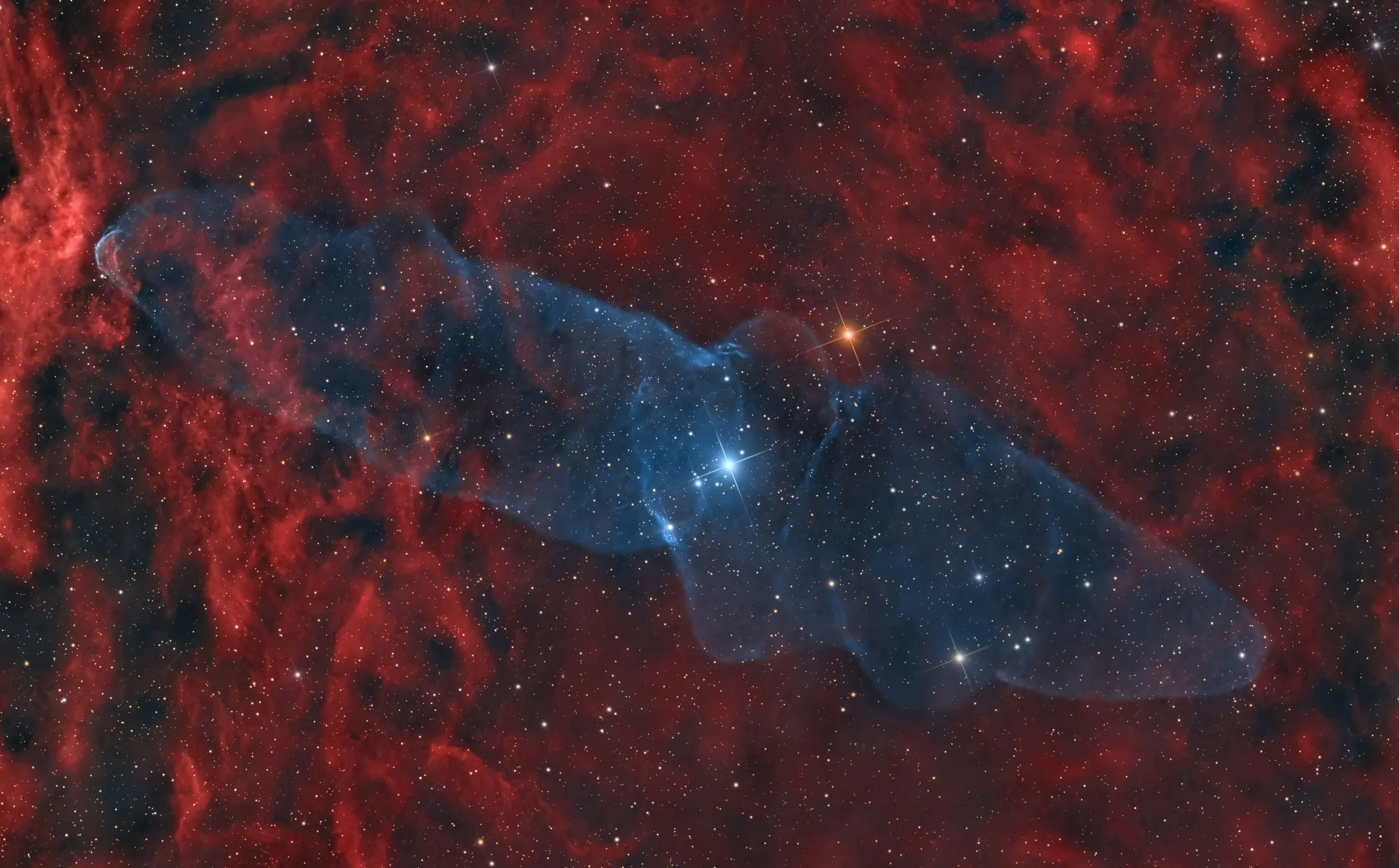
Ou4: The Giant Squid Nebula
Discovered in 2011 by French amateur astronomer Nicolas Outters, Ou4, nicknamed the Giant Squid Nebula, is a remarkably faint bipolar outflow structure located in the constellation Cepheus. Stretching across more than two degrees of sky, its ghostly blue form resembles a deep-sea squid drifting through space. The nebula is likely powered by the triple-star system HR 8119, located near the apparent center of the outflow.
Ou4 lies within the larger and brighter emission nebula Sh2-129, also known as the Flying Bat Nebula. The deep red background is dominated by ionized hydrogen (Hα) emission, contrasting starkly with the OIII-rich, oxygen-emitting outflow that defines Ou4’s structure. The nature of the Giant Squid remains under study, with hypotheses ranging from a planetary nebula to a massive stellar wind structure formed by high-energy interactions in the central system.
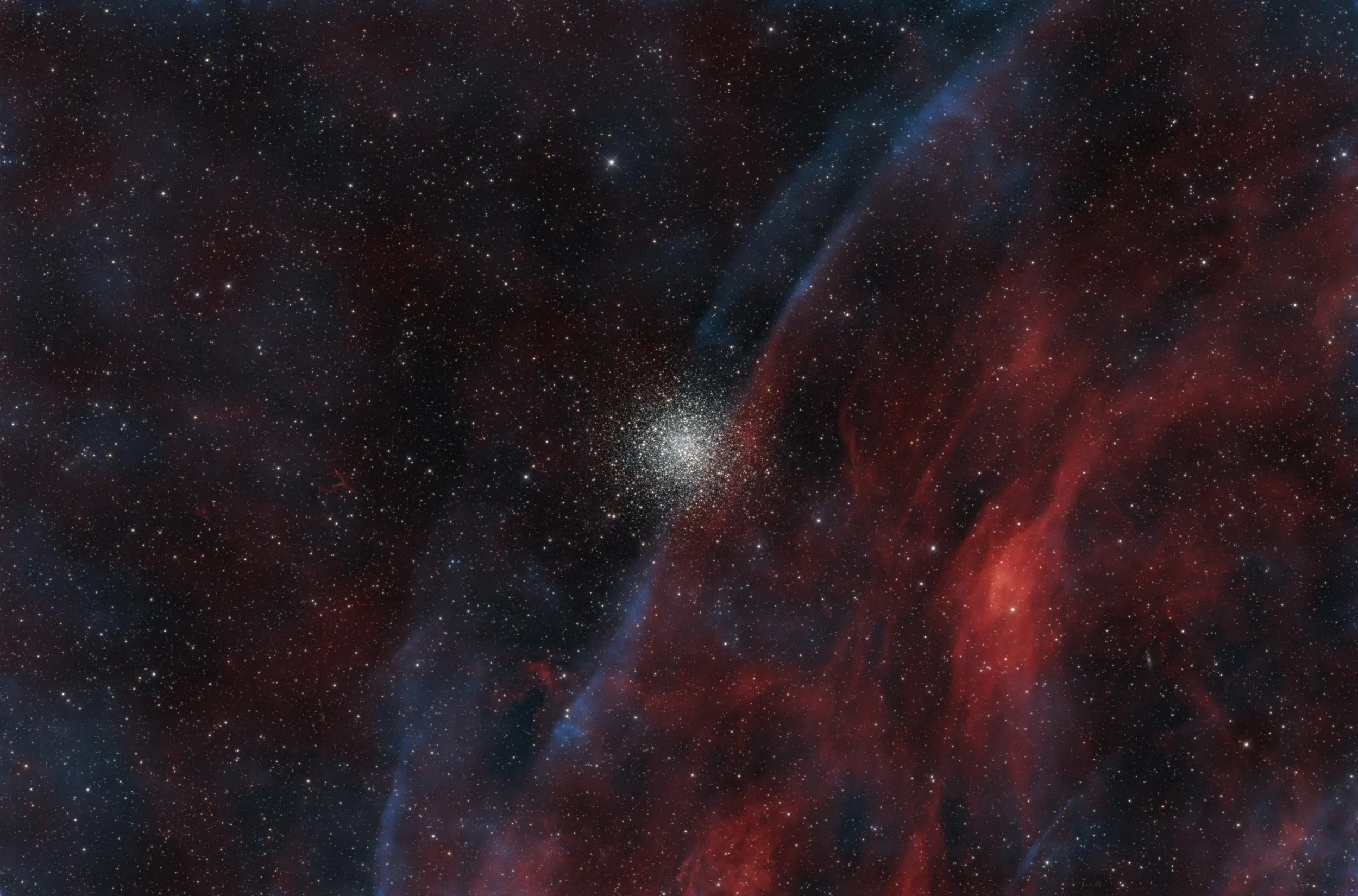
NGC 3201 and the Unexpected Glow
Located in the southern constellation Vela, NGC 3201 is a globular cluster approximately 16,300 light-years from Earth. This stellar system hosts hundreds of thousands of stars and is known for its unusually high radial velocity, suggesting a dynamic history within the Milky Way. Its relatively loose stellar concentration sets it apart from denser clusters like Omega Centauri.
Surrounding this ancient cluster is a surprising presence of faint H-alpha emission. Red hydrogen filaments thread across the field, likely unrelated to the cluster itself. Such emissions are rare in the vicinity of globular clusters, which typically contain little to no interstellar gas. The source of this emission remains unidentified but could be associated with galactic cirrus, an extended ionized structure, or even remnants of a past supernova in the line of sight.
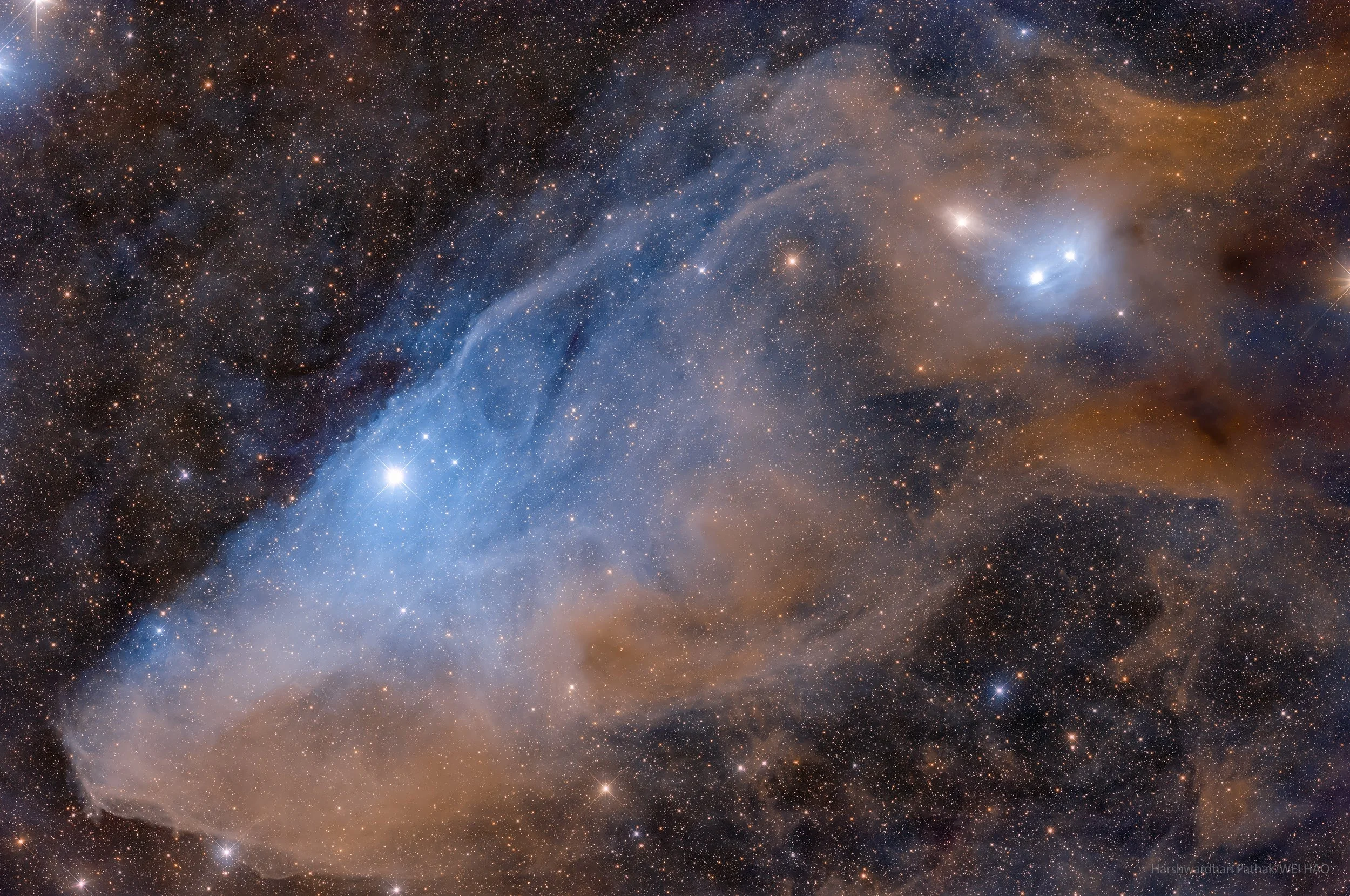
IC 4592: The Blue Horsehead Rises
The Blue Horsehead Nebula, cataloged as IC 4592, is a prominent reflection nebula located in the constellation Scorpius. Its distinct equine profile is sculpted from interstellar dust and gas reflecting starlight, primarily from the bright star Nu Scorpii near the "eye" of the horse. The blue hue results from dust grains scattering shorter wavelengths of visible light, similar to the way Earth's sky appears blue.
To the upper right lies another reflection nebula, IC 4601, surrounding a young B-type star. Both nebulae are embedded in the larger Scorpius-Ophiuchus star-forming complex and are part of the vast interstellar medium spanning hundreds of light-years. Dark nebulae streak the frame, absorbing and obscuring the light of stars behind them.
This deep, high-resolution image was captured from Yushan National Park in Taiwan, a Bortle Class 2 site offering excellent conditions for revealing faint galactic cirrus and the full extent of this ethereal nebular landscape.
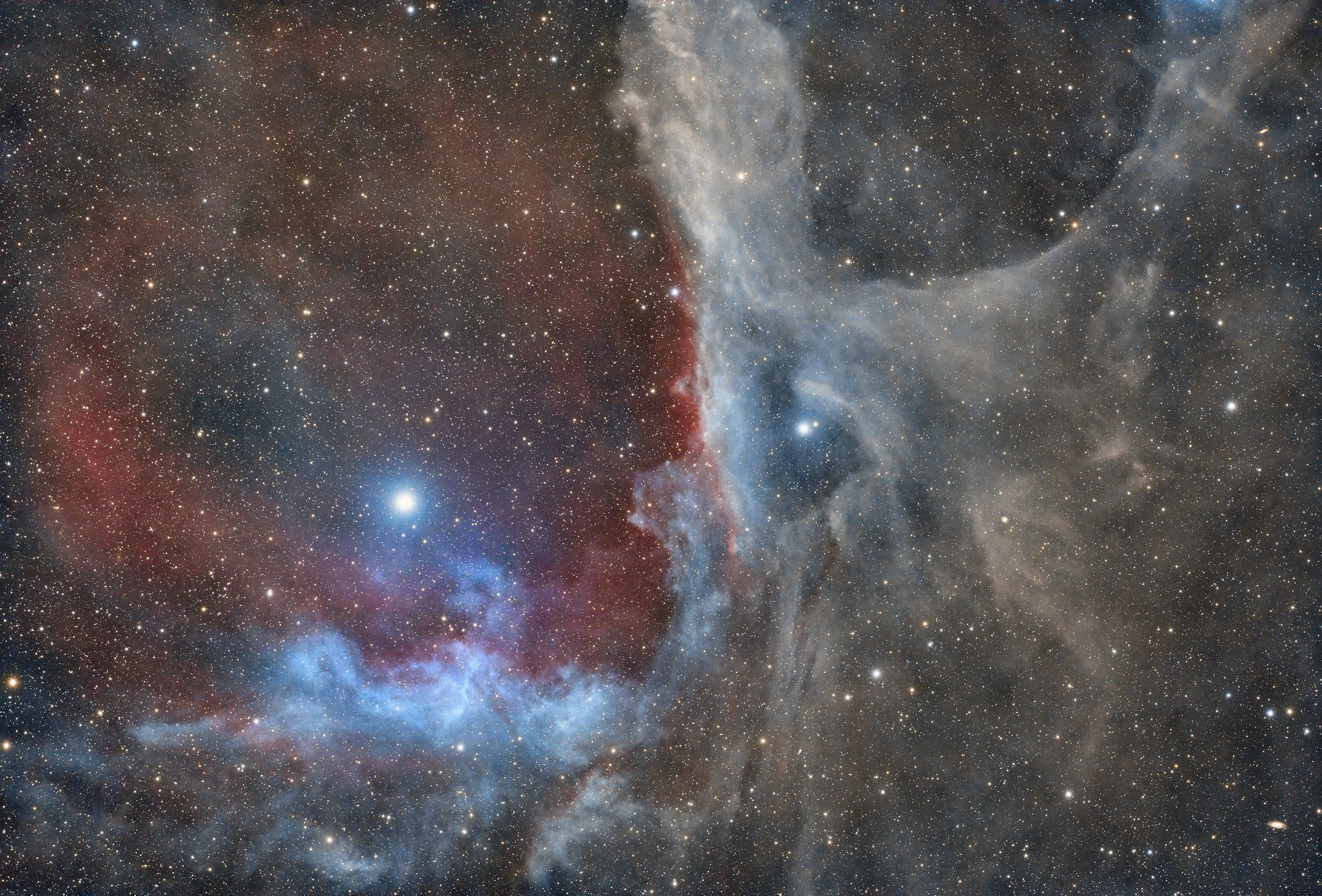
Pi Scorpii and the Blue Reflection Nebula Sh2-1
Dominating the lower left of this frame is the brilliant blue star Pi Scorpii, embedded in a swath of glowing interstellar dust and gas. The surrounding nebula, cataloged as Sh2-1, is a striking reflection nebula located in the constellation Scorpius. Illuminated by the hot B-type star, the dust reflects and scatters starlight, creating the characteristic blue glow.
To the right of Pi Scorpii lies an extensive field of faintly glowing interstellar cirrus and dark molecular dust. These structures are part of a larger complex of nebulae threading through this region of the sky, including faint emission nebulae that appear red from ionized hydrogen. The bright star to the right-center is HD 147165 (also known as Sigma Scorpii), further contributing to the illumination of the nebular material.
This deep image was captured from Tivoli Southern Sky in the Khomas region of Namibia, one of the darkest observing sites on Earth. The pristine southern skies reveal not only the bright nebulae, but also faint, extended dust structures often lost to light pollution.
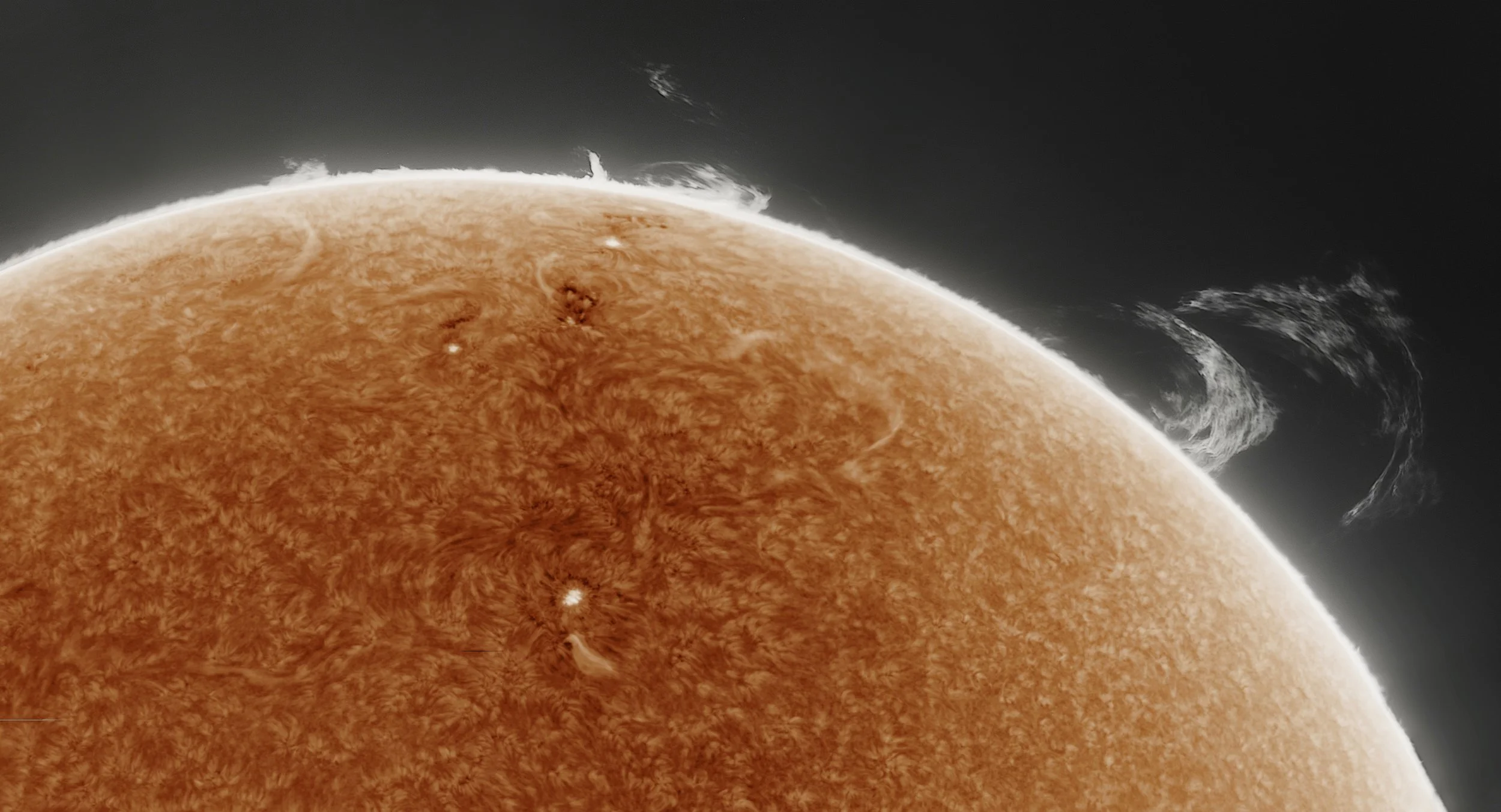
Great Coronal Mass Ejection
This high-resolution view captures the dynamic edge of the Sun in H-alpha light, revealing spectacular prominences arcing above the solar limb. These luminous plasma structures, suspended by magnetic fields, extend tens of thousands of kilometers into space. The twisting motion seen in the large prominence at upper right suggests a complex and active magnetic field structure.
Two active sunspot regions are also visible on the solar disk, their bright plages and dark cores surrounded by swirling chromospheric filaments. These sunspots are regions of intense magnetic activity and often serve as the source of solar flares and coronal mass ejections. The solar chromosphere, rendered here in rich detail, displays the textured pattern of spicules and fibrils that dominate its surface.
Captured on June 12, 2025, at 07:45 UTC using a dedicated solar telescope with an H-alpha filter, this image provides a dramatic look at our star's constantly changing face.
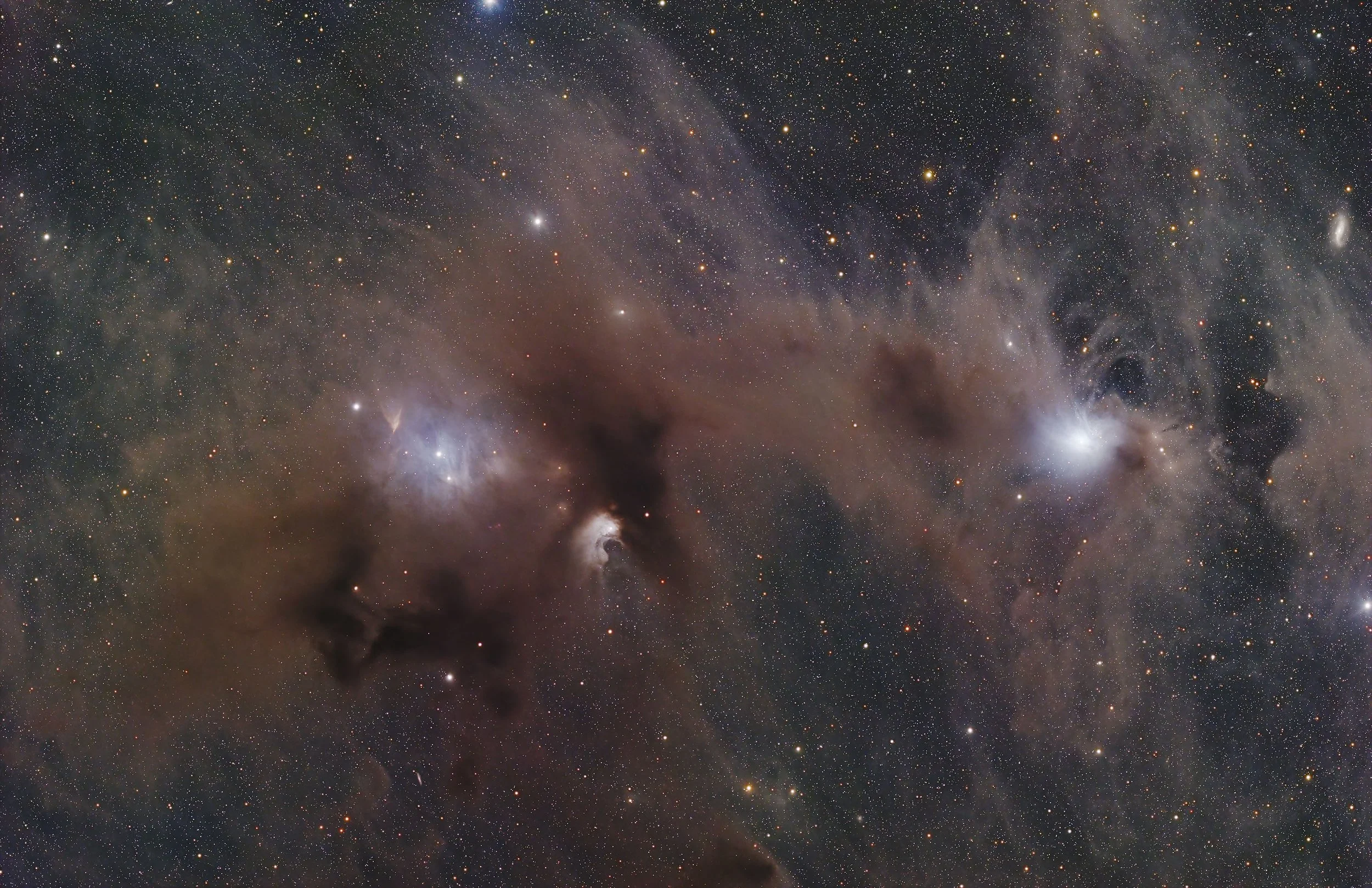
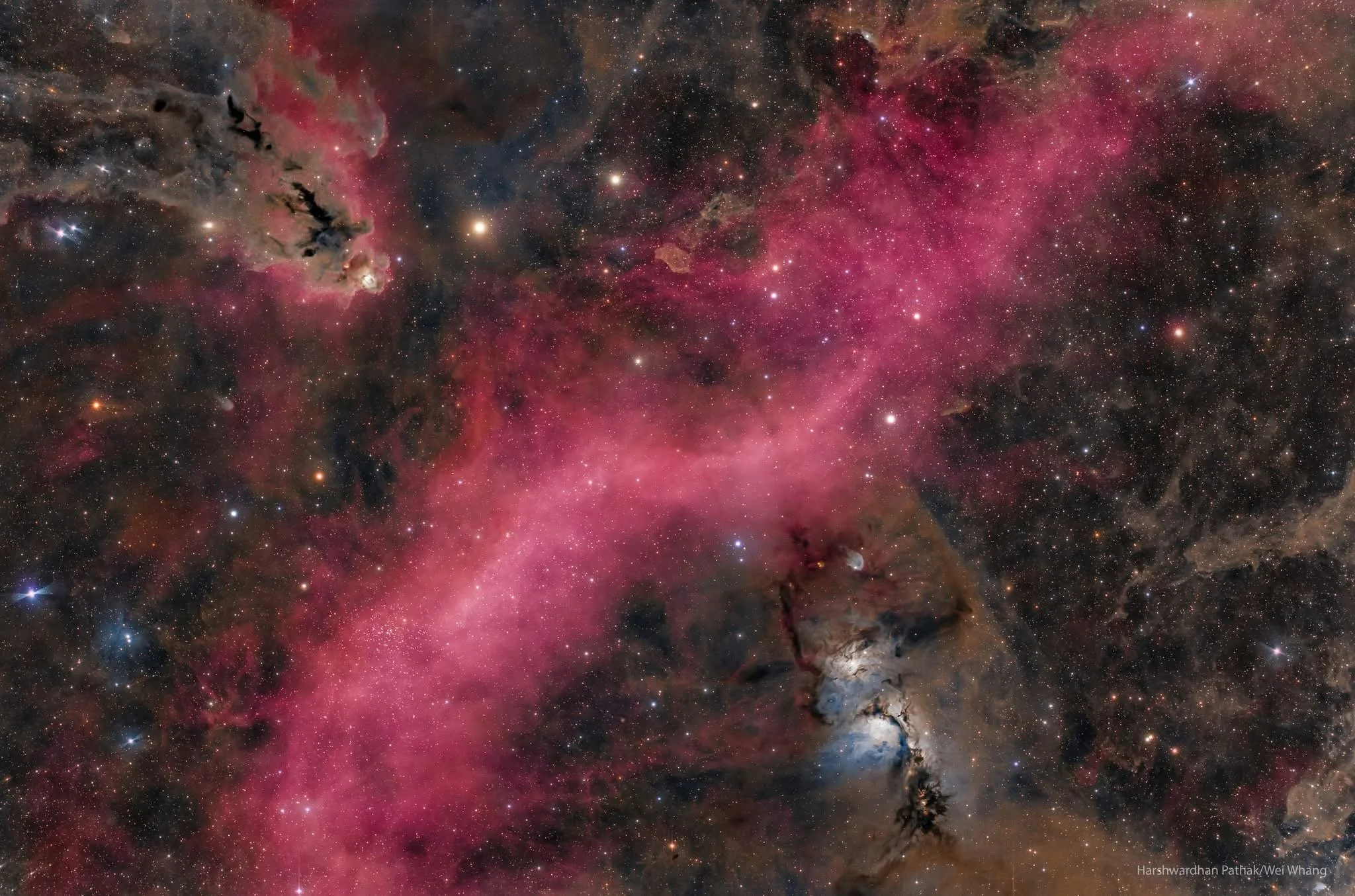
Star Formation and Dust in the Chamaeleon Complex
The Chamaeleon Complex is a rich star-forming region located approximately 450 to 650 light-years away in the southern constellation Chamaeleon. This wide-field image captures several of its most photogenic features, including dark molecular clouds, reflection nebulae, and young stellar objects. The region is known for its active stellar nurseries and intricate interstellar dust structures.
To the right lies the barred spiral galaxy NGC 3620, situated at a distance of 59 million light-years. Just left of it is IC 2631, a reflection nebula illuminated by the hot star HD 97300. To the left side of the field is Cederblad 111, which glows with a characteristic blue hue as starlight scatters off fine dust particles. Embedded within Ced 111 are Herbig-Haro objects HH 49 and HH 50—bright shock fronts formed by jets of gas from young stars interacting with surrounding material. Just beneath Ced 111 is the dark nebula GN 11.07.3, notable for its deep reddish tones and lack of a clearly identifiable illuminating source.
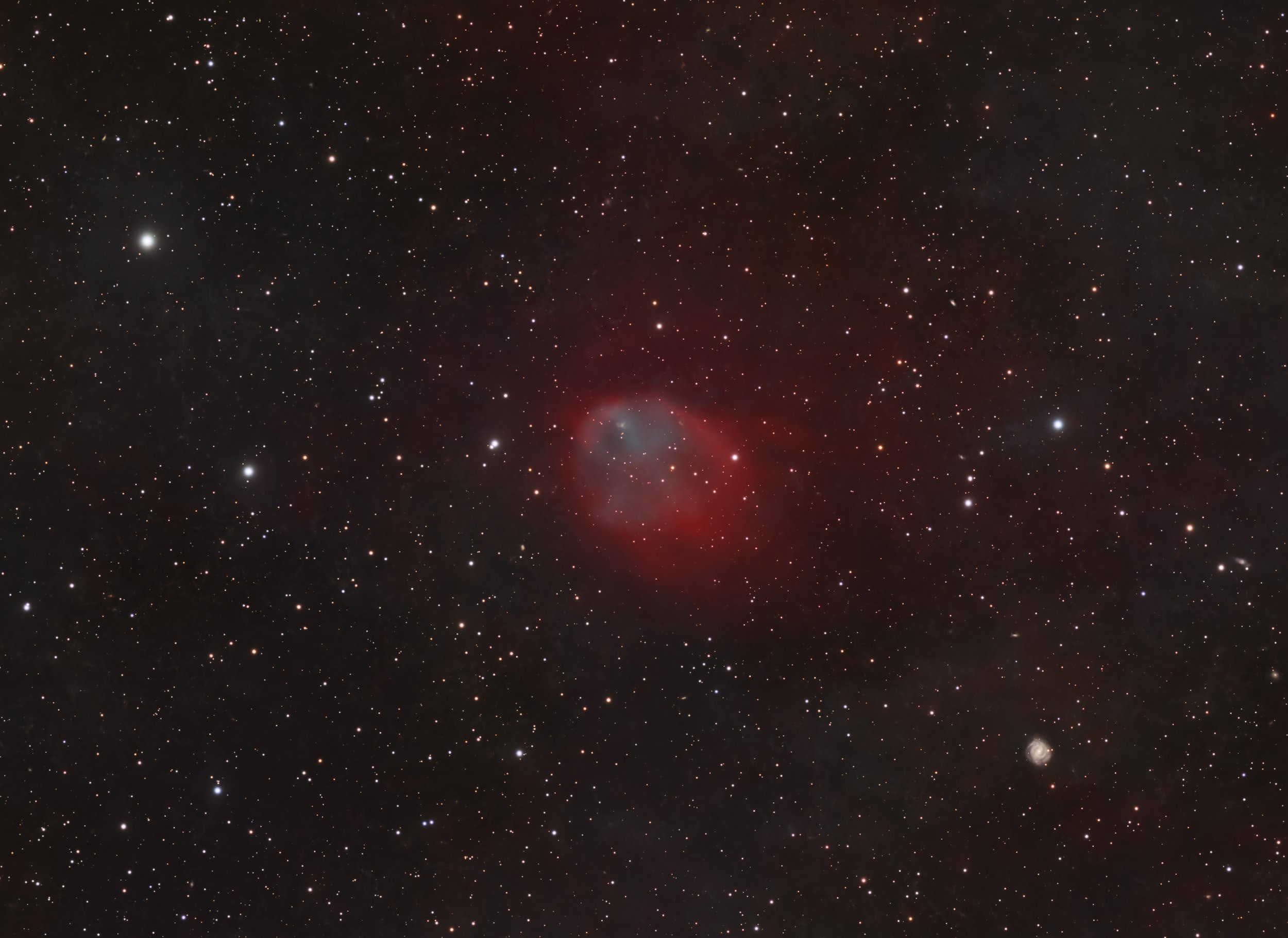
DR 28 – A Rare Planetary Nebula Candidate in Andromeda
DR 28 is a planetary nebula candidate located in the constellation Andromeda. Discovered in May 2019 by amateur astronomer Marcel Drechsler, the object features a faint, structured emission profile with a central region dominated by [O III] surrounded by extended H-alpha. The central ionizing star is cataloged as Gaia DR3 450596357738685952 and is identified as a DAO white dwarf, a classification that includes both hydrogen and helium in its spectrum. DAO white dwarfs are very hot stars at the beginning of the white dwarf cooling sequence.
The main nebular structure measures approximately 8.5 by 5.5 arcminutes, with fainter emission extending to about 24 by 22 arcminutes. Deep exposures also reveal widespread H-alpha emission and significant molecular dust throughout the field. This image was captured using a 6-inch refractor and a monochrome CMOS camera over 62 hours from October to November 2024. High-resolution filters were used to isolate key emission lines and enhance faint structures. DR 28 remains an understudied object with very few known amateur images.
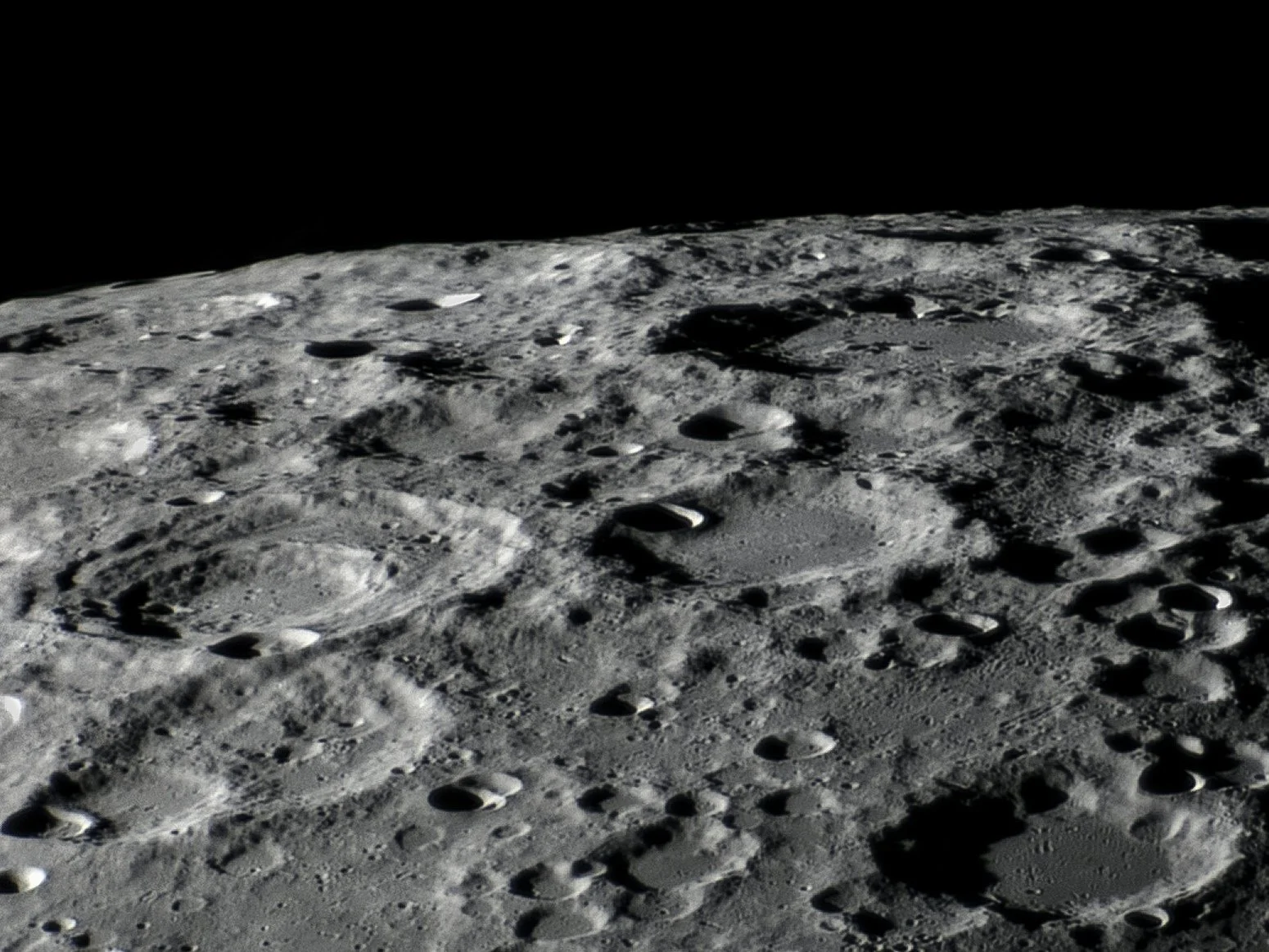
Craters on the Southern Limb of the Moon
Raking sunlight reveals dramatic topography across the rugged southern highlands of the Moon. In this high-resolution view along the lunar limb, a cascade of overlapping craters stretches across the field, including several large impact structures displaying well-preserved rims and terraced walls.
The oblique angle of the shot emphasizes shadow and elevation, capturing a stark sense of depth across the ancient terrain. These highlands, among the oldest parts of the lunar surface, have endured countless collisions—each crater a story in stone. This image offers a striking reminder of the Moon's violent, cratered past, carved in stark relief against the blackness of space.

NGC 2685 – The Helix Galaxy in a Dust-Laced Halo
NGC 2685, also known as the Helix Galaxy or Arp 336, is a rare and peculiar lenticular galaxy roughly 42 million light-years away in the constellation Ursa Major. Its tightly wound polar ring structure is a telltale sign of a cosmic merger in its past—where one galaxy may have cannibalized another, leaving behind this fascinating, misaligned system. Unusually, it appears both spiral and elliptical depending on the angle viewed, confounding early classification attempts.
In this 30-hour integration using a Celestron C8, the dusty structures surrounding NGC 2685 are rendered in exceptional detail. Faint galactic cirrus swirls through the field, and selective H-alpha filtering brings out subtle knots of emission. Together, the image offers a rare glimpse of this strange galaxy suspended in a softly glowing web of interstellar dust—an exceptional capture of both structure and environment.
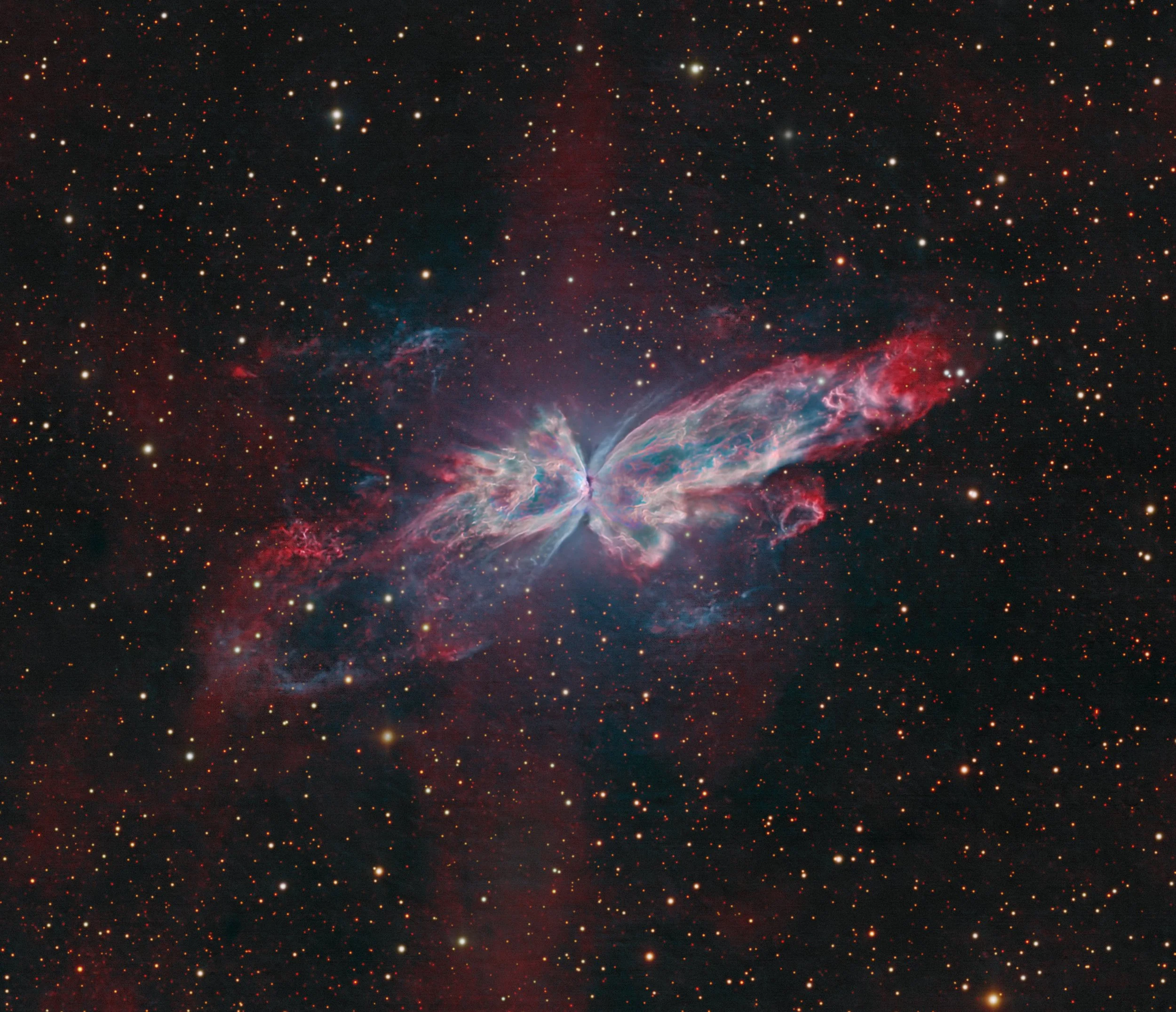
NGC 6302 – The Butterfly Nebula Unfolds
Unfolding like celestial wings, NGC 6302—commonly called the Butterfly Nebula—captures the dramatic final stages of a sun-like star’s life. This bipolar planetary nebula spans over two light-years and is located in the constellation Scorpius, roughly 3,800 light-years from Earth. Its vibrant wings are composed of material violently ejected from the dying star at its center, which remains hidden behind a dense torus of dust.
Captured over 52 hours with Chroma filters, this image blends 9 hours of luminance with 13 hours each of Ha and OIII, and 8 hours per channel of RGB. The result reveals the exquisite structure of ionized gas sculpted by stellar winds—an intricate canvas of motion and light, glowing in hues of red and blue as the nebula races outward into interstellar space.
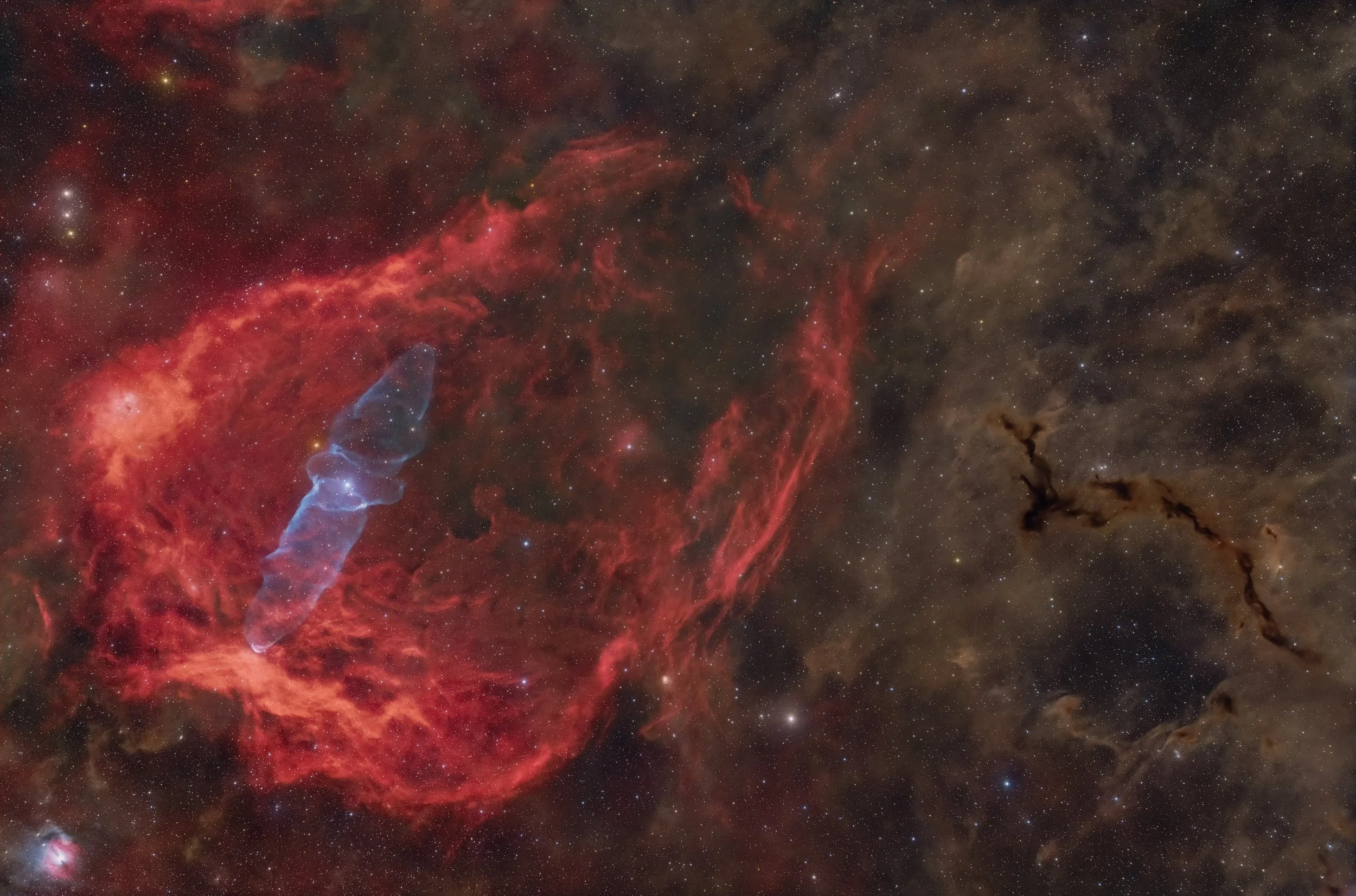
The Squid and the Seahorse: A Deep Dive into Cepheus
A meeting of light and shadow unfolds in this wide-field image from the Atlas Mountains of Morocco, revealing some of Cepheus’s most enigmatic structures. At the center of the glowing red Flying Bat Nebula (Sh2-129) lies the elusive Squid Nebula (Ou4), a faint bipolar outflow visible primarily in OIII that appears to swim through a sea of hydrogen gas. The Squid’s rare bluish arcs contrast spectacularly against the deep red ionization front of the surrounding nebula.
To the right, Barnard 150 — the Seahorse Nebula — winds its way through the dusty starfield as a silhouetted column of interstellar dust, marking an active cradle of young stars still hidden within. Completing the tableau is LBN 446, a reflection nebula that drapes the scene in soft starlight. Captured in a single frame thanks to a full-frame sensor and dark skies, this scene highlights the power of international collaboration and remote observatories to reveal cosmic vistas otherwise out of reach.

Barnard’s Galaxy (NGC 6822)
Barnard’s Galaxy, or NGC 6822, floats 1.6 million light-years away in the constellation Sagittarius—a modest island universe with a rich cosmic history. This deep-sky image, captured from Río Hurtado, Chile, using a CDK-17 telescope and over 25 hours of integration, showcases the galaxy’s scattered stellar population and wisps of hydrogen-alpha emissions through carefully blended RGB and Hα data.
Discovered in 1884 by Edward Barnard and later studied by Edwin Hubble, this unassuming galaxy became the first irregular galaxy proven to lie beyond the Milky Way. Hubble’s observations, made in 1925, helped shift our understanding of the cosmos, establishing that the universe is filled with galaxies far beyond our own. Though faint to the eye, NGC 6822’s legacy remains anything but.
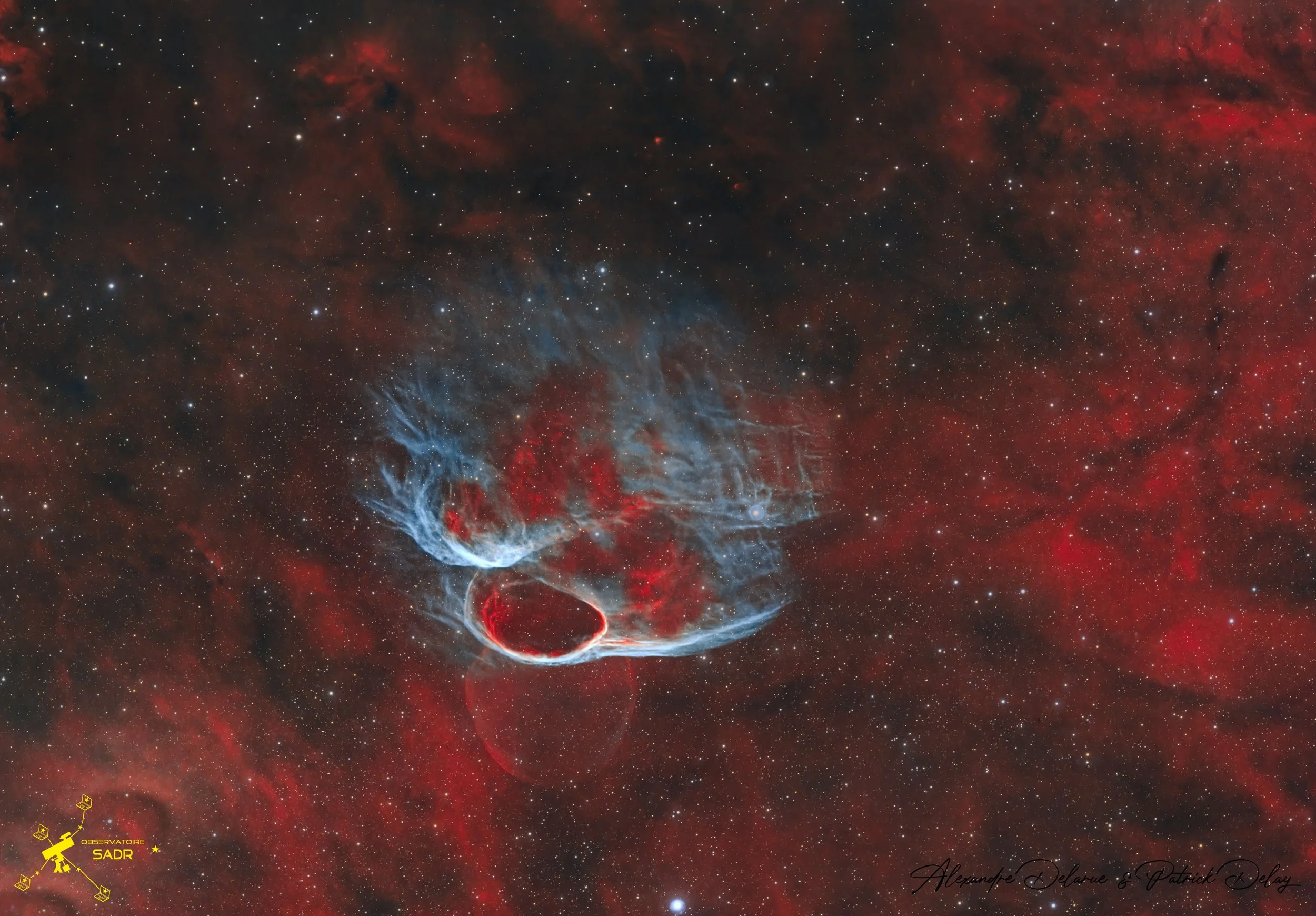
Unclassified Bubble in Vela
Floating through the rich hydrogen backdrop of the Vela constellation is a curious and newly discovered structure—an ethereal bubble glowing in red and blue. Found in March 2024 by Aygen Erkaslan and Marcel Drechsler, this object remains unclassified, but early analysis suggests it may be the remnant of an ancient shockwave expanding at roughly 100 km/s. Its beautifully layered emission in H-alpha and [O III] hints at turbulent past events, though no definitive connection has been made to the nearby Vela Supernova Remnant.
Despite its striking resemblance to planetary nebulae, this structure lacks an identifiable central star—raising the possibility that whatever formed it has long since vanished. It could be the ghost of a star, leaving behind only its final breath etched in glowing gas. Whatever its true nature, the bubble adds a hauntingly beautiful mystery to the southern skies, inviting astronomers and imagers alike to look closer.
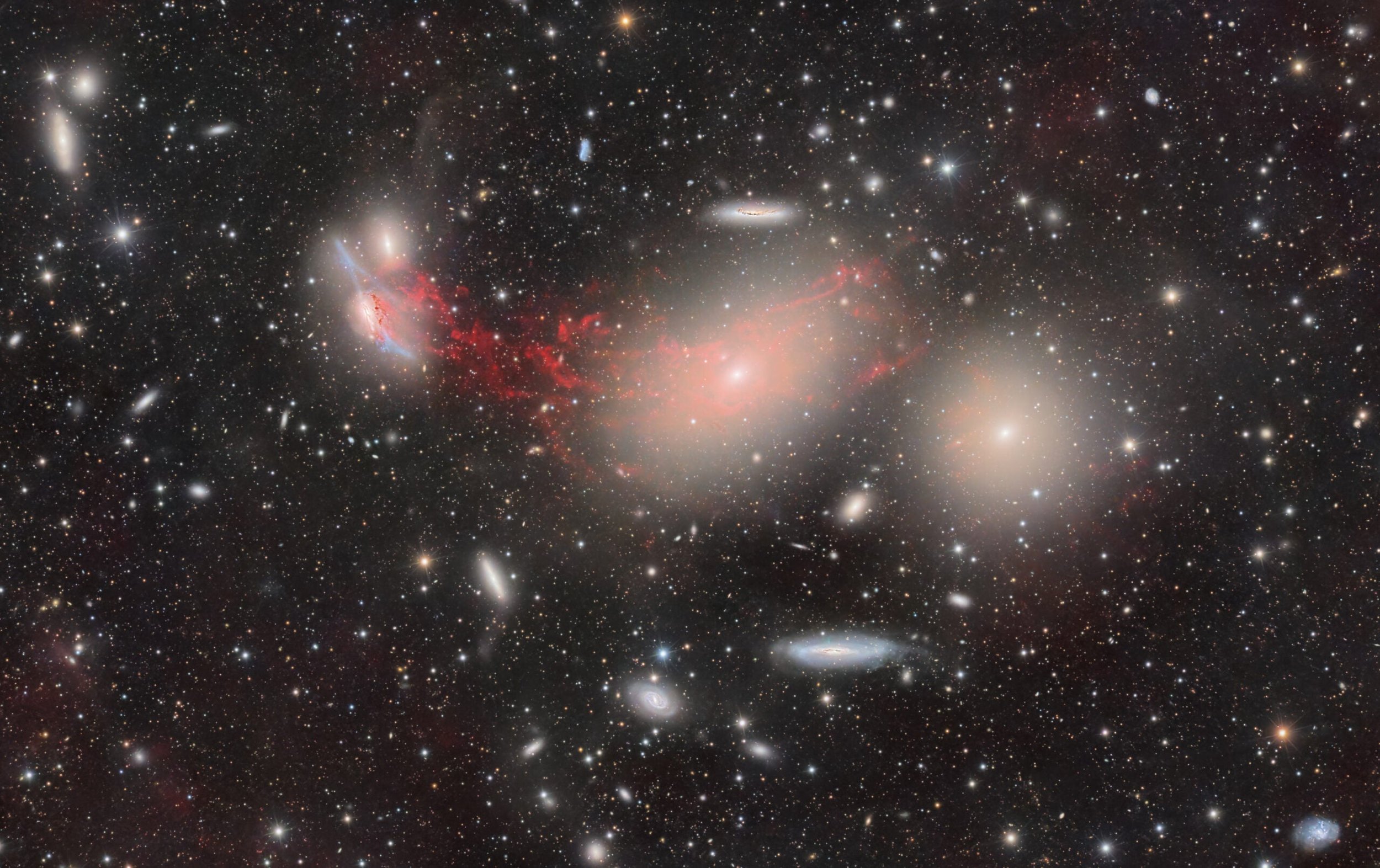
Markarian's Chain — Depth and Connection
This extraordinary deep-field image of Markarian’s Chain captures the heart of the Virgo Cluster in a way few images ever have. With a staggering 660 hours of integration—322 hours in H-alpha and 338 in LRGB—faint galactic structures are revealed with remarkable clarity. Most striking is the network of ionized hydrogen filaments and subtle tidal bridges connecting the galaxies, offering rare visual evidence of gravitational interactions between these elliptical and spiral members.
Markarian’s Chain, named after Armenian astrophysicist Benjamin Markarian, contains a visually curved line of galaxies anchored by M84 and M86. Though the galaxies are only loosely bound, the depth of this exposure showcases a dynamic ballet in slow motion, one that spans millions of years. In a region teeming with hundreds of galaxies, this image isolates and celebrates the intricate web of matter tying them together—a cosmic bridge that speaks to the connectedness of the universe itself.
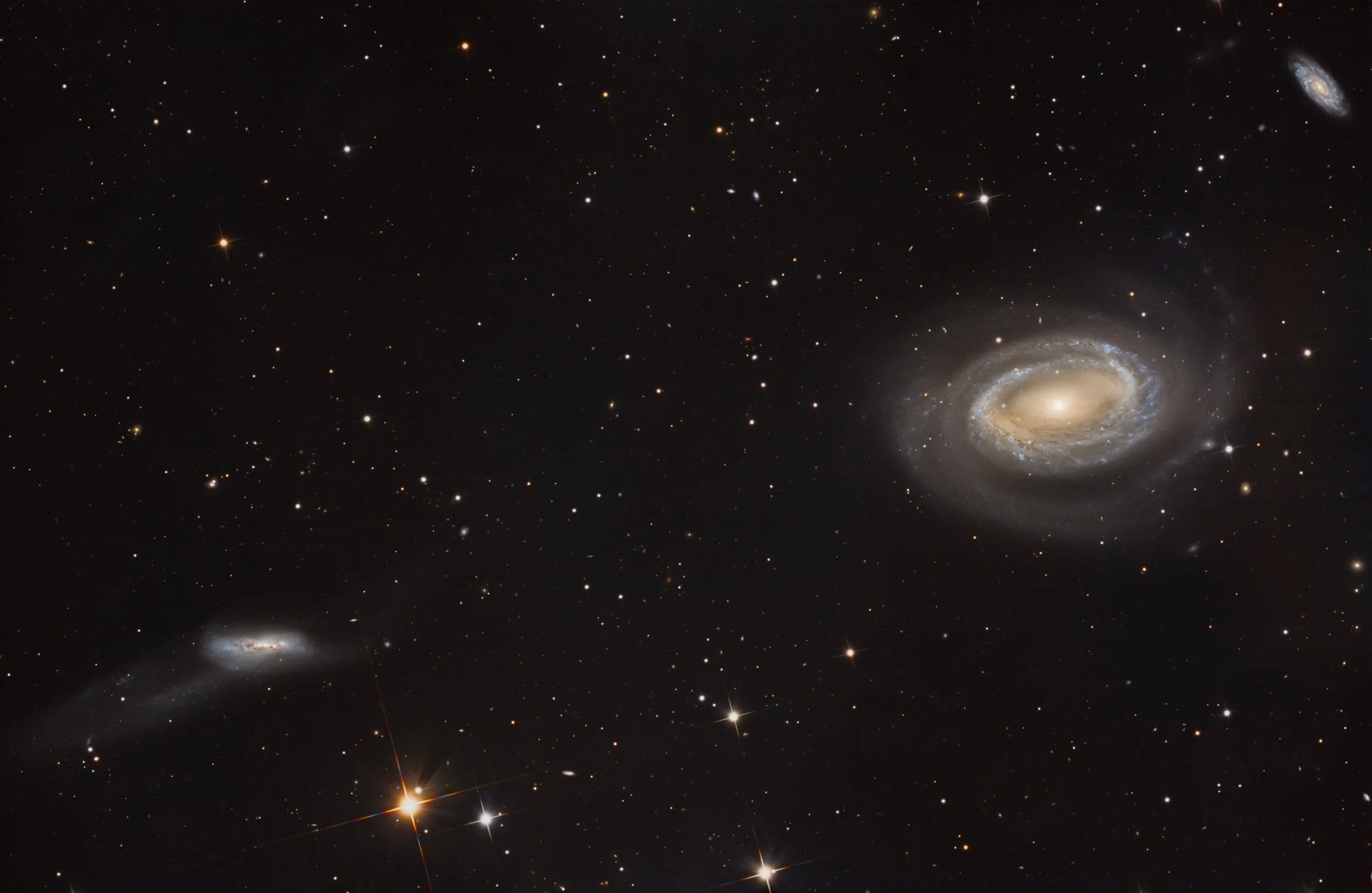
Galactic Drama in Coma Berenices
This dramatic scene in Coma Berenices centers on NGC 4725, a striking barred spiral galaxy about 41 million light-years away. To its lower left is the disrupted dwarf galaxy NGC 4747, visibly warped by gravitational forces. Faint tidal streams connect the two, evidence of a galactic interaction that began hundreds of millions of years ago. Above right, the more distant spiral NGC 4712 adds balance to the frame, creating a layered view into cosmic depth.
Captured from the Alentejo Remote Observatory in Portugal, this deep exposure reveals subtle details often lost in shorter integrations — including delicate arcs of stellar material around NGC 4747 and the pronounced one-arm spiral structure of NGC 4725. These distortions hint at past encounters, telling a story not just of light, but of motion and transformation. Tidal tails like these serve as galactic fingerprints, preserving the history of collisions in the quiet vastness of space.
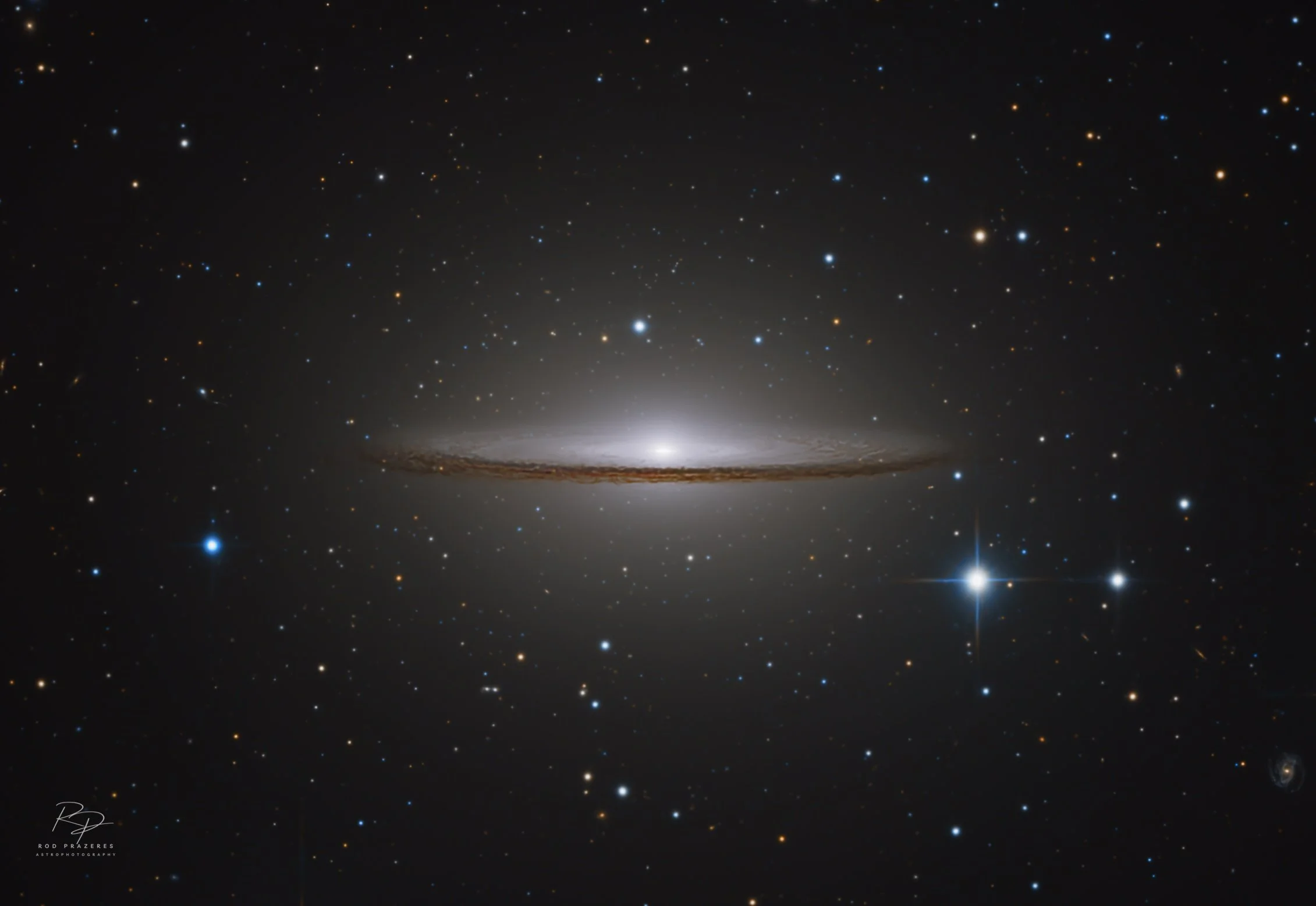
"Edge of Elegance" - M104 - The Sombrero Galaxy
Seen edge-on from our vantage point on Earth, Messier 104—better known as the Sombrero Galaxy—cuts a dramatic profile against a rich field of distant stars and galaxies. The thick dust lane bisecting its bright, glowing halo is what gives M104 its distinctive hat-like appearance, while the brilliant central bulge reveals the intensity of stellar activity and a suspected supermassive black hole at its heart.
Located approximately 28 million light-years away in the constellation Virgo, M104 spans nearly 50,000 light-years across. This deep image masterfully reveals the fine structure of the galaxy's dark dust, glowing core, and extended halo, along with hints of background galaxies far beyond. The clarity and isolation of the Sombrero in space make it one of the most photogenic spiral galaxies in the sky.